
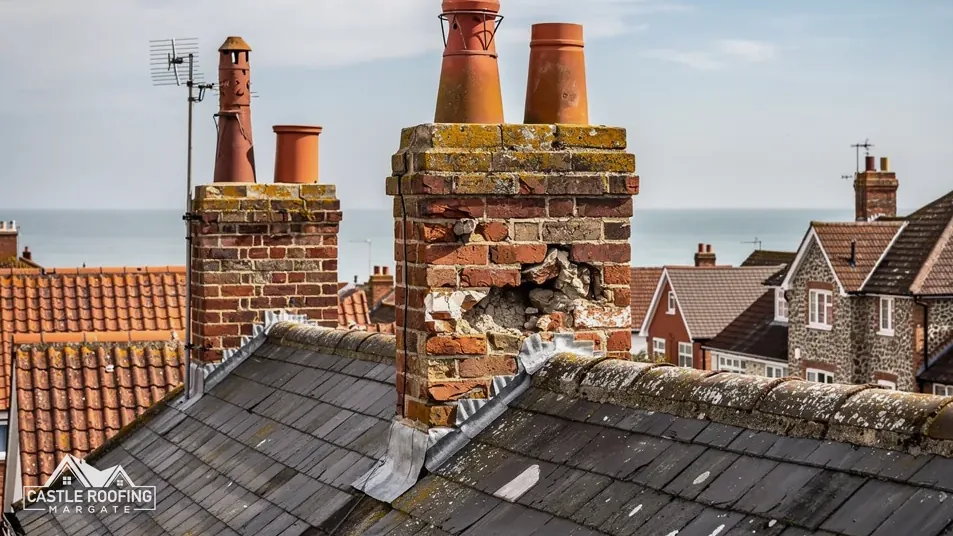
Chimney Repairs in Margate
Chimney repairs in Margate and across East Kent: repointing, flaunching, lead flashings, pots and cowls, leaning stacks rebuilt and redundant ones taken down, by a local roofer.
On the stack
The parts of a chimney we put right
- Pots and flaunching
- Brickwork and pointing
- Lead flashings and soakers
- Back gutter behind the stack
- Cowls and caps
Repointing, new flaunching, fresh lead, pot and cowl work, rebuilds of leaning stacks and the removal of redundant ones, on houses, flats over shops and holiday lets across Thanet and East Kent.
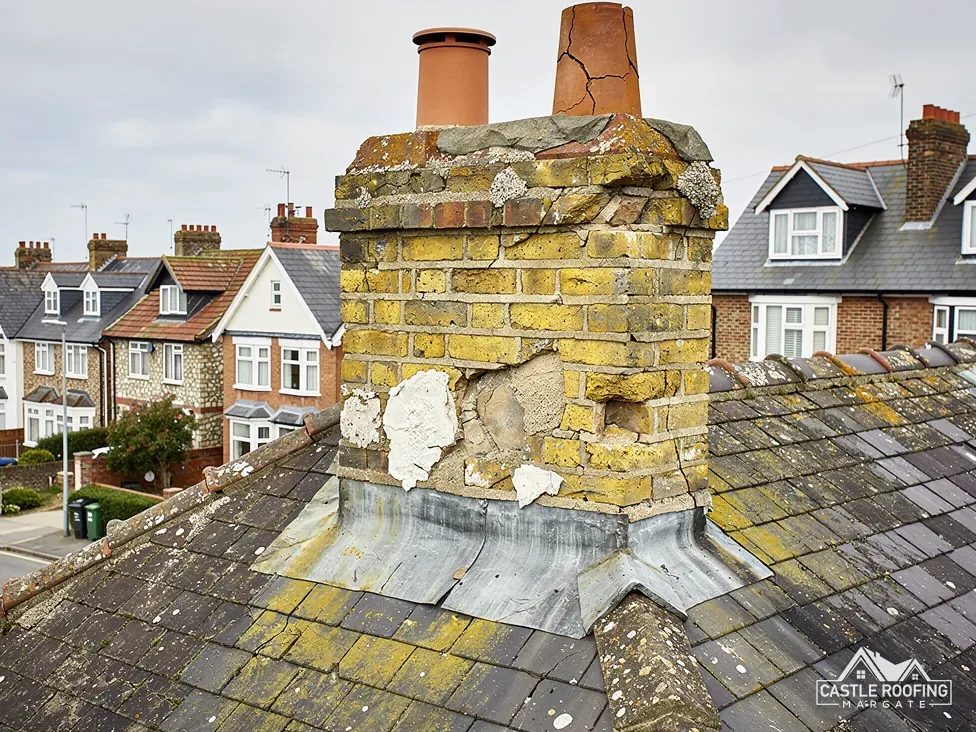
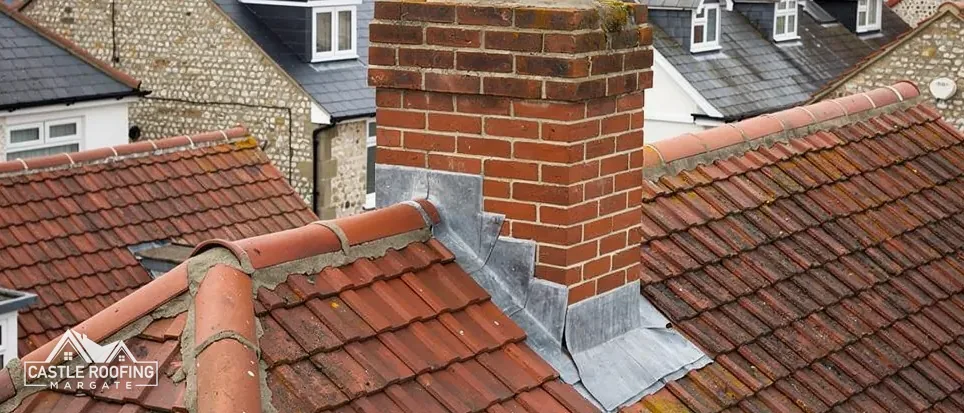
When a chimney needs looking at
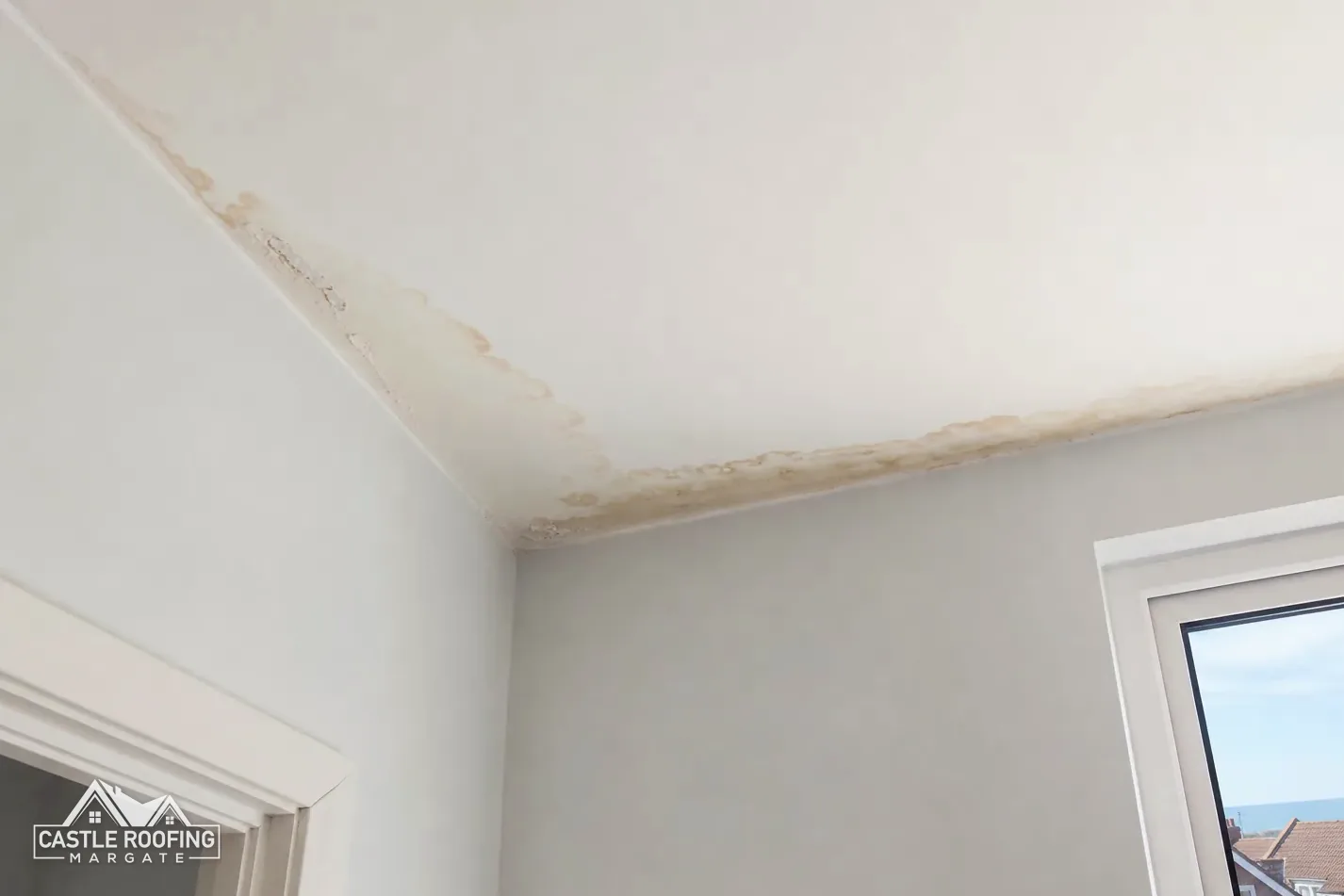
A damp breast
A wet patch on the chimney breast after rain points to the stack above it.
Grit on the slope
Crumbs of mortar on the tiles below mean the flaunching or the joints are breaking up.
A pot off true
A leaning pot or shaft has lost the mortar that once held it square.
The chimney guide
What keeps a chimney stack dry on a Thanet roof, and what to do when it fails
Six chapters on the stack: its parts, the weather it takes, leaks, lead, rebuilds and the rules. Start with the one that sounds like your chimney.
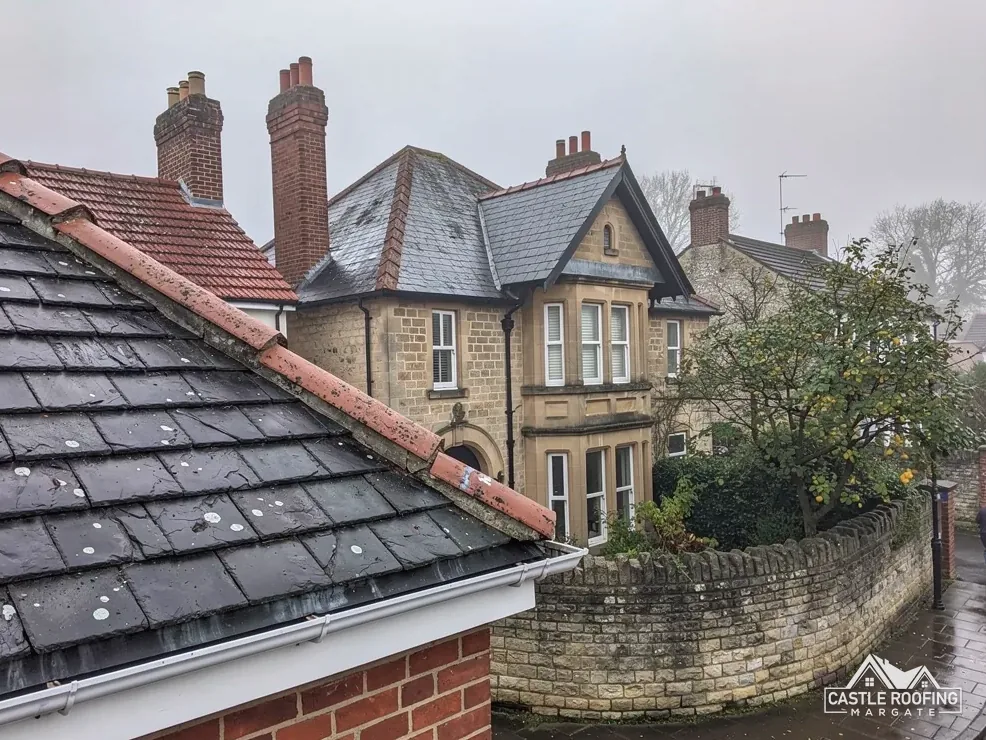
Chapter 01 of 06
Why a roofer repairs the chimney stack
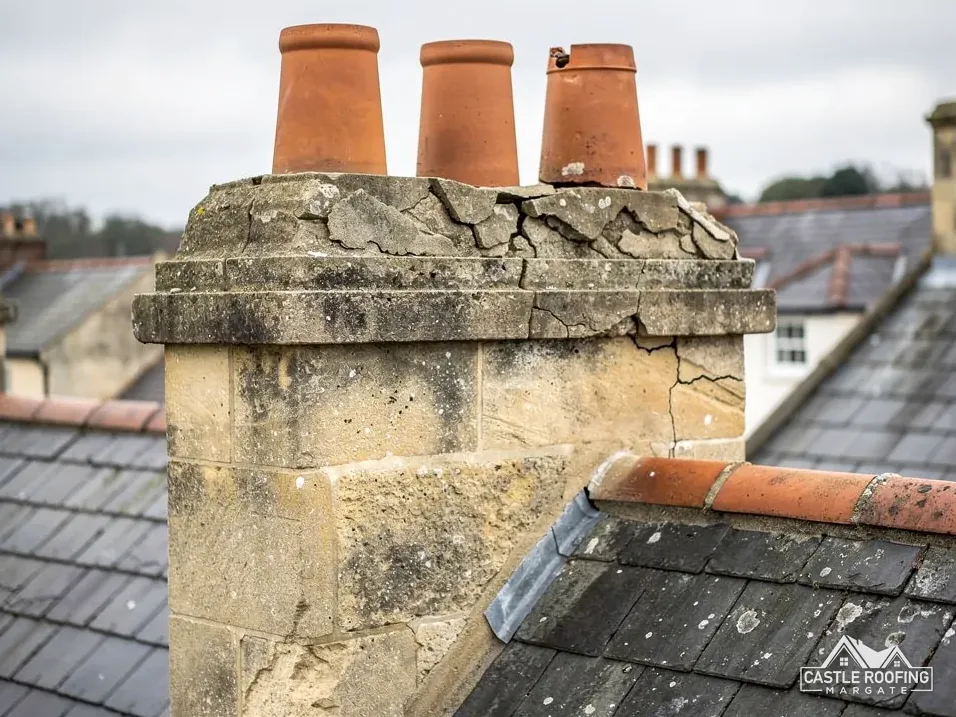
A chimney stack is brickwork carried up through the roof slope and out into the open air, and nearly everything that goes wrong with it shows up first as a roofing fault. Rain that gets past a stack runs down inside the loft, wets the rafters beside it and comes out as a brown patch on a bedroom ceiling or a damp stripe on the chimney breast, which is the part of the chimney that projects into the room. Sweeping a flue and fitting a stove are chimney work too, but they belong to a different trade. The outside of the stack is ours: the bricks and their mortar joints, the collar at the top that holds the pots, and the lead that seals the stack to the tiles or slates around it.
Picture a stack in layers, from the top down. The pots sit in flaunching, a sloped bed of mortar spread across the top of the brickwork so that rain runs off it rather than soaking in. Below that is the brick shaft, held together by its pointing, the finished face of mortar in each joint. Where the shaft passes through the slope, lead flashings, which are sheets of lead dressed over the joint between brick and roof, keep the water out. On the uphill side a back gutter, a small lead channel behind the stack, catches the rain running down the slope and turns it round the brickwork instead of into it.
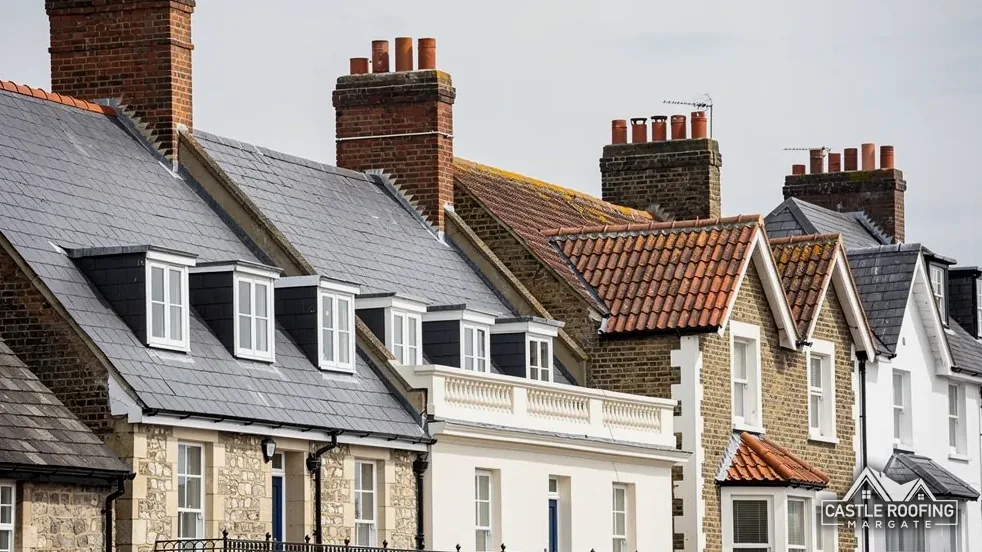
One of Thanet District Council's conservation area appraisals records how much of it survives. For the Cliftonville Clifftop conservation area, the council's appraisal finds plenty of tall stacks still standing, on houses whose roofs mix red clay tile with natural slate. The council lists 27 conservation areas across the district, and where a stack adds to the look of a terrace, the first aim is to keep it in the form it was built. A tall stack also stands proud of the ridge with nothing round it to break the wind, so it takes more weather than the slope it rises from.
The base of a stack is finished differently on each covering. On a slate or plain clay tile slope, soakers, small folded pieces of lead laid in with each course, sit under a stepped flashing that climbs the side of the brickwork. On a concrete interlocking tile the lead is shaped over the profile of the tile instead. Either way, part of the covering has to be lifted and laid back without damage, so we treat the stack and the roof round it as one job, and you are not left waiting for a second trade to make the slope good. Each visit begins on the stack itself: we photograph every face, the flaunching and the lead, and you see those photos alongside our account of what we found. A stack with sound brickwork and tired lead needs new lead, not a rebuild, and that is the work we price.
Chapter 02 of 06
What the Manston record means for a stack
- 613 mmRain at Manston in an average year
- 21.43 daysAir frost in an average year
- 9.86 knYearly mean wind at 10 metres
Source: Met Office, Manston 1991 to 2020
Manston's Met Office climate station keeps the long-term figures for this part of East Kent. The Met Office's Manston averages for 1991 to 2020 give about 613 mm of rain a year, spread over 110.05 days that each bring 1 mm or more. At Manston the Met Office records a mean wind at 10 metres of 9.86 knots over the year and 11.21 knots in January, and an average Manston year has 21.43 days of air frost. Set against the Met Office's inland station at South Farnborough, with 7.07 knots and about 715 mm, Manston comes out windier and drier.
Each of those averages reaches a chimney by its own route. Rain carried sideways on the wind soaks the face of the brickwork that points into the weather, so one side of a stack can be wet through while another stays dry. Frost then works on the wet side, because water held in an open joint or under cracked flaunching expands as it freezes and widens the gap a little more each winter. Wind loads the whole shaft, rocks a pot that has lost its bedding and lifts the edge of any flashing that has come loose from its joint. Before deciding what a stack needs, we look at which face takes the weather, whether the house is in Westbrook, Garlinge or Canterbury. A stack that is rained on over 110 days in an average year is damp for long stretches, and the joints on its weather face show it first.
These are averages rather than storms. The Met Office's account of the Great Storm of 1987 names both Dover, where a ship went over in the wind, and Folkestone, where a cross-Channel ferry came ashore, so rare nights of violent wind sit behind the yearly means. A stack that has dropped a pot or shed its lead in a gale needs making safe before anything else, and our emergency roof repairs page explains how storm damage is handled. Whether a policy pays for that damage turns on its own wording, and our guide to insurance and chimney repairs sets out what to check first.
Chapter 03 of 06
Inspecting a chimney that lets the rain in
A leak beside a chimney can start in half a dozen places, and the stain indoors may sit well away from the fault. Water can soak through porous brick or open pointing, run in under a lifted flashing, seep below cracked flaunching, fall straight down an open pot or come from the slope just uphill of the stack. Condensation inside a flue that is no longer used can look like a leak as well. So a chimney inspection works through each route in turn rather than settling on the first likely one. In a doubtful case, wetting one face of the stack at a time while someone watches from the loft can show which route is to blame.
We start outside with the four faces of the stack, the top and the lead, then go into the loft to see which timbers beside the chimney are wet, and whether the staining follows rain or stays the same through a dry week. The table sets out the patterns we look for and where each one tends to lead. Afterwards you get the photos and a plain account of which route the water is taking. Where two faults sit together, such as open pointing on the weather face and a split back gutter, we say which one is letting the water in now and which can wait for routine maintenance.
| What you see | Likely cause | Usual repair |
|---|---|---|
| Damp patch on the chimney breast | Porous brick or open joints | Repointing and new bricks |
| Ceiling stain beside the stack | Lifted flashing or back gutter | New lead at the stack |
| Mortar crumbs on the slope | Cracked flaunching | New flaunching, pots reset |
| Wet only in driving rain | Open pot or failed cap | Cowl or vented cap |
| Stack leaning or cracked | Weakened mortar joints | Take down and rebuild |
Source: Castle Roofing Margate chimney inspection checklist
Repointing the brickwork
Chimney repointing means raking the old mortar out of the joints back to sound material and filling them with new mortar, pressed in and finished so that water runs off the face. It suits a stack whose bricks are sound and whose joints have eroded, cracked or dropped out. We match the new mortar to what the stack was built with, and on an older stack we talk through whether a lime mortar suits it better than cement. Bricks that have shed their face, which is called spalling, are cut out and replaced with a matching brick. What sets the figure for repointing is the height of the stack, how deep the failed joints go and the access, so that work is priced after a survey. Our guide to chimney stack repointing goes through the work joint by joint.
Flaunching, pots and cowls
Flaunching cracks with age, and once water gets beneath it the top courses of brick stay wet. Grass or a small shrub growing from the top of a stack is a sign the collar has opened far enough to hold soil and seed. We break out the failed collar, reset any loose pots and lay new flaunching with a fall away from each pot. A cracked or leaning pot is rebedded or replaced. On a flue still in use, a cowl, which is a cap fitted to the pot, keeps rain and birds out while letting the flue breathe and draw. On a flue nobody uses any more, the pot can take a vented cap, so the flue stays dry inside without being sealed airtight.

Chapter 04 of 06
Flashings, soakers and the back gutter round a stack
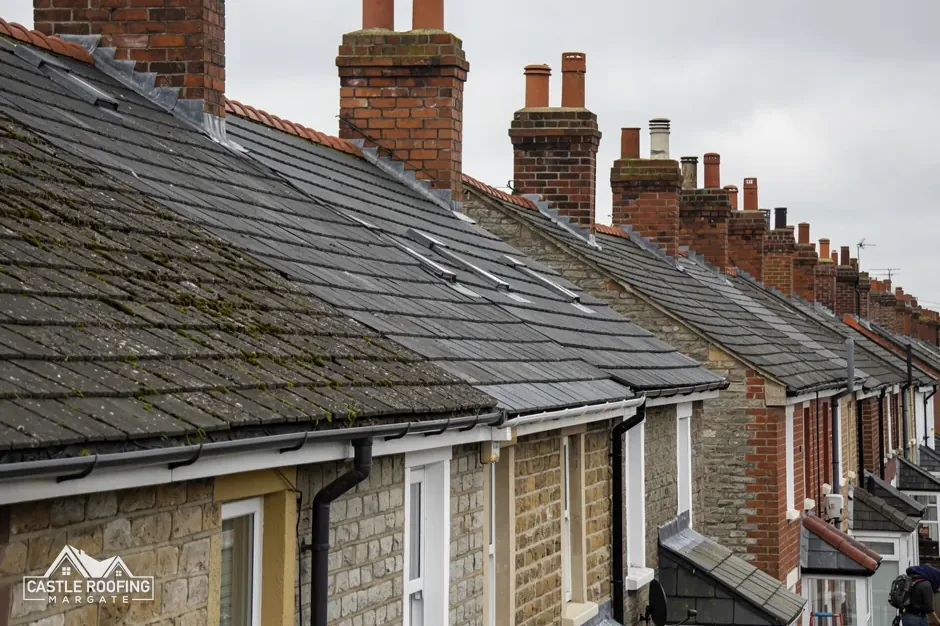
When the brickwork of a stack looks sound and the room below is still damp, the lead is the next thing we check. Flashing is the general name for lead dressed over a joint to shed water, and round a stack it comes in several pieces. Down each side a stepped flashing follows the slope like a staircase, each step tucked into a brick joint, wedged and pointed. On slate and plain tile, soakers sit underneath it, one folded leg under the covering and one turned up against the brick. Across the downhill face runs an apron, a single piece dressed over the tiles below. Uphill sits the back gutter, which has to carry all the rain coming down the slope above the stack.
Lead is sold in codes, a number that stands for its thickness and weight. The Royston Lead brochure gives Code 3 as 1.32 mm and 14.97 kg/m², marked green, and recommends it for lead soakers only. Code 4 is 1.80 mm and Code 5 is 2.24 mm. The code for every other piece round a stack, from the apron to the back gutter, is set in the specification for that job, which allows for the size of each piece and how exposed the stack is. We write those codes down before the work begins, so you know what is going onto your chimney.
Lead lets go in ways that can be read from the roof. The wedges and pointing holding a flashing in its brick joint work loose, and the lead lifts off the wall in the wind. A back gutter silts up with leaves and moss, so water rises over its upstand and into the loft. Old lead can split where it was worked too tightly, and mastic or tape over the split is a stopgap, not a repair. Well-laid lead flashing, MyJobQuote says, can last for over 80 years, and that figure is a lower bound rather than a promise for any one stack.
On a repair we take the old lead off rather than dressing new lead over the top of it. The brick joints it was wedged into are checked and repointed where they have gone soft, so the new flashing has a firm joint to sit in. Where the stack rises beside a valley or close to a parapet, the lead there is renewed on the same visit, which keeps the number of joins between old and new lead as low as it can be. For the work itself, MyJobQuote puts replacing the leadwork on a chimney at between £350 and £920 (Sep 2026), a typical UK range, and the size of the stack, the number of pieces and the access decide where a job falls in it. Lead on the rest of the roof, in valleys, on bays and along parapets, is covered on our lead roofing page.
Myth
A leaking chimney flashing can be sealed for good with mastic or tape.FactSealant over split or lifted lead only holds for a while. The lasting fix is new lead, wedged and pointed back into the brick joint.
Myth
Every piece of lead round a stack can be cut from one thickness.FactRoyston Lead recommends Code 3 for soakers only, so the apron, flashings and back gutter each take the code their specification sets.
Source: Royston Lead
Chapter 05 of 06
Leaning stacks, rebuilds and taking a chimney down
A lean in a chimney stack builds up slowly, as the joints on one side weaken and the shaft settles toward them. A hairline crack across the brickwork, a pot sitting off true or a gap opening where the flashing meets the brick are the early signs. We look at a lean from more than one side, because a stack can look straight from the street and bow when seen from the garden. Our page on the leaning chimney stack explains what we measure and when a lean needs acting on. A slight lean caught early can sometimes be held with repointing and new flaunching; a lean that keeps growing means the stack has to come down to sound brick.
Where the brickwork above the roof is past repointing, the stack is taken down to sound courses and rebuilt, reusing the original bricks that come off whole and a matched brick where they do not. The pots go back on new flaunching and the lead is renewed at the same time, so the rebuilt shaft and its weathering start out together. On a stack shared by two houses on a party wall, the neighbour is part of the plan from the first visit, and the work is arranged with both owners.
A redundant stack can also come down altogether. Taking it down below the roofline and closing the slope with matching tiles or slates removes a source of leaks for good, on a chimney that no longer serves a fire. That is outside work on the roof. Removing a chimney breast inside the house is a separate matter: the Planning Portal says building regulations approval will always apply, since chimney breasts are part of the building's structure, and MyJobQuote gives between £1,200 and £3,500 for the work (Aug 2026), a typical UK range. Our guide to chimney stack removal covers the roof side of the job.
Before any stack comes down, three questions are settled. First, whether anything still uses a flue in it, on your side or a neighbour's, since a shared stack can carry flues from both houses. Second, support: a breast taken out below can leave the brickwork above with nothing under it, so a structural engineer may need to design the support, and building control approval is needed for the removal in any case. Third, how the change will look from the street, which the next chapter covers.
Capping is the lighter choice for a chimney that stays in place but is no longer used. The pots come off or are capped, and the flue is left ventilated at the top and at the bottom so it does not gather damp inside. A capped and vented stack still needs its pointing, flaunching and lead kept in order like any other stack on the roof. On a terrace where the neighbour's half of a shared stack is still in use, capping only your own flues keeps the brickwork whole and leaves their chimney working.
A redundant stack taken down, in order
Check every flue
We confirm no fire, boiler or neighbour's appliance still uses the stack.
Settle the approvals
Planning, listed building consent, party wall notice or building control, where one applies.
Scaffold and protect
The scaffold goes up and the slope below is covered against falling brick.
Take it down by hand
Bricks come off course by course and are lowered, never thrown.
Close the slope
New battens, underlay and matching tiles or slates keep the loft dry.
Chapter 06 of 06
Planning, building control and scaffold licences in Kent
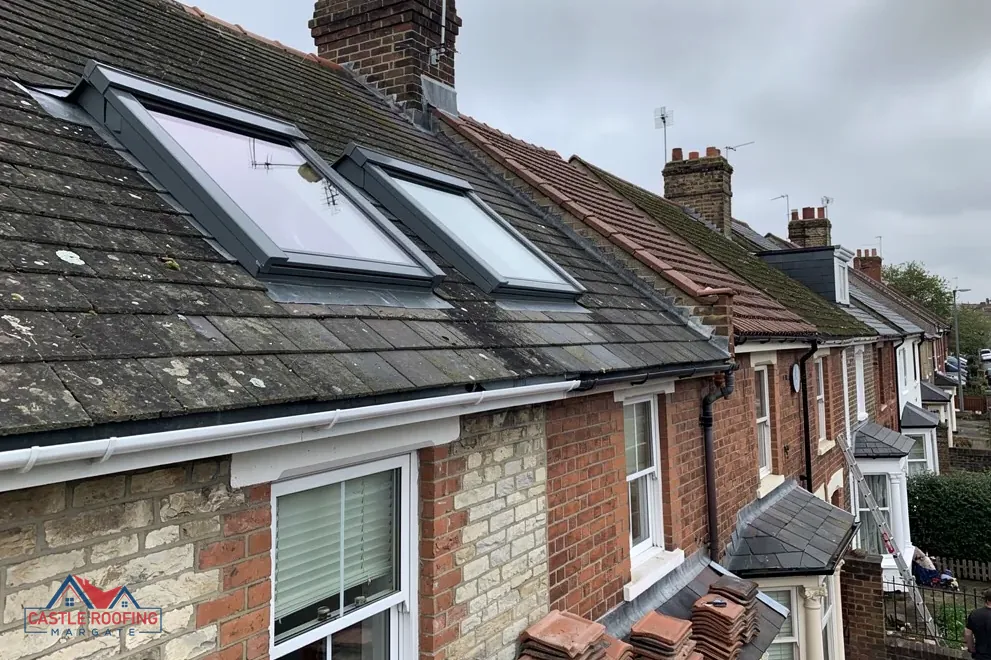
Repointing in a matching mortar or renewing lead like for like does not normally change how a stack looks, and section 55 of the Town and Country Planning Act 1990 says works that do not materially affect the external appearance of a building are not development. Changing a stack is another question. Class C of the permitted development rules, which normally covers alterations to the roof of a house, does not extend to the installation, alteration or replacement of a chimney. Taking a stack down or building it differently can therefore need planning permission, and we raise it with the council before that work is priced. Our guide to planning permission to remove a chimney sets out the questions to ask.
Listed homes and conservation areas add another layer. A listed house needs listed building consent for any work that affects its character, and that can include a rebuilt stack, new pots or a change of mortar. On a listed house the consent comes before the work, never after it, so the details are agreed with the council before anyone touches the stack. Thanet District Council has 27 conservation areas, Canterbury City Council 97 and Dover District Council 57. Dover's page says its Article 4 directions can cover alteration to the roof of a dwelling on the parts of a home that face a road, waterway or public open space. In Thanet, the council's Article 4 directions sit in the Pegwell, Ramsgate and Ramsgate Marina extension conservation areas, so check with Thanet District Council for a house in any of them. Elsewhere, check whether an Article 4 direction applies with your own council.
Building control comes in when a breast is removed or a stack's structure changes. Thanet District Council runs its own team, on 01843 577522. For Canterbury, Whitstable and Herne Bay addresses, and for Swale, approval goes through STG Building Control, on 01634 331133. Folkestone & Hythe District Council's own team is on 01303 853538, and Dover District Council runs its own service as well. Ashford addresses go to Ashford Borough Council's building control. A registered building control approver can be used in place of the council. Where the breast is on a party wall, the Party Wall Act asks for two months' notice ahead of the work, unless the adjoining owners and occupiers give their consent in writing, and any question about it goes to a party wall surveyor rather than building control.
Stack work is done from scaffold. Scaffold standing on a footway or carriageway needs a Kent County Council licence under section 169 of the Highways Act 1980, and Kent County Council asks the scaffolding company to apply for it at least 5 working days ahead. It charges £52 per week for 2026 to 2027, plus a £78 site inspection where the council decides one is needed. The height of the stack and the access round it decide how much scaffold a job takes, and our page on scaffolding for chimney repairs explains the options.

Show us the stack first
Message a picture of your chimney on WhatsApp or book a visit; after the survey, one written total price follows.
Our guarantee
10-Year workmanship guarantee. In writing
- We look at the roof before we price it
- One written price, one total
- We tell you before any extra work
Find us on Google (opens Google Maps in a new tab) What the guarantee covers
Chimney questions from Thanet and East Kent homes
Do roofers repair chimneys, or do I need a sweep?
A roofer repairs the outside of the stack: the brickwork and pointing, the flaunching that holds the pots, and the lead where the stack passes through the slope. Sweeping a flue, lining it and fitting a stove are the work of a sweep or an installer. If a stain on the ceiling sits beside the chimney, start with a roof inspection, since that is where rain gets past a stack.
How much do chimney repairs cost in Margate?
MyJobQuote puts replacing chimney leadwork at between £350 and £920 (Sep 2026) and removing a chimney breast at between £1,200 and £3,500 (Aug 2026), both typical UK ranges. Repointing and scaffold are priced after a survey, because the height of the stack, the state of its joints and the access set the figure. Check that any quote you are given includes VAT and the scaffold.
Why does my chimney only leak in heavy rain?
Rain driven sideways soaks the face of a stack that takes the weather, then gets in through open joints, porous brick or a lifted flashing that a light shower never reaches. An open pot lets rain fall straight down the flue, and a blocked back gutter overflows when the slope above it is carrying a lot of water. Each route leaves its own pattern, which an inspection traces back to the stack.
Does house insurance cover chimney repairs?
That depends on your policy's own storm definition and its exclusions. The Financial Ombudsman Service counts violent winds as the usual sign of a storm, mostly accompanied by rain, hail or snow, while it accepts rainfall, hail or snowfall by itself as a possible storm too, and it lists gradual damage and wear and tear among the common exclusions. A stack blown over in a gale is a different case from one that has weathered slowly. Tell your insurer first, make the chimney safe and keep photos and receipts.
Can a redundant chimney stack be taken down?
Yes. A stack that no longer serves a fire can come down below the roofline, with the slope closed in matching tiles or slates. Class C permitted development does not cover the alteration or replacement of a chimney, so ask the council about planning first, and listed building consent applies on a listed house. Removing a chimney breast inside always needs building regulations approval, the Planning Portal says.
Do I need scaffolding for chimney repairs?
The Work at Height Regulations 2005 oblige an employer, as far as is reasonably practicable, to guard against any fall liable to cause injury. On a chimney stack we work from a proper platform, and for us that normally means scaffold. Where it stands on the pavement, Kent County Council issues the licence and the scaffolding company applies 5 working days ahead, at £52 per week for 2026 to 2027. How much scaffold a stack takes depends on its height and the access round it.
What happens if birds are nesting in my chimney pot?
The work waits. Under the Wildlife and Countryside Act 1981, intentionally taking, damaging or destroying a wild bird's nest while it is being built or used is an offence. Once the nest is no longer in use, a cowl or a bird guard on the pot keeps birds out of the flue, and a vented cap does the same on a chimney nobody uses.
What can I check on my chimney from the ground?
From across the street, look at whether the pots stand straight, whether the collar of mortar at the top is whole, and whether any lead has lifted away from the brick. Plants growing from the stack and open joints on its weather face are worth a photo. Indoors, check the loft beside the chimney after rain for wet timber, and the chimney breast for a damp patch.
Read more
Chimney guides and quick answers
 Guide · 9 min readRepointing a chimney stack: when and howWhen a chimney stack needs repointing and how the work is done: the signs of failed joints, the effect of frost and…
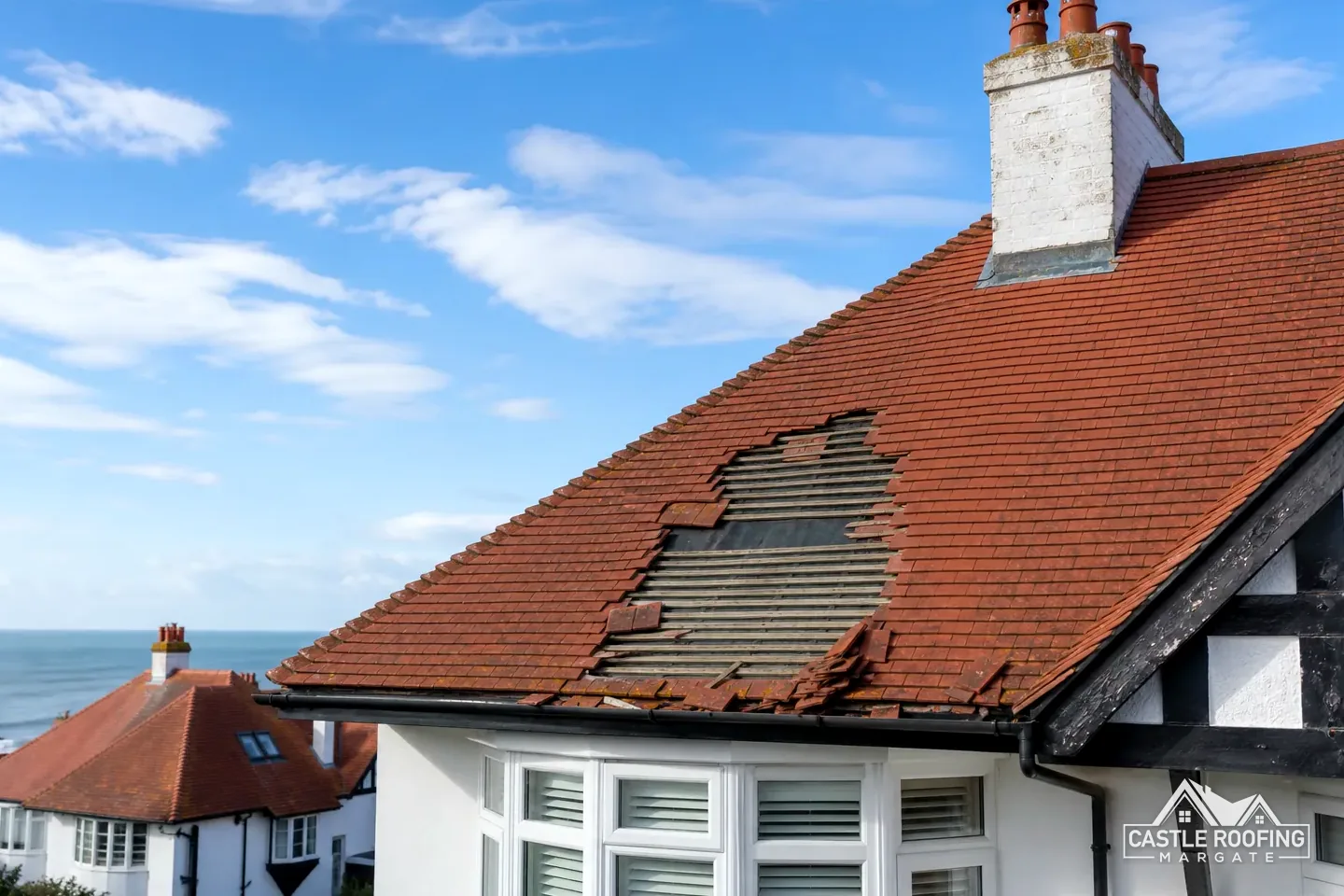 Guide · 9 min readRepairing cracked chimney flaunchingWhat flaunching does for a chimney pot, why it cracks in Thanet weather, how to spot it from the ground, and what…
 Guide · 9 min readRemoving a chimney stack above the roofWhat taking a chimney stack down above the roofline involves: the planning question to put to the council, the Building Regulations position,…
- GuideRemoving a chimney breast: approval, party walls and cost
- GuideWhy a chimney stack leans, and what to do about it
- GuideChimney pots and cowls: replacing and fitting
- GuideChimney repairs in a conservation area
- GuideRepairing a chimney stack shared with a neighbour
- GuideCapping a disused chimney: ventilation and weather
- BlogDo roofers repair chimneys? Who to call for what
- BlogWhy is my chimney leaking when it rains?
- BlogChimney rules explained: insurance, removal, consent and repairs
- AnswerDoes house insurance cover chimney repairs?
- AnswerDo I need planning permission to remove a chimney stack?
- AnswerDoes removing a chimney breast need Building Regulations approval?
- AnswerWhy is there a damp patch on my chimney breast?
- AnswerDo chimney repairs need scaffolding?
- AnswerA chimney pot has fallen off: what should I do?
- AnswerWhat is flaunching on a chimney?
- AnswerWhat can I do about birds nesting in my chimney?
- AnswerDoes a bird guard cowl stop birds getting into a chimney?
- AnswerCan chimney repairs be done in winter?
- AnswerWhy are the bricks on my chimney crumbling?
- AnswerShould an old chimney be repointed in lime mortar?
- AnswerWhen does a chimney stack need rebuilding?
- AnswerDo chimney repairs on a listed building need consent?
- AnswerWhat should I do about a chimney damaged in a storm?
- AnswerDoes a capped chimney need ventilating?
- AnswerCan a TV aerial bracket damage my chimney?
- AnswerDoes my chimney need a flue liner?
- AnswerWhat are the white marks on my chimney bricks?
- AnswerWhat is different about chimney repairs on a terraced house?
Other services for the roof round a stack
- Lead roofingLead flashings, valleys, soakers, lead roofs over bays and lead flat roofs repaired, renewed or replaced across Margate and Thanet, with the lead code…
- Roof repairs & emergencyLeaks traced to where they start, storm damage made safe and lasting roof repairs to slate, tile, lead and felt across Margate, Thanet and…
- Pitched roofingPitched roofing for slate, clay, peg and concrete tile roofs across Margate and Thanet, from one slipped tile above the gutter to a full…
- Roof inspectionsA roofer's inspection of your slopes, loft, chimney and gutters in Margate and across Thanet, with photos of what we find and a plain…
Tell us what the stack is doing
Say where the house is and what you have spotted, a stain, a leaning pot or loose lead, and we will arrange a visit.