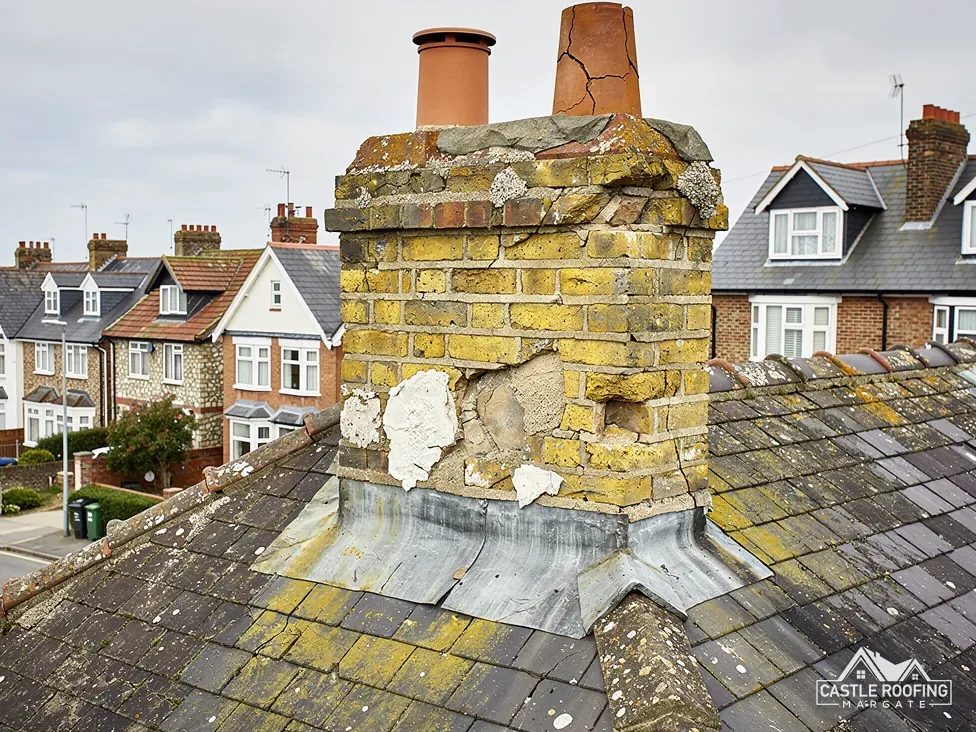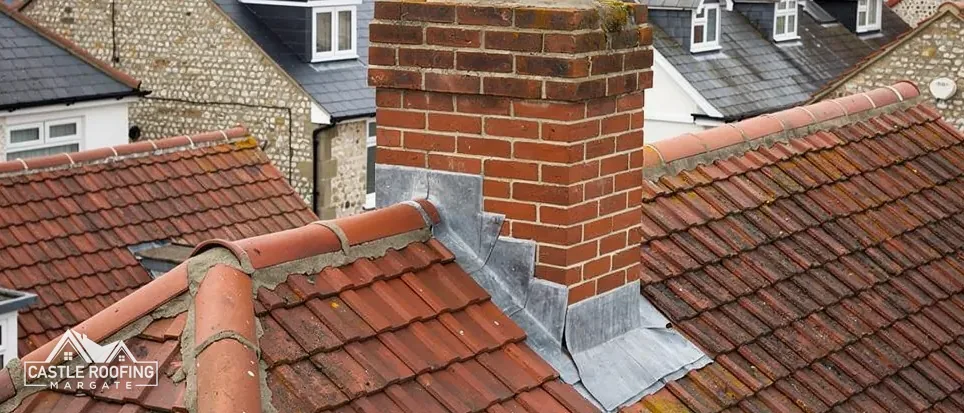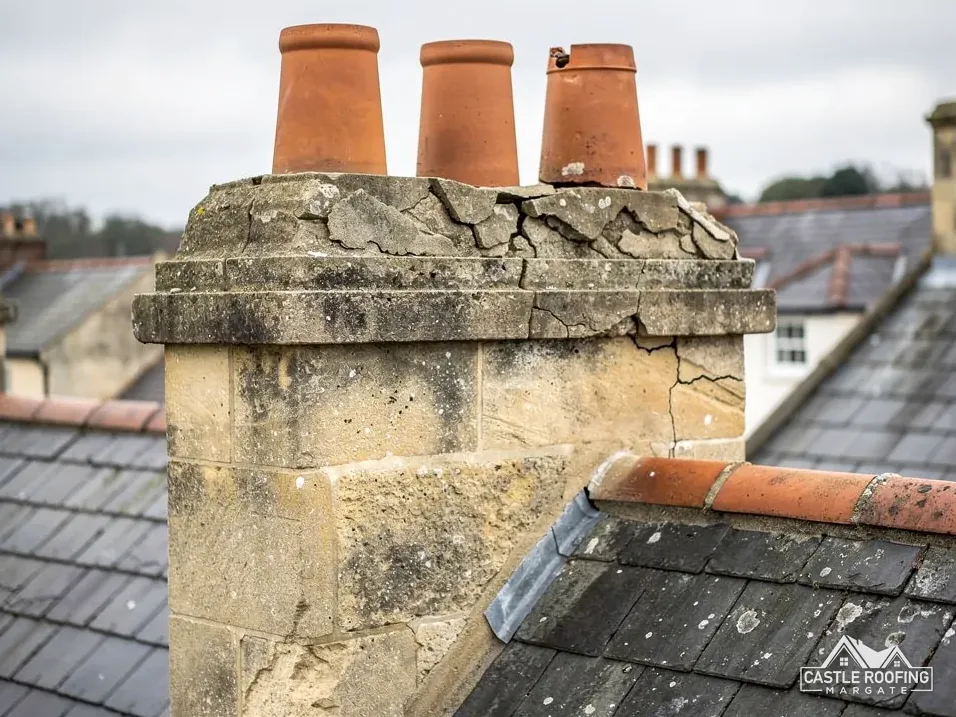
A leaning stack is a safety matter before it is a repair. This guide covers how to look at one without climbing, why stacks lean, what making safe involves, and which approvals follow the choice between rebuild and removal.
A chimney stack that leans is carrying its weight off to one side. The lean may be a few degrees that have been there for decades, or it may be new, and from the pavement the two look alike. What separates them is whether the lean is moving, and whether the joints below the lean have opened on one face.
The first rule is simple: do not stand under a stack you think is leaning, and do not go up to look at it. A stack that has started to move can drop bricks or pots onto the slope, and from there into a garden, a path or the street. Look from a distance, take photos, and keep people and cars out of the fall zone until someone has been on the roof.
The rest of this guide follows the order of events: the signs, the causes in general terms, the steps that make the stack safe, and then the choice between rebuilding and removal. It sits within our chimney repairs work. A lean is one of the few chimney faults where the right repair cannot be settled from a photograph alone, so the survey on the roof comes first.
Reading a lean from the ground
A stack is meant to stand square to the roof. From the garden or the opposite pavement, line the edge of the stack up against a door frame, a drainpipe or the corner of the house, and the lean shows as a gap that widens towards the top. Photos taken from the same spot a week apart show whether it has moved.
What matters, beyond the angle itself, is the state of the stack around the lean:
- A line of open joints on the side the stack is leaning away from.
- A crack running across the stack, often stepped along the bed joints.
- Pots or a cowl that sit out of line with the flaunching.
- Fresh brick dust or chips of mortar lying on the slope, or caught in a valley or a gutter.
- A wall or ceiling stain on the chimney breast inside, showing that water is getting down.
None of these alone proves a stack is unsafe, and a stack with an old lean and sound joints can stand for a long time. A fresh crack, loose bricks or a lean that grows between photos is different, because it means movement is happening now. In that case treat the stack as unsafe until someone has seen it.
The photos you receive come from the roof itself and show the cracks, the bed joints and any loose bricks, so you can see what was found instead of taking it on trust.
Why a stack leans, in general terms
A lean has a cause, and finding it matters because rebuilding a stack without curing the cause only repeats the problem. The surveyor works through the likely ones, starting with the ones that are easiest to check from the roof.
| Cause | What the survey looks at |
|---|---|
| Failed mortar on the weather side | Depth of open joints on each face |
| Water behind the pots | Flaunching, cowl and lead tray |
| Wind load on a tall stack | Height against width, and bracing |
| Added weight at the top | Heavy cowls, aerials and brackets |
| Support taken away below | Breast removed or altered indoors |
Two of those deserve a word. Removing a chimney breast indoors, or cutting into it, can leave the stack above it without the support it was built with, and the Planning Portal says removing a breast always needs approval because it is part of the building's structure. Movement of the house itself is the other, and settling it is a question for a structural engineer, not a job for a chimney repair alone.
Water is the common thread. A joint that has lost its mortar lets rain into the heart of the stack, the brickwork swells and freezes, and the bed joints on one face give way first. Once one face has weakened, the weight of the stack no longer bears evenly, and the lean can grow.
Making the stack safe first
Before anything is priced, a leaning stack that might fall is made safe. That is a separate step from the repair, and it may be a smaller job than the repair that follows.
- Clear everyone, cars included, from the ground beneath the stack and from the slope it leans over.
- Photograph the stack and the damage from a safe distance, with dates on the photos if you can.
- If the damage is from a storm, tell your insurer first, and keep the photos and any receipts. The Institution of Structural Engineers advises photographing the damage as evidence for a claim.
- Have the stack looked at on the roof, with proper access.
- Where it is not sound, make it safe: take the loose top courses down, or take the whole stack down to a sound level, and cover the opening so rain stays out.
Making safe is not the repair, and it does not decide whether the stack is rebuilt or taken away. It stops the danger, and it gives the choice time to be made properly.
Insurance and the policy
On insurance, the Financial Ombudsman's own storm wording centres on violent winds, which often bring rain, hail or snow, and wear and tear is one of the exclusions it calls common. Read your policy's own storm definition, and do not assume a lean will be covered. Our guide to whether insurance covers chimney repairs goes through the questions to ask.
Work on a stack at that height needs safe access, so even a make-safe visit comes with a scaffold or tower plan.
Rebuild or remove: the choice
Once the stack is safe and the cause is known, there are two routes. Which one suits the house depends on the stack, the flues below it and the fireplace.
A rebuild takes the stack down to sound brickwork and relays it to the same height, usually with the same bricks, a new flaunching and lead where the stack meets the slope. It keeps the roofline and the look of the house, and it keeps the flues available. It suits a stack that is still in use, a stack that matters to the look of a terrace, and a house where the council wants the stack kept. Our page on rebuilding a chimney stack describes the work in order.
Taking it away
Removal takes the stack down below the roof covering and closes the roof over the gap. It suits a chimney that has no use, serving no fireplace and with no flue to keep, and a stack whose repair would cost more than the owner wants to spend on a chimney that is not needed.
The choice is not only about money. A rebuilt stack keeps ventilation and the option of a fire or stove later. A removed stack ends both and can end a lean for good, but it needs approvals a rebuild may not, as the next section sets out. For a stack whose lean is old and stable, a repair that holds it in place may be the third option, and the survey will say if it is realistic.
Whichever you choose, the written price is one total for that route.
The approvals each route needs
A rebuild and a removal both alter a chimney, and the permitted development class for roof alterations leaves chimneys out. Condition C.1(d) of Class C rules out any work that puts in, changes or replaces a chimney, whether or not a flue or a soil and vent pipe is involved. Neither route can therefore lean on Class C, and the council's planning team says what it expects for your address. Put the question in writing, with photos, and keep the reply.
- Rebuild: ask the planning team whether a like-for-like rebuild to the same height needs an application. In a conservation area or on a listed house, say so at the start, because a listed house needs listed building consent for work that affects it.
- Removal: ask the same question, then ask building control how it treats the work. For a breast taken out indoors, approval under the Building Regulations is always needed.
- Shared stack: the Party Wall etc. Act 1996 may apply. Section 3(2) calls for two months' notice, and section 3(3)(a) allows work to go ahead where the neighbours have agreed in writing. Questions go to a party wall surveyor.
Where an emergency makes the stack unsafe, the make-safe step comes first and the approvals follow it. Taking the loose top courses down so the stack cannot fall is different from choosing between a rebuild and a removal, and the council can be told what has been done and why.
A scaffold on the pavement needs Kent County Council's licence, applied for by the scaffolding firm, at £52 per week for 2026 to 2027, with 5 working days' notice.
What the survey decides and the quote covers
The survey on the roof is where the lean stops being a worry and becomes a plan. It records the state of the stack, the cause, the flues and the roof around the base, and it gives you the photos to match.
From it you should have clear answers to these:
- Is the stack safe now, and what was done to make it safe?
- What caused the lean, and has the cause been dealt with?
- Can the stack be rebuilt as it was, and does the brick need to be new?
- Would removal be sensible, given the flues and any breast below?
- Which approvals does the chosen route need, and who asks for them?
The price follows from those answers. It is written as one total for the route you choose, covers the access, the takedown, the rebuild or the closing of the roof, the flaunching and the lead, and is given after the survey. If the stack serves the house next door as well, the neighbour's agreement is settled before the date is fixed.
If your insurer asks for a report, ask for the photos and the survey notes to be sent to you, and send them on. The photographs record the stack as it was found, which is what an insurer wants to see.
Our page on storm damaged chimneys covers the case where a recent storm is the cause.