
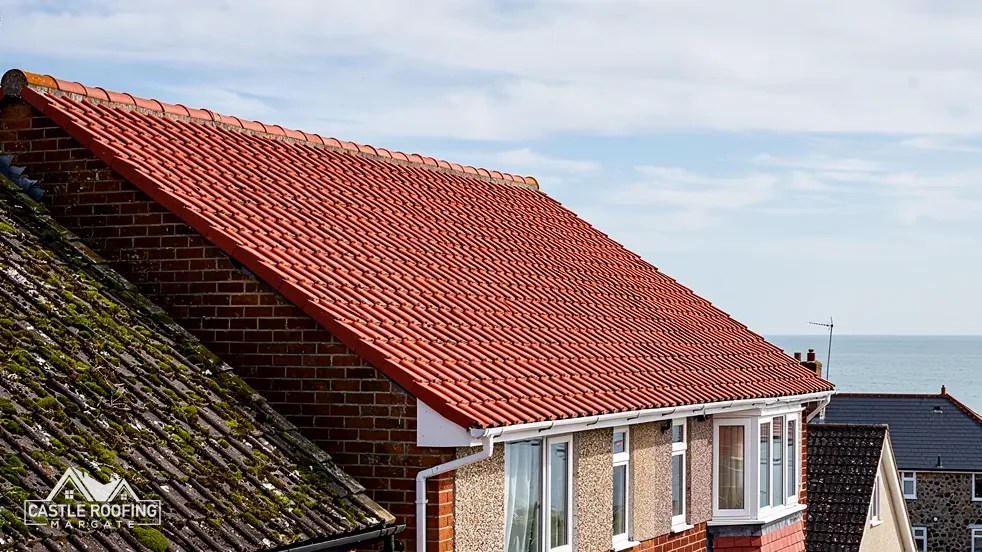
Roof Cleaning and Moss Removal in Margate
Moss and lichen lifted off Margate and Thanet roofs by hand and soft wash, gutters cleared and any loose tile or slate put right while we are up there.
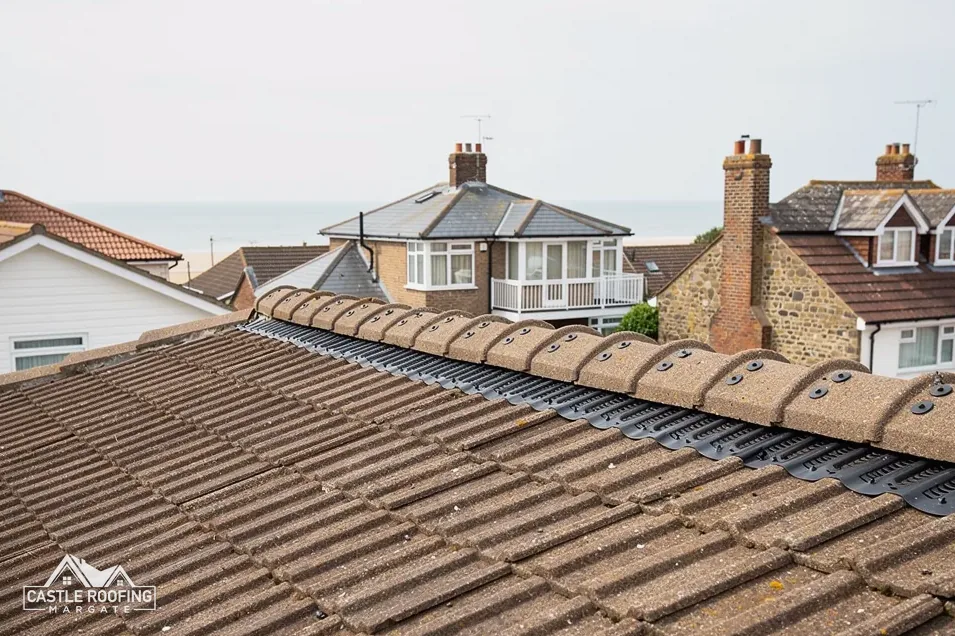
On a mossy roof
What we clean, clear and fix on a roof
- Moss along the tile laps
- Lichen and algae stains
- Gutters and outlets
- Valleys and parapet gutters
- Cracked or slipped tiles
Slate, clay and concrete tile roofs on houses, bungalows, flats and shops, cleaned by roofers who check the fixings, ridges and flashings as the growth comes off, then leave every gutter and downpipe running clear.


Signs your roof is due a clean
Green cushions
Thick moss along the tile laps keeps the slope wet and can prise the tile edges up.
Moss on the path
Clumps landing under the eaves are also rolling into the gutters and outlets above.
Spilling gutters
Rain pouring over the front of a gutter often points to moss packed into an outlet.
The roof cleaning guide
How moss, lichen and algae come off a Thanet roof without harming the covering
Six chapters covering the growth itself, the Manston weather behind it, the method for each covering and the price. Pick the chapter closest to your own roof.

Chapter 01 of 06
What grows on a Thanet roof, and which kind matters
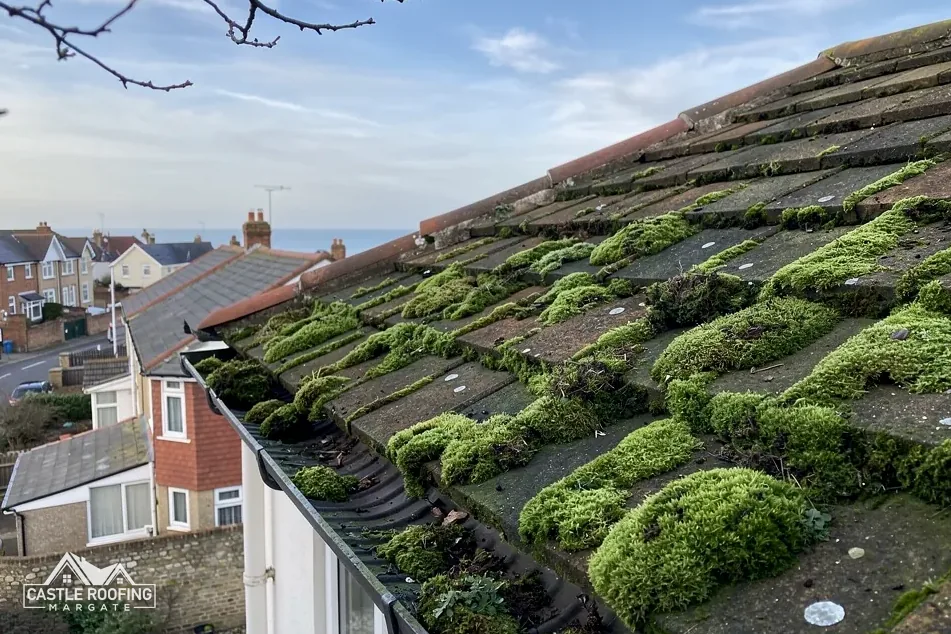
Three different things grow on a pitched roof in Thanet, and they are worth telling apart before anyone climbs a ladder. Moss forms soft green or brown cushions, usually along the lower edge of each tile where the course above overlaps it. That overlap is called the lap, and it is the part of the covering that passes rain from one tile down onto the next. Lichen is the flat, crusty growth in grey, yellow or orange that clings to the face of a tile or slate and spreads very slowly. Algae is the thinnest of the three: a dark film or streak, green or black, that stains a slope without building up any depth.
Moss is the one that causes trouble. A cushion holds water like a sponge, so the tile under it stays wet for days after the rain has stopped. When that water freezes it expands, and a tile that is already porous or carries a hairline crack can lose a flake of its face or split along the crack. The Met Office's 1991 to 2020 averages for its Manston climate station give 21.43 days of air frost a year. Each of those freezes works on any tile that moss has kept saturated. Moss also breaks loose in dry, breezy spells, rolls down the slope and settles in the gutter, where it slows the flow and in time blocks the outlet at the head of the downpipe.
Lichen and algae are mainly a question of looks. They hold far less water than moss, and on a sound slate or clay tile they can sit for years without letting rain in. We still note where they are, because a heavy crust tends to mark the slope of the house that dries out slowest, and that slope deserves a closer look at its ridge, valleys and flashings. A ridge is the line of capping tiles along the top; a valley is the channel where two slopes meet; a flashing is lead, or a similar sheet, dressed over the joint where the roof meets a wall or chimney.
Thanet's older roofs carry a real mix of coverings, and that changes how growth is taken off. The council's own write-up for the Cliftonville Clifftop conservation area finds red clay tiles alongside natural slate. Its write-up for Northdown Road finds slated and tiled roofs, many of them hidden behind parapets, with fishscale slates on some, which are slates cut with a rounded tail. A parapet roof hides its gutter, so moss can fill it unseen from the pavement in Margate, Cliftonville or Ramsgate. Our guide to cleaning a slate roof covers the extra care split stone needs.
Chapter 02 of 06
Manston's rain and frost, and why moss settles in
- 613 mmRain at Manston in an average year
- 110 daysDays bringing 1 mm or more
- 21.43 daysAir frost days in a year
Source: Met Office, Manston 1991 to 2020
Moss needs moisture more than anything else, and the long-run record for this corner of Kent shows how much a roof here gets. The Met Office's Manston averages for 1991 to 2020 give about 613 mm of rain in a year, falling on 110 days that each bring 1 mm or more. Those are averages rather than a forecast, and Manston comes out drier than the Met Office's inland station at South Farnborough, at about 715 mm. Even so, a slope in Thanet is rained on for more than a hundred days in an average year, and a shaded one can stay damp from one shower to the next.
The same Manston record averages 21.43 days a year with an air frost. On its own that figure says little, but set it beside a mossy slope and it explains a good deal. A cushion that soaked up the afternoon's rain is still wet when the temperature drops overnight, and the freeze happens in the pores of the tile as well as on top of it. A soft or weathered clay or concrete tile suffers more from that than dense slate. Wind plays its part too: Manston's mean wind speed is 9.86 knots at 10 metres, and a dry, gusty day is when loose moss breaks away and drops into the gutters. That is why a roof that looked tidy in summer can have its outlets choked by the first autumn storm.
None of this means every Margate roof needs cleaning. A slope facing south over open ground can dry within hours and carry little more than a dusting of lichen. The roofs that collect moss are the ones that stay damp: north slopes, roofs under trees, the back of a terrace in the shadow of the next street, and low extensions tucked under a taller wall. On a visit we note which slopes those are, because cleaning the damp side can be all a house needs while the sunny side is left as it is. A seafront house in Margate and a bungalow a mile inland can each carry one green slope and one clean one, so we survey slope by slope rather than judging by the street.
Chapter 03 of 06
Hand scraping, soft washing and a biocide finish
A roof clean done by a roofer starts with hand tools rather than a machine. On a pitched roof the bulk of the moss is lifted off with a plastic scraper or a stiff brush, working down the slope so that nothing is pushed up under the laps. The growth comes away in pieces that can be bagged where the slope ends over the wall, the line roofers call the eaves, instead of washing into the gutters and drains. On a fragile or very old covering we work from roof ladders and crawling boards, so no weight goes onto a tile in the middle of its span.
Soft washing follows where it suits the roof. It means applying a cleaning solution at low pressure, not much more than the flow from a garden hose, and leaving it to work instead of blasting the surface. The solution is a biocide: a treatment that kills the moss spores, lichen and algae that scraping leaves behind in the joints and on the face of each tile. It goes on in dry weather, as the product's own label directs, and is left to act. Lichen can take weeks to fade after treatment before the rain rinses it away, so a roof often looks better a month after a clean than on the day itself.
Myth
A jet washer is the quickest way to a properly clean roof.FactMarley advises against high-powered jet washing, which can damage the tile surface and shorten its life, so we scrape by hand and soft wash.
Myth
Grey lichen on a slate roof means the slates are failing.FactLichen sits on the surface. A slate slope gives way when its nails rust, so we judge the fixings, not the colour.
Low pressure on tiles, and the reason for it
A high-pressure jet clears a roof quickly, and that speed has a cost. Marley, the tile maker, advises against high-powered jet washes because they can damage the surface of a slate or tile and considerably reduce its expected life. On clay that life is long enough to be worth guarding: Marley cites the BRE's minimum life expectancy of 60 years for clay tiles. A jet can wear the surface of an older clay or concrete tile, stripping its outer skin and leaving a rougher face that holds water and regrows moss sooner. Before cleaning any covering we check what it is and, for a newer tile, what its maker advises. Our page on pressure washing a roof shows the damage a jet can do to old tiles.
The biocide itself is chosen and used by its label. A treatment sold for roofs carries its own instructions on dilution, weather and protecting the plants and ponds below, and we follow them exactly. Run-off from a treated slope drains through the gutters, so we cover borders, check where each downpipe discharges and keep the solution off glass and painted joinery. Our guide to roof biocide treatment explains how it works on a shaded slope and what to expect afterwards.
Timing matters as much as method. The right window is a dry spell clear of frost: moss scrapes off cleanly when it is damp rather than frozen, and a biocide needs a run of dry hours once it has gone on. The forecast for the day decides, not the month on the calendar. A frosty morning is left alone, because a frozen tile is brittle underfoot and an icy slope is no place to work.

Chapter 04 of 06
Slate, clay, concrete and cement sheet, cleaned differently
Every covering reacts differently to a scraper, a brush and a wet solution, so the first job on any roof clean is naming what is up there. Natural slate is split stone: dense, smooth and hard-wearing, but each slate hangs on one or two nails, and a heavy hand can crack a thin one or pull it off a rusted fixing. Clay plain tiles are small, slightly curved and fired, and old ones can be soft at the surface. Concrete interlocking tiles are larger, with a sanded or coloured finish that wears with age and gives moss a rough face to hold. Each gets its own tool and its own pressure.
Lifespans are worth knowing, because there is little sense in paying to clean a covering that has few years left in it. On HomeBuilding's figures (Sep 2025), natural Welsh slate runs to 100+ years, clay tile to 60 to 80 years, and concrete tiles, plain or Double Roman, to 40 to 50 years. Marley reports BRE's figure of at least 60 years for clay tiles, a minimum that applies to clay alone. They are typical spans, and no roof is promised any of them. A concrete roof with worn faces and soft battens may be a better candidate for re-covering than for cleaning, and we tell you so with photos of the slope.
Asbestos cement sheets and slates
Some garages, outbuildings and a few houses carry asbestos cement sheets or slates. The HSE rule of thumb is simple: if the building dates from before 2000, or was refurbished before then, assume asbestos is there. In its A14 guidance the HSE puts the other half plainly: "AC roofs are always fragile". Nobody stands on one. Cleaning a cement sheet roof means working from boards with edge protection and using no abrasion at all, because scraping or jetting breaks up the surface and the aim is to leave the sheet whole. A biocide sprayed gently from the boards, with the dead growth left for the weather to clear, is often the gentler course. Our guide to cleaning an asbestos cement roof sets out the safer options, which can include leaving the growth where it is.
A clean also shows up faults the moss was hiding: a cracked tile, a slate held in place by habit, a ridge with open joints. When those are put right, the repair follows BS 5534:2014+A2:2018, the British Standard for slating and tiling, whose A2:2018 amendment brought repairs and normal re-roofing into its scope. Fixings are worked out for the site's exposure, and Cupa Pizarras, the slate maker, grades exposure higher for tall buildings, for those on slopes or hills and for those in "coastal areas". That counts on a cliff-top street in Cliftonville or Westgate-on-Sea, where a re-fixed tile has to hold against the wind off the sea.
| Covering | Cleaning method | Typical life |
|---|---|---|
| Natural Welsh slate | Hand scrape, biocide | 100+ years |
| Clay plain tile | Soft brush, biocide | 60 to 80 years |
| Plain concrete tile | Scrape, soft wash | 40 to 50 years |
| Double Roman concrete | Scrape, soft wash | 40 to 50 years |
Source: HomeBuilding, Sep 2025
Chapter 05 of 06
Gutters, nests and the repairs a clean uncovers
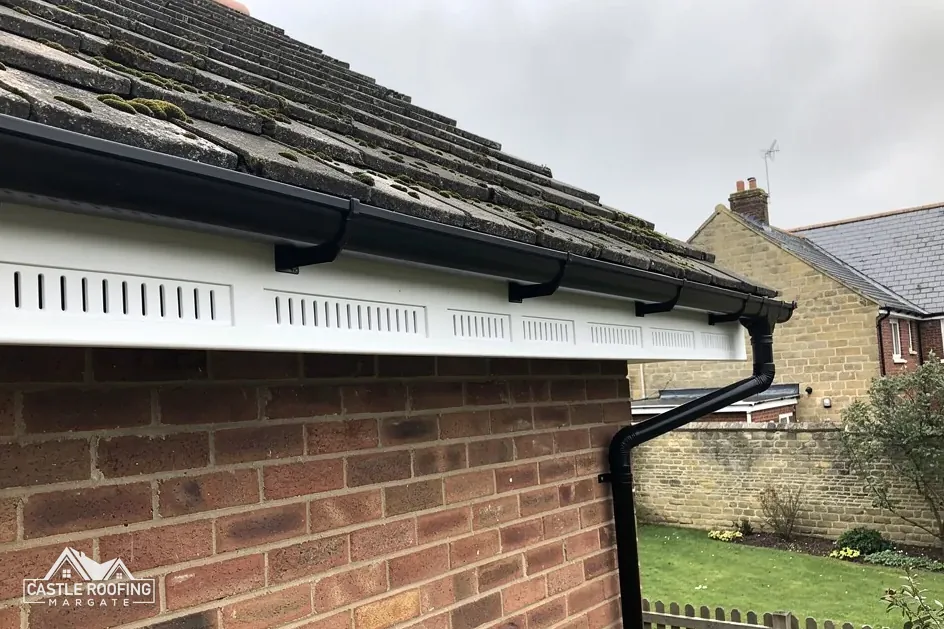
A roof clean that stops at the eaves leaves half the job undone. Scraped moss, grit from worn tiles and dead lichen all end up in the guttering, and a gutter that was half full before the clean can be blocked after it. So once a slope is done we clear the gutters, check each outlet and run water down the downpipes. While we are there we look at the fascia, the board along the eaves that carries the gutter, and the soffit, the board underneath it, for rot or splits. Moss in a parapet gutter or a valley is lifted out by hand, because a blockage there sends water sideways into the house rather than over the edge. Where the roofline needs more than a clear-out, our guttering, soffits and fascias service takes it on, and our post on moss blocking gutters shows what a packed outlet does in heavy rain.
Birds and bats under the tiles
A roof clean can reach the places where wildlife lives, and the law treats that seriously. Under section 1 of the Wildlife and Countryside Act 1981, it is an offence if any person intentionally takes, damages or destroys the nest of any wild bird "while that nest is in use or being built". Before working any slope we look for active nests in gutters, valleys and under ridge tiles, and an occupied nest is left alone until the young have gone. Bats have stronger protection still. GOV.UK guidance gives every bat species, with its roosts, full legal protection, and names roof repair and replacement as work that can affect them. Under regulation 43 of the Habitats Regulations 2017, damaging a breeding site or resting place is an offence with no need to show intent. If we see signs of bats, such as droppings at the eaves or in the loft, work on that part of the roof waits until specialist advice has been taken.
Faults the moss was covering
Moss conceals defects as well as tiles. With a slope clean we can see slipped or cracked tiles, a slate hanging on a corroded nail, mortar missing from the ridge and a lead flashing lifted at its edge. You get photos of each one, with a plain note of what needs doing now and what can wait for a later visit, and nothing beyond the clean is done without your agreement. Where the moss has hidden a leak or storm damage, our roof repairs service picks it up. On a house in Broadstairs, Birchington or Westbrook, that can mean a short repair carried out from the same ladders, rather than a second visit weeks later. Where the fault is bigger than a clean can sensibly absorb, such as a valley lining that has split, it gets its own visit and its own conversation first.
A roof clean, in order
Look from ground and loft
We name the covering, find the damp slopes and check the loft.
Cover the ground below
Borders, ponds and paths under the eaves are sheeted first.
Scrape by hand
Moss comes off downslope and is bagged at the eaves.
Soft wash with biocide
A low-pressure treatment goes on in dry weather to kill the spores.
Clear and flush gutters
Each gutter, outlet and downpipe is emptied, then run with water.

Chapter 06 of 06
What sets the cost of a roof clean
Two roofs on the same street can take very different work to clean, so a roof clean is priced after a survey. The things that set it are mostly visible from the pavement and the garden:
- the area and pitch of the slopes, and how many of them there are;
- the height of the house and the access it needs, from roof ladders on a bungalow to scaffold on a three-storey terrace;
- how thick the moss is, and whether lichen needs a biocide to shift it;
- the covering, since slate and old clay need a lighter hand and more time;
- parapet gutters, valleys and dormers that must be cleared by hand;
- a garage, porch or outbuilding roof cleaned on the same visit;
- any repair found once the slope is clean.
Commercial roofs follow the same logic. A shop with a flat above, a holiday let or a small unit with a tiled front slope is priced on its height, its access and how much growth it carries, and a landlord gets the same photos as a homeowner. Some of the work around a clean does have published figures. Which? (Nov 2025) prices a clear-out of every gutter on a house, front and back, at £75 to £350, and gives £75 to £400 for replacing between one and six broken tiles, both ex VAT. Which? adds that homes in London and the South East, Kent included, should expect the upper end. Both figures are national guide ranges, not our prices. Our roof cleaning cost guide goes through what moves the figure on a Margate house. Whoever you ask, check that the quote includes VAT at 20% and any scaffold.
Access is part of the safety of the job. Regulation 6(3) of the Work at Height Regulations 2005 places a duty on an employer to stop anyone falling a distance that could injure them, as far as that can reasonably be done. We choose the access to suit the house: roof ladders hooked over the ridge on a low bungalow, scaffold on a tall house in Ramsgate or Broadstairs. Where a scaffold stands on the footway or the carriageway, Kent County Council licenses it under section 169 of the Highways Act 1980, and the scaffolding firm makes that application for you 5 working days ahead. The fee is £52 per week for 2026 to 2027. On many terraces a rear slope can be reached from the garden instead, which keeps the street clear.
We look at the roof before pricing it, from the ground, from the loft and, where it is safe, from the slope itself, and you see photos of the moss and of whatever lies beneath it. The written price follows that survey as one total, covering everything agreed in a single sum you can plan around. If a worn concrete roof would be better re-covered than cleaned, that is the honest answer, and it is the one you get.
Start with a picture of the moss
WhatsApp us the green slope from the street or garden, name the town, and we will put a date in the diary.
Our guarantee
10-Year workmanship guarantee. In writing
- We look at the roof before we price it
- One written price, one total
- We tell you before any extra work
Find us on Google (opens Google Maps in a new tab) What the guarantee covers
Moss and roof cleaning, answered
How much should I pay to have a roof cleaned in Margate?
It depends on the size, pitch, height and covering of the roof, the depth of the moss and the access. A bungalow in Westgate-on-Sea cleaned from roof ladders is a very different job from a three-storey terrace that needs scaffold, which is why we look at the roof first. For the gutter clearing that goes with it, Which? gives £75 to £350 ex VAT for clearing all the gutters on a house (Nov 2025).
Is getting a mossy roof cleaned worth the money?
It pays off when moss is thick enough to hold water, fill the gutters or hide faults, because those lead to blocked outlets, frost-damaged tiles and leaks found late. On a covering near the end of its typical life, the money may be better put towards re-covering, and we will say which applies to your roof. A clean before selling can also help, since a buyer's surveyor sees the tiles rather than the moss.
What time of year should moss come off a roof?
Choose a dry spell outside the frosts. Moss lifts away cleanly when it is damp rather than frozen, and a biocide needs dry hours after it is applied, as its label sets out. The Met Office's Manston averages give 21.43 days of air frost a year, so a cold winter morning is often unsuitable. Spring and autumn usually suit, though the weather on the day has the final say.
How often does a house roof need cleaning?
There is no set interval. A shaded north slope under trees can grow moss back far sooner than a sunny south slope over open ground, which may never need more than a look. A biocide slows regrowth. Look the roof over from the ground each year once autumn leaf fall is done, and arrange a clean when moss is building along the laps or turning up in the gutters.
Can pressure washing damage roof tiles?
It can. A high-pressure jet can wear the surface of older clay and concrete tiles, and Marley warns that a high-powered jet can cut the expected life of a tile considerably. We scrape by hand and soft wash at low pressure instead, and check a newer tile maker's cleaning advice before starting.
Will the moss grow back after my roof is cleaned?
On a slope that stays damp it will in time. Spores arrive on the wind and settle wherever water lingers. A biocide after scraping kills what is left in the joints and slows the return, and cutting back overhanging branches lets the slope dry out faster after rain. A roof that gets more sun and air will hold off regrowth longer than one hemmed in by trees or taller walls.
Are the gutters cleared once the roof is clean?
Yes, on every roof clean. Scraped moss and grit end up in the guttering however carefully a slope is worked, so we clear each gutter, check each outlet and run water through the downpipes before we leave. Parapet gutters and valleys are emptied by hand. Where a gutter is cracked, sagging or falling the wrong way, we show you and explain what would put it right.
How long does cleaning the moss off a house roof take?
It turns on the size of the roof, how many slopes carry moss, how thick it has grown and the access. A small bungalow reached from roof ladders is a shorter job than a tall Cliftonville house that needs scaffold. Weather also sets the pace, since the biocide waits for a dry spell. When we survey the roof, we tell you how the work will be split up and what happens each day.
Read more
Moss, lichen and roof cleaning guides
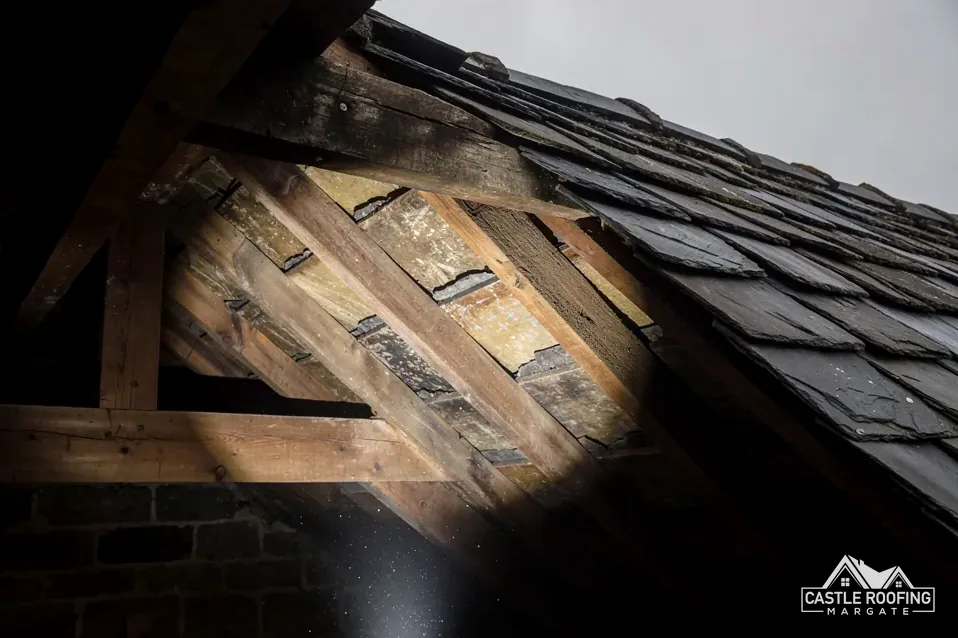 Guide · 9 min readWhat decides the cost of cleaning a roofRoof cleaning is priced after someone has looked at the roof, because the same job differs widely from house to house. This…
 Guide · 9 min readHow moss is removed from a roof, method by methodHow moss comes off a Thanet roof: hand scraping, soft washing and treatment, then the gutters cleared and any tiles the moss…
 Guide · 9 min readWhat a biocide treatment does on a roofA biocide treatment is the wash that kills living growth on a roof. This guide explains what it does, why the product…
- GuideLichen on roof tiles: harmless or a problem?
- GuideRoof coatings after cleaning: pros and cons
- GuideRoof moss and blocked gutters
- GuideHow a slate roof is cleaned safely
- GuideHow concrete roof tiles are cleaned
- GuideWhat causes black streaks on roof tiles?
- BlogUnderstanding roofing safety equipment: scaffolds, towers, harnesses and roof ladders
- BlogWhen is the best time of year to remove moss from a roof?
- BlogIs roof cleaning worth it? An honest look at the benefits and risks
- AnswerHow often should a house roof be cleaned?
- AnswerDoes moss damage roof tiles?
- AnswerShould a roof be pressure-washed?
- AnswerCan roof cleaning go ahead if birds are nesting?
- AnswerCan moss be removed from a roof in winter?
- AnswerDoes roof cleaning need scaffolding?
- AnswerWill moss grow back on my roof after cleaning?
- AnswerWill roof cleaning run-off harm my garden or pond?
- AnswerCan an asbestos cement roof be cleaned?
- AnswerWhy is moss worse on the north side of my roof?
- AnswerDoes moss on the roof affect selling a house?
- AnswerDo copper strips stop moss growing on a roof?
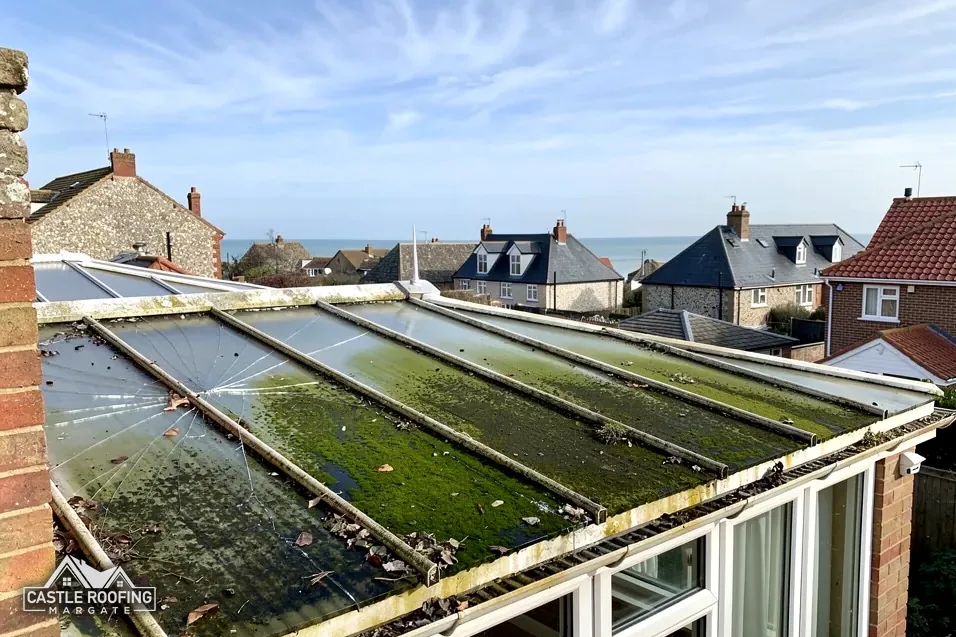
- AnswerHow is a conservatory roof cleaned safely?
- AnswerIs moss on a flat roof a problem?
- AnswerHow long does it take to clean a roof?
- AnswerCan roof cleaning disturb bats?
- AnswerShould I clean my roof myself?
- AnswerCan roof cleaning damage tiles or slates?
- AnswerShould a roof be cleaned before or after repairs?
- AnswerShould roof tiles be sealed after cleaning?
Work that often follows a roof clean
- Guttering, soffits & fasciasGutter repairs and clearing, plus removal and new installation of fascias, soffits, bargeboards and downpipes, done by roofers who check the felt and rafter…
- Roof repairs & emergencyLeaks traced to where they start, storm damage made safe and lasting roof repairs to slate, tile, lead and felt across Margate, Thanet and…
- Pitched roofingPitched roofing for slate, clay, peg and concrete tile roofs across Margate and Thanet, from one slipped tile above the gutter to a full…
- Roof inspectionsA roofer's inspection of your slopes, loft, chimney and gutters in Margate and across Thanet, with photos of what we find and a plain…
Get the moss off your roof
Name the town and the slope that has turned green, and we will fix a day to come and look at it.