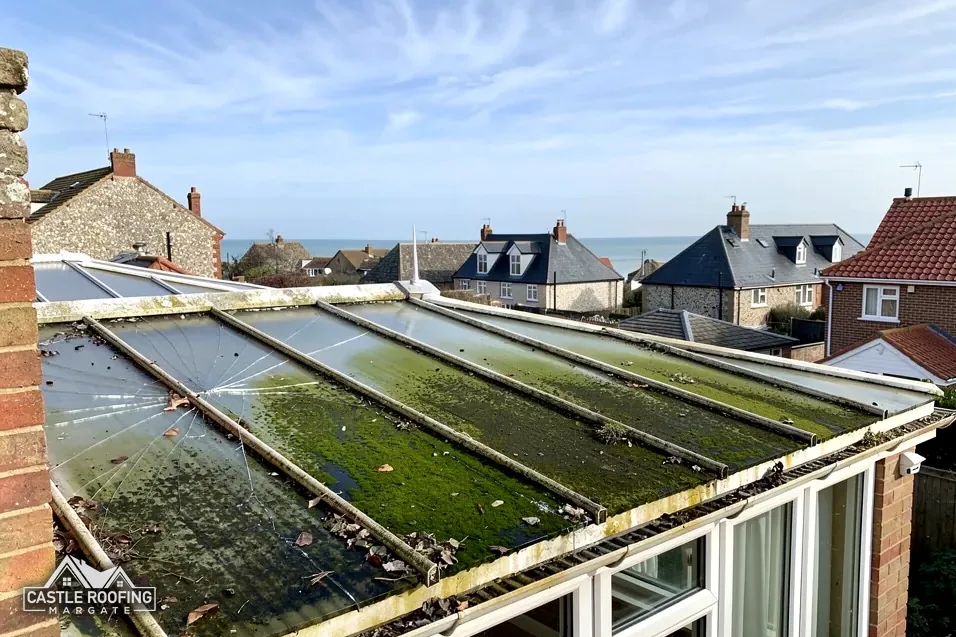
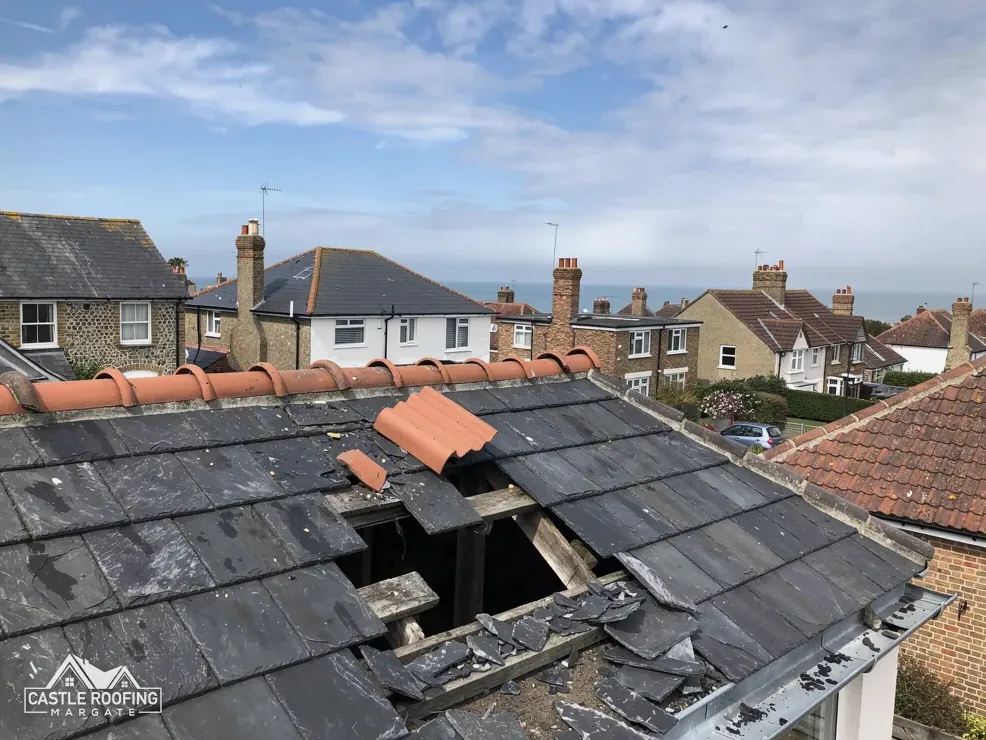
You get a plain split between the cosmetic and the practical, what moss does to gutters, how frost enters the question, why we clean by hand, what coatings are and what decides the price of a clean.
A roof covered in green looks neglected, and a clean one looks cared for. That alone sells a lot of roof cleaning, and for some owners it is reason enough. The better question is what the clean changes beyond the view from the road. Does it protect anything? Does it find faults early? Or is it a bill that pays for appearance and little else?
The answer depends on the roof. On a sound roof with light growth, cleaning is mostly cosmetic and can wait. On a roof where moss is feeding debris into the gutters, or sitting heavy in the laps between tiles, it does practical work. On a roof that is already failing, a clean is the wrong first step, because the money is better spent on the repair.
This piece sets out the benefits and the risks side by side, including the risks of the cleaning method itself. For the full service, see our roof cleaning and moss removal page.
What a clean changes and what it leaves alone
A clean removes moss, lichen and the dark streaks that settle on tiles, and it leaves the roof looking closer to how it did when it was laid. It does not change the structure underneath. A cracked tile is still cracked after cleaning, a rusted fixing is still rusted, and a failed lead flashing still lets water past.
It helps to separate the effects into those you can see and those you cannot.
| Effect | Real gain? | Note |
|---|---|---|
| Tidier appearance | Yes, cosmetic | Fades as growth returns |
| Clearer gutters | Yes, practical | If moss was shedding |
| Faults exposed | Yes, useful | Moss can hide damage |
| Roof repaired | No | Repairs are separate work |
The third row is often missed. Moss covers cracked tiles, slipped tiles and perished mortar, and clearing it lets a roofer see them. That is a good reason to clean before a repair, not after.
If you are weighing a sale, a clean roof reads well in photographs, and it removes a question a buyer might ask. It is not a substitute for a survey. Our guide to roof moss removal methods covers how the options differ.
One more point belongs here. Cleaning is a one-off treatment of a condition that returns wherever damp and shade linger. A north slope under a tree will regrow sooner than a sunny one. So weigh the cost against how long you expect the result to last on your own house, and ask a roofer for a straight view of the slopes most likely to green over again.
Gutters are where moss does practical harm
Moss on a roof is rarely a problem while it stays put. The trouble starts when it loosens, particularly after rain or after a frost, and falls down the slope into the gutter. A gutter holding a mat of moss and grit cannot carry water to the downpipe. It overflows at the front edge, soaks the fascia and runs down the wall.
That is a practical cost you can see from the ground. Look for:
- Green growth poking from the gutter, or grit and moss on the ground below.
- Water pouring over the lip in heavy rain, not leaving by the downpipe.
- Damp or staining on the wall under the gutter line.
- Plants sprouting in the gutter itself.
None of that needs the roof to be cleaned, but the gutter does need clearing, and a roof that sheds moss will refill it. Which? Trusted Traders (November 2025) gives a typical UK range of £75 to £350, ex VAT, for having every gutter on a house cleared out. That figure is for the gutters alone, and it does not include the roof.
When the roof is clean and the gutter clear, water leaves the roof as it should. Our guide to moss blocking gutters shows how a blocked outlet is traced and cleared. The point to take away is that gutters and roof belong in one conversation, since a clean roof with a full gutter has not solved the problem.
Frost, wet tiles and what to say carefully
The usual argument for cleaning is frost damage: moss holds water, water freezes, and ice breaks the surface of the tile. That chain sounds sensible and may be true in some cases. It is not something to state as a rule, because how a tile reacts depends on its material, its age and its surface, and the evidence for any given roof is the roof.
What can be said safely is the weather. At Manston, the Met Office records an average of 21.43 days of air frost a year, from its 1991 to 2020 figures. A tile that stays wet through the colder months meets frost more often than one that dries between showers. Whether that harms a particular tile is a question for someone who has looked at it.
If you want to know, the test is practical. Look at the tiles under the moss once it is cleared. A face that is flaking, a chipped edge or a surface that comes away on your finger are signs worth recording. Smooth, sound tiles under moss are a sign that growth has so far been cosmetic.
- Photograph the tile surface before and after the clean.
- Ask the roofer what they saw under the moss, and ask for the photographs.
- Do not accept a general claim that moss destroys roofs, from anyone.
A roofer worth hiring tells you what they found, whether the finding is good or bad, and does not use frost as a scare. If the tiles are sound, you can reasonably decide to clean for looks alone, or to wait.
How we clean a roof
Our method is brushing and scraping by hand, with a treatment applied to what remains and the water kept at a gentle flow. A roof is not a patio. Tile faces are thin. Marley, as a manufacturer, does not recommend powerful jet washes on slate or tile at all, because of what the blast does to the face and to how long the covering lasts.
That is reason enough to keep the jet off your roof, and a hand clean takes its place, slower to finish but kinder to a thin tile face.
The steps for a hand clean run in this order:
- Survey the roof from the ground and, where safe, from a ladder, noting loose or cracked tiles.
- Clear gutters and protect the ground and plants below.
- Brush and scrape the bulk of the growth from the top downward.
- Apply the treatment to the surface and leave it to work.
- Clear the debris that falls into the gutters, and take it away.
Access is part of the job. Scaffold, a tower or a roof ladder may be needed, and the access sets some of the price. Where scaffold stands on the public highway it needs a Kent County Council licence at £52 per week for 2026 to 2027, with the scaffolding company lodging it.
The longer discussion of method sits in our guide, linked in the first section above.
Coatings and sealers in neutral terms
After a clean, some companies offer a coating or sealer applied to the tiles. The idea is that the layer sheds water, slows regrowth and keeps colour, so the roof looks fresh for longer. It is a different product from the treatment that kills moss, and it is a separate decision. A coating can also alter the colour and sheen of old tiles, so ask to see a small test patch first, on a tile that is not on show from the street.
The neutral view is that coatings change how a tile surface behaves, and what they do depends on the product and on the tile. A coating over a dirty or damp surface does not bond well. A coating over a tile that is already failing hides the problem. Both are reasons to ask what the product is, what it sits on and what the maker says about its use.
Before agreeing to one, ask:
- What is the product called, and where can the maker's own instructions be read?
- How is the surface prepared, and is it dry when the coating goes on?
- What happens to the roof if the coating wears or flakes?
- Is there any difference in how a tile dries or breathes afterwards?
No lifespan is promised for a coating. If a salesperson states one, ask where it comes from, and remember that a warranty on a product is not the same as how long it will last. Our guide to roof coating pros and cons sets out the questions in more detail.
So is it worth it, and what sets the price
A clean is worth paying for when at least one of these is true: moss is feeding the gutters, the growth hides the tiles, the house is about to be sold or repaired, or you simply want the roof to look the way it should and are happy to pay for that. It is not worth it as a repair, as a cure for a leak or as a reason to put off work that is already due.
The price of a roof clean is set after a survey, by the factors listed below.
- The area of the roof and its pitch.
- Access: ladders, a tower or scaffold, and whether the highway is involved.
- How thick the growth is and how much of the roof carries it.
- The condition of the gutters and whether they need clearing as well.
- Whether a coating is wanted on top.
Each of these is visible in photographs, which is why the first step is some photographs of your own roof, taken from the ground. The written price follows the survey and is one total for the job. Citizens Advice advises asking at least 3 traders for written quotes, and the principle is sound: compare what is included, and ask each of them what they found on the roof before they cleaned it. A trader who cannot describe the tiles beneath the growth has not looked closely enough to price the job.
If the survey finds tiles that need replacing, ask for the clean and the repair on the same visit, which keeps you from paying twice for access.