
Commercial Roofing in Margate
Commercial roofers for shops, parades, industrial units, warehouses and church halls in Margate, Thanet and East Kent, covering flat roofs, single ply, profiled sheet, cladding and leak repairs.
Shops, units and halls
Commercial roof work we take on in Margate
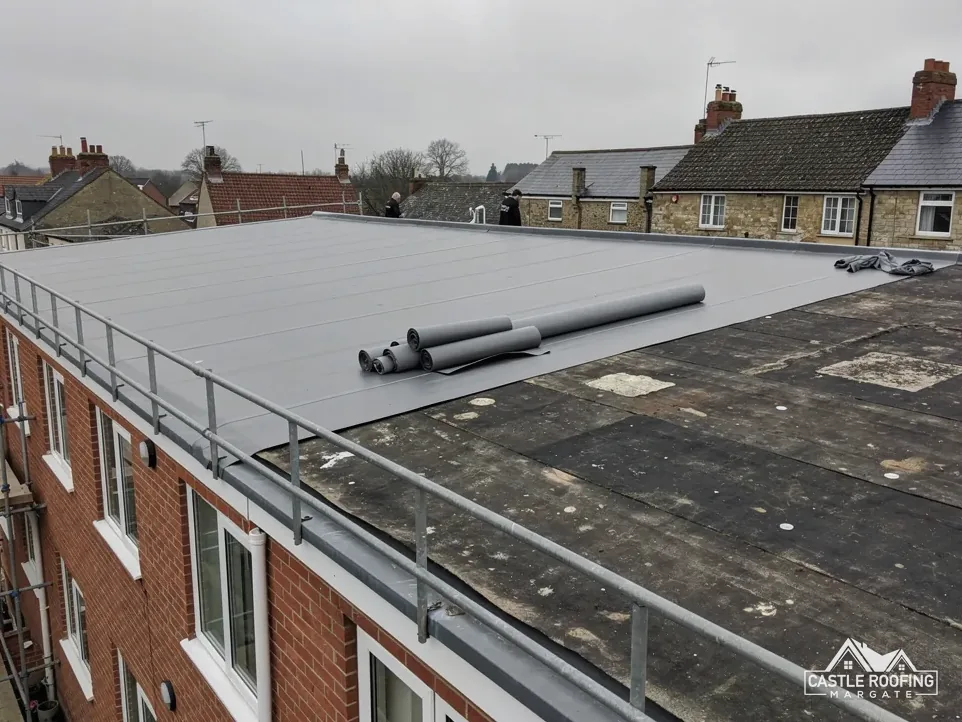
- Membrane and felt flat roofs
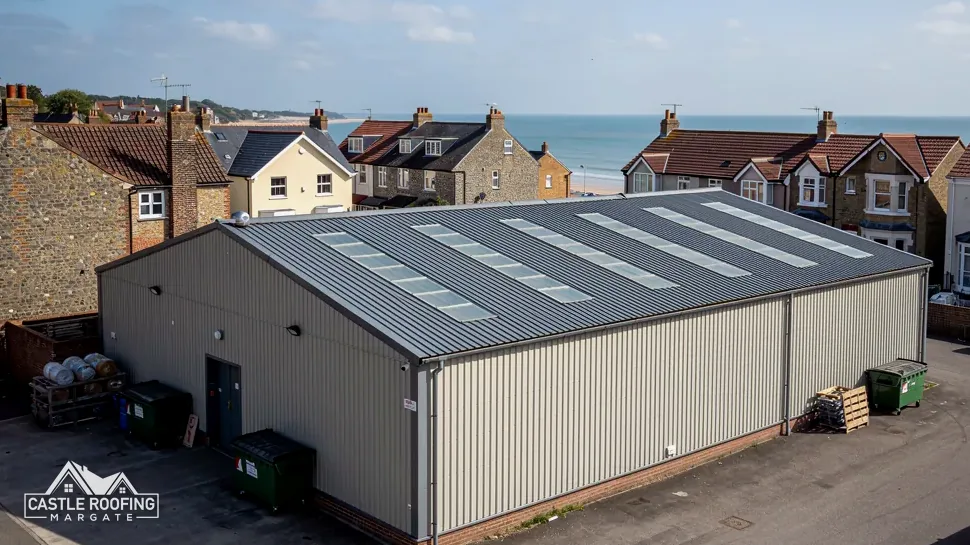
- Profiled metal sheets
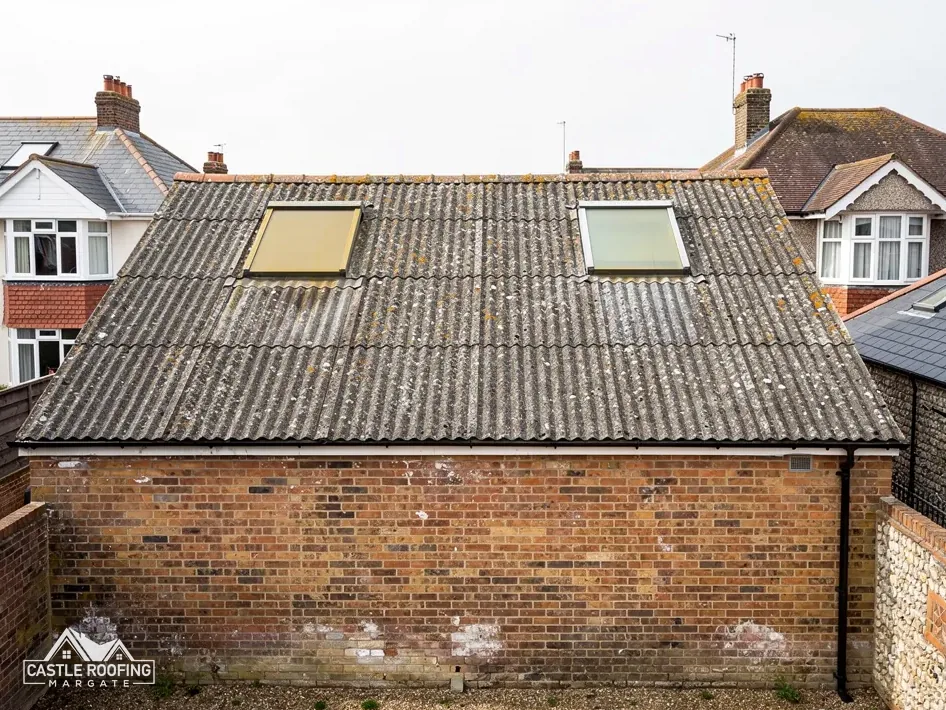
- Fibre cement sheets
- Rooflight panels
- Box and valley gutters
Leak tracing and roof repairs, part and full re-roofs, over-cladding of tired sheet roofs, new single ply and felt coverings, gutter lining, and planned maintenance visits for landlords, agents and business owners across Thanet.
Signs a commercial roof is starting to fail
Drips on the stock
Water landing on shelves or tills has usually travelled along a purlin or seam first.
Pools after rain
Standing water a day after a shower means the falls or the outlets have stopped working.
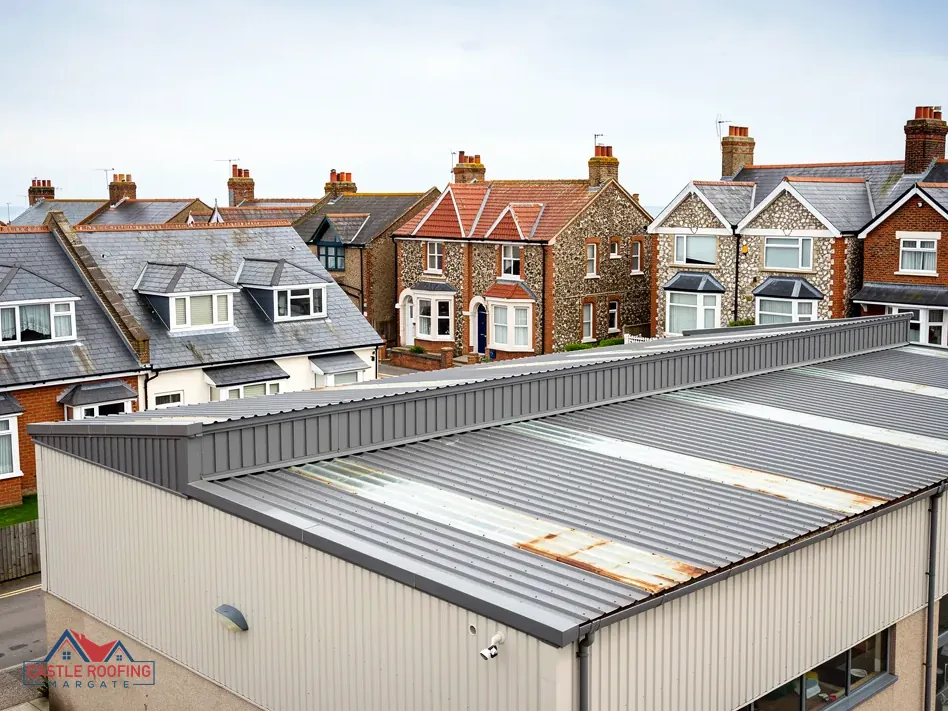
Rust at the laps
Orange edges where sheets overlap show the coating has lifted and the steel is going.
The commercial roof guide
How commercial roofs in Margate and Thanet are covered, drained, repaired and kept safe to work on
Six chapters for owners, landlords and managing agents, from the sheets and membranes overhead to the rules that apply on site. Tap a band to jump.

Chapter 01 of 06
Repairs on the sheets, membranes and slates of business premises
A commercial roof is any roof over a building used for business rather than as somebody's home: a shop with a flat above it, a seafront parade, an industrial unit, a warehouse, a surgery, a school block or a church hall. Around Margate and the rest of Thanet they come in three broad kinds. Flat roofs carry a waterproof membrane, one continuous skin laid over boards, in felt, GRP (glass-reinforced plastic, the resin and glass-fibre finish people call fibreglass) or EPDM (a synthetic rubber sheet). Commercial sheet roofs on units and warehouses are corrugated or trapezoidal panels of coated steel or fibre cement, bolted down to purlins, which are the horizontal steel or timber rails spanning between the frames. Older commercial buildings, halls and converted premises often have a pitched roof in slate or tile, built the same way as a house.
Shop roofs in Cliftonville show why the hidden details matter. In the Northdown Road conservation area, Thanet District Council's appraisal records slate and tile roofs that sit out of sight behind parapets. A parapet is the low wall carried up above the roof edge at the front of a building. Behind it runs a gutter nobody sees from the pavement, and when that gutter blocks or its lining splits, water can come through the shop ceiling with nothing at all to see from outside. Parapet gutters are also where litter, moss and pigeon droppings collect between visits.
Exposure counts as well. The Met Office climate station at Manston records a mean wind speed of 9.86 knots at 10 metres over 1991 to 2020, rising to 11.21 knots in January. Cupa, the slate maker, puts coastal sites, hillsides and tall buildings into a higher exposure grade. A wide sheet roof on a unit catches that wind along its eaves and ridge, so loose fixings, lifted laps and tired ridge flashings are the first things we check after a blow. Flashings are the strips of lead or folded metal dressed over the joint where a roof meets a wall, an upstand or a ridge, and they take the brunt of any wind that gets under an edge.
Tracing a leak on a large roof
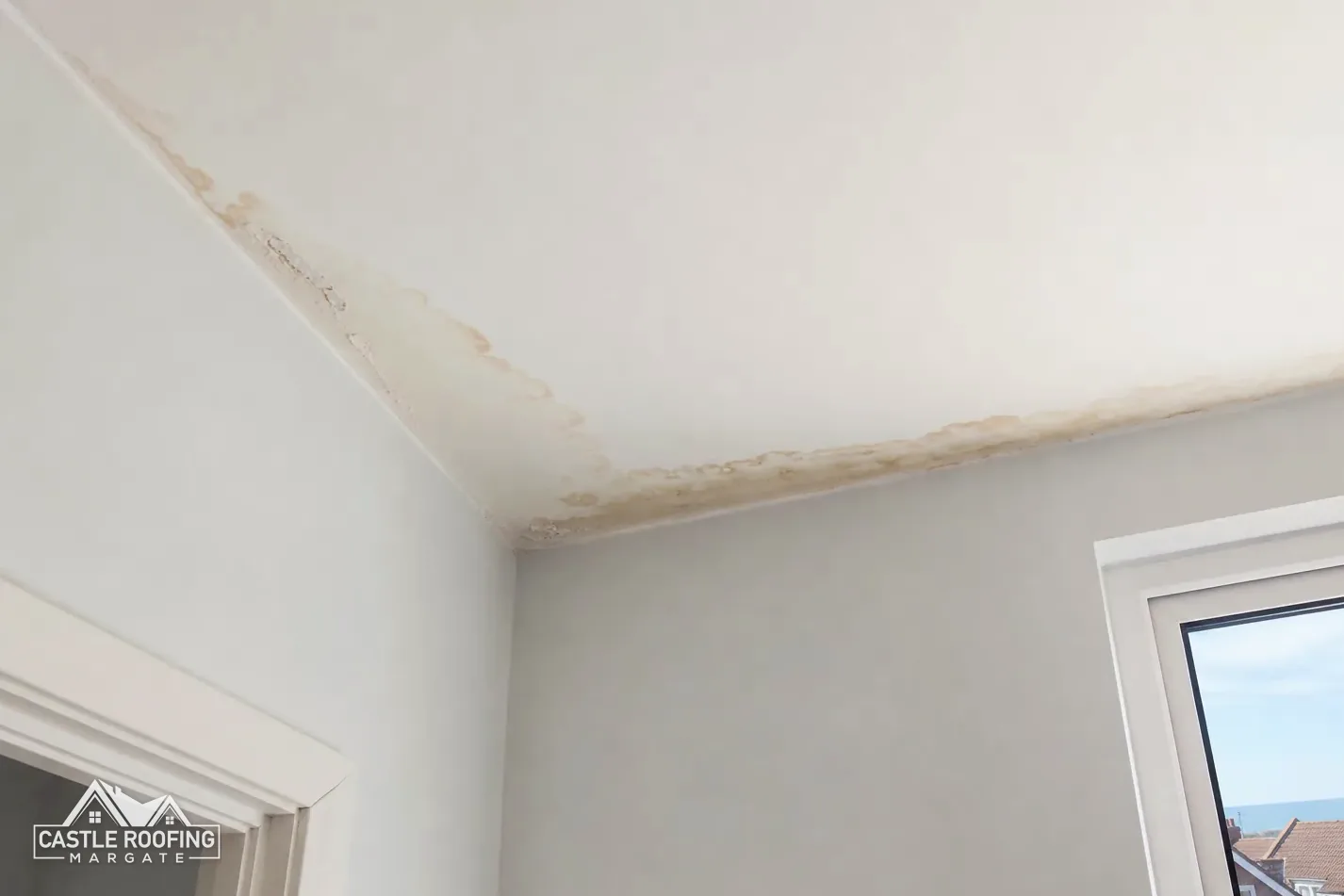
On a big roof, the drip inside is often a long way from the gap outside. Water runs along a purlin, the underside of a sheet or the top of a deck before it drops, so we work back from the wet patch to the laps between sheets, perished fixing washers, split rooflight panels, membrane seams, outlets and flashings. A controlled hose run along one lap at a time can confirm the entry point on a sheet roof, and a moisture meter does a similar job across a membrane. Once the source is found, the repair is matched to it. Our warehouse roof leaks guide follows that search step by step, and you see photos of each fault before any work is agreed.

Chapter 02 of 06
Falls, outlets and box gutters on a wide flat roof
- 1:80Minimum finished fall, general roof areas
- 1:40Design fall IKO works to
- 613 mmAverage yearly rain at Manston
Source: BS 6229:2025; IKO; Met Office, Manston 1991 to 2020
Membrane flat roofs are designed and laid to BS 6229:2025, the British Standard code of practice for flat roofs with continuously supported flexible waterproof coverings. It replaced BS 6229:2018, which BSI now lists as withdrawn, and it covers membranes only. A lead flat roof follows a different route: Approved Document C points to BS 6915 for lead sheet.
The fall is the slope built into a flat roof so rain runs to the outlets instead of sitting on top. The 2025 code keeps a minimum 1:80 finished fall for general roof areas and internal gutters, which means a drop of one unit for every 80 along. IKO, the membrane maker, says the roof should be designed for a fall of 1:40. Eaves gutters along a sheet roof need their own slope too, and Brett Martin's fitting guide gives 1mm for every 600mm of run.

The Met Office averages for Manston show why drainage matters so much on a commercial roof: about 613 mm of rain a year, and 110.05 days a year with 1 mm or more. On a Margate commercial unit or parade, hundreds of square metres of membrane may drain to a handful of outlets or a box gutter, which is a lined gutter built into the roof between two slopes or behind a parapet. Block one outlet with leaves, gull nesting litter or a lost ball and the water backs up. Overflow spouts through a parapet, sometimes called spitters, exist to show when that has happened; water pouring from one on a dry day is worth a call.
Ponding is standing water left on a flat roof after rain. It adds weight to the deck, holds dirt against the membrane and sits on every seam until it finds a weak one. That is why a maintenance visit clears outlets, leaf guards and gutters before it looks at anything else, and why a new roof is set out with its outlets at the low points.

Chapter 03 of 06
Single ply, felt, GRP and EPDM on commercial flat roofs
Single ply means a waterproof membrane laid as one layer rather than built up in several. On commercial flat roofs the common single ply materials are PVC and TPO (thermoplastic polyolefin), supplied in rolls and joined by welding the seams with hot air, and EPDM, a rubber sheet laid in wide pieces with bonded or taped seams. A single ply membrane can be fully bonded to the deck, held down with mechanical fixings or ballasted, and the choice turns on the deck, the height of the building and its exposure. PVC and TPO sheets usually come in light grey or white, which keeps a large roof cooler in summer.
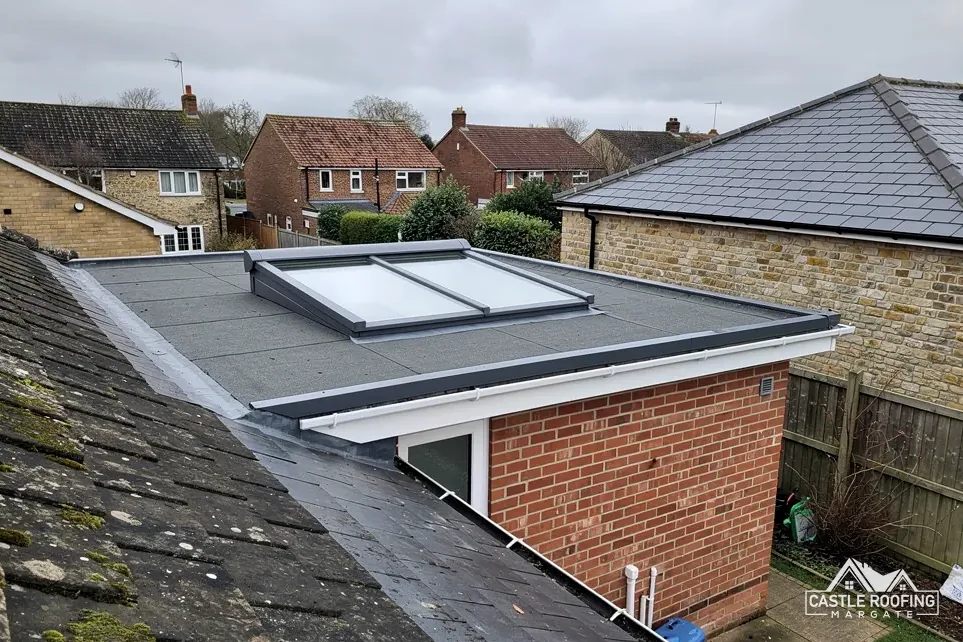
Felt is the older route. Torch-on felt is a bitumen sheet with a modified backing, laid in two or three layers and bonded with a gas torch. GRP is laid wet over boards as resin and glass-fibre matting, then sealed with a topcoat. Lifespans for all of these are typical ranges, never promises, and HomeBuilding and Less publish different figures, so the table gives both. HomeBuilding gives EPDM and GRP 25 to 30 years each, and torch-on felt 10 to 15 years. Less puts EPDM at 30 to 50 years, GRP at 25 to 40 years and felt at 10 to 20 years. Either way, a membrane that ponds, takes heavy foot traffic or sits under blocked outlets will reach the short end of its range sooner, and one that is inspected and kept clear has the better chance of the long end.
| Covering | HomeBuilding | Less |
|---|---|---|
| EPDM rubber | 25 to 30 years | 30 to 50 years |
| GRP fibreglass | 25 to 30 years | 25 to 40 years |
| Torch-on felt | 10 to 15 years | 10 to 20 years |
Source: HomeBuilding, Sep 2025; Less, Oct 2026
Matching the membrane to the building
A choice between them starts with what is already there and what the roof has to do. A flat roof carrying air-conditioning plant, extract fans or regular foot traffic for servicing needs walkways and a membrane that copes with it. A roof full of upstands, rooflights and pipe penetrations needs a material that can be detailed neatly round each one. Over an occupied shop or a building with timber decks, an open flame on the roof calls for a hot-works routine, and a cold-applied or hot-air welded single ply membrane avoids the torch altogether. Colour and surface count on a parade roof overlooked by flats above, where a pale or mineral finish reads better from the windows than bare black bitumen.
Where the deck below is sound, a new membrane can often go over the old one once the surface is prepared; where boards are wet or rotten, they come up first. A core cut through the old layers tells us which, and whether insulation under the membrane has taken on water. Upstands at walls and plant kerbs are raised where they sit too low, and new outlets are set at the low points before the first sheet goes down. Our single ply membrane roofing guide compares the options in more depth, and smaller flat roofs on homes, garages and extensions are covered on our flat roofing service.
Chapter 04 of 06
Cut edges, over-cladding and rooflight sheets on industrial units
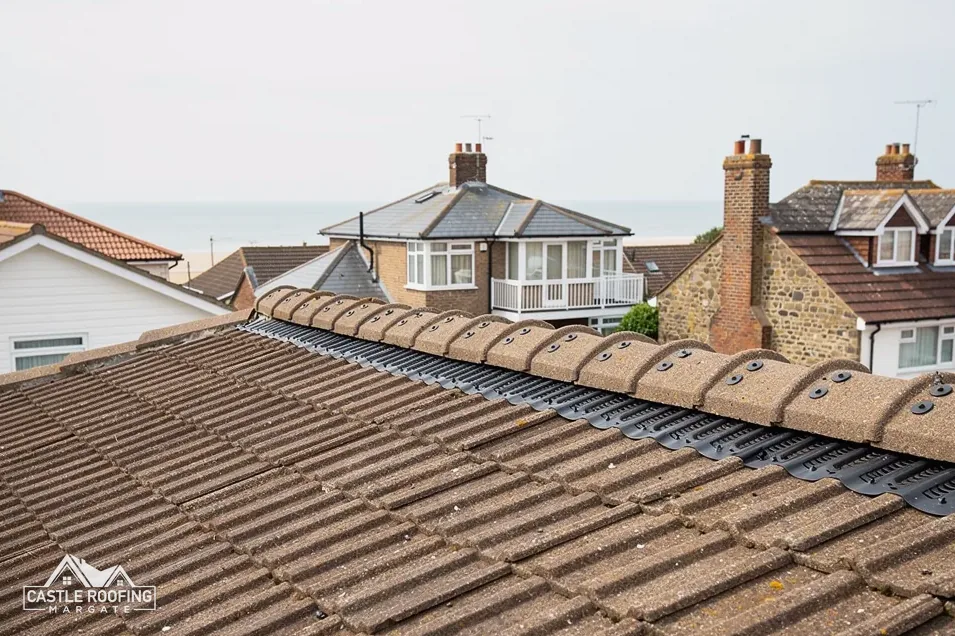
Profiled steel sheets are cut to length at the factory, and every cut leaves bare steel at the end of the sheet where the protective coating stops. Cut-edge corrosion is the rust that starts there, along the bottom edge at the eaves and at the end laps where one sheet overlaps the next. The coating peels back, the steel under it rusts, and the damage creeps up the sheet a little further each year. Edges on a seafront unit in Margate, open to salt-laden air, are worth a look at every maintenance visit. Caught early, the edge is cleaned back, primed and sealed with a coating system made for it. Once rust has eaten through the sheet, those sheets are replaced. Our guide to what cut-edge corrosion is shows the stages side by side.
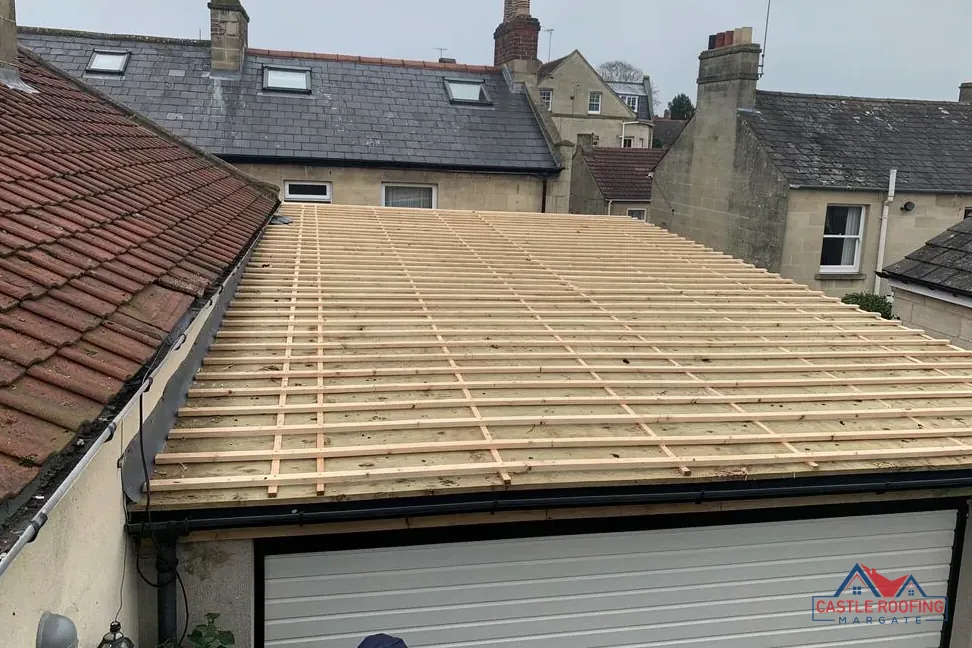
When a whole commercial sheet roof is tired but the frame is sound, over-cladding is often the better buy than stripping. New industrial roof cladding in profiled sheet is fixed over the old roof on spacer brackets bolted through to the purlins, with insulation in the void between. The old sheets stay where they are, so nothing is broken up, and the building can keep working underneath. Weight is the first question. Approved Document A says a significant change in roof loading is when the loading upon the roof is increased by more than 15%, so a structural engineer checks the frame before anything is ordered. A change in how the covering behaves in a fire matters too: the Planning Portal says approval is needed where the new covering's fire performance will be significantly different from the old. The council's planning team may need asking as well. Under section 55 of the Town and Country Planning Act 1990, works are not development if they leave a building's external appearance without material change, and a second skin of sheets may well change it. Insulation in the void also changes how warm the space below stays, which tenants in a cold workshop will feel in the first winter.
Rooflight sheets are the translucent panels in a sheet roof, made in GRP or polycarbonate to the same profile as the metal sheets around them. With age they yellow, craze and turn brittle, letting in less light and more water. We treat every rooflight as fragile until it has been covered or netted, and new panels are matched to the profile and lapped in with the sheets either side. Rooflights next to a valley or box gutter take water across their laps in every shower, so their seals are checked first. Valley and box gutters between bays can often be lined with a new membrane or formed liner instead of being cut out. On a unit anywhere in the Dover district, roof lights are on Dover District Council's own list of work needing building control approval, so we settle that with the council before ordering.
An over-clad, in order
Survey and sample
Old sheets, purlins and fixings are checked, and suspect fibre cement tested.
Check the extra load
An engineer confirms the frame carries new sheets, spacers and insulation.
Set edge protection
Guard rails or scaffold go up, and every rooflight is covered or netted.
Fix spacers to purlins
Brackets bolt through so new sheets sit clear of old.
Insulate and sheet
Insulation fills the void, then new sheets and rooflight panels are fixed.
Close every edge
New flashings seal ridge and verges, and gutters are lined or renewed.
Chapter 05 of 06
Fibre cement sheets, asbestos and what the HSE asks
Fibre cement sheets are the grey corrugated panels found on older commercial units, workshops, garages and farm buildings, and sheets of that kind could be made with asbestos in the cement. The HSE's advice is plain: if the building was built or refurbished before 2000, assume that there is asbestos in it. Before we cut, drill or lift anything on a sheet roof of that age, a sample is taken and tested, and the work is planned around the answer. Old sheets also turn brittle as their surface weathers and gathers moss, and a tired sheet can crack under a dropped tool, which is one more reason to plan the access before anyone climbs up.
The HSE places asbestos cement products such as roof sheeting and rainwater goods in the category of work that needs no licence, provided the material is carefully handled or removed without breaking up, and that includes sheets which are weathered but not otherwise substantially damaged. Where the sheets will be substantially damaged or broken up, the job moves into notifiable work, known as NNLW, which still needs no licence but brings notification and health records. HSE guidance says registers of work must be kept for 40 years.
Asbestos insulating board, known as AIB, is a different matter. The HSE lists it among the materials found in external soffits, the boards that close the underside of the eaves overhang. On older units and halls that board can look much like painted timber, so a sample settles what it is. Work on AIB is licensable unless the risk assessment shows it will be of short duration, and any part of a job that needs a licence goes to an asbestos contractor who holds one, before the roof work begins.
Every asbestos cement roof is treated as fragile. HSE guidance A14 states that AC roofs are always fragile, and the Work at Height Regulations 2005, regulation 6(3), require suitable and sufficient measures to prevent, so far as is reasonably practicable, any person falling a distance liable to cause personal injury. On a sheet roof that means staging, edge protection and nets, and nobody walking on the sheets themselves. Crawl boards and staging spread a person's weight onto the purlins, and any rooflights in the same roof are covered before anyone moves along it.
The waste is handled with the same care. HSE leaflet EM9 says double-wrap and label asbestos waste, and the sheets go into a lockable skip, never an open one. A roofer's load is trade waste, so it travels on a consignment note with an upper-tier registered waste carrier; the Kent County Council recycling centres take a householder's own small amounts only, and not at Sheerness. The new roof is then sheeted in profiled steel or asbestos-free fibre cement, with fresh rooflights. Our asbestos cement roof sheets guide sets the removal out in order, and asbestos garage roofs at home have their own garage roof service.
Myth
Any work on an asbestos cement roof needs a specialist asbestos licence.FactThe HSE puts careful removal of cement roof sheeting, kept whole, among work needing no licence; heavy breakage makes it notifiable.
Myth
Weathered cement sheets will take your weight along the bolt lines.FactHSE guidance A14 calls asbestos cement roofs always fragile, so work runs from staging and edge protection.
Myth
Old sheets can go straight into an open skip.FactAsbestos waste is double-wrapped, labelled and kept in a lockable skip, never an open one, per HSE leaflet EM9.
Source: HSE
Chapter 06 of 06
Keeping a business open while the roof is done
Scaffold, CDM and the plan for each day
Scaffold over the footway outside a Margate shop or parade needs a licence from Kent County Council under section 169 of the Highways Act 1980. Kent County Council expects the scaffold firm itself to apply, at least 5 working days before the licence begins. Kent charges £52 per week for 2026 to 2027, plus £78 for a site inspection if it decides one is needed. Its conditions keep a walk-around of at least 1.2 metres between scaffold and carriageway and white-painted standards to 2.5 metres, which is what lets your customers keep using the pavement.
CDM 2015, the construction safety regulations, hand a domestic client's duties to the contractor, and the HSE defines a domestic client as an individual having work done on their own home. A company, a landlord or a church committee ordering commercial roof work sits outside that, so ask early what CDM expects of you as the client. Where we are the only contractor, regulation 15(5) has us draw up a construction phase plan. Before work starts we agree which rooms or bays sit under the roof each day, how exits, deliveries and fire routes stay clear, and where the public walk, and you are told each evening what happens next. Birds nesting on a flat roof or behind a parapet are protected too: it is an offence under the Wildlife and Countryside Act 1981 to intentionally damage a nest in use or being built, and bat roosts in older halls are fully protected by law. Our guide to roof work while the business stays open covers phasing in more detail.
What sets the cost and the quote
Commercial rates per square metre are priced after a survey. The figure moves with the roof's area and height, the access and scaffold it needs, the covering chosen, any changes to the falls, asbestos handling and the state of the deck or purlins once the old covering is open. You get one written total once we have surveyed the roof, and it is worth checking that any quote you hold states VAT and includes the scaffold. VAT is charged at the standard rate of 20%. GOV.UK says the domestic reverse charge applies to supplies for businesses registered for VAT in the UK and reported within the Construction Industry Scheme, so ask your accountant whether it touches your job; our page on VAT on commercial roofing explains the basics.
Building control may need to hear about a commercial re-roof. Thanet District Council runs its own building control team on 01843 577522, and Canterbury and Swale use STG Building Control on 01634 331133. In Dover District the council's approval list takes in a new covering on a flat or pitched roof even where it matches the old one, so a job there starts with that conversation. If a terraced shop shares a party wall with next door, party wall questions go to a party wall surveyor, not to building control.
Show us your commercial roof in Margate
WhatsApp a few pictures of the commercial roof, or ask us round, and tell us the trading hours we need to work around.
Our guarantee
10-Year workmanship guarantee. In writing
- We look at the roof before we price it
- One written price, one total
- We tell you before any extra work
Find us on Google (opens Google Maps in a new tab) What the guarantee covers
Commercial roofing questions from Margate and Thanet businesses
Can an old commercial roof be over-clad rather than stripped?
It often can, provided the frame will carry the extra load and the old sheets are sound enough to stay in place. Over-cladding avoids breaking up old fibre cement, which keeps the asbestos side simpler, and the building can usually stay in use beneath it. A structural check comes first, and building control and the planning team may need to be asked if the weight, fire performance or appearance changes.
How long does a commercial flat roof membrane last?
Published lifespans are guides to plan with, never promises. On HomeBuilding's figures EPDM and GRP each run 25 to 30 years and torch-on felt 10 to 15; Less gives 30 to 50 for EPDM, 25 to 40 for GRP and 10 to 20 for felt. On any building, ponding, foot traffic round plant and blocked outlets shorten that life, so drainage deserves as much care as the covering itself.
Can roof work go ahead while the shop or unit stays open?
Usually, yes, with some planning. We agree which rooms or bays sit under the work each day, keep exits and deliveries clear, and put up edge protection and covered walkways where the public pass. Noisy or dusty stages can be timed around your quieter hours. Where a leak sits over stock, tills or a kitchen, we make that area watertight first and then work outwards from it.
What is cut-edge corrosion, and can it be treated?
It is rust that begins where a coated steel sheet was cut to length, typically along the eaves and at end laps where one sheet overlaps another. The coating lifts and the bare steel beneath rusts back from the edge. Treated early, the edge is cleaned, primed and sealed with a coating made for the purpose; where the rust has gone right through, those particular sheets are replaced.
Do you offer planned roof maintenance for landlords and agents?
Yes. A planned visit to a commercial roof clears gutters and outlets, checks membrane seams, sheet laps, fixings, rooflights and flashings, and records what it finds with photos and a short note, so repairs can be budgeted before they become leaks. How often depends on the roof, nearby trees and the birds that use it, and we agree the interval after a first survey. Condition surveys on their own sit under our roof inspections service.
How do I tell whether a commercial roof needs replacing or just repairing?
Look at the pattern of faults. One split seam, a loose sheet or a cracked rooflight panel is a repair. Leaks in several bays, a membrane blistered or brittle across the whole area, cut edges rusted through along a full run of eaves, or a deck that gives underfoot all point towards re-roofing or over-cladding. You see photos of each fault, so the decision stays with you.
Can you replace asbestos cement sheets on a warehouse or farm building?
Yes, where the sheets can come off whole. Removal of asbestos cement sheeting without breaking it up sits in the HSE's non-licensed category, so we sample first, lift each sheet intact, double-wrap the waste and take it away under a consignment note. Asbestos insulating board, which the HSE says turns up in some soffits, is licensable unless the job is short, and that part goes to a firm holding an asbestos licence.
What does a commercial roof survey cost, and what moves the price of the work?
MyJobQuote puts the average roof survey at around £300 (Oct 2026) and the typical asbestos survey at £325 (Sep 2026), both typical UK figures. Which? sets its own scale toward the top for South East homes, Kent among them, and HomeBuilding reports higher labour rates in that region. Work on a commercial roof depends on its area, height, access, scaffold, covering, any asbestos and the condition of the deck, so each figure is set for that building.
Read more
Guides for commercial roof owners and agents in Margate
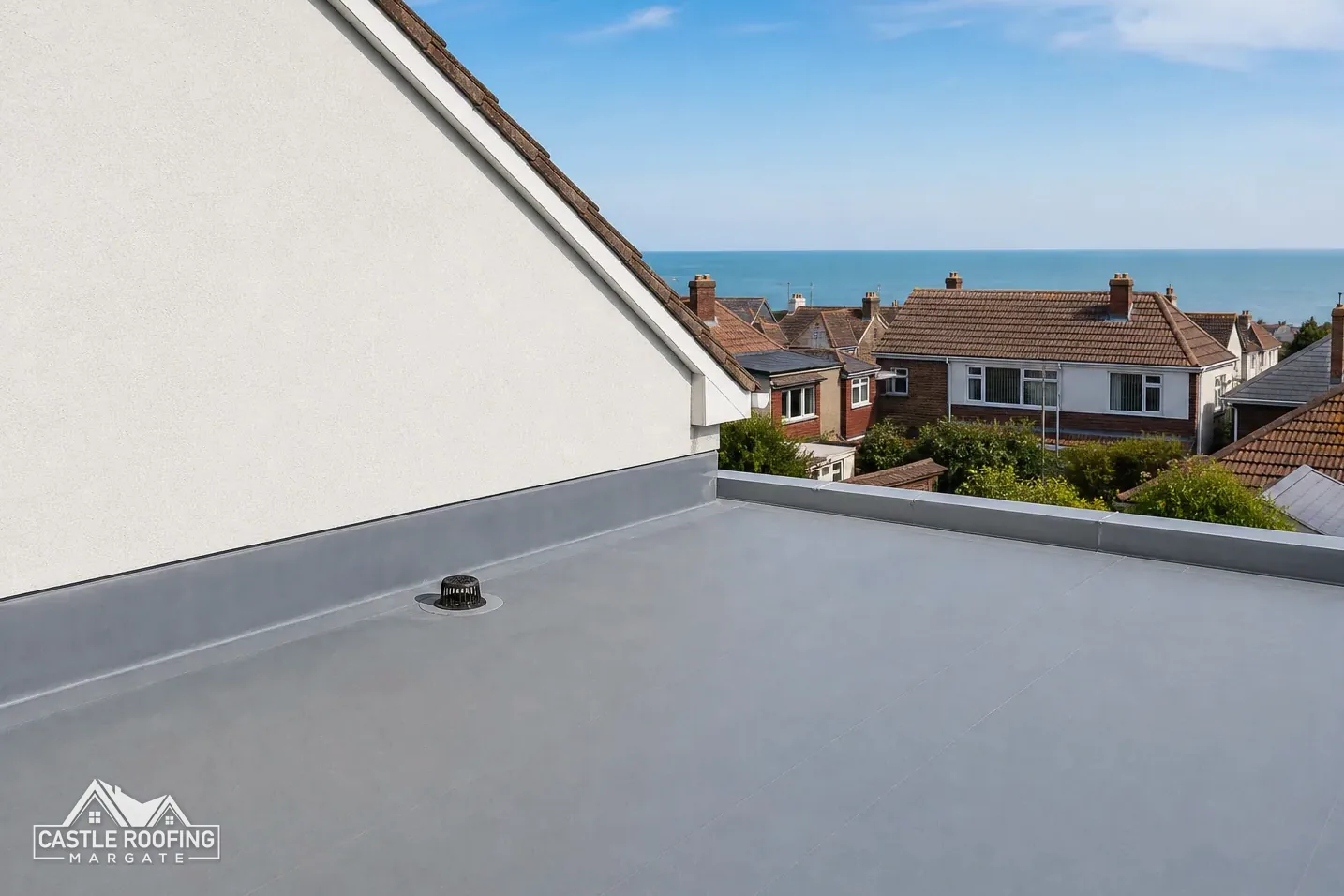 Guide · 9 min readSingle-ply membrane roofs for commercial buildingsHow single-ply membrane roofs are built on commercial flat roofs in Thanet and East Kent: PVC, TPO and EPDM, the falls the…
 Guide · 9 min readAsbestos cement roof sheets on commercial buildingsHow to tell whether a commercial roof is sheeted in asbestos cement, what the HSE says about taking the sheets off, why…
 Guide · 9 min readFragile roofs: why they are dangerous and how work is done safelyWhy some commercial roofs will not carry a person, which surfaces fall into that group, what the law asks of those who…
- GuideCDM regulations and commercial roof work
- GuideReplacing profiled roof sheets on an industrial unit
- GuideRoof repairs over shops and the flats above them
- GuideWhat a commercial roof survey covers
- GuideCommercial roof coatings: when they help and when they do not
- GuideFinding and fixing leaks on a warehouse roof
- BlogKey considerations for commercial roof installation and repair
- BlogMaintenance tips for getting the longest life from a commercial roof
- BlogCut-edge corrosion on industrial roofs: repair or over-clad?
- AnswerHow does VAT work on commercial roofing?
- AnswerIs PVC or TPO the better single-ply membrane?
- AnswerHow do I make a storm claim for a commercial roof?
- AnswerCan asbestos cement sheets on an industrial roof be over-clad?
- AnswerCan a leaking industrial gutter be lined instead of replaced?
- AnswerHow are rooflights on an industrial roof replaced safely?
- AnswerCan roof work be done while my business stays open?
- AnswerHow often should a commercial roof be inspected?
- AnswerWho approves roof repairs on a church hall?
- AnswerWhat edge protection does commercial roof work need?
- AnswerCan damaged cladding on a commercial building be repaired?
- AnswerWhat decides the cost of a commercial roof?
- AnswerDoes changing a roof covering affect fire performance?
- AnswerIs EPDM suitable for a commercial flat roof?
- AnswerDo I need an asbestos survey before roof work on an older building?
- AnswerWhat roof repairs should a commercial landlord plan for?
- AnswerWhat is cut-edge corrosion on roof sheets?
- AnswerWhat should I do about an emergency leak in a commercial roof?
- AnswerWhat is involved in replacing roof sheets on a farm building?
- AnswerCan a commercial roof be bird-proofed?
Services that sit alongside commercial work
- Flat roofingFlat roofs on Margate and Thanet extensions, dormers, bays, garages and shop units, repaired or re-covered in GRP, EPDM rubber, torch-on felt or single-ply…
- Roof inspectionsA roofer's inspection of your slopes, loft, chimney and gutters in Margate and across Thanet, with photos of what we find and a plain…
- Garage & asbestos roofsNew roofs for garages across Margate and Thanet, from one felted lock-up behind a terrace to a whole row of corrugated cement sheets on…
- Guttering, soffits & fasciasGutter repairs and clearing, plus removal and new installation of fascias, soffits, bargeboards and downpipes, done by roofers who check the felt and rafter…
Ask about a commercial roof in Margate
Give us the address and the type of commercial roof, and say whether tenants or staff need warning before we arrive.