
Lead Roofing and Leadwork in Margate
Lead flashings, valleys, soakers, lead roofs over bays and lead flat roofs repaired, renewed or replaced across Margate and Thanet, with the lead code for each detail agreed first.
Where the lead goes
Lead roofing and leadwork we repair and renew
- Chimney aprons and back gutters
- Valleys between two slopes
- Soakers at side walls
- Bay and porch roofs
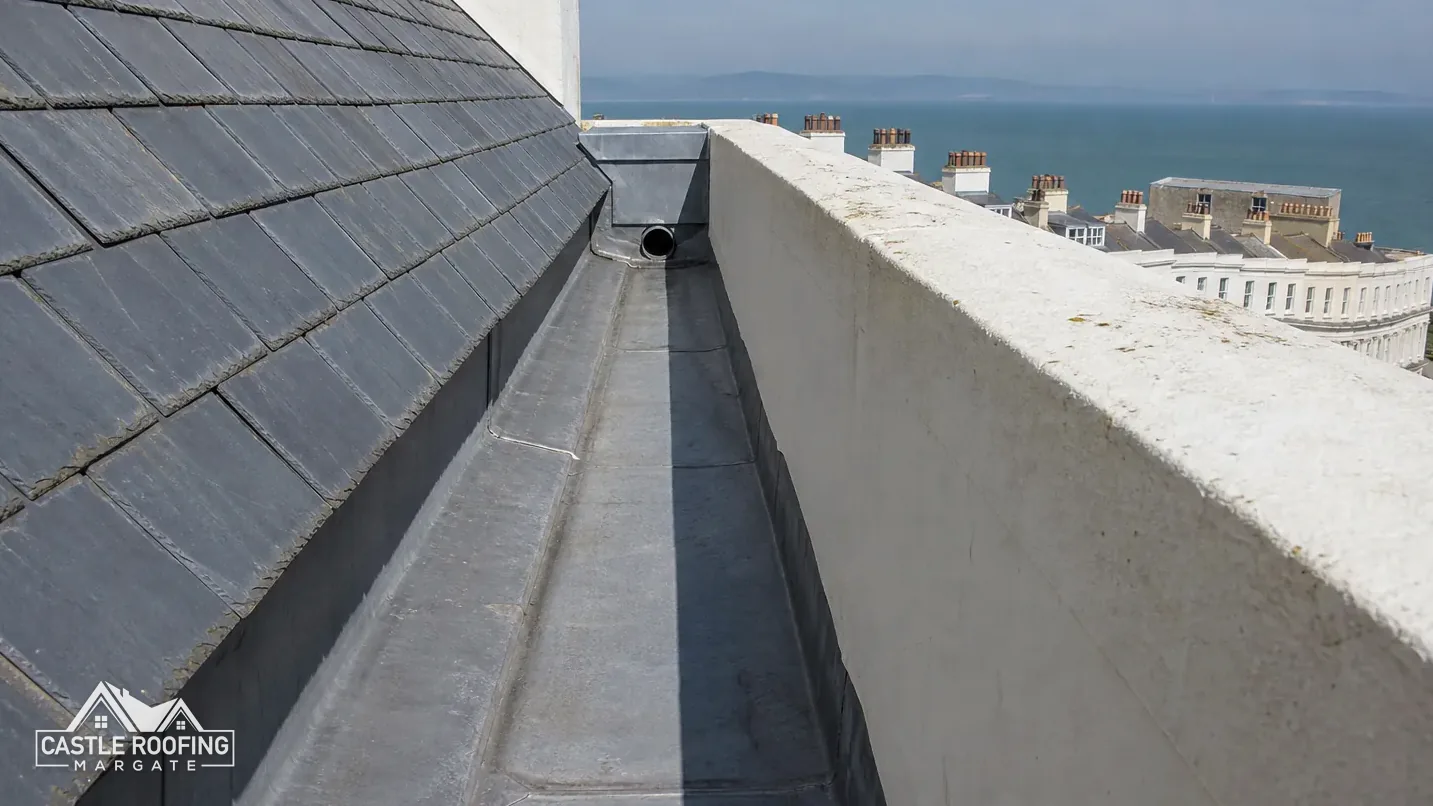
- Parapet and box gutters
From one slipped soaker to a whole lead bay roof, we cut, dress and fix new lead or mend the old, on houses, flats over shops, holiday lets and commercial buildings across Thanet.


Signs the leadwork or lead roof has failed
Damp by the stack
A stain on the chimney breast after rain often starts at a lifted apron or back gutter.
A wet valley line
A brown line across the ceiling under a valley points to a cracked sheet or a choked channel.
Lead on the move
Flashings pulling out of the brick joint, or sheets creeping downhill, have lost their wedges or clips.
The lead roof guide
How lead keeps the joints of a Margate roof dry, and what to do once it stops
Six chapters on flashings, valleys, bays and lead flat roofs, the codes behind them and the rules for listed homes. Start with the detail that is letting water in.
Chapter 01 of 06
Where we fit lead on a Margate house
Lead is a soft, heavy metal that comes on the roll as flat sheet, and a roofer can cut it, fold it and beat it into shape right where it is needed. That makes it the material of the awkward places on a house. Wherever a slope runs into a wall, wraps round a chimney or meets another slope, there is a joint that tiles and slates cannot close on their own, and lead is dressed over it to throw the water clear. A lead roof can also be the whole covering of a small space, such as the top of a bay window or a porch canopy, where the sheet has to follow corners and curves that no tile could manage.
On a typical period house the leadwork comes in a handful of parts, each with its own job:
- a flashing, the general name for any strip of lead dressed over a joint so rain runs past it;
- an apron, one piece laid across the front of a chimney or along the top of a lean-to;
- soakers, small folded pieces slid under each course of tiles where a slope meets a side wall;
- a back gutter, the little lead channel behind a chimney that turns water round the stack;
- a valley, the lined channel where two slopes meet and their rain runs together.
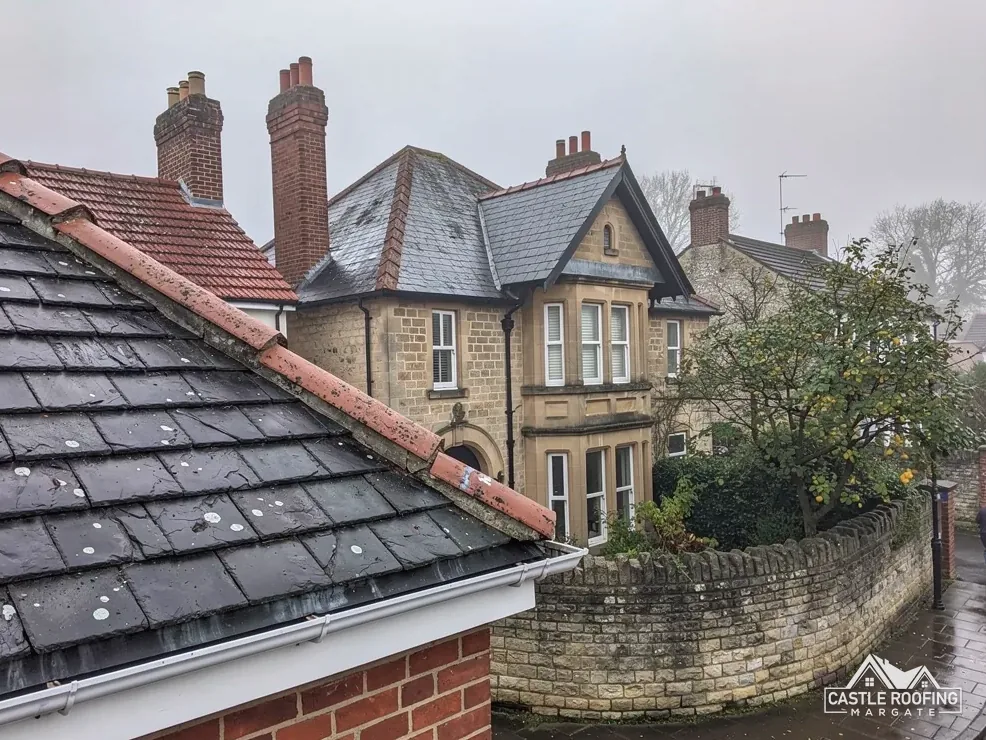
Two of Thanet District Council's own appraisals hint at where this work sits on local roofs. Its study of the Cliftonville Clifftop conservation area says "Tall chimney stacks survive in many locations", and every one of those stacks meets its roof through an apron, side flashings and a back gutter. The same council's Northdown Road appraisal notes how often the roofs there hide behind parapets. That parapet, a stub of brick wall rising above the eaves line, can have a lead-lined gutter tucked behind it, which can fail for years without anyone on the pavement seeing a thing. The first sign is often a damp patch high on a bedroom wall, well away from where the water actually got in.
The weather here is hard on any free edge of lead. The Met Office's long-term averages for its Manston station, 1991 to 2020, give a mean wind speed of 9.86 knots across the year, rising to 11.21 knots in January, with about 613 mm of rain a year. Lead holds itself down partly by weight and partly by its fixings: wedges driven into the mortar joint and clips along its edges. Once a wedge works loose or the pointing over it falls out, wind gets under the edge, lifts it a little in every gust, and rain blows in behind. So on every visit we look at the lead itself and at what holds it. Where the brickwork of the stack is crumbling or the flaunching on top has cracked, our chimney repairs page covers that side of the job, and the lead is renewed once the masonry is sound.
Chapter 02 of 06
Lead codes, thickness and weight on the Royston table
- Code 3Recommended for soakers only
- 1.80 mmThickness of a Code 4 sheet
- 30.05 kg/m²Weight of Code 6 per square metre
Source: Royston Lead cast lead brochure
Roofing lead is bought by code, and the code number stands for a thickness. Royston Lead's cast lead brochure gives the range in a single table. Code 3 is 1.32 mm thick and weighs 14.97 kg/m². Code 4 is 1.80 mm at 20.41 kg/m², Code 5 is 2.24 mm at 25.40 kg/m², and Code 6 is 2.65 mm at 30.05 kg/m². Codes 7 and 8 run on to 3.15 mm and 3.55 mm. Every roll carries a colour stripe, green for Code 3, blue for Code 4, red for Code 5 and black for Code 6, so a roofer can see what has been delivered before a single piece is cut.
The brochure makes one pairing plain: it recommends Code 3 for lead soakers only. For every other detail, from an apron to a box valley, the right code is written into the specification for that roof, and we name the code we plan to use on the quote before any lead is ordered. Ask about it if a price for leadwork says nothing about thickness, because two prices for the same chimney can hide two quite different sheets. Our guide to what code of lead a flashing needs walks through how that choice is made.
Thickness also means weight. At 30.05 kg/m², Code 6 weighs about twice what Code 3 does per square metre, so the choice of code is a structural question as well as a weathering one, and a lead roof on a bay or a porch is a real load on the timbers under it. Under the Planning Portal's guidance, a new covering material that adds 15 per cent or more to the weight of the roof covering needs building regulations approval, so swapping a felt bay roof for lead is checked at the survey, not on the day. A heavy sheet laid on a weak deck can sag and hold water, which is the opposite of what it was put there to do.

Chapter 03 of 06
Valleys, soakers and side walls where water gathers
A valley is the internal angle where two roof slopes meet, and every drop that lands on both slopes ends up running down it. A lead valley is a channel of lead sheet laid on boards in that angle, with the tiles or slates on each side cut to line and finished just short of the centre so water has a clear path to the gutter. On an older Margate house you find valleys where a back addition joins the main roof, between the twin roofs of a double-fronted villa, and where a dormer meets the slope it sits in.
Valleys rarely fail in only one way. The lead can crack where a length was laid too long to move freely with the seasons. Cut tiles along the edges can slip down into the channel and dam it. Leaves and moss can pile up at the foot, and the mortar some roofers bed the cut tiles on can break away and wash into the gutter. In each case water spills sideways under the tiles, and inside it shows as damp on the valley boards in the loft or a stain along the ceiling. Because the water can travel along a rafter before it drips, the stain is not always directly under the fault, which is why we trace it from the roof side as well as from the loft. Our page on a leaking lead valley sets out how to tell which fault you have.
Myth
Mastic along the top edge will hold a lifted flashing for good.FactMastic only glues the edge for a while. A flashing stays put once tucked into the joint, wedged and pointed.
Myth
A lead valley only leaks once the sheet itself has split.FactSlipped cut tiles, a broken mortar bed or leaves at the foot can push water under the tiles beside sound lead.
Myth
The thickest lead on the roll suits every detail.FactRoyston Lead points Code 3 at soakers alone; each other detail takes the code in its specification.
Source: Royston Lead cast lead brochure
Where a slope runs alongside a wall rather than another slope, the joint is closed in two layers. Soakers are slid under each course of tiles and turned up the wall, and a stepped flashing is cut to follow the brick courses and dressed down over them. The top edge of each step is tucked into a mortar joint, held with a lead wedge and pointed in. You find this detail on a terrace where the party wall rises above the roof, on the cheeks of dormers and wherever a lean-to roof leans against the house. Some abutments were finished with a mortar fillet instead, a wedge of sand and cement trowelled into the corner, and once a fillet parts from the wall water runs straight down behind it.
Repairing a valley or relaying it
A single crack in otherwise sound lead can sometimes be repaired by welding in a new piece, and cut tiles that have slipped can be refixed. Where the boards under the valley have softened, the lead has thinned in several places or earlier patches have failed, relaying the whole valley in new lead, set out in shorter lengths with proper laps, is the better use of the scaffold. We tell you which of those your valley needs after we have seen it from above, and you see the photos we took.

Chapter 04 of 06
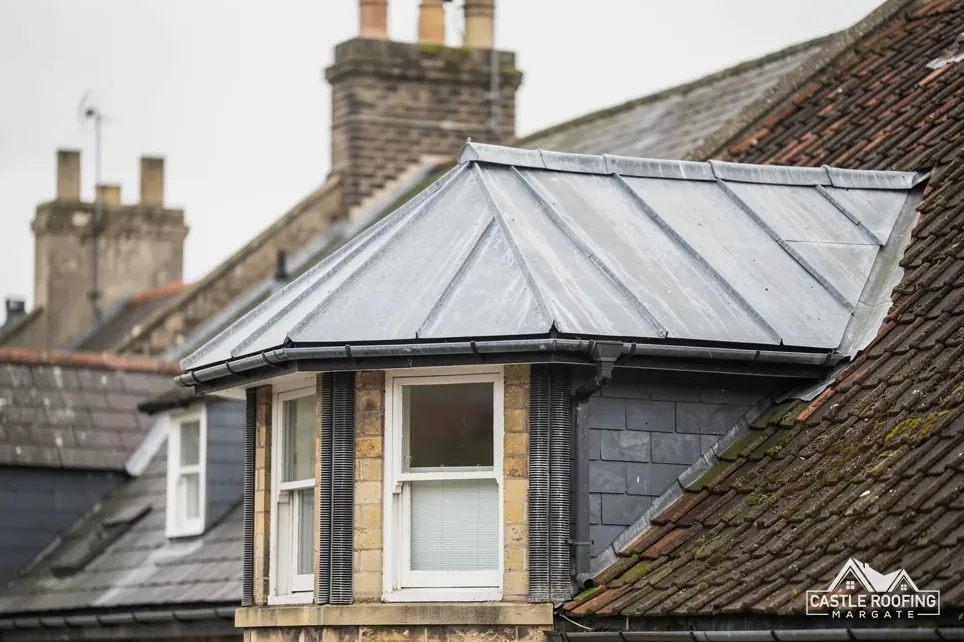
Bay, porch, dormer and flat roofs dressed in lead
A bay window that pushes out from the front wall of a Margate house carries its own small roof, and lead suits it well because the sheet can be worked round the angles of the bay and down over the curve at its edge. Porch canopies, the flat tops of dormers and their cheeks, the triangular side walls of the dormer, are dressed in lead for the same reason. Royston Lead's brochure lists dormer roofs and cheeks, flat roofing and parapet walls among the places its sheet is used.
A lead roof of this kind is not one big sheet. It is laid on boards in a set of smaller sheets, joined so that each can expand in summer and shrink back in winter without tearing. Joints running down the fall are formed over wood rolls, rounded timber battens the lead is dressed over, and joints across the fall are made as drips, small steps in the deck where the upper sheet laps over the lower. Approved Document C points lead sheet roofs to BS 6915, and that standard together with the specification sets the sheet sizes and how far apart the joints go. BS 6229:2025, the flat roof code, deals with membranes and not with lead.
HomeBuilding gives a lead flat roof a typical life of 60 to 100 years, while MyJobQuote puts lead flashing at over 80 years. Read the first as a typical range and the second as a floor, never as promises. When a lead roof gives up well short of that, there is normally a reason worth finding: a sheet laid bigger than its fixings allow, a drip set too shallow, people standing on the roof to clean windows, or a rotten board underneath that let the lead sink and hold a puddle.
Not every bay or porch in Thanet is lead. Some have been re-covered over the years in felt or a membrane such as EPDM, a synthetic rubber sheet, or GRP, glass-reinforced plastic laid as a liquid over matting. Where a membrane is already there and sound, it can stay. Where it has failed, we look at whether lead or a new membrane suits that roof, its weight limit and the look of the street, and our flat roofing page covers the membrane side of the choice.
Leaks around a bay often come from the wall above rather than the roof itself, and a bay roof can look perfect from the garden while water runs in behind it. The cover flashing along the top, where the lead meets the brickwork or the render over the window, is the joint that takes the most water. Our page on the lead roof on a bay window shows the details that matter when one starts to drip into the front room.
Re-covering a lead bay roof, in order
Strip and inspect
Old lead comes off; boards and joists are checked for rot and sag.
Renew the deck
Soft boards are replaced so the sheet lies flat and dry.
Set out rolls and drips
Rolls and drips are fixed to the sheet sizes in the specification.
Dress the new sheets
Each sheet is cut, bossed round the bay corners and clipped.
Close the top joint
A cover flashing goes into the wall above, wedged and pointed.

Chapter 05 of 06
Stolen lead, the insurer and what goes back on
Lead has a scrap value, and that makes roof lead a target for theft. A stolen flashing or valley, or a lead roof stripped from a bay, leaves a joint wide open, often found only when water comes through a ceiling after the next downpour. The first steps are the same as for any sudden damage. Tell your insurer first, have the roof made safe with a temporary cover over the open joint, and keep photos and receipts for everything. The Institution of Structural Engineers puts it simply: "Photographs are vital for your insurance claim, as they provide visual evidence of the damage." Whether a policy pays for stolen roof lead depends on its own wording, and no roofer can tell you a claim will succeed. Our guide to a lead theft insurance claim covers what to gather.
Then comes the choice of what to put back. New lead is the like-for-like answer, and for a listed building, or a house inside a conservation area, it may be the only one the council will accept. Where theft is likely to happen again, or the detail is a simple valley or flashing on a later building, a lead alternative or a GRP valley may suit better. Alternatives look similar from the ground but have no scrap value. The decision turns on how the roof is seen from the street, the consent the building needs, the shape of the detail and the risk of a second theft.
Published lifespans help with that weighing, as long as they are read as typical ranges. HomeBuilding's range for a lead flat roof is 60 to 100 years, and lead flashing gets over 80 years from MyJobQuote. For zinc, VMZinc, which makes it, says "The BRE Environmental Product Declaration states 100 years." GRP, often used to rebuild a stolen valley, is given 25 to 30 years by HomeBuilding and 25 to 40 years by Less. The two GRP figures disagree, so both are shown, and none of the four is a promise.
A theft can also reveal older trouble. With the lead gone, the boards, the brick joints and the tiles at the edge are open to view, and that is the moment to put right anything that was failing anyway. We set the findings out with photos, say what the theft caused and what was already there, and you decide how far the work goes. Timing has a legal side too. A contract signed at your home after a survey normally carries a 14-day right to cancel, but that right does not cover a visit you specifically requested so that urgent repairs could be done, under regulation 28(1)(e) of the Consumer Contracts Regulations 2013. So the make-safe over an open joint can go ahead at once, while the larger job of putting new lead or an alternative back can be agreed separately, in writing, once you have heard from the insurer.
| Material | Typical life | Published by |
|---|---|---|
| Lead flat roof | 60 to 100 years | HomeBuilding |
| Lead flashing | Over 80 years | MyJobQuote |
| Zinc | 100 years | VMZinc citing BRE |
| GRP | 25 to 30 years | HomeBuilding |
| GRP | 25 to 40 years | Less |
Source: HomeBuilding, Sep 2025; MyJobQuote; VMZinc; Less, Oct 2026
Chapter 06 of 06
Listed homes, Kent scaffold licences and the price of lead
A lead roof or leadwork on a listed Margate house brings its own rules. Listing does not take away a house's permitted development rights, yet section 7 of the Listed Buildings Act 1990 still asks for listed building consent wherever the work would alter the building's character. Renewing lead in the same form is a different matter from replacing it with a substitute, so talk to the council before a listed roof loses its lead for anything else. Thanet has 27 conservation areas, two of them being Margate itself and Margate Seafront, and Thanet District Council advises that replacing like with like makes planning permission less likely to be needed. Thanet District Council also has Article 4 directions in three conservation areas (Ramsgate, the Ramsgate Marina extension and Pegwell); an owner in any of them should ask the council which rights are withdrawn. A flat has no permitted development rights of its own. Lead on a church follows its own route: a Church of England church in use goes through the faculty system, Roman Catholic, Methodist, URC and Baptist churches use their own systems; Unitarian and Quaker meeting places, and redundant churches in Churches Conservation Trust hands, go the listed building consent way; and works to a scheduled monument call for scheduled monument consent. Our page on leadwork on listed buildings goes further.
Building control and scaffold in Kent
Under the Planning Portal's test, re-covering needs no building control application where less than 25 per cent of the building envelope and less than 50 per cent of the roof is affected. Thanet Building Control is on 01843 577522, or you can appoint a registered building control approver instead. Dover District Council goes further for homes in its district: its building control page lists re-covering a pitched or flat roof as work needing approval even where the new covering matches the old. Scaffold standing on a Kent pavement needs a licence from Kent County Council under section 169 of the Highways Act 1980, and the scaffolding company applies to Kent County Council 5 working days ahead. The fee is £52 per week for 2026 to 2027, and Kent County Council also issues skip permits, at £45 per week for 2026 to 2027.
What moves the cost of leadwork
For a sense of scale, MyJobQuote puts chimney leadwork at between £350 and £920 and a roof valley replacement at around £540 (Sep 2026). Those are typical UK ranges for the country as a whole, not prices for Kent. The real figure turns on the lead code and how much of it goes on, the height of the roof and the scaffold it needs, the state of the boards and brickwork underneath, and any consent a listed building calls for. A small lead roof repair at the eaves can be done from a tower, while a parapet gutter three storeys up needs scaffold on the street. Make sure a leadwork quote states whether VAT and the scaffold are inside the total.
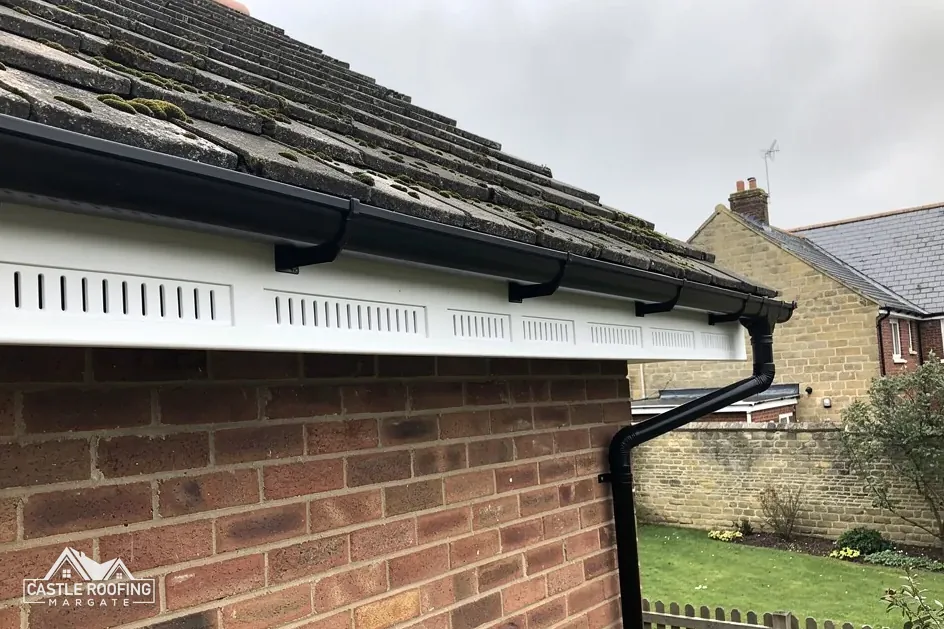
Show us where the lead has failed
WhatsApp a picture of the failing flashing, valley or bay roof, and we can come and see it before giving one written price.
Our guarantee
10-Year workmanship guarantee. In writing
- We look at the roof before we price it
- One written price, one total
- We tell you before any extra work
Find us on Google (opens Google Maps in a new tab) What the guarantee covers
Lead roofing questions from Margate and Thanet homes
How long does lead flashing last on a house near the sea?
MyJobQuote's guide to chimney leadwork gives lead flashing more than 80 years, and HomeBuilding gives a whole lead flat roof 60 to 100 years. Treat both as typical figures, not promises. On an exposed Thanet roof the lead itself can outlive its fixings, so a flashing that has lifted may only need re-wedging and repointing rather than new lead. We check the sheet and the joint before suggesting either.
Why does water come through the ceiling under my lead valley?
There are several possible causes, and the lead is only one of them. A crack in the sheet, cut tiles slipping into the channel, a mortar bed breaking up along the edge or leaves blocking the foot can each send water under the tiles to either side. A look from above, and from the loft at the valley boards, shows which one it is before anything is relaid.
Which code of lead goes on a chimney flashing?
Royston Lead's cast lead brochure recommends Code 3 for soakers only. For a chimney apron, side flashings or back gutter, the code comes from that roof's own specification, taking in the size of the piece and how exposed it is. Whatever we use, the code is named in the quote, and the colour stripe on the roll lets you check it when it arrives.
Can a split lead flashing be repaired, or does it need replacing?
A short split in sound lead can sometimes be repaired with a welded patch, and a flashing that has pulled out of the wall can often be re-dressed, wedged and pointed back in. If the lead is thin, cracked in several places or was laid in pieces too long to move, replacing that length is the longer-lasting lead roof repair. Mastic smeared over the split only delays the next leak.
What can be put back after roof lead is stolen?
New lead, a lead alternative or, for a valley, GRP. New lead matches the rest of the roof and may be what a listed house or a conservation area needs. An alternative has no scrap value, which matters if the roof could be hit again. Tell your insurer first and keep photos of the damage, then we can set out the options for that roof.
Do you work on the lead of listed buildings in Margate?
Yes, and the consent comes first. Work that changes the character of a listed house calls for listed building consent, so swapping its lead for a substitute is put to the council before anyone climbs a ladder. The town also has its own conservation areas, the Margate and Margate Seafront designations included, and a church with a lead roof has its own consent route to follow.
How much does it cost to repair lead flashing round a chimney?
MyJobQuote gives between £350 and £920 for chimney leadwork as a typical UK range (Sep 2026), and HomeBuilding points out that London and the South East, Kent included, pay more for labour. The height of the stack, the scaffold needed to reach it, the code and amount of lead and the state of the brickwork all move the figure. Ask whether the price you are given covers VAT and the scaffold.
Does new lead on a bay or porch roof need building regulations approval?
It can. The Planning Portal's re-roofing test is triggered when the new material makes the roof covering 15 per cent or more heavier, and sheet lead weighs far more than felt. For a house in the Dover district, the council's building control page wants like-for-like re-covering of flat roofs approved as well. We check the deck and the approval route with you before the old covering comes off.
Read more
Guides and answers on lead roofing and leadwork
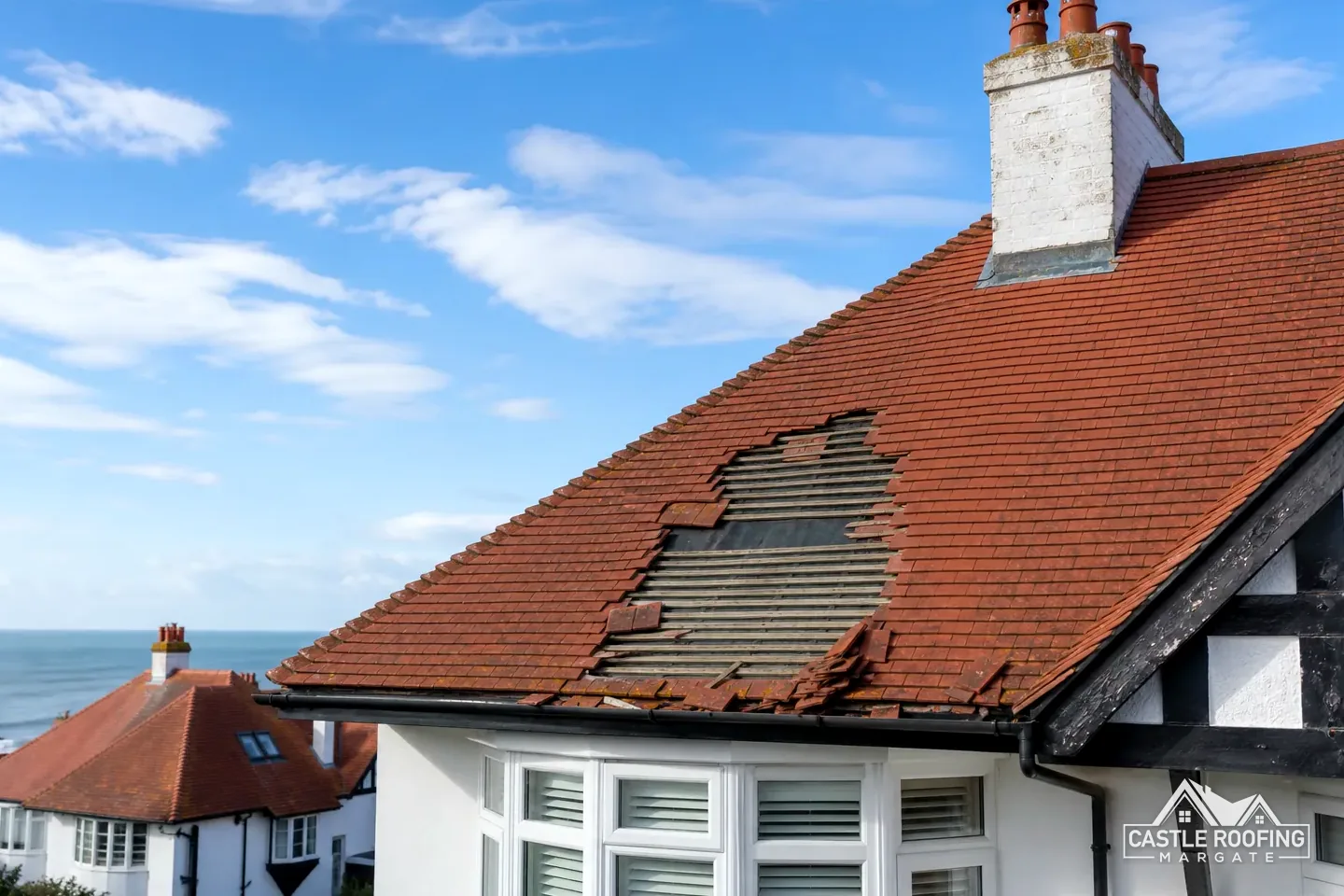 Guide · 9 min readLead flashing repairs: abutments, stacks and stepsFlashings are the lead strips that seal the join where a roof slope ends at masonry. This guide shows where they fail,…
 Guide · 9 min readReplacing a lead valley on a pitched roofA lead valley carries the water from two slopes down to the gutter, so when it fails the leak is steady. This…
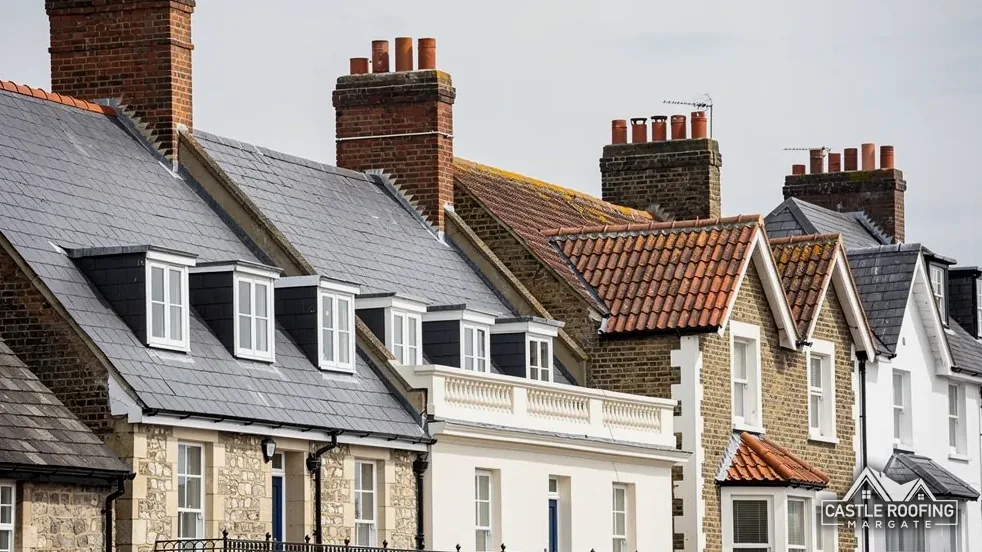 Guide · 9 min readWhat chimney leadwork costs, and what the price coversFor chimney leadwork, MyJobQuote shows a typical UK range from £350 to £920. This guide covers the lead that range pays for…
- GuideLead roofs on bay windows and porches
- GuideLead flat roofs: how they are laid and how long they last
- GuideLeadwork on listed and historic buildings
- GuideAlternatives to lead flashing: when they suit and when they do not
- GuideLead on dormers: cheeks, tops and aprons
- GuideRepairing a parapet gutter behind a period frontage
- BlogExploring the metal roofing materials used on British homes: lead, zinc and copper
- BlogRoof lead stolen? Your repair and replacement options
- BlogLead codes explained: thickness, weight and colour marks
- AnswerHow long does lead flashing last?
- AnswerWhat code of lead is used for flashing?
- AnswerCan lead on a roof be repaired, or must it be replaced?
- AnswerWhy has my lead flashing cracked?
- AnswerIs lead flashing better than a mortar fillet?
- AnswerWhat are lead soakers, and where are they used?
- AnswerWhat is a lead apron?
- AnswerDoes home insurance cover stolen roof lead?
- AnswerWhat is the white staining on new lead flashing?
- AnswerShould a roof valley be GRP or lead?
- AnswerCan leadwork be done in cold weather?
- AnswerHow is lead flashing fixed where a wall is rendered?
- AnswerWhat is stepped lead flashing?
- AnswerIs lead a good choice for a porch roof?
- AnswerIs copper or lead better on a roof?
- AnswerHow long does a zinc roof last?
- AnswerHow do I know if a lead valley is leaking?
- AnswerWhat is a back gutter behind a chimney?
- AnswerShould lead flashing be painted?
- AnswerDo I need consent to replace lead on a listed roof?
Roof work that sits beside a lead roof
- Chimney repairsChimney repairs in Margate and across East Kent: repointing, flaunching, lead flashings, pots and cowls, leaning stacks rebuilt and redundant ones taken down, by…
- Flat roofingFlat roofs on Margate and Thanet extensions, dormers, bays, garages and shop units, repaired or re-covered in GRP, EPDM rubber, torch-on felt or single-ply…
- Pitched roofingPitched roofing for slate, clay, peg and concrete tile roofs across Margate and Thanet, from one slipped tile above the gutter to a full…
- Roof repairs & emergencyLeaks traced to where they start, storm damage made safe and lasting roof repairs to slate, tile, lead and felt across Margate, Thanet and…
Tell us where your lead roof is failing
Name the town and whether it is the chimney, valley or bay, and we can book a time to see the leadwork.