
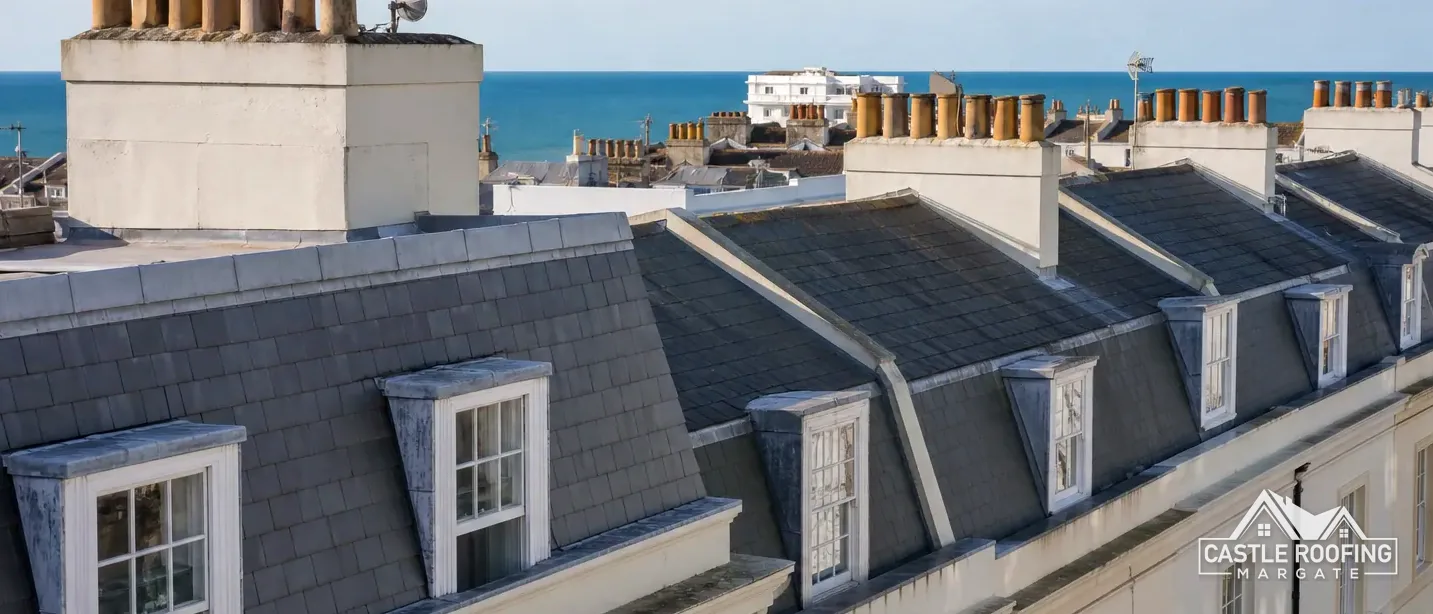
Roofers in Margate
Roof repairs, re-roofs, slate, tile, flat roofs, lead and chimneys across Margate, Thanet and East Kent, with every roof looked at before anything is priced.
- Look firstPhotos of your own roof
- One priceOne written total price
- Repair firstRepairs before replacement
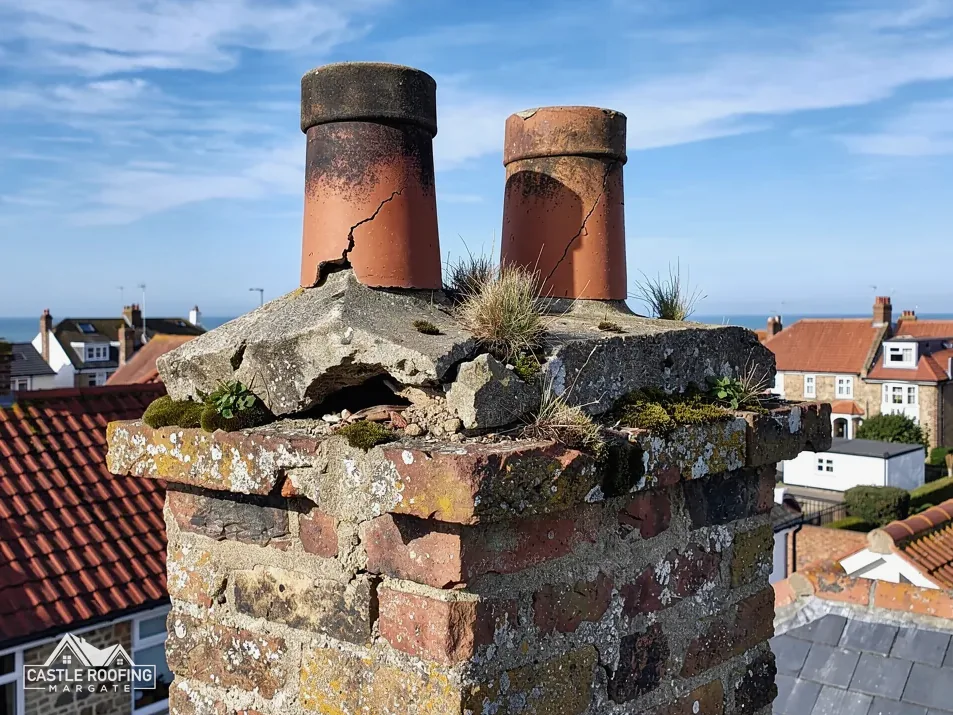
What sea wind and old age do to a Thanet roof
Wind
Gusts off the sea pull at ridge tiles, verges and any slate already loose.
Driven rain
Rain on a strong wind gets under tired flashings and open mortar joints.
Age
A Victorian or Edwardian roof may still carry its first nails, battens and lead.
Every roofing service
All types of roofing work, in and around Margate
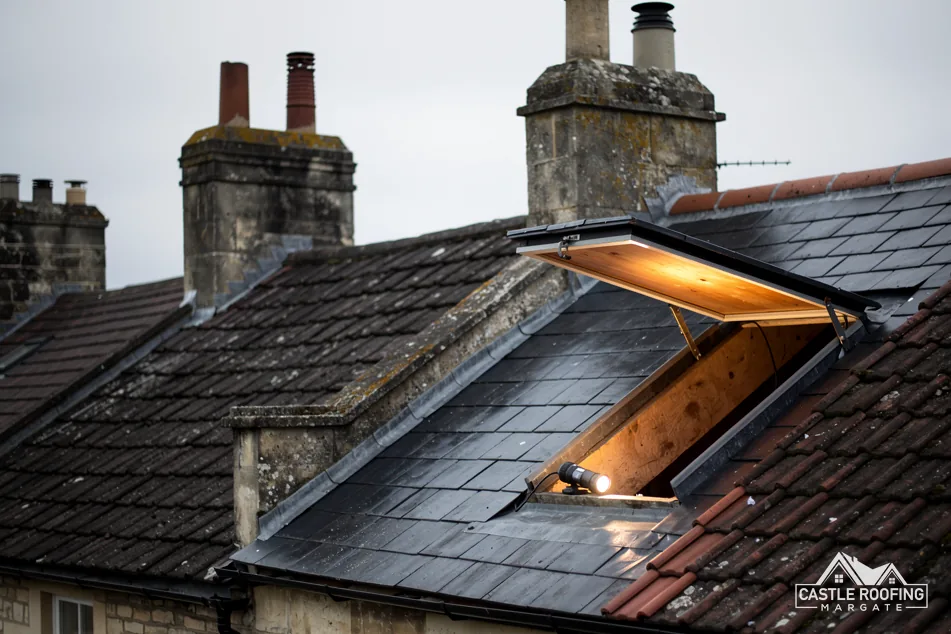
How a job is run
10-Year workmanship guarantee. In writing
- You see photos of your own roof before anything is priced.
- Each day you are told what is happening on the roof.
- Waste taken away and the site left tidy when we finish.
Find us on Google (opens Google Maps in a new tab) What the guarantee covers
From call to clean-up
How a roofing job runs, from your first call to a tidy site
Call or WhatsApp
Ring 01843 305243 or send a WhatsApp photo of the problem.
Roof inspection
We get up to the roof itself and show you photos of every fault.
Written price
One total figure in writing, saying whether VAT and scaffold are included.
The work
Scaffold licence arranged where needed, the roofing done, each day explained.
Clean-up
Waste taken away, gutters cleared of our debris, and the site left tidy.
Where we work
Roofers across Thanet and East Kent
From Cliftonville, Westbrook and Garlinge to Broadstairs, Ramsgate, Westgate and Birchington, and on to Canterbury, Herne Bay, Whitstable, Deal and Dover, we work within about 30 road miles of Margate.
- Westgate-on-Sea , about 6 minutes by road
- Broadstairs , about 7 minutes by road
- Birchington , about 8 minutes by road
- Minster , about 10 minutes by road
- Ramsgate , about 11 minutes by road
- Sandwich , about 17 minutes by road
- Herne Bay , about 19 minutes by road
- Deal , about 27 minutes by road
- Whitstable , about 27 minutes by road
- Canterbury , about 30 minutes by road
The Margate roof guide
How a Margate roof is put together, what the weather does to it, and what it costs
Six chapters, from the slates on a Cliftonville terrace to the Kent County Council licence for the scaffold. Start with whichever one answers your question.
Chapter 01 of 06
How Thanet's period roofs are put together
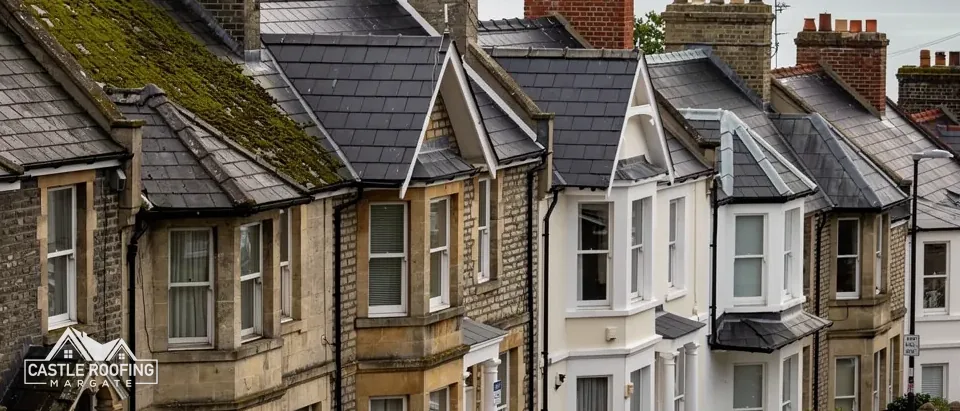
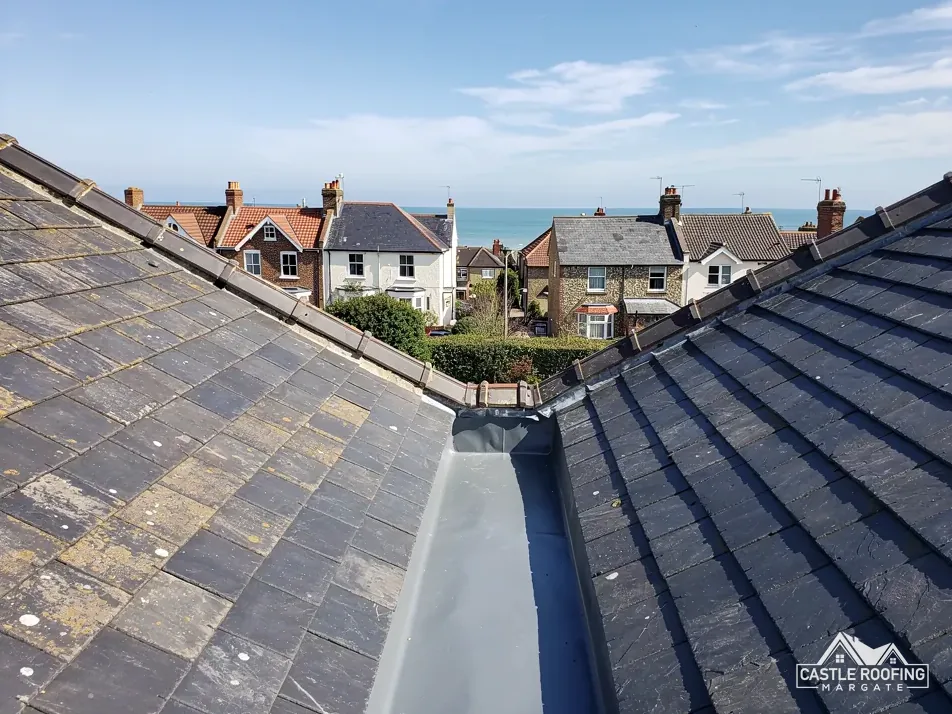
Walk down a street of Victorian or Edwardian houses in Margate, Cliftonville or Broadstairs and look up. You will see natural slate and red clay tile, tall brick chimney stacks, valleys where two slopes meet, and parapets that hide the roof from the pavement. Thanet District Council's appraisal of the Cliftonville Clifftop conservation area describes the roof materials there as quite mixed, red clay tiles and natural slate both, with tall chimney stacks surviving in many places. Its Northdown Road appraisal says "Roofs are usually slated or tiled, often concealed by parapets from the street", and notes some roofs covered with fishscale slates.
Under the slates the build-up is simple, and every layer matters. Rafters carry the roof. Battens, the thin timber strips fixed across the rafters, hold the slates or tiles. Underlay, the sheet laid over the rafters beneath the battens, catches water that gets past the covering. At the top, the ridge is the row of capping tiles along the peak that closes the join between two slopes; a hip does the same job on a sloping outside corner, and the verge is the edge of the roof at a gable end. Each slate is nailed, and the overlap with the courses below keeps the rain out.
What we check on a slate roof
- Slipped or cracked slates, and the gap each one leaves in the overlap
- Ridge and hip tiles that rock when pressed, or mortar falling from under them
- Valleys, for split lead, worn linings or a build-up of moss and debris
- The verge, where loose edge slates or tiles let the wind under the roof
- Timbers and underlay seen from the loft, for damp, staining or daylight
The current code of practice for slating and tiling is BS 5534:2014+A2:2018. Marley points out that installing to it is not required by law, but its 2018 amendment widened its scope to normal re-roofing work, including repairs, and we work to it. Marley also notes that since the 2015 amendments mortar can no longer be relied on as the only means of securing the roof covering. That is why ridges and verges on a re-roof are now often dry-fixed, meaning clipped and screwed in place to BS 8612:2018 rather than bedded in mortar alone. Cupa, the slate maker, says BS 5534 gives a minimum pitch of 20° for natural slate in moderate exposure, and that hook fixings should not be used on any pitch below 25°. A shallow back addition or porch roof is checked against those numbers before a slate goes on it.
That is why slate roofing and roof repairs on a period house start with a look, not a price. One slipped slate may be a single tired nail; a run of them across a slope can mean the fixings have reached the end of their life. Our slate roofing work runs from one slate to full re-slating, and the photos from the survey show which your roof needs. For leaks, slipped tiles and storm damage, see our roof repairs and emergency roofing.
Chapter 02 of 06
The coast in numbers, measured at Manston
- 613 mmRain a year, on average
- 9.86 knMean wind speed at 10 m
- 110 daysWith 1 mm of rain or more
Source: Met Office, Manston climate station, 1991 to 2020 averages
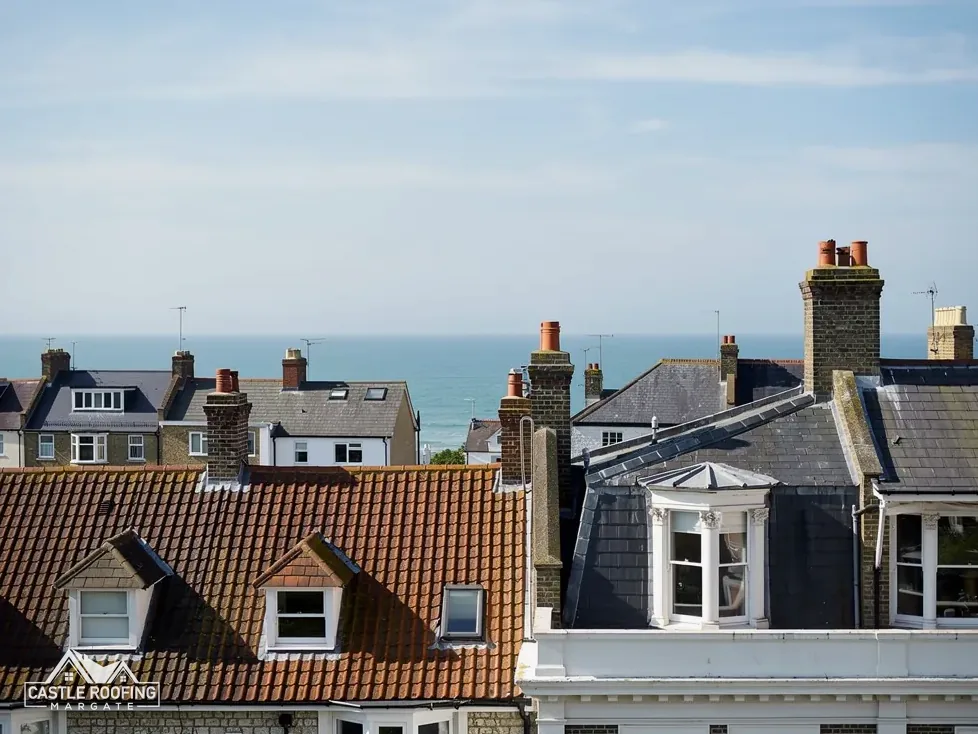
The Met Office publishes long-term averages for its Manston climate station in Thanet, which stands 49 m above sea level. Over 1991 to 2020 Manston recorded about 613 mm of rain a year, falling on about 110 days with 1 mm or more. The mean wind speed at Manston at 10 m was 9.86 knots across the year, rising to 11.21 knots in January, and the station logged an average of 21.43 days of air frost. For contrast, the Met Office station at South Farnborough in Hampshire averaged 7.07 knots and about 715 mm of rain over the same thirty years, so Manston is the windier and drier of the two. These are averages for one station, not a forecast for your street, and they say nothing about a single gale. A ridge tile that rocks in October is a loose tile on the pavement after the first big blow, so it is fixed before winter, not after.
On a roof, wind matters more than rain alone. Cupa says buildings on slopes, hills or coastal areas, and tall buildings, are graded with higher exposure, and Marley notes that BS 5534 carries the wind uplift formulas used to work out fixings. On a Margate job that means the nails, clips and ridge fixings are calculated for the exposure of that site, not copied from a sheltered roof inland. Ridges, hips and verges are where we look first after a windy spell.
Rain falls at Manston on about 110 days a year, so gutters, valleys and outlets are carrying water often. A blocked gutter or a valley packed with moss overflows into the wall or under the roof edge, which is why we clear debris from gutters and valleys whenever we are up on a roof for repairs or maintenance.
Storms sit in the record too. The Met Office account of the Great Storm of 1987 describes a ship blown over at Dover and a Channel ferry blown ashore near Folkestone, with winds reaching Force 11 in many coastal parts of south-east England.
Chapter 03 of 06
Flashings, valleys and the lead that keeps joints dry
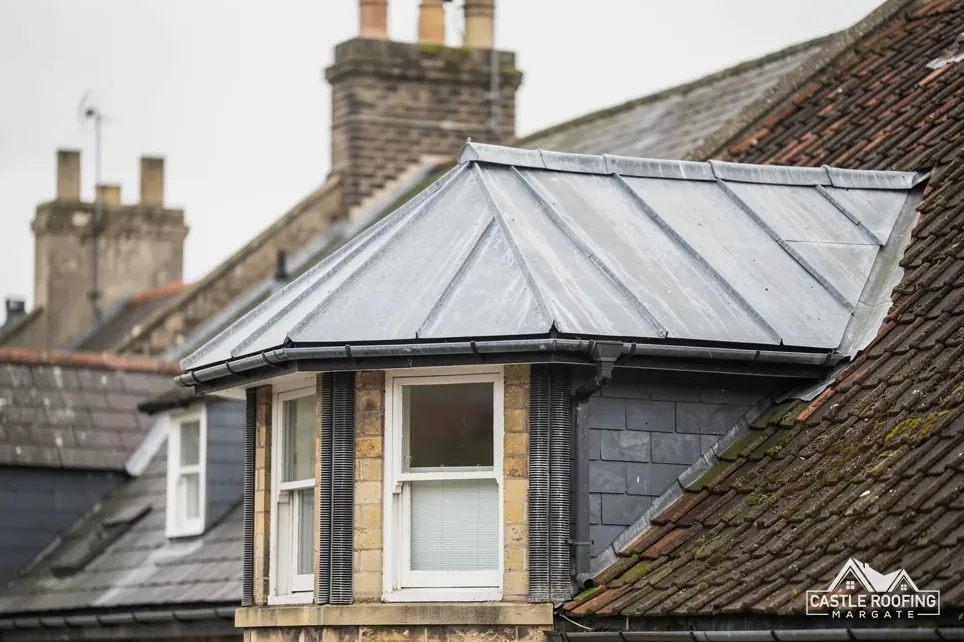
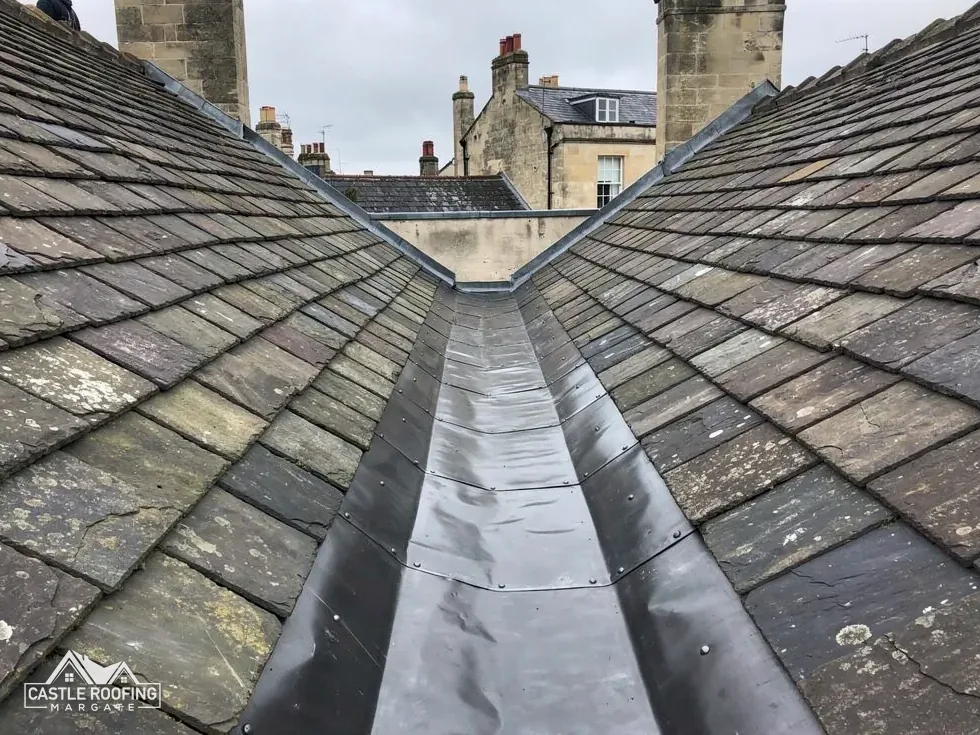
The open slope of a roof is the easy part. The hard parts are the joins: where the roof meets a chimney, a wall, a dormer cheek or another slope. Lead is the traditional answer at those joins. A flashing is a strip of lead dressed over a join so that water runs past it. A soaker is a small piece of lead slipped between each course of slates or tiles where they meet a wall, with a stepped flashing tucked into the brickwork over the top. Valleys are often lined with lead, and so are the gutters hidden behind parapets on a terrace. Where a valley runs into a parapet or a dormer, several pieces of lead may be lapped together in a small space, and every lap has to shed water downhill. That is fiddly roofing work, and it is where a rushed job shows first.
Lead sheet is sold in codes, and the lead code is a measure of its thickness. The Royston Lead cast-lead brochure lists Code 3 at 1.32 mm, Code 4 at 1.80 mm and Code 5 at 2.24 mm, and recommends Code 3 for lead soakers only. Its table marks each code with a colour, green for Code 3, blue for Code 4 and red for Code 5, so the stripe on a roll tells you what has arrived on site. Every other detail, from a chimney apron to a box gutter, has its code set in the specification for the job, so a quote that names the lead is worth more than one that just says leadwork.
Myth
Any thickness of lead sheet will do for a soaker or a valley.FactRoyston Lead recommends Code 3 for soakers only; every other code is set in the job's specification.
Myth
A lead flat roof is built to the same standard as a rubber one.FactBS 6229:2025 covers membrane flat roofs only; Approved Document C points lead to BS 6915.
Myth
Lead flashing needs renewing every twenty years or so.FactMyJobQuote says lead flashing can last for over 80 years, a floor for sound lead and never a pledge.
Source: Royston Lead cast-lead brochure; BSI; Approved Document C; MyJobQuote; HomeBuilding
Signs a lead detail is failing
- Lead lifting away from the brickwork at a chimney or a side wall
- Splits, holes or thin patches in a valley or a parapet gutter
- Sealant or mortar smeared over a join where lead should be
- Damp on a ceiling below a chimney, a valley or a dormer
Lead lasts when it is dressed and fixed properly. MyJobQuote's guide to chimney leadwork says lead flashing can last for over 80 years, and HomeBuilding gives a lead flat roof 60 to 100 years. Those are typical figures, never promises. Where lead covers a flat roof or a bay, Approved Document C points to BS 6915 for the design, rather than to BS 6229, which deals with membrane flat roofs.
Where a Thanet terrace has a parapet, the lead behind it sits out of sight, so it is checked from the roof, not the pavement. A parapet gutter, the lead-lined channel that carries rain from the back of a slope to an outlet, depends on that outlet staying clear: once it blocks, water rises over the lining and finds its way into the house. Our lead roofing and leadwork covers flashings, valleys, aprons and bay roofs. If the lead is sound and one join has failed, we repair that join and say so.
Chapter 04 of 06
Stacks, pots, flaunching and the lead around them
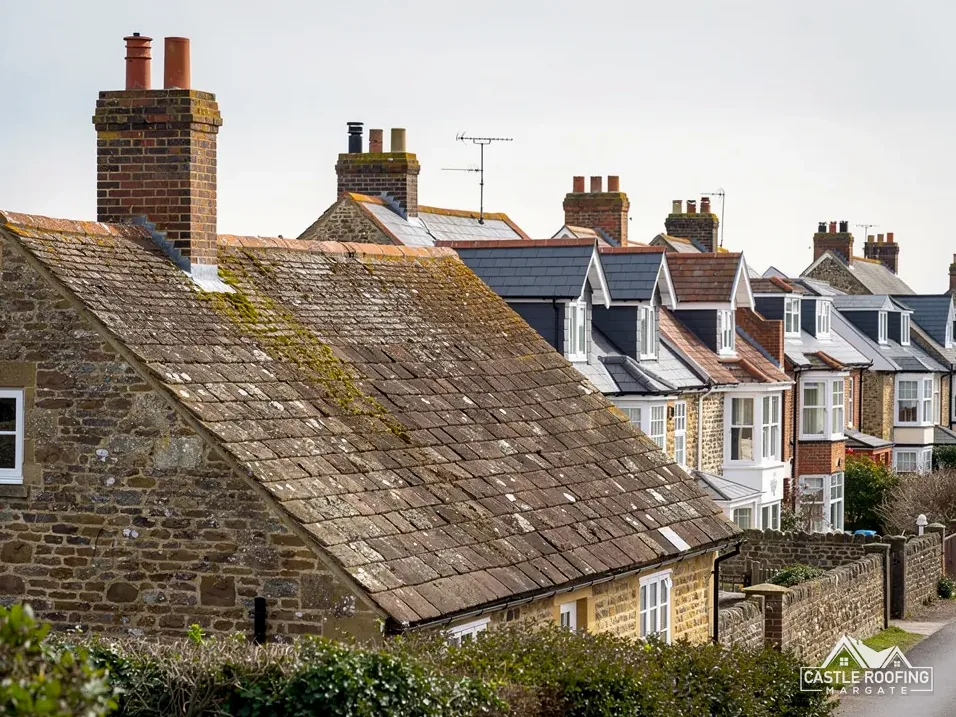
A chimney stack stands proud of the roof on every side, so it takes the weather from every direction. The Cliftonville Clifftop appraisal notes that tall stacks survive in many locations, and each one meets the roof through a set of joins: soakers and stepped flashings up the sides, an apron across the front and a back gutter behind it. At the top sits the flaunching, the sloped bed of mortar around the base of the pots that sheds rain off the crown of the stack.
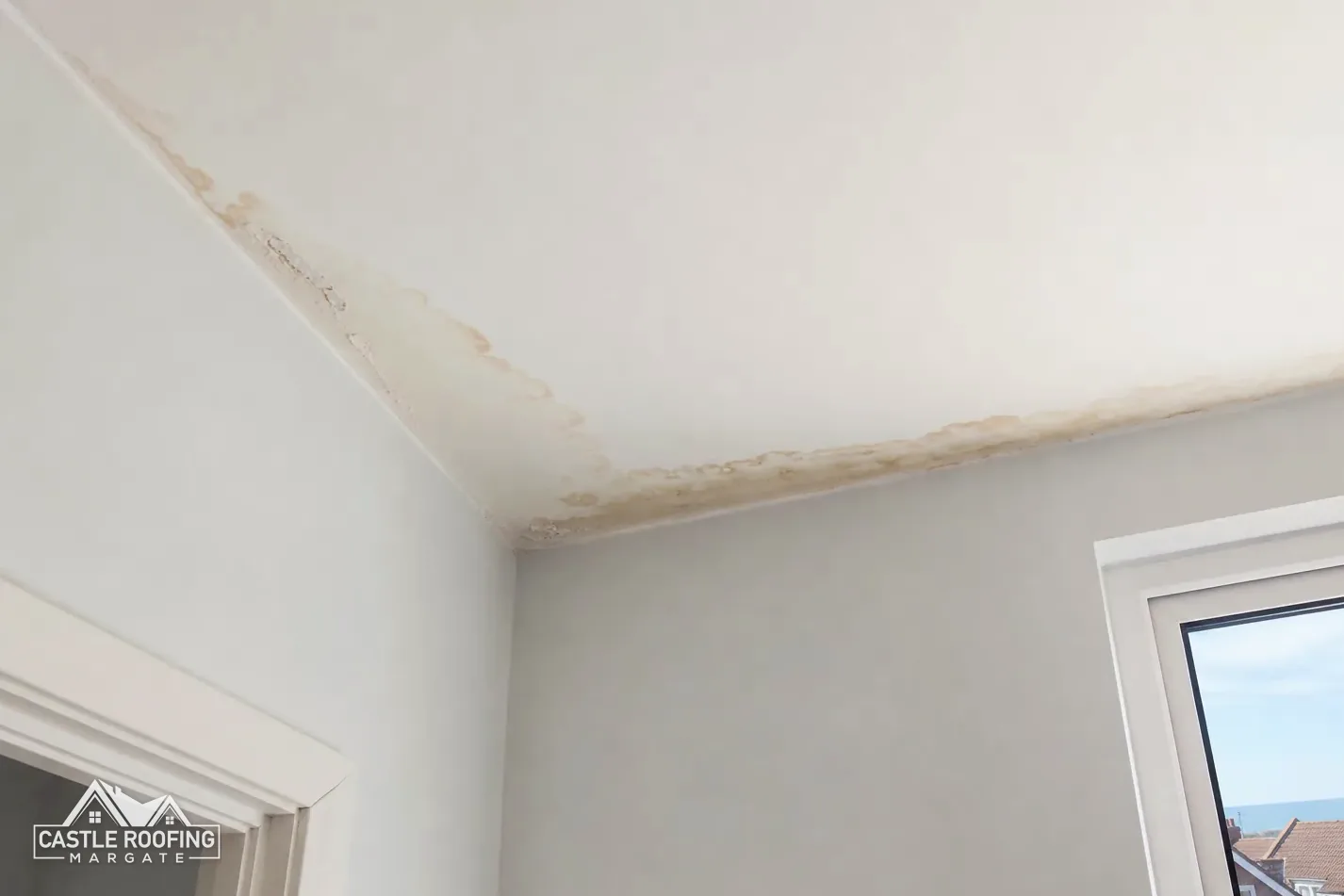
Faults usually show from the street before they show indoors. Look for a pot that leans, plants growing out of the brickwork, open mortar joints, or a dark stain running down the stack below the flashings. Inside, damp on a chimney breast, or on the ceiling beside it, can mean water is getting in at the stack rather than through the slope of the roof. A stack shared with next door, as on many terraces, is a shared job as well, and the neighbours need to know before any roofing work on it begins.
What a stack needs depends on what is found. Repointing, rebuilding the flaunching, re-dressing or renewing the lead, fitting a cowl to a pot that is no longer used, or taking a redundant stack down: each is priced after a survey, because the access, the height and the state of the brickwork decide the work. Our chimney repairs start with photos of the stack, so you see what we saw, and a stack in sound order is left alone. Pots are worth a look in spring as well. The Wildlife and Countryside Act 1981 makes it an offence to intentionally take, damage or destroy the nest of a wild bird while it is in use or being built, so a pot with an active nest waits. Bats are covered too: GOV.UK says all bat species, their breeding sites and resting places are fully protected by law, and it lists repairing or replacing a roof among the activities that can affect them.
Some chimney work brings other rules with it. The Planning Portal says Building Regulations approval will always apply when removing chimney breasts, because they are part of the building's structure. If the breast is on a party wall, the Party Wall etc. Act 1996 asks for notice at least two months before the work starts, unless the neighbours agree in writing, and party wall questions go to a party wall surveyor rather than to building control. Taking a stack down above the roof line can be a planning question too, and our guide to planning permission for roof work explains where the lines fall.
A chimney check, in order
From the street
Leaning pots, open joints, plants in the brickwork and stains below the stack.
On the roof
Soakers, stepped flashings, the apron and the back gutter checked for splits and lifted edges.
At the crown
The flaunching round the pots checked for cracks and loose sections.
From the loft
Timbers beside the stack looked at for damp, staining or rot.
In writing
Photos of the stack and one written price for what it needs.
Chapter 05 of 06
What a fair roofing quote includes, and what moves it
Nothing on a roof is priced until someone has been up to look at it. After the survey you get one total figure in writing, and if something else turns up once the roof is open, you hear about it before anyone touches it. The figure moves with the roof: its size and height, how easy it is to reach, the covering, the state of the timbers and the lead, and whether scaffold has to stand on a busy street. The same holds for a garage roof replacement, a conservatory roof or the flat roof over a shop. Scaffolding itself is priced after a survey, since the height, the street and the weeks it stands all change it.
National guides give a sense of scale. Which?, in a survey of roofers on its trader scheme in November 2025, put replacing one to six broken or missing standard tiles at £75 to £400 and a new ridge tile at £80 to £300, with a whole roof on an average three-bedroom house at £7,000 to £21,000. Those Which? figures exclude VAT, which is charged at 20%. HomeBuilding (September 2025) puts a 65 m² three-bed semi in plain concrete tiles at £10,000 to £15,000, and MyJobQuote gives an average roof repair at around £650 in 2026, while noting that extensive storm damage repairs can cost £1,200 or more. All are typical UK ranges, and Which? and HomeBuilding both say prices in the South East, which takes in Kent, run higher.
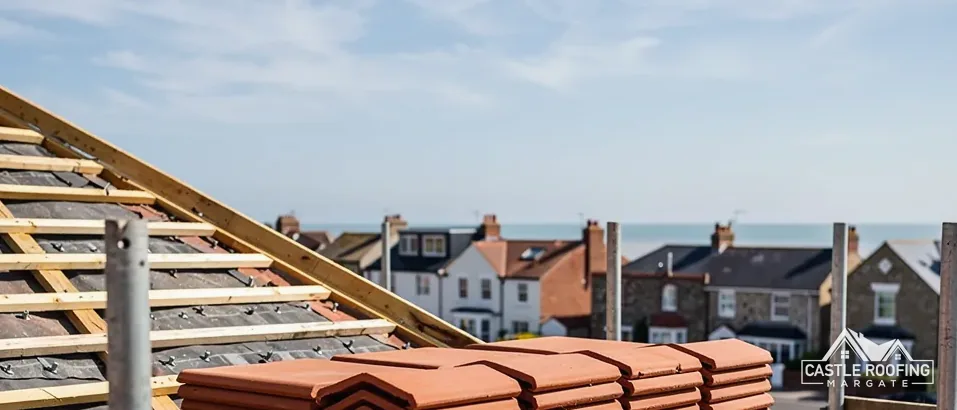
On a new roof or re-roof the covering sets how long the money lasts. HomeBuilding gives Welsh slate a typical life of 100+ years, clay tile 60 to 80 years and plain concrete tile 40 to 50 years. For flat roofs it gives EPDM, the rubber membrane, 25 to 30 years, against 30 to 50 years from Less, and GRP, glass-reinforced plastic or fibreglass, 25 to 30 years. These are typical lives, never promises.
A fair roofing quote is easy to read. It names the work and the covering, gives the total, says whether VAT and scaffold are included, and comes with your cancellation rights in writing. Citizens Advice suggests getting written quotes from at least 3 traders before you choose one. A contract signed at your home, including one signed after a survey, can be cancelled within 14 days under the Consumer Contracts Regulations, and that period runs up to 12 months longer if you were never told about the right. A visit you asked for to carry out an urgent repair carries no cancellation right, and work starts inside the 14 days only at your written request.
The Consumer Rights Act 2015 says a service must be carried out with reasonable care and skill, whoever does it. Our guides on what a roofing quote should include and choosing a roofer in Kent go further, with the questions worth asking before you sign.
| Covering | Typical life | Source |
|---|---|---|
| Welsh slate | 100+ years | HomeBuilding |
| Clay tile | 60 to 80 years | HomeBuilding |
| Plain concrete tile | 40 to 50 years | HomeBuilding |
| EPDM rubber | 25 to 30 years | HomeBuilding |
| EPDM rubber | 30 to 50 years | Less |
| GRP fibreglass | 25 to 30 years | HomeBuilding |
Source: HomeBuilding, How much does a new roof cost, last updated 30 September 2025; Less, flat roof cost, last updated 27 October 2026
Chapter 06 of 06
Scaffold licences, building control and planning in Kent
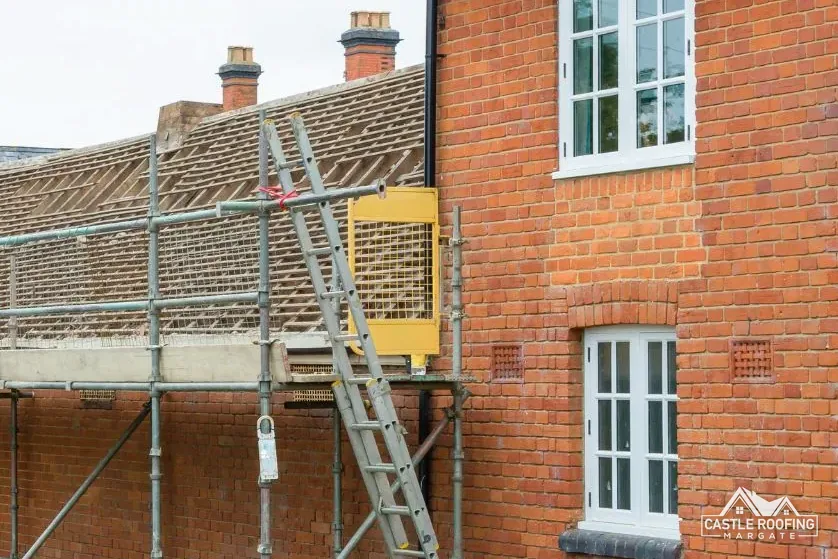
Where scaffold has to stand on the pavement or the road, it needs a licence. Kent County Council is the highway authority for every district we work in, Ashford included, and it says the scaffolding company should submit the application for you, 5 working days before the licence starts. The fee for 2026 to 2027 is £52 per week, with a site inspection at £78 if the council decides one is needed. Kent's conditions also hold the scaffold at least 1.2 metres back from the carriageway. A skip on the road needs a Kent County Council permit too: £45 per week for 2026 to 2027, 5 working days' notice, and no bigger than 5 m by 2 m.
Re-roofing has its own test. The Planning Portal says a re-roof normally needs no building regulations application if less than 25 per cent of the total building envelope is affected and less than 50 per cent of the roof. Approval is needed if a new covering increases the weight of the roof covering by 15 per cent or more, or performs significantly differently in a fire. Thanet District Council runs its own building control team (01843 577522) and points owners to the Planning Portal test. Canterbury and Swale use STG Building Control (01634 331133). Dover District Council's building control page lists replacing roof coverings, even like for like, among work that needs approval, so for Dover addresses we confirm the route before a re-roof starts. Folkestone & Hythe District Council (01303 853538) says replacing roof coverings may need approval. You can also use a registered building control approver: registration with the Building Safety Regulator began on 6 April 2024, although private building control existed long before that.
Planning is a separate question. Class C of the permitted development rules normally covers re-roofing a house, but flats have no permitted development rights, and a listed house needs listed building consent for work that affects its character. Thanet District Council lists 27 conservation areas, among them Margate (designated 1978), Margate Seafront (1997) and Dalby Square in Cliftonville (2010), and it has Article 4 directions in the Ramsgate, Ramsgate Marina extension and Pegwell conservation areas; check with Thanet District Council what they cover at your address. A conservation area is article 2(3) land, and so is the Canterbury World Heritage Site of the Cathedral, St Augustine's Abbey and St Martin's Church; on that land a dormer has no permitted development right and needs planning permission.
We check the building control route and the planning position before work starts, we arrange the Kent County Council licence with the scaffolder, and you are told which rules apply to your roof. The same checks run on commercial roofing, from a shop roof to a small unit. Older garage and outbuilding roofs bring asbestos rules: HSE says asbestos cement sheets removed carefully, without breaking them up, fall outside its licensing rules, and Kent County Council's household waste recycling centres take a householder's own double-wrapped asbestos at every site except Sheerness, by booking. Our guide to Building Regulations for roof work sets out the detail.
Start with a look at the roof
Book a survey of your roof in Margate or anywhere in Thanet, and the photos come to you first.
Read more
Guides for homeowners in Margate and Kent
Before anyone climbs a ladder, these guides cover quotes, planning, Building Regulations, neighbours, wildlife and your rights, written for homes in Thanet and the rest of East Kent.
 Guide · 9 min readChoosing a roofer in Kent: a homeowner's checklistA short checklist for picking a roofer in East Kent, from how many written quotes to collect to the scaffold licence, the…
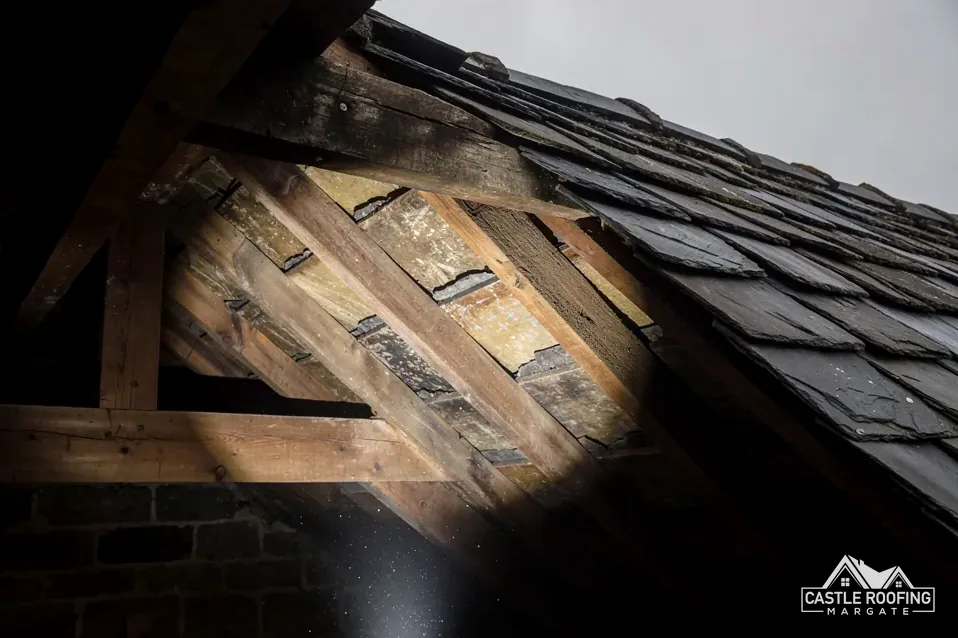 Guide · 9 min readThe roof questions to ask before you buy a house in ThanetThe questions to put to a seller about the roof of a Thanet house, the papers worth asking for, and where a…
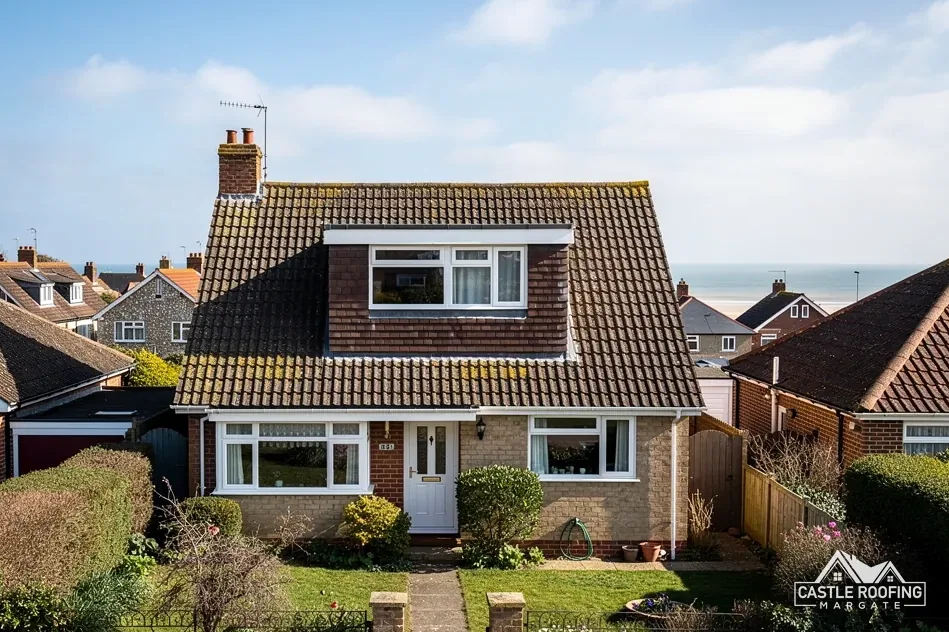 Guide · 9 min readWhen does roof work need planning permission in East Kent?On a house, re-covering the roof is normally permitted development, yet flats, conservation areas, the Kent Downs and Article 4 directions each…
- GuideBuilding Regulations and roof work in Kent: what needs approval
- GuideHow to get your home and neighbours ready for roof work
- GuideRoof repairs on listed buildings: consent, like for like and churches
- BlogHow long does a thatched roof last, and who looks after one in East Kent?
- BlogDIY roof repairs: what is safe from the ground, and what to leave to a roofer
- BlogEssential roof maintenance tasks for every season on a coastal home
- BlogMargate's roofs by street and era: what your house's age tells you
- BlogHow to spot a dodgy roofer in Thanet, and what a fair quote looks like
- BlogWhat does a roofer cost in Margate? Repairs, new roofs and what moves the price
- AnswerHow many roofing quotes should I get?
- AnswerCan I cancel a roofing contract after signing it?
- AnswerDo you pay VAT on roofing work?
- AnswerDo roofers need a licence in the UK?
- AnswerShould a roofer ask for a deposit before starting?
- AnswerDo I need a permit for a skip on the road in Kent?
- AnswerCan roof work go ahead if birds are nesting in the roof?
- AnswerWhat happens if bats turn up during roof work?
- AnswerDo I need a party wall notice for roof work?
- AnswerWhat do the CDM regulations mean for a homeowner having roof work done?
- AnswerHow do I find the building control completion certificate for my roof?
- AnswerCan roof work be done in winter?
- AnswerWhat are my rights if a roofer's work is poor?
- AnswerHow do I settle a dispute with a roofer?
- AnswerWhat should a written roofing quote include?
- AnswerHow do I check whether my house is in a conservation area?
- AnswerWhat is an Article 4 direction, and does it affect my roof?
- AnswerDo flats have permitted development rights for roof work?
- AnswerDoes the Canterbury World Heritage Site change what roof work needs permission?
- AnswerWho gives consent for roof repairs on a church?
Roofing questions, answered for Margate and Thanet
How much should I pay for a roofer in Margate?
There is no fixed rate, because the roof sets the price. As a guide, MyJobQuote puts an average roof repair at around £650 in 2026 and an emergency call-out at £150 to £300, with storm repairs starting at around £300. Kent sits in the South East, where Which? and HomeBuilding both say prices run higher. Whatever the job, ask for one total in writing that says whether VAT is in it.
How can you tell a dodgy roofer from a sound one?
Watch for pressure. A cold call about a loose tile, a discount that ends today, cash only, or nothing in writing are all reasons to stop. A sound roofer gets up to the roof, shows you photos of what is wrong, gives you a written roofing quote with a total, and tells you your cancellation rights before you sign anything. If a job goes wrong, the Citizens Advice consumer helpline is 0808 223 1133.
Do roofers charge by the hour or by the job?
Day rates differ between firms and between jobs, so they make a poor guide to what a roof will cost. We price the job, not the hours: the figure follows a look at the roof and covers the work agreed. If a roofer gives you only an hourly or daily rate, ask how many days they expect and what happens if the job runs over.
Is a repair enough, or does a leaking roof need replacing?
A leak tells you where water is getting in, not how old the whole roof is. One slipped slate, a cracked ridge tile or a split flashing is a repair, and it can be a small one. Roof replacement comes into it when the fixings, battens or covering have failed across a whole slope, and the survey photos show you which it is. Where a repair is the right answer, that is what we recommend.
Which flat roof covering suits an extension or garage in Thanet?
EPDM rubber, GRP fibreglass and torch-on felt all go on extensions, dormers and garage roofs. HomeBuilding gives felt a typical life of 10 to 15 years, against 25 to 30 years for EPDM and GRP. Whatever the covering, BS 6229:2025 keeps a minimum finished fall of 1:80 so water drains away. Garage roof replacement starts with a check for asbestos cement: HSE advises assuming asbestos in any building built or refurbished before 2000.
What should I do first if a storm damages my roof?
Tell your insurer first, then get the roof made safe and keep photos and receipts; IStructE says photographs are vital evidence for a claim. Whether the damage counts is down to your policy's own storm definition, and the Financial Ombudsman (0800 023 4567) says a storm usually involves violent winds, usually with rain, hail or snow. We make the roof safe and send you photos of what we find.
Tell us about your roof
Send a photo or ring 01843 305243, and we will arrange a visit to look at the roof before pricing anything.