
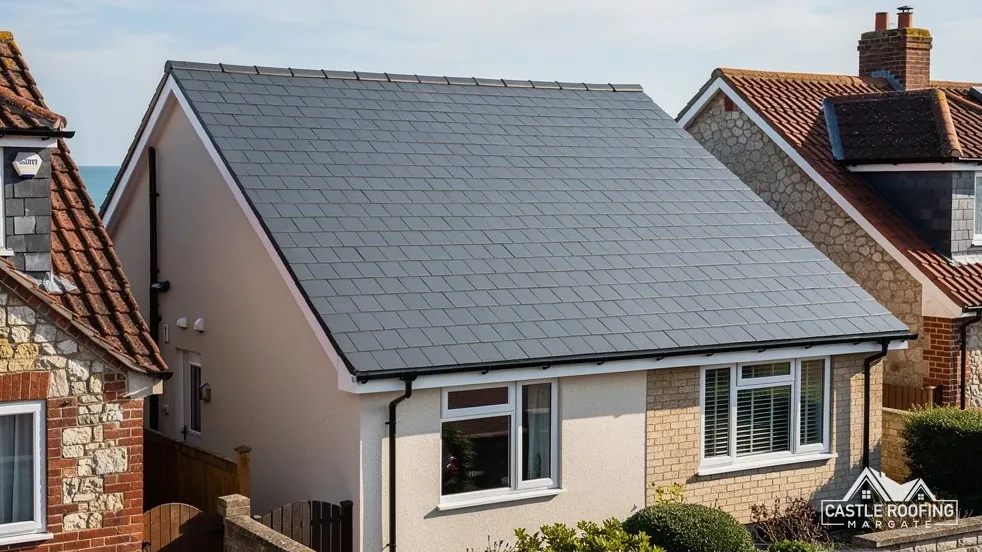
Slate Roofing in Margate
Slate roof repairs, re-slating and new roof work in natural slate for period houses in Margate, Cliftonville, Ramsgate and across Thanet, from a single slipped slate to every slope.
Slate work
Slate roof work we carry out across Thanet
- Slipped and cracked slates
- Valleys and soakers
- Lead at the chimney
- Ridge along the top
- Battens and underlay
Single slates refixed on hooks or tingles, slopes re-slated in Welsh, Spanish or reclaimed slate, whole roofs laid new in natural stone, and the lead and ridge work that finishes them, on houses, flats and shops.
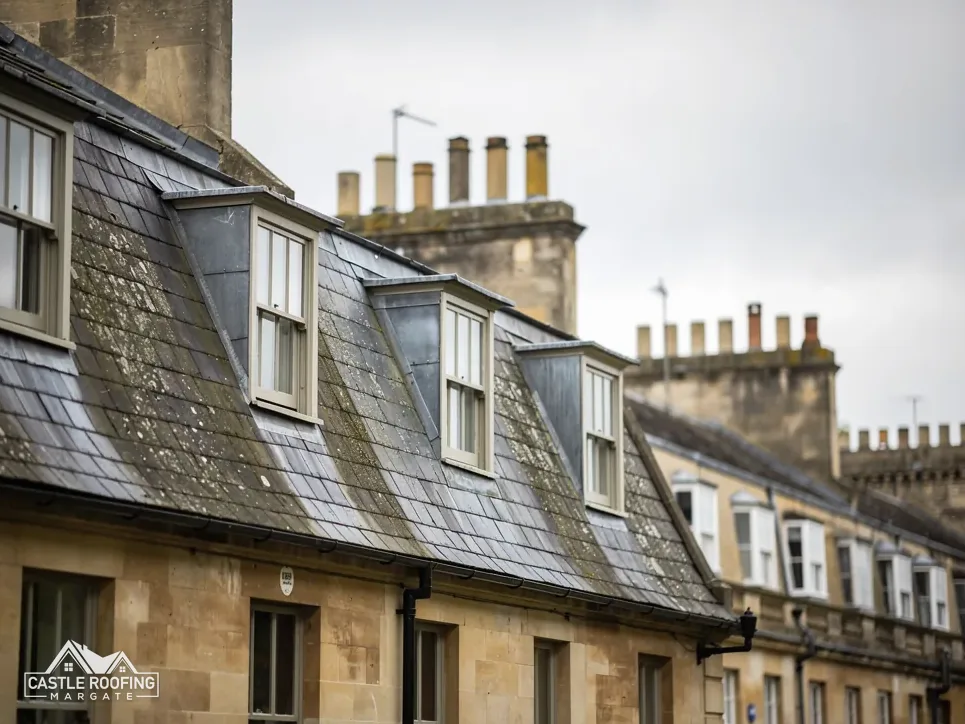

Signs to check for on a slate roof
Slates out of line
A slate sitting lower than its row has lost a nail, and wind will take it next.
Shards on the path
Slate pieces in the gutter or garden: one further up has split or lost its nail.
Damp after rain
A leak stain on a ceiling or rafter points to a gap in slates, valley or lead.
The slate roof guide
Slate on Thanet's period houses, from one slipped slate to a full re-slate
Six chapters on the stone, the weather, the nails, re-slating, choosing slate and the consents, so you can go straight to the part your roof needs.
Chapter 01 of 06
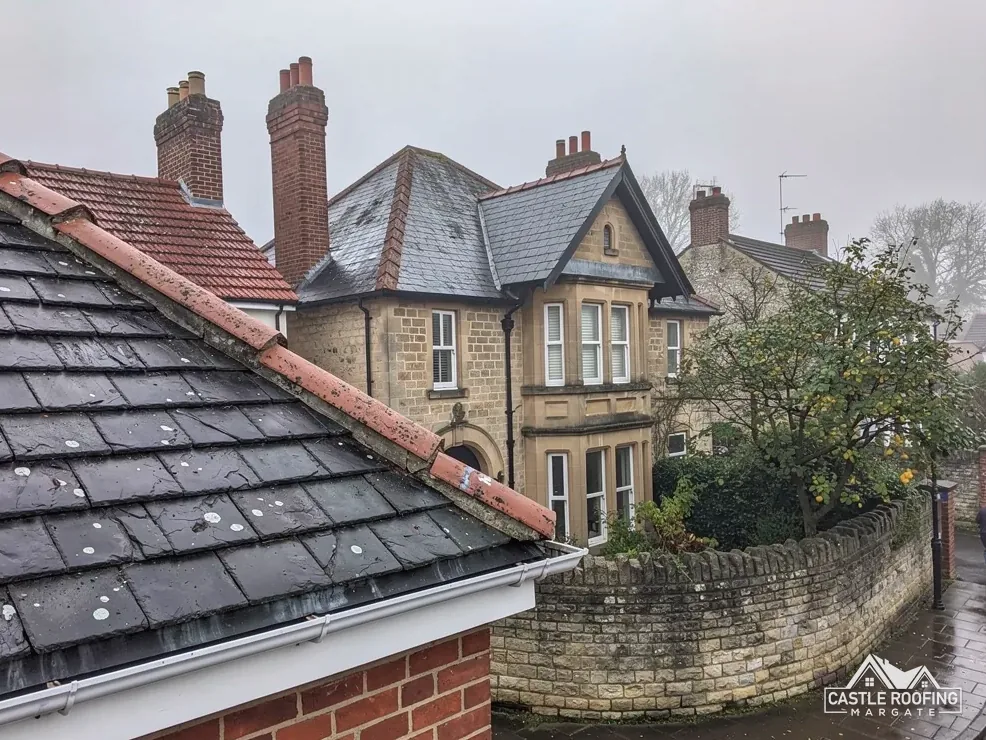
Split stone on Thanet's terraces and villas
Natural slate is stone that splits into thin, even sheets. On a roof the slates are laid in rows, called courses, across the slope, and each course covers the nail holes of the one beneath it. The overlap that matters is the head-lap: how far a slate reaches over the slate two courses below, and it is the head-lap that stops driven rain reaching the timber. That timber is the battens, the horizontal strips fixed across the rafters, and every slate is held to them by its nails, or on some later slopes by a small metal hook. Under the battens runs the underlay, a sheet that carries away any water getting past the stone.
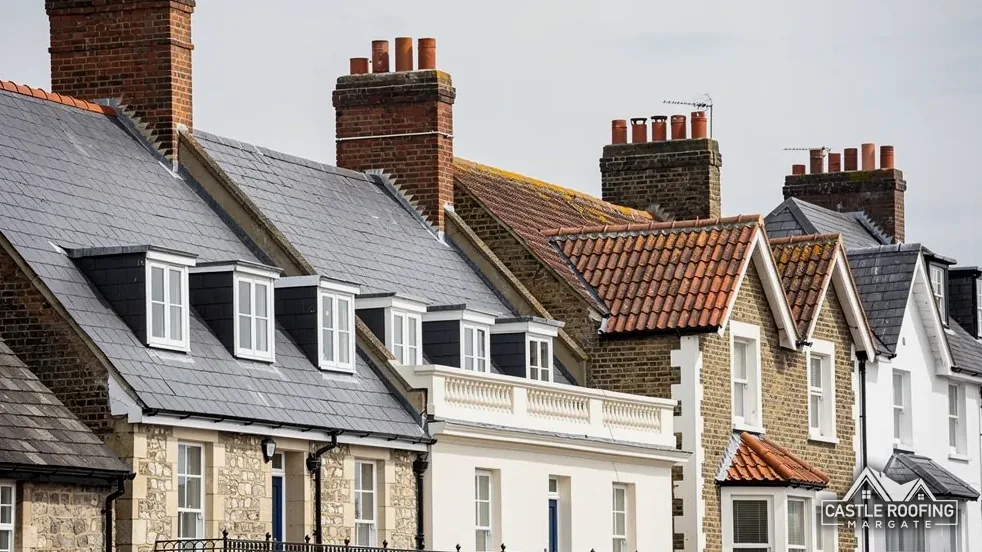
On a Victorian or Edwardian house in Margate, Cliftonville or Ramsgate, a slate roof is rarely one plain plane. There is a ridge along the top, front and back slopes, valleys where two slopes meet in an inside corner, stacks rising through the slates and, on many terraces, a parapet wall in front of the lowest course. In the Northdown Road conservation area, a Thanet District Council appraisal finds the roofs usually slated or tiled and often hidden from the street behind parapets, with some laid in fishscale slates, the round-tailed kind that gives a scalloped pattern. For Cliftonville Clifftop, the same council's appraisal describes the roofscape as a quite mixed one, with natural slate set alongside red clay tiles, and notes that many tall stacks are still standing.
Three sorts of slate can turn up on these roofs: Welsh slate, Spanish slate and reclaimed slate salvaged from another building. From the pavement they can look much the same. Close up, the colour, thickness, size and the way the edges were dressed set them apart, and that matters for any repair. A new slate has to match its neighbours in size and thickness, or it sits proud of the course and gives the wind an edge to get under. A slate that is too long for its row also upsets the head-lap above it, so the sample is measured before anything is ordered.
Slate itself wears slowly, and HomeBuilding puts Welsh slate at 100+ years as a typical life. The weak points on an old slate roof are the things around the stone: the nails, the battens, an underlay that may be torn or missing on an older house, and the lead in the valleys and round the stacks. So a survey looks at the fixings as closely as the slates, and we tell you which of the two has given out, with photos of your own roof to show it. On a roof that has been patched many times, odd slates of another colour or size on one slope are often the first clue. If your house has clay or concrete roof tiles rather than slate, our pitched roofing page deals with those coverings and the same pitched roof details.

Chapter 02 of 06
What the Manston weather record means for slate
- 9.86 knMean wind speed over the year
- 110.05 daysDays with 1 mm or more of rain
- 21.43 daysDays of air frost a year
Source: Met Office, Manston 1991 to 2020
For a long-run weather record near Margate, we use the Met Office climate station at Manston. For 1991 to 2020 the Met Office gives Manston a mean wind of 9.86 knots, measured 10 metres above the ground, with the January mean at 11.21 knots. Rain falls at Manston on 110.05 days in an average year with 1 mm or more, about 613 mm in all, and the Met Office counts 21.43 days of air frost a year there. None of that is a storm. It is the ordinary weather of the place, and it means a slate roof here is often wet and seldom in still air.
Wind is what moves slates. A slate is held by its nails, and its tail, the exposed bottom edge, is free to lift when air races over the slope. Each gust flexes the slate a little on its fixings, and over the years the nail holes wear and the nails thin. Then on one blowy night the slate drops a course, slides into the gutter or leaves a gap for the next shower. Frost works more slowly on a slate that has begun to split into layers: water gets between them, freezes and pushes them apart, so a flaking slate is replaced rather than left in place. An end-of-terrace house or a gable facing the sea takes the first of each gust, so its verges and top courses tend to go before the middle of the row.
Exposure is therefore part of the specification on any slate roof. Cupa Pizarras, a slate maker, grades a building higher for exposure when it stands on a slope, a hill or the coast, or when it is tall, and a higher grade asks for more lap and firmer fixing. A four-storey house above the Cliftonville seafront and a sheltered bungalow inland at Minster may take the same slate with different laps and nails. On a re-slate, we work out the fixings for your own site's exposure under BS 5534. That is a calculation rather than a guess, and it is written into the specification before a batten goes on.

Chapter 03 of 06
Nail fatigue, slipped slates and fair repairs
Nail fatigue, which some roofers call nail sickness, is the point where the nails holding a slate roof have corroded or worn through and can no longer hold. The slates themselves may be fine. From the street you see a slate hanging a few centimetres below its row, a gap showing a pale strip of underlay or batten, or broken slate on the path. One slipped slate after a gale can be a one-off. Slates slipping in different places across the same slope, month after month, mean the nails have had their life. Our answer on what nail sickness is goes through the signs one by one.
A single slipped or cracked slate can be refitted without stripping anything. Because the course above covers the nail holes, a replacement cannot be nailed in the usual way, so it is held at the tail instead. A slate hook is a metal hook fixed to the batten through the joint between the two slates below, and the new slate sits in its curl. A tingle is a narrow metal tab, lead or copper, fixed to the batten in the joint below, with its end turned up to cradle the tail of the new slate. Both are proper repairs. Neither puts fresh nails into the slates around it, so neither cures a roof that is failing all over.
Myth
A slipped slate means the slate has worn out and the roof needs replacing.FactOn an old roof the stone often outlives its fixings. Slips scattered over a slope are the nails' doing; one slip on its own can be refitted with a hook or tingle.
Myth
Slate hooks are a quick fix that suits any slate roof at all.FactCupa Pizarras warns against hooks on slopes pitched under 25°, so on a shallow slope a tingle or new nails make the better repair.
Source: Cupa Pizarras
Where hooks and tingles fit
Hooks have limits. Cupa Pizarras says hooks should stay off any pitch below 25°, and it quotes BS 5534 as indicating a minimum pitch of 20 degrees for natural slate in moderate exposure, with a 500 mm slate and a 115 mm head-lap. On a shallow back addition close to that limit, we would tingle the slate or re-nail it rather than hang a hook. On a steep front slope a hook is neat and holds well. Our guide to slate tingles versus hooks compares the two side by side.
Then comes the honest question of how many patches are too many. When slips are spread over a whole slope, every hook or tingle marks a nail that has gone, and the slates between them hang on nails of the same age. At that stage a re-slate of the slope costs more now and less over the following winters, because the scaffold goes up once rather than again and again. We show you photos of the slope and of the loft side, and say whether the pattern is local or general.
Some slipped slates have nothing to do with nail fatigue. A slate can crack where someone has stood on it, where an aerial bracket or a dish was fixed, or where a ladder leaned on the eaves. A slate can also flake apart, which slaters call delamination, and once it starts it runs through that slate. These are local faults with local fixes, so a slate roof repair on an otherwise sound roof can be small, and a look over the slopes after a hard winter is sensible maintenance.
Chapter 04 of 06
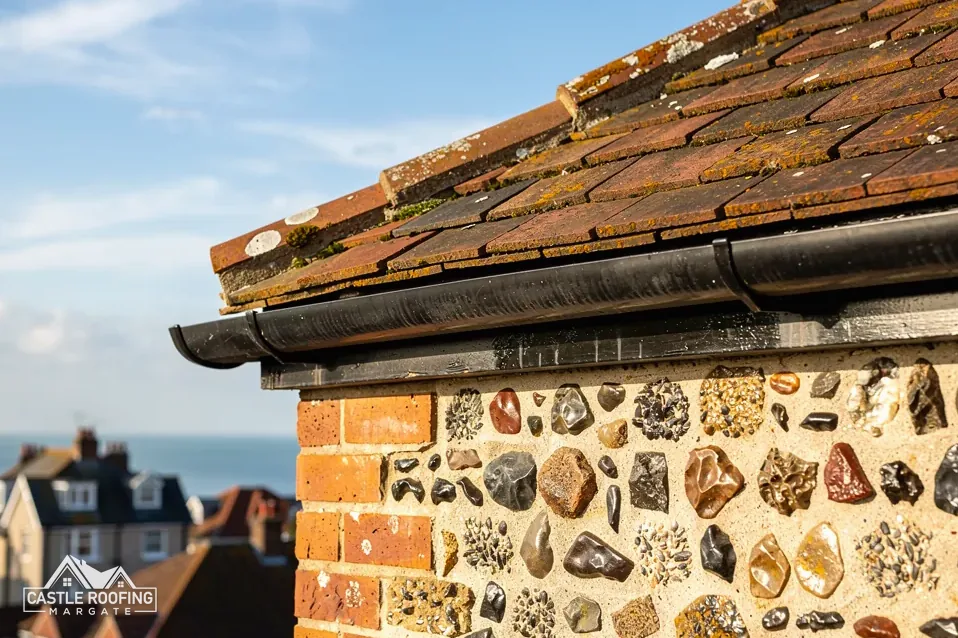
Re-slating a roof, from the strip to the ridge
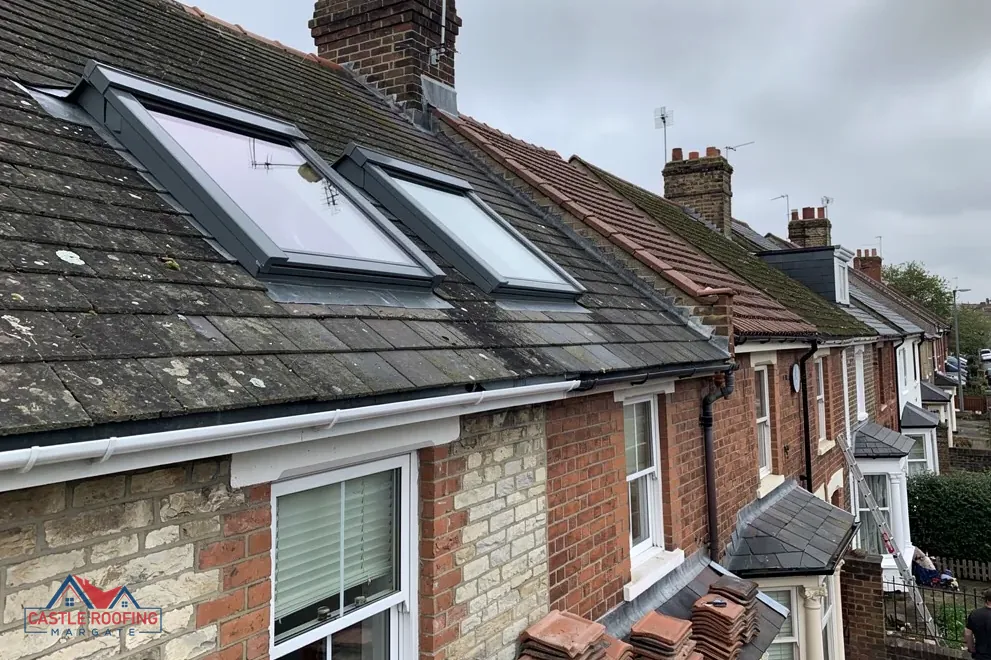
When the nails have gone across the roof, the battens have softened or the underlay has rotted to shreds, the repair that lasts is a re-slate. Re-slating means stripping the slates, sorting them, renewing everything beneath and laying the roof again. Sound slates from your own roof are the closest match there will ever be, so they are cleaned, checked for cracks and flaking, and set aside. Any shortfall is made up with reclaimed or new slate, and on a terrace the new stock goes on a back slope where it can, so the street face keeps its original stone. It is the biggest job a slate roof gets, and done properly it resets every fixing on the roof at once.

Under the slates, the roof gets new underlay and new battens. BS 5250:2021 is the current moisture standard, and on a re-slate the underlay and the air path beneath the slates are planned together. Where the insulation sits on the loft floor and the underlay is HR, short for high resistance, so it does not breathe, Marley asks for a 10mm gap along the length of the eaves on pitches over 15° and 25mm on pitches of 15° or less. A vapour-permeable membrane follows its maker's own data sheet instead. Without the right air path, condensation can form under the slates and drip onto the insulation. On an old slate roof with no underlay at all, a new underlay changes how air moves through the loft, so the ventilation is planned at the same time.
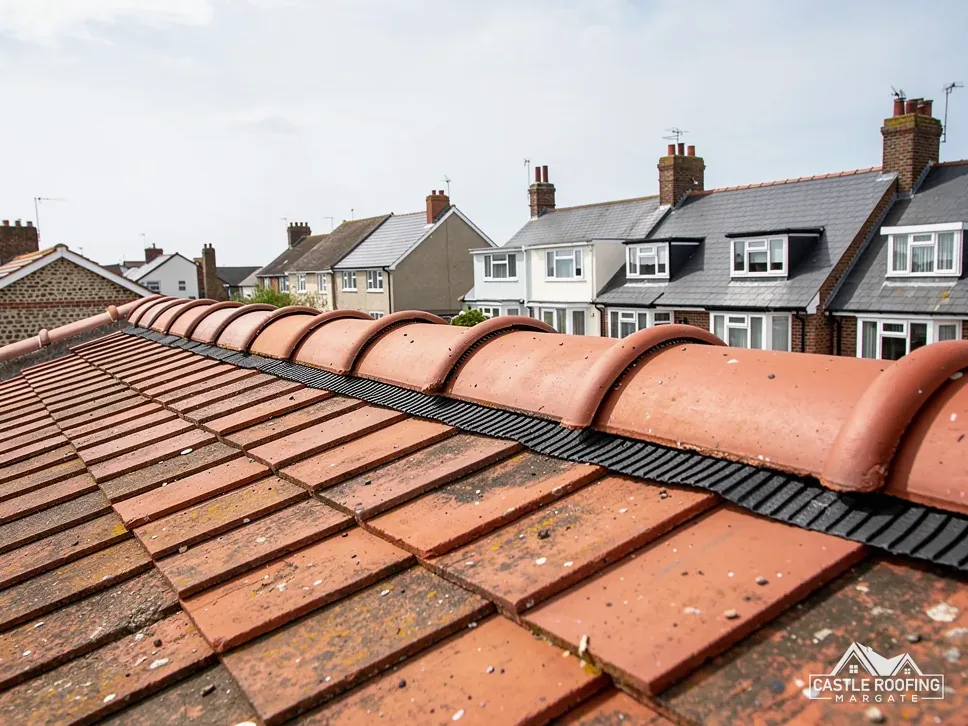
Then the slates go back. BS 5534:2014+A2:2018 is the current British Standard for slating and tiling, and it carries the method for working out fixings against wind uplift. It is not the law, as Marley points out, and since its 2018 amendment it reaches repairs and everyday re-roofing as well as new roofs, so we work to it on both. The head-lap, the gauge (the spacing of the battens) and the number of fixings come from that calculation for your site, so a re-slate in an open position can need more nails or a bigger lap than the same slate a mile inland.
Valleys, soakers and the chimney
A re-slate is the moment to renew the lead the slates meet. Valleys are often lined in lead; soakers are small pieces of lead tucked between the slates where they butt against brickwork, with a flashing dressed over them from the wall. Royston Lead's brochure recommends Code 3 for soakers alone, while the thickness for valleys and flashings is written into the job's specification. In MyJobQuote's words, lead flashing can last for over 80 years, but old lead lifted during a strip is often split, and renewing it while the scaffold is up saves a second visit. For the stack itself, including the flaunching, the mortar collar round the pots, our chimney repairs service picks up the brickwork.
How a slope is re-slated
Survey and photos
We check the slates, the loft side and the lead, and show you photos.
Scaffold and strip
Slates come off course by course; sound ones are sorted and kept.
Battens and underlay
New underlay and battens go on at the gauge the slates need.
Slating to specification
Slates go back with the lap and fixings set for the site.
Lead, ridge, clear-up
Lead is renewed, the ridge goes on and the waste leaves site.
Chapter 05 of 06
Welsh, Spanish or reclaimed slate, and what it costs
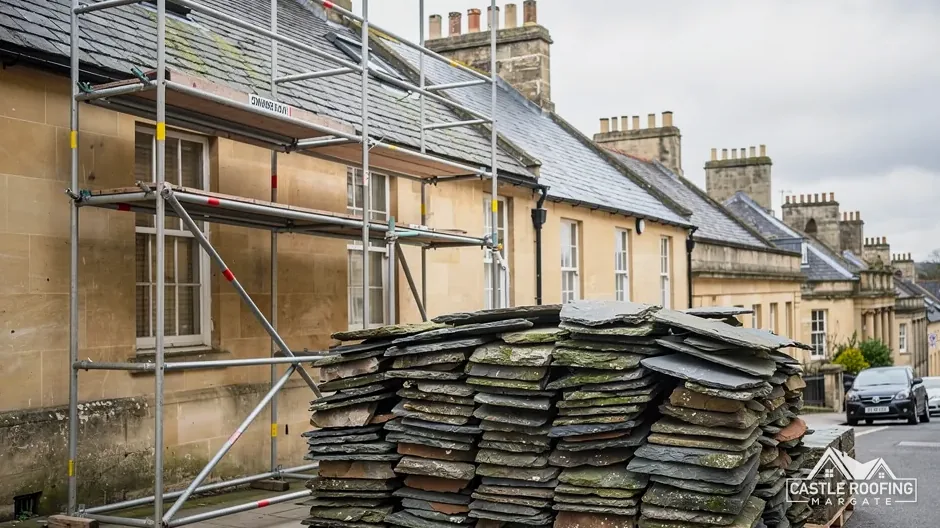
Welsh slate and Spanish slate are both natural stone, and HomeBuilding's typical lifespans put them close together: Welsh slate at 100+ years and Spanish slate at 75 to 100 years. Reclaimed Welsh slate, already part of the way through its life on another roof, gets 50 to 80 years on the same guide. Those are typical ranges, never promises, and a slate only lasts as long as the nails and battens under it let it. An old slate laid again on new fixings can still have plenty of life in it, which is why sound slates are saved on a strip. Slate from a demolished building can carry old nail holes, which are trimmed off or set where the next course hides them.
On a period house the choice turns on matching. For a repair or a part re-slate, the new slate has to sit with the old in colour, size and thickness. Slates are sold by length and width, so the size is measured off a sound slate on your roof before any stock is bought. Reclaimed slate of the same type is often the nearest match to a weathered roof, and on a street of matching terraces it keeps the roofline even. New Spanish slate can suit a full re-slate where every slope changes at once. Our answer on matching old slates explains how a sample is chosen.

Not every grey roof is natural slate. Man-made slates of fibre cement are thinner, flatter and very regular, and for a house built or refurbished before 2000 the HSE says to assume asbestos is present until it is checked. Careful removal of asbestos cement without breaking it up needs no licence from the HSE, though work that will break it up substantially becomes notifiable; where a job is licensable, it goes to a contractor holding the licence. On the HSE's own wording, a roof of asbestos cement is always fragile, which rules out walking on it unsupported. If you cannot tell what your roof is made of, our answer on asbestos cement slates shows what to look for.
What moves the price of slate work
For a small repair, Checkatrade's June 2026 rates put natural slate repairs at £150 to £220 per m², ex VAT, for areas up to 3m². For a whole roof, MyJobQuote gives an average slate roof cost of around £7,800 (Oct 2026), while HomeBuilding says Welsh slate on a 65 m² three-bed semi might reach £18,000 (Sep 2025). These are typical UK ranges, and HomeBuilding expects labour to cost more in London and the South East, which takes in Kent. The size and pitch of the roof, the slate chosen, how many original slates can be saved, the chimneys, valleys and lead, and how the scaffold reaches each slope all move the figure. Our guide to slate roof repair costs sets out those drivers for Thanet houses.
| Slate | Typical life | Where it suits |
|---|---|---|
| Welsh slate | 100+ years | Matching an original Welsh roof |
| Spanish slate | 75 to 100 years | A full re-slate of every slope |
| Reclaimed Welsh slate | 50 to 80 years | Repairs and street-facing slopes |
Source: HomeBuilding, Sep 2025
Chapter 06 of 06
Conservation areas, listed slate and the paperwork in Kent
Re-slating a house is normally permitted development under Class C, the class that deals with alterations to a house roof. Two exceptions matter on Thanet's period streets. A flat has no permitted development rights of its own, so the owner of a house converted into flats should ask the council before the roof's appearance changes. A listed building keeps Class C, but works touching its character need listed building consent, and swapping one slate for another can be exactly that kind of change. Our guide to slate roofs in a conservation area lists the questions worth putting to the planners.
Thanet District Council lists 27 conservation areas, among them Margate, designated on 7 February 1978, Margate Seafront and a run of Cliftonville areas such as Dalby Square. Its page ties planning risk to the match: the closer the work comes to like for like, the less likely it is that permission is needed, and on a slate roof that means the same stone, size and detail. Ramsgate, Pegwell and the Ramsgate Marina extension all carry Article 4 directions, and an owner there should ask Thanet District Council which rights still apply. Further afield, Swale's direction for the Faversham conservation area covers roof coverings on front elevations facing a public highway, and Dover District Council's directions can take in roof alterations on any part of a house fronting a road, open public space or waterway.
Building control and the scaffold
Building control is a separate test. On the Planning Portal's test, you do not normally need to apply when less than 25 per cent of the total building envelope and less than 50 per cent of the roof is affected. Swap to a slate that weighs 15 per cent or more above the old covering, however, and the job does need approval. Thanet District Council runs its own building control team, on 01843 577522. Dover District Council names roof covering replacement among the jobs needing approval, like-for-like work included, so for addresses across Dover district we confirm the route with the council before a slate is stripped.
Scaffold placed on the highway, the footway included, needs a Kent County Council licence under section 169 of the Highways Act 1980, and Kent County Council expects the scaffold firm to make the application 5 working days before the scaffold goes up. Kent County Council's scaffold fee is £52 per week for 2026 to 2027, and a skip left on the road is permitted separately by Kent County Council, at £45 per week for 2026 to 2027. Before any slates come off we also look for signs of bats, because GOV.UK warns that mending or stripping a roof can harm them, and bats, with their roosts and breeding sites, all have full legal protection.
Start with a look at the slates
Send a WhatsApp photo or book a visit, and you get one written price for the slate work once we have seen it.
Our guarantee
10-Year workmanship guarantee. In writing
- We look at the roof before we price it
- One written price, one total
- We tell you before any extra work
Find us on Google (opens Google Maps in a new tab) What the guarantee covers
Slate roof questions from Margate, Ramsgate and Broadstairs
How long can a natural slate roof last in Thanet?
The stone is rarely the first thing to go. On HomeBuilding's figures, Welsh slate lasts 100+ years, Spanish slate 75 to 100 years and reclaimed Welsh slate 50 to 80 years, each a typical range and never a promise. On a slope open to the weather, the nails, battens and lead tend to give out before the stone, so an old roof can often be stripped and its sound slates laid again on new fixings.
Can slipped slates be refixed without re-slating the whole roof?
Yes, where the slips are few and in one place. A replacement slate cannot be nailed through the course above, so it is held at its tail with a slate hook or a lead or copper tingle. That suits a roof that is otherwise sound. Once slips turn up all over a slope, the nails holding the rest are the same age and close behind, and re-slating that slope saves paying for scaffold twice.
Welsh or Spanish slate: which should go on a Margate house?
Match what is already there if you can. On a repair or a front slope, slate of the same type, size and colour keeps the roof reading as one piece, and reclaimed Welsh slate is often the closest fit on a period terrace. For a full re-slate, new Spanish slate is a sound choice, with HomeBuilding's typical life of 75 to 100 years. In a conservation area, ask the council before changing the slate.
Is natural slate worth the extra over concrete roof tiles?
On a period house it usually is. It suits the building, it copes with lower slopes than many tiles, down to the 20 degrees Cupa quotes from BS 5534, and HomeBuilding's lifespans for Welsh slate run well past those for concrete tile. Changing one covering for another needs care, though. The Planning Portal says building regulations approval is needed if the new covering is 15 per cent or more heavier, so weight is checked first.
Does the lead round my chimney get renewed when the slates are redone?
It should be checked, and a re-slate is often the right time to renew it. The soakers under the slates and the flashing over them both sit where the slope meets the stack, and neither can be renewed properly without lifting slates. With the scaffold already up, new lead costs less than a separate visit later. MyJobQuote puts chimney leadwork at between £350 and £920 as a typical UK range (Sep 2026).
Do I need consent to re-slate in a Margate or Ramsgate conservation area?
Re-slating a house is normally permitted development under Class C, and Thanet District Council's page says a like-for-like job is less likely to call for planning permission. In Ramsgate, Thanet District Council has Article 4 directions in Ramsgate, in Pegwell and in the Ramsgate Marina extension conservation areas, so ask the council which rights apply. A listed house needs listed building consent for changes to its character, and a flat has no permitted development rights.
What does a slate re-roof cost in Kent?
As typical UK figures, MyJobQuote gives around £7,800 for a slate roof (Oct 2026), and HomeBuilding says Welsh slate on a 65 m² three-bed semi might reach £18,000 (Sep 2025). Which? gives £7,000 to £21,000, ex VAT, for a full roof replacement on a three-bedroom home of average size (Nov 2025), with South East prices nearer the top. Ask for VAT and scaffold to sit inside the one total you are quoted.
Slates blew off in a storm overnight: what should I do first?
Keep people clear of the ground below and tell your insurer before any work beyond making safe. What counts as a storm is set by your own policy's wording, and the Financial Ombudsman Service names the Beaufort Scale as one thing it weighs. Take photos of the damage and keep receipts; the Institution of Structural Engineers calls photographs vital for a claim. We can make the roof safe as an emergency job, with photos from above.
Read more
Slate roof guides, answers and posts
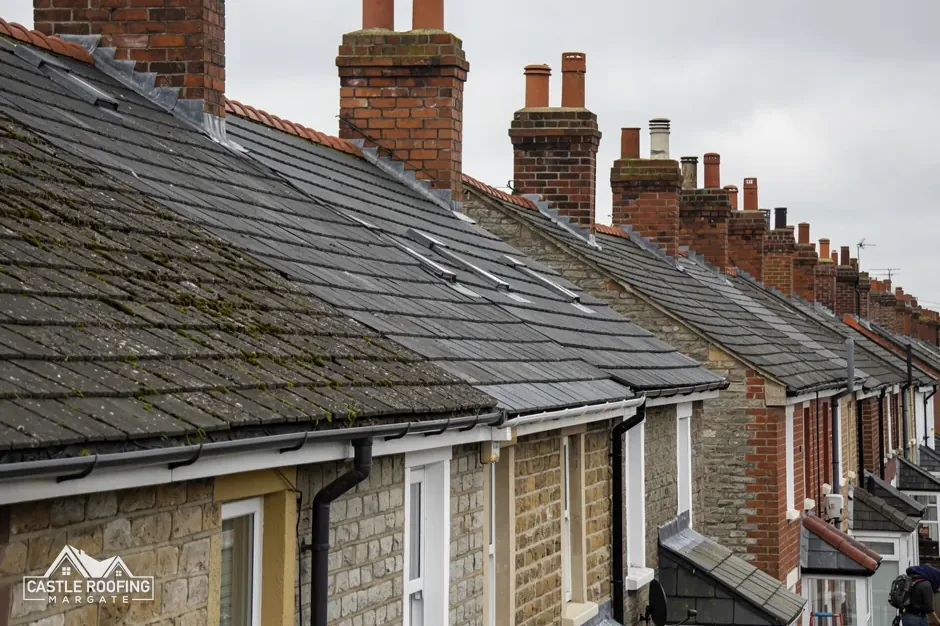
 Guide · 9 min readWhat slate roof repairs costPublished figures for slate repairs run from a few hundred pounds to several thousand, depending on what is wrong. This guide sets…
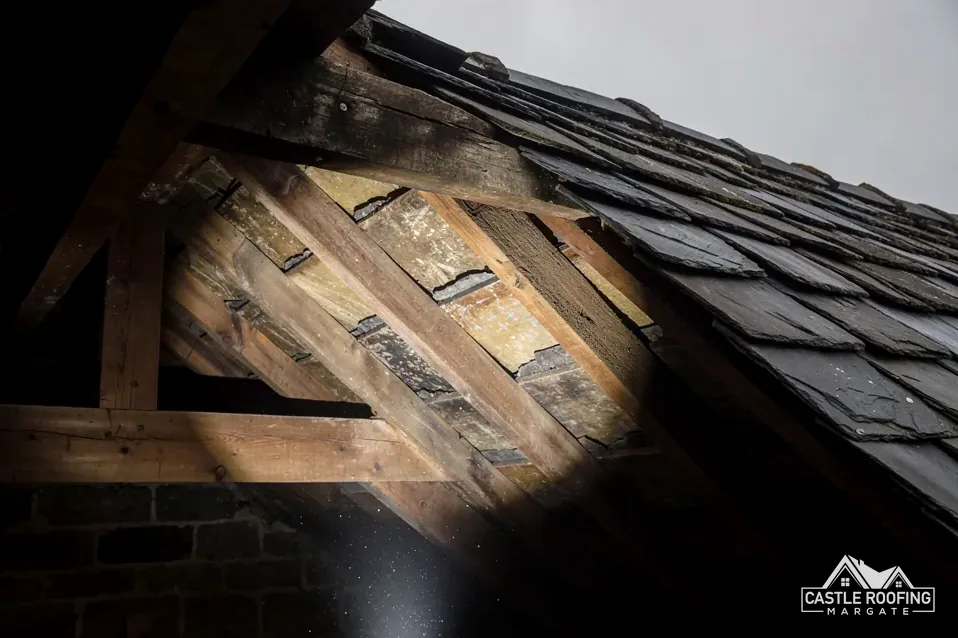 Guide · 9 min readHow long a slate roof lasts, and what shortens itSlate itself can outlast several generations of owners, but the roof around it has parts with shorter lives. Here are the published…
 Guide · 9 min readSlate tingles or slate hooks: which repair suits your roof?Two ways of holding a slipped slate back in place, a tingle or a hook, compared in plain terms, with the pitch…
- GuideFishscale slate roofs: repair and matching
- GuideRepairing or re-slating a roof in a conservation area
- GuideMan-made or natural slate: which suits a re-roof?
- GuideSlate roofs on listed buildings: consent and matching
- GuideWhy roof slates flake and delaminate
- GuideWhat a survey of a slate roof checks
- GuideSlate roof weight: what it means for a re-roof
- BlogNail fatigue: why old slate roofs shed slates in a gale
- BlogWelsh, Spanish or reclaimed? Choosing slate for a Margate re-slate
- AnswerCan one broken roof slate be replaced on its own?
- AnswerWhat is the minimum roof pitch for natural slate?
- AnswerHow long does Welsh slate last?
- AnswerHow long does Spanish slate last?
- AnswerWhat is nail sickness on a slate roof?
- AnswerCan a slate roof be walked on?
- AnswerIs reclaimed slate worth using on a re-roof?
- AnswerWhat is headlap on a slate roof?
- AnswerHow is a slipped slate repaired?
- AnswerDoes a slate roof cost more than a tiled roof?
- AnswerCan a slate roof be repaired in winter?
- AnswerHow do roofers match old slates on a repair?
- AnswerWhat underlay goes under a slate roof?
- AnswerWhy is there condensation under my slate roof?
- AnswerCan a slate roof have a dry ridge?
- AnswerCan frost damage roof slates?
- AnswerHow can I tell if my roof slates are asbestos cement?
- AnswerShould I re-slate the roof or repair it?
- AnswerHow many broken slates mean a roof needs replacing?
- AnswerDo I need planning permission to re-slate my roof?
Services that often join a slate job
- Pitched roofingPitched roofing for slate, clay, peg and concrete tile roofs across Margate and Thanet, from one slipped tile above the gutter to a full…
- Lead roofingLead flashings, valleys, soakers, lead roofs over bays and lead flat roofs repaired, renewed or replaced across Margate and Thanet, with the lead code…
- Chimney repairsChimney repairs in Margate and across East Kent: repointing, flaunching, lead flashings, pots and cowls, leaning stacks rebuilt and redundant ones taken down, by…
- Dry ridge & vergeRidge tile repairs, dry ridge conversions and dry verge systems for Margate and Thanet roofs, from one loose ridge tile to a whole gable…
Tell us what the slates are doing
Send the address and a photo from the street or garden, and we will tell you the next step for your slate roof.