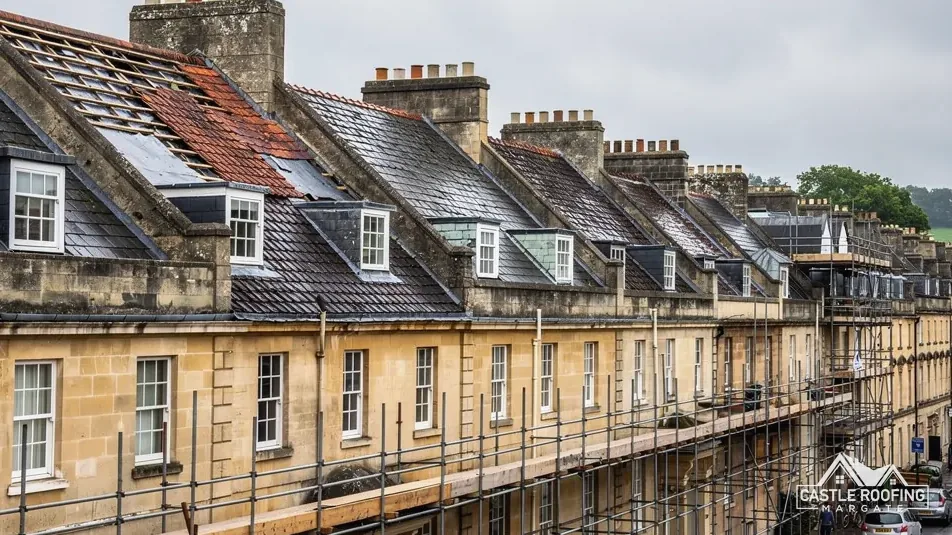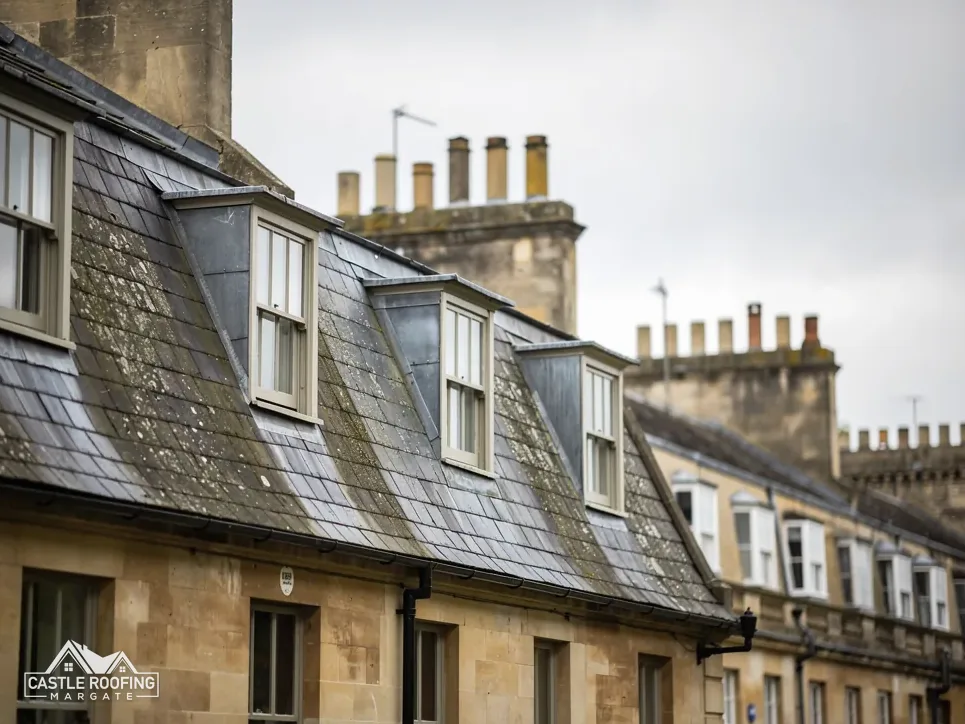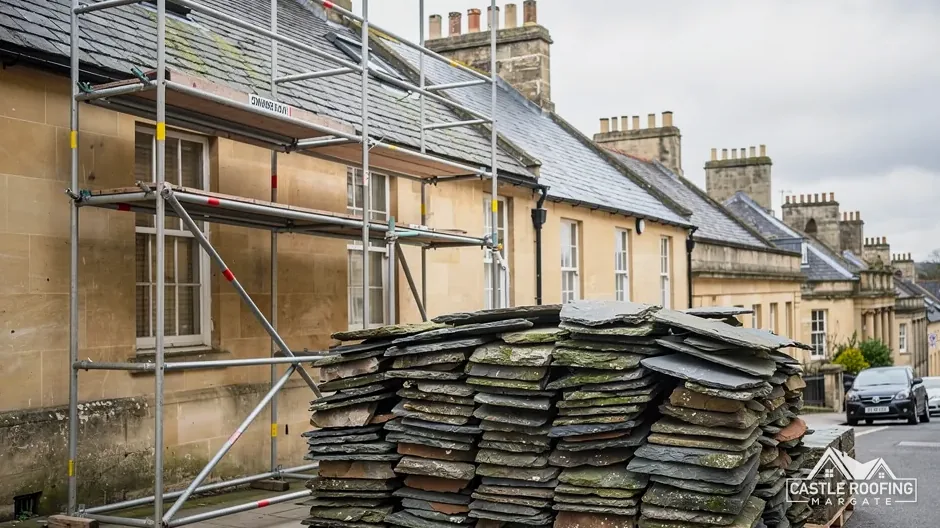
Read this before you choose between the two. It sets out what is published about natural slate lives, what to ask a maker about a manufactured slate, and why a conservation area or a listing can settle the choice for you.
Anyone pricing a new slate roof meets the same fork early on. One quote names natural slate, cut from rock and split into thin sheets. Another names a man-made slate, manufactured to look like it. From the street the two can pass for each other, but on the roof, at the planning counter and in the bank they behave differently.
A fair comparison puts the same questions to each. How long does it last, according to someone who has published a figure? How heavy is it? What pitch will it work on, and how is it fixed? Does the council care which one goes on? For natural slate, some of those questions have a published answer. For a manufactured slate the answers sit on the maker's data sheet, and they vary from product to product, so the sheet for the exact product is where to read them.
The sections below take those questions in turn, with the Thanet and East Kent rules where they bite. The guide belongs to our slate roofing work. Two neighbouring pages go further on how long Welsh slate lasts and on slate against tile on cost.
What separates the two
Natural slate is a rock that splits along its grain into thin sheets. A manufactured slate is made in a factory from other materials and formed to resemble split slate. That is the whole difference in kind, and every other difference follows from it: weight, thickness, edge, colour, fixing and price are all set by what the slate is made of and who made it.
Because manufactured slates differ from one maker to the next, a fair comparison asks each maker the same short set of questions. The table shows where a published answer exists for natural slate and where the maker's own data sheet has to supply the rest.
| Question | Natural slate | Manufactured |
|---|---|---|
| Typical life | HomeBuilding ranges | Maker's data sheet |
| Lowest pitch | 20° under BS 5534, per Cupa | Maker's data sheet |
| Fixing | Nails or hooks; no hooks below 25° | As the maker specifies |
| Weight | Varies with slate and size | Maker's data sheet |
Wherever a cell says data sheet, we ask for the sheet before any price is written and keep it with your survey notes. It is worth reading the small print too. Marley, writing about its tiles, stresses that a stated life expectancy is not a warranty, and the same distinction applies to a slate: a warranty term on a sheet describes cover, and a lifespan describes the material.
Treat the sheet as the start of a conversation with the maker, because a clear answer to each of the four questions is itself a good sign.
How long natural slate lasts
HomeBuilding publishes figures for natural slate in an article last updated on 30 September 2025. It gives Welsh slate "100+ years", Spanish slate 75 to 100 years and reclaimed Welsh slate 50 to 80 years. These are typical ranges for the material, not promises for your roof.
| Slate | Typical life |
|---|---|
| Welsh | 100+ years |
| Spanish | 75 to 100 years |
| Reclaimed Welsh | 50 to 80 years |
Two things sit behind those ranges. A slate can outlast the nails, battens and underlay that hold it, so a roof can be worn out while the slates themselves are sound. And a range is only a range: a reclaimed slate may have spent part of its life on an earlier roof before it reaches yours.
For a manufactured slate there is nothing equivalent to quote, because one maker's figure would not describe another maker's product. Ask the maker for the typical life it publishes, and ask what that figure assumes about fixing, pitch and ventilation. If a maker will not say, that is useful information too.
Our page on Welsh slate and our page on Spanish slate each take one row of the table further, and say what shortens the life of a slate roof in practice.
Whichever slate you choose, the covering is only as good as what holds it down, and the survey checks those fixings and battens first.
Weight, pitch and fixing
Weight matters because the roof structure has to carry the covering. Where the new covering would be heavier than the old by 15 per cent or more, the Planning Portal says Building Regulations approval is required, and it recommends asking a surveyor or structural engineer to check before work begins. AD A, the structural approved document, draws its line a little differently: it counts a loading increase above 15% as significant. Whichever wording applies, a heavier covering is a question for the survey before it is a question for the quote.
Pitch is the second check. Under BS 5534, as Cupa reads it, natural slate goes no lower than 20 degrees (moderate exposure, a 500 mm slate, a 115 mm lap), and Cupa keeps hook fixings off anything under 25°. A shallow roof can therefore rule out a slate size or a method of fixing. The same measurement is needed for a manufactured slate, using the maker's own limits.
Fixing comes third. BS 5534:2014+A2:2018 is the current code of practice. Marley says no law requires it, and that its 2018 amendment took in ordinary re-roofing and repairs. The standard includes uplift calculations for wind, so we work out the fixings from how exposed your own site is. That holds whichever slate goes on.
The questions that fall out of this section:
- How heavy is the new covering against the old, per the maker's data?
- What is the pitch of every slope, measured rather than assumed?
- Which fixing does the maker specify for that pitch and exposure?
Conservation areas and listed homes: like for like
In an older area the choice can be made for you. Thanet District Council's conservation area page connects like-for-like work to a smaller chance that planning permission is needed. Natural slate laid in place of natural slate is like for like. A manufactured slate in place of natural slate is a change of material, and whether that counts as like for like is a question for the council, not the roofer.
Article 4 directions can tighten matters. Swale's direction in Faversham reaches the covering on main elevations that front a public road, so a different covering on the front of a Faversham house is a case to take to Swale before anything is ordered. Dover District Council notes that its directions can restrict roof changes, and that this applies to the elevations that overlook a road, a waterway or public open space. Elsewhere, including Ashford, Canterbury, Thanet and Folkestone & Hythe, ask the council for your address directly.
A listed house adds another layer. Listed building consent is needed where works change a building's character, and a different roof material is the kind of change to put to the council in advance. Our guide to slate roofs on listed buildings covers that route in full.
The practical rule is simple. A house that is listed, or that stands in a conservation area, should ask about the covering first, and treat natural slate as the safe answer to what goes back.
Cost, and why the sources differ
Published costs for slate come from a handful of guides, and they differ widely, so two are named here. MyJobQuote's slate roof guide gives around £7,800, dated 6 October 2026. HomeBuilding's costings for a 3-bed semi of 65 m² put plain concrete tiles at between £10,000 and £15,000 and say Welsh slate "might reach £18,000". HomeBuilding flags higher labour rates for the South East, which is where Kent sits, along with London.
These are typical UK ranges, not Castle Roofing Margate prices. A manufactured slate is priced from the maker's current list once the survey has fixed the quantity, so the comparison is made on the written price rather than on a headline rate.
What the quote depends on matters more than the headline:
- the area of each slope and how steep it is
- the height of the eaves, which sets the scaffold
- how sound the battens and underlay prove to be when the old slates come away
- the amount of lead: flashings, valleys, soakers
- the slate chosen, new or reclaimed, and its size
Scaffolding is priced after a survey, as are most of the items above. Check that any quote you receive states whether VAT, at 20 per cent, and the scaffold are included. Citizens Advice recommends at least 3 written quotes, each from a different trader, before you commit, which is worth doing on a job of this size.
Compare like with like, too: a quote for natural slate and a quote for a manufactured slate are only comparable when both cover the same battens, underlay and lead.
Making the choice for your roof
There is no single right answer, only the right one for a given roof. Start with the survey, because the survey tells you what is wrong. A few slipped slates do not call for a new covering of either kind, and a repair that suits the roof is the better buy when the structure and the battens are sound.
When a whole slope or the whole roof has run out of life, the questions in this guide settle the choice in order:
- Is the building listed, or inside a conservation area? Then the council's view on the covering comes before everything else.
- Can the roof structure carry a heavier covering, and what is the pitch?
- What life does a published source give the slate, and what does the maker's data sheet say for any other?
- What does the written price come to, with VAT and scaffold included?
Thanet District Council lists 27 conservation areas, and the published counts for Dover, Canterbury and Swale are 57, 97 and 51. A quick call to the council's planning team costs nothing and settles the point before the scaffold is booked.
Natural slate is the covering with published lives behind it. We will price a manufactured slate too, set against the maker's data sheet and the council's view.
Either way, you see photographs of what the strip uncovers, so a decision to change the specification is made on evidence rather than on trust.