
Spray Foam Insulation Removal in Margate
Spray foam removal in Margate and across Thanet, done by roofers: the foam comes out, the rafters and felt are checked, and the loft gets its airflow and insulation back.
Under the foam
What we remove, check and put back
- Foam between the rafters
- Rafters and battens
- Underlay and roofing felt
- Airflow at the eaves
- Loft insulation
Hand removal of open-cell and closed-cell foam, timber checks and repairs, re-felting where the old felt has given out, and fresh insulation with the airflow restored, on houses and flats across East Kent.
Signs the foam in your roof is causing trouble
A stalled sale
A survey or valuation notes foam in the loft and the buyer's lender asks questions.
Stained rafters
Dark marks or a musty smell where foam meets timber point to damp held against the wood.
Foam over a leak
Foam sprayed to stop a drip hides the loose tile and the path the water still takes.
The spray foam guide
How spray foam comes out of a pitched roof, and what goes back in its place
Six chapters on lenders, damp, the two kinds of foam, removal, the timbers underneath and insulating again. Start with whichever one your surveyor raised.
Chapter 01 of 06
Spray foam, mortgages and selling a house in Thanet
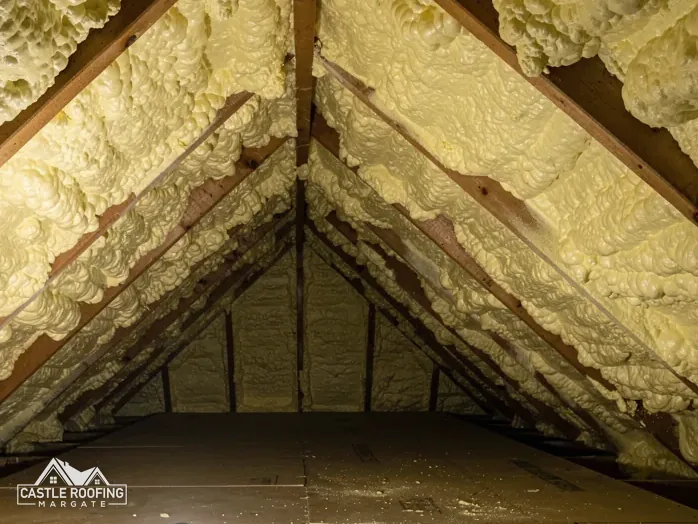
Spray foam insulation is a polyurethane foam sprayed onto the underside of a pitched roof, between and over the rafters, the angled timbers that run from the eaves up to the ridge. It was sold as a quick way to insulate a loft and, on some houses, as a way to hold slipping tiles or slates in place from below. The foam sets against whatever it touches: the rafters, the battens that the tiles hang from, and the underlay or old roofing felt behind them. For the owner, the trouble can surface years later, when a buyer's surveyor or a lender's valuer climbs the loft ladder in a Margate terrace and finds the roof structure out of sight.
RICS, the professional body for chartered surveyors, published a consumer guide on spray foam in March 2023. Its press release said there had been concern within particular parts of the lending market, equity release mortgages among them, and that the concern was now spreading to lenders more widely. The guide itself tells owners to check with their mortgage provider whether its lender policy allows products of this kind. Put plainly, some lenders have doubts, equity release lenders among them, and the only way to know where your own lender stands is to ask it. Nobody but the lender can say whether it will lend once the foam has gone.
The reason surveyors raise it is straightforward. RICS warns that where foam coats a timber roof, the structure can no longer be looked over or examined in full. A valuer standing at the hatch cannot tell whether the rafters are sound, whether the battens have rotted or whether the felt has perished, so the report says as much, and the lender then decides what it needs from you. That is how a sale in Broadstairs or a remortgage in Westgate-on-Sea can stall on a loft that nobody has been into for years, and why the question tends to arrive with a deadline attached.
Why removal is worth it before a sale
Taking the foam out puts the timbers back on view. Once it is off, we inspect every rafter and batten we can reach, record the state of the underlay, and give you a written report with photos of your own roof showing what was found and what was done about it. You can hand that report to your solicitor, your buyer's surveyor or your lender, and keep a copy with the house deeds for the next time the roof is questioned. It decides nothing on their behalf, but it answers the question their surveyor could not answer before. Our page on spray foam and mortgage problems looks at the lender side in more depth, including what to ask your lender before you book the work.

Chapter 02 of 06
Condensation, airflow and the timber behind the foam
- BS 5250:2021Code of practice for moisture in buildings
- 25mmEaves gap at 15° or less
- 10mmEaves gap above 15°
Source: BSI; Marley cold roof guidance
A pitched roof stays dry partly because air can move through it. Warm, damp air from the rooms below finds its way into the loft, and in a cold roof, meaning one insulated at ceiling level, that moisture is carried off by fresh air drawn in at the eaves, the low edge of the slope above the gutter. BS 5250:2021 is the British Standard that deals with controlling moisture in buildings, and Approved Document C accepts ventilating a cold deck roof as a way of meeting its moisture requirement. Foam sprayed across the rafters and packed into the eaves can shut that air path off.
The Energy Saving Trust sets out the risk to the timber. It says that foam sprayed on the underside of the roof will partially seal the timber, and that water from a leak will cause the timbers to rot. A rafter wrapped in foam cannot dry out the way it once did, and the first sign of trouble may be a soft patch found only when the foam is cut away. Condensation adds to it from the inside, on cold nights when warm air from the house meets a chilled underlay. On the Met Office's Manston averages for 1991 to 2020, this part of Thanet sees about 613 mm of rain a year across 110 days, so a single slipped tile has plenty of wet days to let water in where nobody can see it.
When the foam has gone, the ventilation has to be put back by design rather than left to chance. Where HR underlay, a non-breathable type, sits over a cold roof, Marley gives a continuous 25mm eaves opening for a pitch of 15° or under, and 10mm on any slope steeper than 15°. Those figures belong to HR underlay, so the airflow is worked out for the underlay actually on your roof once we can see it. Our guide to roof ventilation after spray foam covers the choices, from eaves vents to vent tiles near the ridge, and how each one suits a terrace or a bungalow.

Chapter 03 of 06
Open-cell and closed-cell foam, and what each leaves behind
Two kinds of spray foam turn up in Kent lofts, and telling them apart is the first job on a survey. Open-cell foam is the softer kind: light, springy and easy to dent with a thumb. Closed-cell foam sets hard and dense, closer to a rigid board than a sponge. Both go on as a liquid that swells and cures where it lands, so either can fill the space between rafters and spread across the battens and felt behind them. Age, colour and the depth of the layer vary from house to house, and none of them tells you which type you have as reliably as a small cut does.
The difference matters for the timber. The Energy Saving Trust says the risk of rot from a leak should be much lower with an open-cell foam. Lower is still not nil, and a roof that has leaked for a few winters behind either type deserves the same close look. An open-cell layer that has soaked up water from a cracked slate can hold damp against a rafter for a long time, and we check the wood behind it as closely as any other.
Myth
Open-cell foam carries no risk at all to the roof timbers.FactThe Energy Saving Trust puts the rot risk from a leak much lower with open-cell foam. Much lower is still a risk.
Myth
Every mortgage lender turns away a house with spray foam.FactRICS noted in March 2023 that some mortgage lenders, equity release ones included, had concerns. Ask your own lender.
Myth
Foam sprayed under a leaking roof seals the leak for good.FactThe Energy Saving Trust advises against spraying a leaking roof. The loose tile stays loose.
Source: Energy Saving Trust; RICS
It matters for the work as well. Open-cell foam can usually be cut back from the rafters in sections and lifted away. Closed-cell foam is harder going, because it has to be cut and then scraped off the timber, and where it was sprayed straight onto the underlay or the backs of the tiles, the felt may come away with it. Whether that has happened on your roof is something we find out on the survey, by cutting a small test patch and looking at what sits behind. Our page on open-cell and closed-cell spray foam compares the two in more detail.
Foam was also sprayed on some roofs to cure a leak or to steady tiles that had begun to slip. Of spraying a leaking roof, the Energy Saving Trust says "We don't recommend doing this." The foam hides the leak rather than curing it, and the tile or slate that let the water in is still loose above. Where we find foam that was plainly put there to hold a slope together, the covering outside needs a look as well as the loft, and that may add a repair to the job.
Some houses carry foam over only part of the roof: one slope, a back addition or a room in the loft. Partial removal is possible, though it is worth asking your lender whether foam left on one slope still matters to it before you settle the scope. In a Cliftonville or Ramsgate house split into flats, the loft may be shared, so the freeholder or managing agent agrees the work before anything is booked, and access through each flat is arranged in advance.
Chapter 04 of 06
How the foam is taken out of a Thanet loft
Removal starts inside the loft. We lay a safe walkway of boards across the ceiling joists, cover the hatch and the landing below, and set up lighting and dust control before any foam is cut. The foam is then cut away from each bay between the rafters by hand, with blades and scrapers, and the last film is taken back from the timber until the grain of the wood shows. It goes straight into heavy bags, which are carried down through the house and taken away, so nothing is left in the loft, the garden or your bins. Anything stored in the loft is moved out first, or covered where it has to stay.
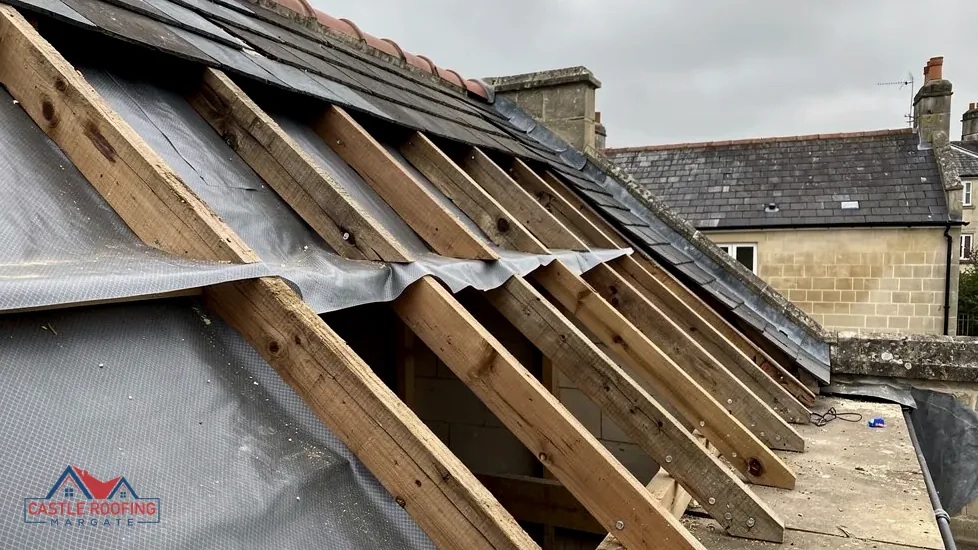
How the felt behaves decides what happens next. If the underlay or old roofing felt behind the foam comes through intact, the job stays inside: foam out, timbers checked, airflow and insulation put back. If the felt tears as the foam comes off, or was brittle to begin with, a new membrane is needed, and that is fitted from outside by lifting the tiles or slates, laying membrane and new battens, and relaying the covering. You hear which way the job is heading as soon as the first bays are open, and nothing outside the agreed scope starts without your say.
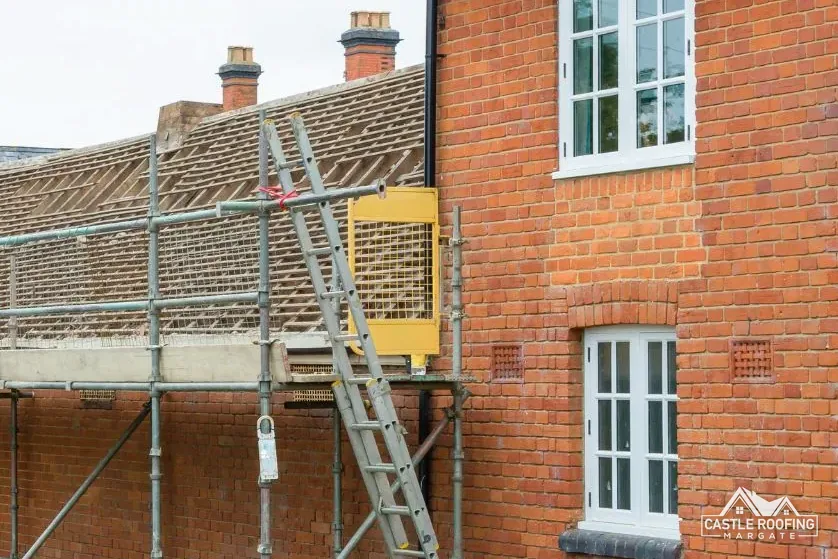
Outside work brings a scaffold. Any scaffold standing on the footway or the road needs a licence, and Kent County Council issues it under section 169 of the Highways Act 1980. The scaffolding company makes that application, and Kent County Council needs it 5 working days ahead of the first scaffold tube touching the pavement. The licence protects people walking past as much as the house, which is why the council sets conditions on lighting and walkways. For 2026 to 2027 the charge is £52 per week, plus £78 for a site inspection where the council decides one is needed. Where a house fronts straight onto the pavement, as plenty in Margate and Ramsgate do, the scaffold date is fixed around that notice, so the re-felting begins on a day you know about.
Inside or out, the house stays lived in while we work. Loft work brings some noise and dust near the hatch, so the hours are agreed with you, and the hatch is sealed at the end of every day. Each evening you are told what was done that day and what comes next, and the loft is left safe overnight. If the weather turns while a slope is open, it is covered before we leave. Our spray foam removal process page walks through each stage at greater length, including what we need from you on the first morning.
Foam removal, in order
Survey and test cut
A small patch is opened to show the foam type and whether the felt has held.
Protect the house
Boards, covers, lights and dust sheets go in before any cutting.
Cut back each bay
Foam is cut from between the rafters by hand and bagged as it comes away.
Clean the timber
The last film is scraped from rafters and battens so the wood is on view.
Inspect and report
Every timber we can reach is checked, and the findings go in your written report.
Chapter 05 of 06
Checking rafters, battens and felt once the foam is gone
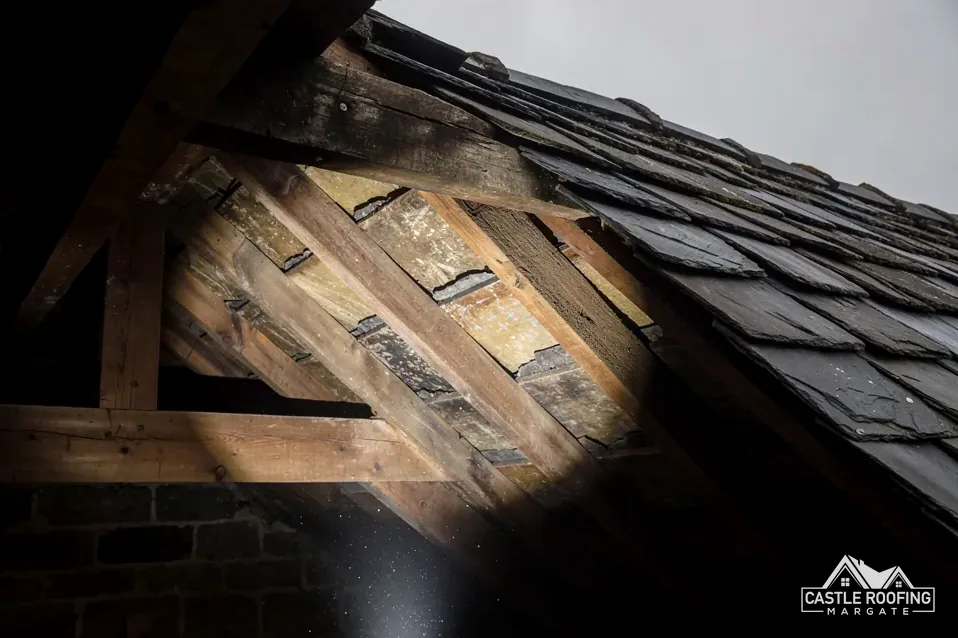
With the foam gone, the roof structure is on view for the first time in years. We look along each rafter for staining, softness and splits, test any doubtful timber with a probe, and check the battens where they cross each rafter. The underlay is checked for tears and brittleness, and the eaves for the airflow the foam may have blocked. We also look for old repairs that the foam was covering up, such as a patched rafter or a slope relaid in a different tile, and for daylight showing through anywhere it should not.
Sound timber needs nothing more than a clean surface. A rafter with surface staining but firm wood can be left to dry and recorded. Where a length has gone soft, it is cut back to sound wood and repaired, or a new timber is fixed alongside it, and the source of the damp is traced before anything is closed up again. Rotten battens are a job for the roof covering, because they sit under the tiles and can only be renewed from outside. Where foam has filled the space right down to the wall plate, the timber that the rafters sit on at the top of the wall, we clear it back far enough to see the feet of the rafters too, since an overflowing gutter can soak them unseen. Each of these findings goes into the report with a photo, so whoever reads it later can see the timber as we saw it.
Timber repairs, re-felting or a full re-roof
Where the old felt is torn or perished across a slope, the roof needs a new membrane, and that means taking the covering off that slope. Sound slates and tiles can often be set aside and laid back on new battens. When the covering itself is worn out, a re-roof is the better buy, and our roof replacement service handles that work. BS 5534:2014+A2:2018 is the standard for nailing and clipping a slate or tile covering, and its scope takes in repairs and normal re-roofing, so the tiles go back on fixings to that standard rather than the way they came off. Our guide to re-felting after spray foam removal sets out the membrane choices.
If a re-roof follows, building control comes into it. On the Planning Portal's test, a re-roof wants no application where less than 25 per cent of the total building envelope is affected and less than 50 per cent of the roof is affected. Approval is needed where a new covering makes the roof covering 15 per cent or more heavier. Dover District Council goes further for its own district: for an address in Sandwich, Deal or Dover, its building control page says that renewing the coverings of pitched and flat roofs needs approval even if the slates or tiles going back are identical to those coming off, so we agree the route with Dover District Council before any slope is stripped.
| Found | What it means | What follows |
|---|---|---|
| Felt whole, timber sound | The foam was the only fault | Airflow and insulation from inside |
| Felt torn by the foam | No barrier left under the tiles | New membrane laid from outside |
| Soft length of rafter | Damp held against the wood | Repair, then trace the water |
| Rotten battens | The covering's fixings are spent | Slope stripped and re-battened |
| Tiles or slates spent | The covering has had its life | Re-roof of the slope or house |
Source: RICS consumer guide on spray foam; BS 5534:2014+A2:2018

Chapter 06 of 06
Insulating again, Part L, bats and building control
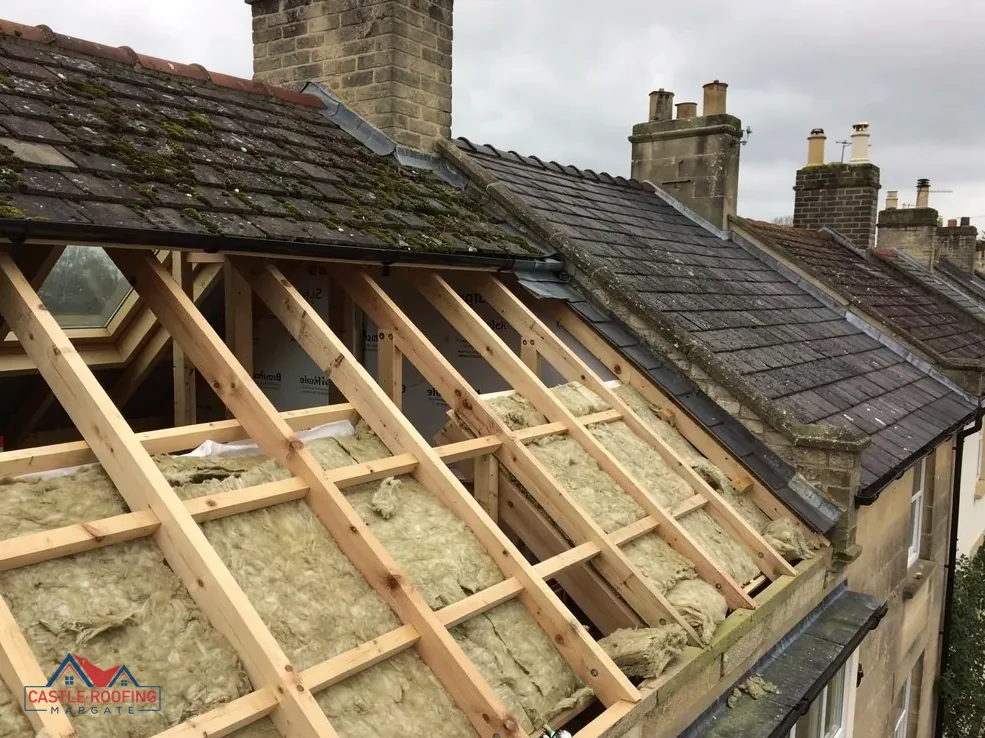
Once the foam is out and the roof is dry and ventilated, the loft needs insulating again. In a cold roof, the insulation goes between and over the ceiling joists and stops short of the eaves so air can still get in. In a warm roof, where the loft is used as a room, it is fitted between and under the rafters, with the ventilation or membrane above set to suit the design. We agree which of the two suits the house before the foam comes out, so the loft is never left bare for longer than the job needs. Mineral wool rolls laid in two layers across the joists are the familiar cold roof choice; rigid boards cut between the rafters suit a room in the roof. Our guide to what decides the cost shows how that choice affects the job.
The Building Regulations define renovation of a thermal element as providing a new layer in it or replacing an existing layer, and a roof counts as a thermal element. Where re-insulating after removal is renovation in that sense, Table 4.3 of Approved Document L applies: a roof whose U-value is worse than the 0.35 threshold is upgraded to an improved value of 0.16 W/(m²·K). Paragraph 4.13 lets the upgrade stop short where the roof's construction or its use rules it out, or where it would take longer than 15 years to pay for itself, and the roof is then improved as far as is feasible. The 2026 edition of Approved Document L takes effect on 24 March 2027.
Building control is the place to ask whether your job counts. Thanet District Council runs its own building control team, on 01843 577522, for Margate, Broadstairs, Ramsgate, Westgate-on-Sea, Birchington and Minster. For Herne Bay and Whitstable, Canterbury City Council works through STG Building Control, on 01634 331133. A registered building control approver can take the application on instead of the council. We settle the route at the survey, so the completion paperwork is ready when a sale or remortgage needs it, filed alongside the report on the timbers.
Bats in the loft
A loft can hold a bat roost, tucked in at the eaves or along the ridge where the foam stops. On GOV.UK, the law fully protects bats of every species along with their roosts and breeding places, and the guidance lists mending or renewing a roof among the jobs it applies to. Under the Habitats Regulations, harming or destroying a place where bats breed or rest is an offence even when nobody meant it. If we find droppings or other signs of bats as the foam comes away, work in that part of the loft stops and you are pointed to a bat survey before it carries on. A roost found early costs far less time than one found halfway through.
Show us the foam first
WhatsApp a photo from the loft hatch or book a survey; once we have seen behind the foam, the price follows in writing.
Our guarantee
10-Year workmanship guarantee. In writing
- We look at the roof before we price it
- One written price, one total
- We tell you before any extra work
Find us on Google (opens Google Maps in a new tab) What the guarantee covers
Spray foam removal questions from Margate and Thanet
What sets the price of taking spray foam out of a Margate loft?
Spray foam removal is priced after a survey of the loft, since the figure turns on what only the loft can show. The area covered, whether the foam is open-cell or closed-cell, how easy the loft is to work in, and whether the felt survives all count. If a slope has to be re-felted from outside, scaffold and the covering come into it too. We look at all of that before we quote.
Why do owners decide to have spray foam taken out?
The usual trigger is a sale or remortgage. RICS said in March 2023 that concern about spray foam in sectors such as equity release mortgages was having a wider impact on lenders, and it warns that foam stops a surveyor examining the roof timbers in full. Others want the foam gone because of damp: the Energy Saving Trust says foam partially seals the timber, so water from a leak can rot it unseen.
Can a house in Thanet be sold with spray foam still in the loft?
A house can be sold with foam in it, but the buyer's surveyor will note it, and the buyer's lender then decides whether it will lend. RICS advises checking with the mortgage provider whether its policy allows the product. Removing the foam before you sell, and handing over a report on the timbers, gives the buyer's side something to look at rather than a hidden roof and a question nobody can answer.
Does the roof have to be replaced when the foam comes off?
Not as a rule. If the felt and battens come through sound, the work stays inside the loft. If the felt tears as the foam comes away, the slope needs a new membrane, which means lifting and relaying the tiles or slates. A full re-roof is only the right call when the covering itself has had its life, and we show you what we found before you decide anything.
Will my lender accept the house once the foam has gone?
Only your lender can answer that, and no roofer should tell you otherwise. What removal does is take away the reason a surveyor could not report on the roof. Ask your lender what it wants to see, then make sure our written report with photos of the timbers, the felt and the new insulation reaches the person dealing with your case at the lender or the solicitor's office.
How many days should I set aside for the work?
That turns on how big the loft is, which foam was used and what is found beneath it. A job that stays inside the loft runs shorter than one where a slope has to be re-felted from outside, and scaffold on the pavement needs a Kent County Council licence applied for 5 working days ahead. You get a programme for the job once we have been up into the loft and seen it.
What insulation goes back into the loft afterwards?
In a cold roof, insulation goes over the ceiling joists with the eaves kept clear for air. If the loft is a room, it goes between and under the rafters as a warm roof. Where the work counts as renovation, Table 4.3 of Approved Document L sets a 0.16 improved value for a roof worse than 0.35, so we check that with building control before the new layer goes in.
Is it safe to stay in the house while the loft is cleared?
Yes. The work is confined to the loft and the route to it, with the hatch and landing covered, dust controlled at the opening and the bags carried straight out. Expect some noise during the agreed hours. If a slope is re-felted from outside, the scaffold goes up around the house and you can carry on living in it as normal, with the slope covered at night.
Read more
Reading on spray foam, lenders and lofts
 Guide · 9 min readHow spray foam insulation is removed, step by stepThe stages of a spray foam removal in the order they happen, from the survey and access to the timber check, the…
 Guide · 9 min readWhat decides the cost of spray foam removalNo two spray foam jobs cost the same. This piece sets out what moves the price, from the area sprayed and the…
 Guide · 9 min readOpen-cell or closed-cell spray foam: what is the difference?How open-cell and closed-cell spray foam differ under a roof, what the Energy Saving Trust says about rot risk, and why removal…
- GuideCan spray foam cause roof timbers to rot?
- GuideRe-felting a roof after spray foam removal
- GuideWhat a spray foam survey checks
- GuideWhy spray foam should never go on a leaking roof
- GuideInsulating the loft again after spray foam removal
- GuideSpray foam and equity release: what RICS said
- BlogDifferent types of roof insulation and their benefits, spray foam included
- BlogSpray foam in the loft: can you still sell or remortgage?
- BlogWhy are people removing spray foam insulation?
- AnswerCan spray foam insulation be removed from a roof?
- AnswerHow long does spray foam removal take?
- AnswerIs spray foam insulation bad for a roof?
- AnswerCan spray foam insulation cause mortgage problems?
- AnswerCan spray foam cause condensation in a roof?
- AnswerCan I stay at home while spray foam is removed?
- AnswerWhy does my loft smell after spray foam insulation?
- AnswerHow is open-cell spray foam removed?
- AnswerHow is closed-cell spray foam removed?
- AnswerWill spray foam show up on a homebuyer survey?
- AnswerDoes spray foam insulation affect home insurance?
- AnswerHow messy is spray foam removal?
- AnswerCan spray foam damage roof tiles or slates?
- AnswerCan spray foam be removed from just part of a roof?
- AnswerDoes re-insulating after spray foam removal need Building Regulations?
- AnswerHow is a roof ventilated after spray foam is removed?
- AnswerCan spray foam be removed from under a slate roof?
- AnswerIs spray foam under a flat roof a problem?
- AnswerCan I remove spray foam insulation myself?
- AnswerWhat happens to the waste from spray foam removal?
Roof work that can follow foam removal
- Roof inspectionsA roofer's inspection of your slopes, loft, chimney and gutters in Margate and across Thanet, with photos of what we find and a plain…
- Roof replacementRoof replacement and new roofs for houses, flats and shops across Margate and Thanet, from re-covering one tired slope to stripping the whole roof…
- Pitched roofingPitched roofing for slate, clay, peg and concrete tile roofs across Margate and Thanet, from one slipped tile above the gutter to a full…
Foam in your loft?
Tell us the town, what your surveyor or lender said and roughly when the foam went in, and we can arrange a visit to look.