How foam grips a slate roof
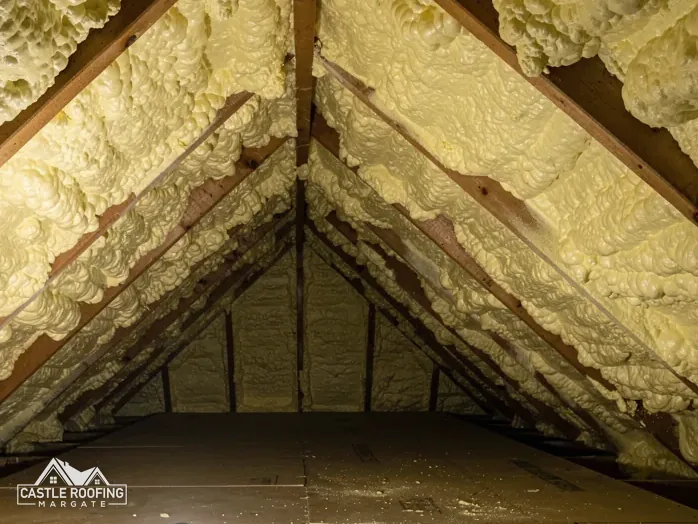
A slate roof is a stack of overlapping pieces of stone, each hung from a batten by nails or hooks. Behind the slates there may be underlay, or in older roofs nothing but the gaps between them. When foam is sprayed from the loft, it expands into those gaps and sets against whatever it finds.
For a slate covering that means the undersides of the slates, the nail holes, the battens and any felt. In places the foam reaches through the joints and holds neighbouring slates together, a bond that was never there before.
That is the difficulty. Slate is thin and splits along its grain, so a pull on foam attached to its back can lift the slate, crack it, or draw it out of place. The roof covering and the foam become one piece, and taking out one risks the other.
The thickness of the slates, their age and the pitch all play a part. Cupa, the slate supplier, reads BS 5534 as setting a 20 degree minimum for natural slate (a 500 mm slate, 115 mm lap, moderate exposure), and it warns against hook fixings on any slope under 25 degrees. A roofer checks how yours is fixed before touching the foam.
Old slate roofs and torching
Many older slate roofs have torching: a layer of lime mortar, often mixed with hair, pushed into the gaps between the rafters or battens from the loft side. Its job was to hold out wind-blown rain and dust through the joints between slates, in a roof that had no underlay.
Spray foam applied over torching sticks to the mortar. When the foam comes off, it can take loose or crumbling torching with it, and what was a sound layer becomes dust and fragments. Torching is easy to overlook until it starts to fall. Loose fragments of old mortar in the loft, or a gritty layer on the boards, are the usual sign that it is present.
Once exposed, a decision is needed about what to do. The slates may be fine and the torching can be patched, or the slates may have lost their fixings and the roof is better re-slated with underlay and battens. Our page on whether spray foam damages roof tiles covers the same issue for tiled roofs.
Each case is judged slate by slate. Only a survey can say which applies.
Taking the foam off without breaking more slates
Slow, steady work is the method. Foam is cut and scraped away in sections, working from the loft side, with the roofer supporting each slate with a hand or a tool as the bond is released. Where a piece will not give, it is left for a second pass instead of forced.
These are the things that make the difference:
- support on the slate side while the foam is eased off
- sharp tools used with the grain of the batten, not across the slate
- no leverage on nails, which can pull out and let slates slip
- a pause at any slate that cracks, so it can be replaced at once
Some breakage is likely on an old roof, and a roofer is prepared for it. Spare slates matched to the roof are on hand, and a slate that cracks during removal is renewed before the end of the day, so rain cannot get in.
The loft side is only one view. Part of the survey is looking from outside, for slipped or broken slates that suggest where foam has been pulling on the covering already.
When re-slating makes more sense
Sometimes the foam has done so much to a slate roof that stripping and re-covering is the sound answer. Signs of that are slates breaking in numbers as the foam is released, nails that have rusted through, battens that are soft or rotten, and underlay that has failed entirely.
Re-slating means taking the slates off, saving those that can be reused and renewing what cannot, then fixing new underlay and battens before the slates go back. Re-slating costs more than a patch. In return the roof gets a covering that is sound and ventilated, and the foam question is closed.
HomeBuilding gives natural slate lives of 100 years or more for Welsh slate and 75 to 100 years for Spanish, as typical ranges and not as promises. A roof of that kind is generally worth saving where it can be, which is why re-slating comes after a repair has been considered.
The removal page explains the general case, and spray foam removal sets out the service. The survey decides which route your roof needs, and one written price follows it.