Read this before agreeing to foam on a roof that has ever let water in. It covers why the repair has to come first, what foam does to a leak you cannot see, and how to tell whether yours is already covered.
A leaking roof makes the case for spray foam sound easy. Someone offers to spray the underside, the ceiling stops looking stained, and the loft is warmer too. The trouble is that a leak is a fault in the covering or the flashings, and insulation sprayed beneath it does not touch either.
The Energy Saving Trust, the independent advice body on home energy, is plain about the idea. Asked about spraying foam onto a leaking roof, its answer is: "We don't recommend doing this." That is the position this guide explains.
Along the Kent coast the roof works hard all year. The Met Office figures for its Manston station, averaged over 1991 to 2020, show about 613 mm of rain a year, and 110.05 days with 1 mm or more. A small fault lets water in on a good many of those days, so a leak should be found and mended before the roof is closed up behind foam. Our spray foam removal service works from that point: we survey first, then advise.
What the Energy Saving Trust advises
The Energy Saving Trust deals with this directly. On the practice of spraying foam onto a damaged or leaking roof, it gives a short answer and attaches no conditions and no list of exceptions. That is a useful thing to put to anyone who proposes it.
Its wider advice on spray foam sets out the mechanism. Foam sprayed straight onto the underside of the roof partly seals the timber. If water from a leak gathers in that sealed area, it will cause the timbers to rot. For open-cell foam the trust puts that risk well below the closed-cell case. Well below is not none, and no roof should be treated as safe because of the type of foam on it.
The point is about order, not about foam being forbidden. Insulation of any kind goes onto a roof that is already sound and dry. Foam adds a second reason for caution, because once it is on, the evidence of a leak is buried under it. If you are offered foam as the answer to a leak, ask the company to show you where the water is getting in and how that will be stopped. A clear answer names a slate, a flashing, a valley or a gutter. If the answer is vague, the leak will still be there after the foam is on, and you will have paid for a covering that hides it.
It costs nothing to ask, and the reply tells you a good deal about the company.
Why foam hides a leak instead of fixing it
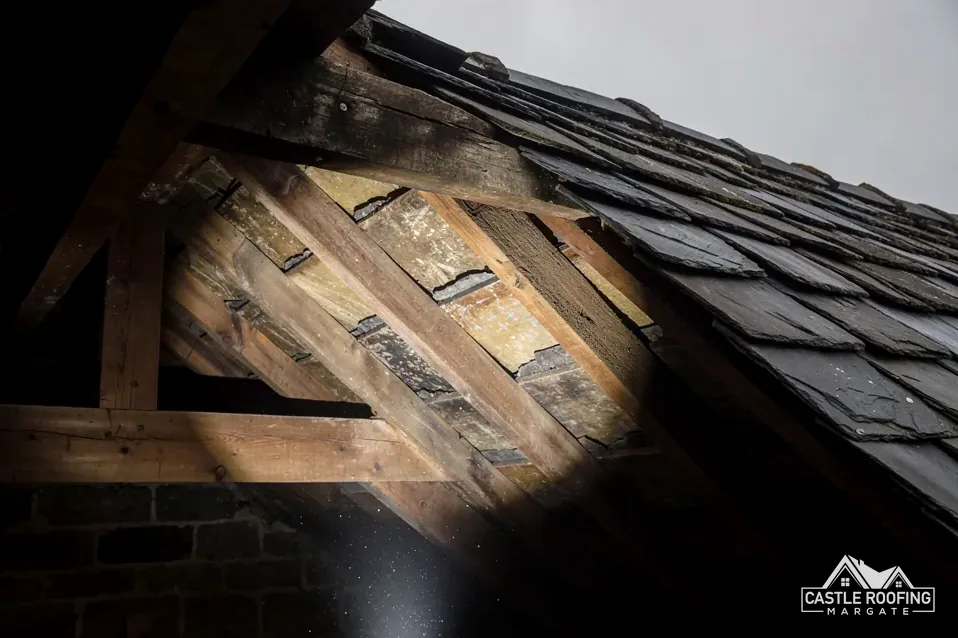
Roofs leak at particular places, and none of them is on the underside. Water gets in where the covering has failed or where two parts of the roof meet. Foam sprayed from inside does not touch any of them, and it cannot stop water entering from above.
The common places are worth knowing:
- a slipped, cracked or missing slate or tile, which lets rain through the covering
- a valley, the low line where two slopes join, with split lead or a failed liner
- a flashing, lead worked over the joint round a chimney or against a wall
- the ridge, where the capping has loosened
- a blocked gutter or outlet that sends water back under the edge of the roof
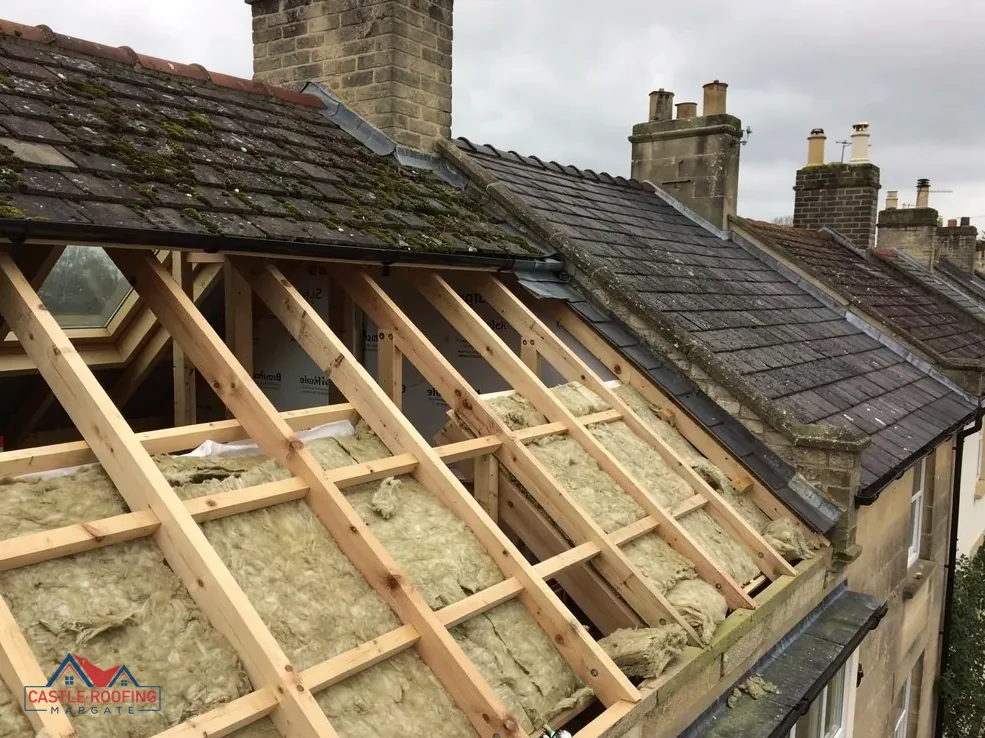
Each of these is mended from the outside, with the right material for the detail. Once it is mended, the water stops coming in. Spraying foam below does none of that work, however thick the coat.
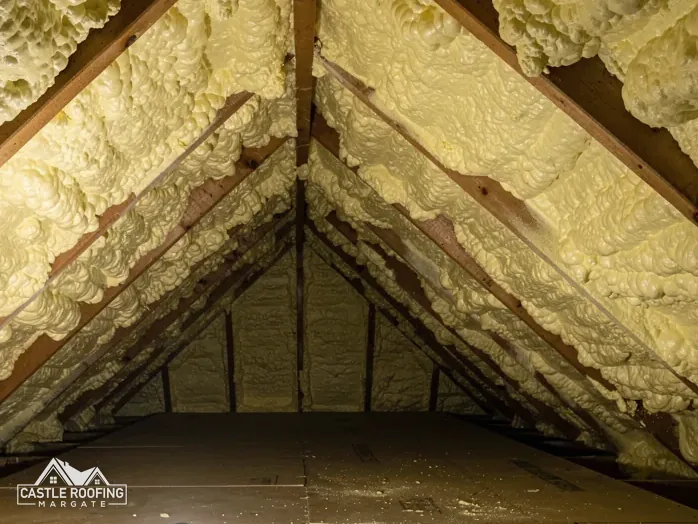
What foam does do is change what you can see. A damp patch on a ceiling is the roof telling you something. Cover the underside of the roof and the message goes with it, while the fault carries on behind. The leak may even get worse unnoticed, since nobody is looking at the timbers any more and the stain that would have raised the alarm cannot form where the foam is. A tenant, a buyer or a surveyor who looks into the loft later sees clean white or yellow foam and no clue that anything is wrong.
What happens to a hidden leak under foam
Water that gets past a covering does not stay where it landed. It runs along the felt, down a rafter or along a batten, and drops where it can. In an open loft you can often follow the track by the stain it leaves.
Under foam, the same water meets a surface that is partly sealed. The Energy Saving Trust describes where this ends: the water collects against the timber and causes it to rot. Rot of that kind takes time, so nothing may show for a while, and by the time something does, the damage has been under way for months or longer.
RICS makes the second half of the point. With the roof timbers covered in foam, nobody can inspect them in full, and a leak you cannot see is a leak you cannot assess.
| What you can check | Open loft | Under foam |
|---|---|---|
| Stain on a rafter | Visible | Covered |
| Damp felt | Visible | Covered |
| Softening timber | Can be tested | Cannot be reached |
That is the reason a surveyor looks for the leak first. The damage under foam is not necessarily worse than in an open loft. It is simply unseen until something else shows it, and that delay is what makes it expensive to put right. By then a rafter end or a wall plate may need cutting out, which means opening the covering above it as well as clearing the foam below, and replacing the section with new treated timber.
Repair the roof first, in this order
The right sequence is short, and every step before the insulation is about making the roof dry and sound. Foam, if it is used at all, comes last.
- Survey the roof from outside and from the loft, with photos of both.
- Find where the water is entering and confirm it, rather than guess.
- Repair the covering, flashing, valley or gutter that is letting it in.
- Let the timbers dry and check them for stains, soft patches and old rot.
- Replace any timber that has failed.
- Only then choose the insulation, with the roof's ventilation worked out first.
Ventilation follows BS 5250:2021, which covers moisture in buildings. How much air a roof needs depends on its construction and on the insulation chosen, so it is set for the roof in question and not by a rule of thumb.
This is also where plain advice can differ from a sales pitch. A repair that fixes the leak may be all the roof needs this year, and insulation can wait until you are ready for it. If the covering is worn out, a repair is the wrong answer, and the survey photos show why. Either way you decide with the evidence in your hand, and nothing is booked until you have seen it.
The order does not change: stop the water, check the timber, then insulate, and never the other way round on a wet roof.
If foam is already over a leak
Some homeowners find this page after the foam is on. The leak may have been there before the spraying, or it may have started afterwards, and a ceiling stain or a damp smell is what brings it to light.
The first step is a survey. We go over the covering outside to find the source of the water, and look at the foam from inside to see how far it reaches. That tells us whether the foam can stay while the covering is repaired, or whether a section has to come off so the timbers can be inspected.
A smaller removal is sometimes enough. Taking the foam from the affected rafters and a margin round them lets the timbers be seen and tested, while the rest stays put. Our page on partial spray foam removal explains when that is a sensible answer, and our guide to spray foam and timber rot covers what rot looks like once it can be reached.
If timber has been damaged, the repair is carried out before the insulation is replaced, and the ventilation is checked at the same visit. Photos come to you at each stage, so you can see the timbers and the repair for yourself. Where a section of foam has been removed, the opened bay is photographed clean, and again after the repair, so the before and after sit side by side in your records.
Questions to ask before anyone sprays
If a company is pressing you to spray a roof with a history of leaks, a few plain questions bring the real position out quickly. Put them in writing and keep the replies.
- Where exactly is the water getting in, and how was that confirmed?
- Which repair will stop it, and will it be done before any foam goes on?
- Have the roof timbers been checked for damp or decay, and can I see photos?
- What happens if the leak returns after the foam is on?
- How will the timbers be inspected in future, once they are covered?
- Which type of foam is proposed, and why that one?
A company that has looked at the roof properly will answer most of these without hesitation. A company that wants the contract signed on the day and cannot say where the water enters has not found the fault, and the Energy Saving Trust advice applies to its proposal in full.
An agreement signed at your home after a visit is an off-premises contract, with a cancellation period of 14 days. Citizens Advice runs a consumer helpline on 0808 223 1133 if you want to check your position before you commit.
If you would like the roof checked first, our survey looks at the covering, the flashings, the valleys, the gutters and the loft, and tells you what the roof needs before any insulation is considered.