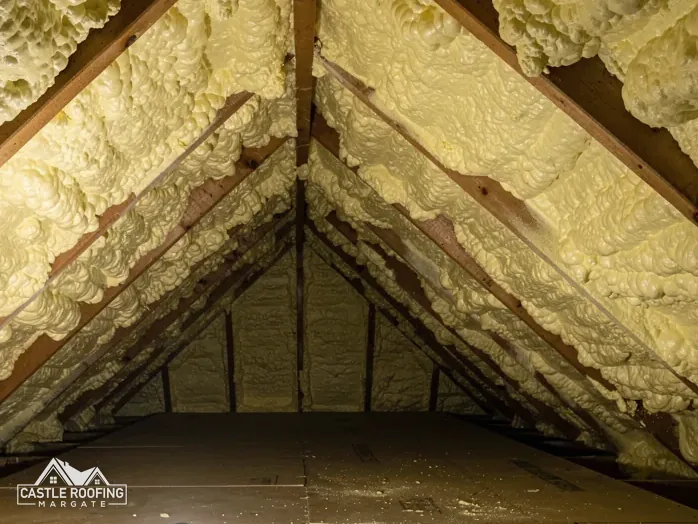
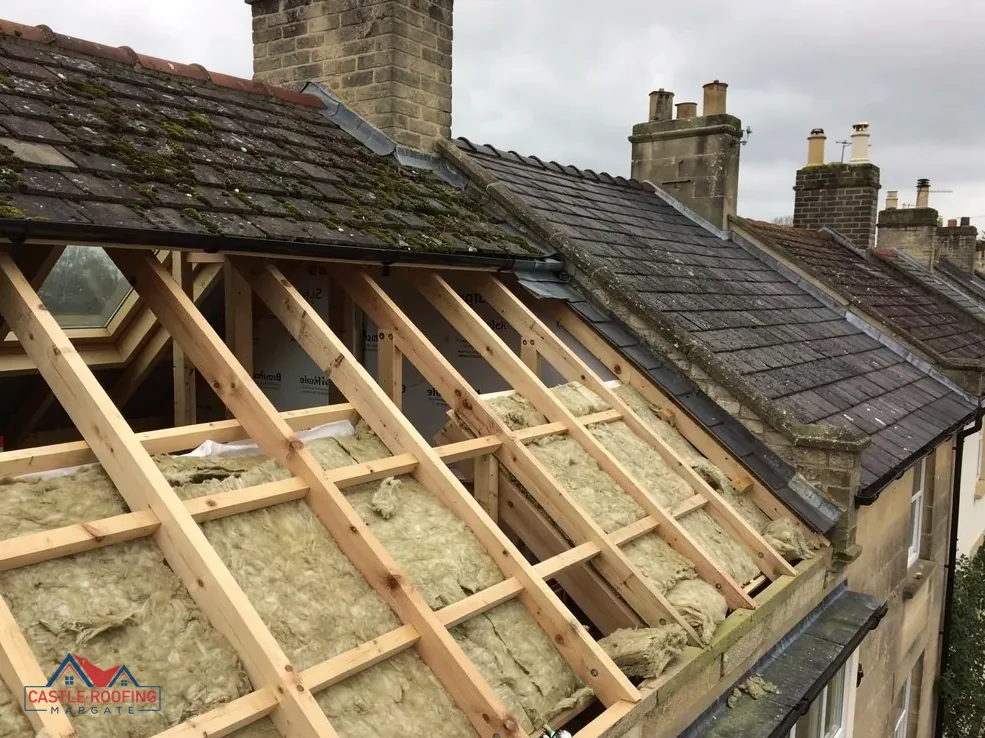
When partial removal is considered
There are good reasons to look at partial removal. The foam may be on one slope only, or the trouble may be confined to a patch of damp near a chimney or valley. Someone may simply want to open up enough of the roof to see what is happening before committing to the whole thing.
In general terms, taking foam from one area makes sense when the problem is local and the reason is clear. Examples include:
- a leak that has been traced to one part of the roof
- a repair that cannot be done with foam in the way
- a patch where damp or staining is already visible below
- an inspection opening so the timbers can be checked
It makes less sense when the aim is to tidy up the whole roof for a sale or lender, because a half-cleared loft will still be a foamed one in a buyer's eyes.
The reverse holds too. If foam is thick on every slope and the reason for removing it is a sale or a lender, a patch job leaves the question open and usually costs you the same set-up twice.
The survey comes first
Whether partial removal is sensible depends on what the roof is doing, and that is only found by looking. A survey checks the covering from outside, then the loft from inside, and notes where the foam has been laid, how thick it is and where signs of damp appear.
It also looks at the edges. Foam does not always end tidily, and a cut line through a continuous layer can leave an exposed face that needs protecting. Where the old and new insulation meet, the joint matters for how air moves in the loft.
The roofer explains the choices in plain words: clear the affected area only, clear more to make a sensible boundary, or remove the lot. You see photographs of your own roof beside each option.
The survey guide sets out what a visit covers, and what the written report contains. Ask for the survey to mark the edge of any proposed clearing on a photograph or a sketch. A clear line, agreed beforehand, avoids arguments afterwards about what was meant by part of the roof, and gives a future buyer something concrete to read.
What a lender may ask
In March 2023 RICS reported unease among some lenders, with equity release given as an example. Its consumer guide points owners to their own mortgage provider for the lender's policy, and it observes that foam-covered roof timbers cannot be properly checked.
That second point is why partial removal does not settle a lender's question. Whatever remains still hides the timber beneath it. A lender or buyer may therefore ask about the foam that is left, as well as the foam that has gone.
No roofer can say what a particular lender will accept, and nobody can promise that part removal will satisfy one. The right step is to ask your provider before work starts, then use the survey report to show what has been found and what has been done.
The equity release page looks at the same question from the borrower's side. If the lender asks for a roofer's report, the survey and the post-clearance photographs are the evidence to hand over. They show which timbers were seen and which remain covered, and a valuer may well want to see that distinction made.
Doing part now and the rest later
Some owners clear an area now and plan to deal with the rest later. That can work, provided the plan is written down so that nobody forgets what remains and where it sits.
A sensible record includes a sketch or photographs of the cleared area, a note of what was found under it, and the survey's view on how likely it is that the rest will need attention. The roofer can add a note of any signs that deserve rechecking after a winter.
There is also a practical cost to splitting the work. Scaffold, access and the setting up of dust protection are repeated for each visit, so doing the whole job once can be simpler even if the first quote looks larger. Both options can be written up so you can compare each as a full total, and weigh them properly against one another.
The service overview is under spray foam removal, which explains how a job runs from survey to new insulation. Whichever way you go, keep the paperwork together: the survey, the photographs and any notes on what was left. A tidy file is worth having when the time comes to sell or refinance the house.