Taking the foam off the rafters
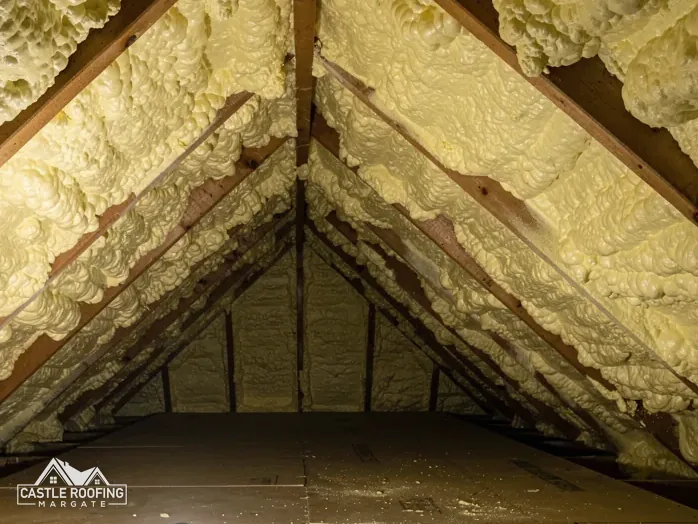
Spray foam is applied wet to the underside of the roof, where it swells and sets against whatever it touches. Removal is the same job in reverse: a roofer works along the loft, cutting and scraping the foam from the rafters, the battens and the underside of the roof covering, and bags it as it comes away.
How easy that is depends on the foam. A softer foam can be pulled and trimmed by hand, while a dense, hard foam needs more cutting and more patience. Our pages on open-cell foam and closed-cell foam set out the difference.
The roof covering often stays on. Whether it has to come off depends on how firmly the foam has bonded and what lies behind it, and that is only known once the first rafter bays are open.
The loft is covered in dust sheets first, the hatch is closed off with sheeting, and the waste is carried out through the house or the roof rather than left to build up. Nothing about this is exotic. It is slow, careful trade work, and the pace is set by the foam and by what the roofer finds behind it. The first bays cleared usually tell you how the rest of the roof is likely to go.
What gets checked once the foam is gone
This is the part that settles whether the roof is sound. Foam can bond to the underlay and cover timber, so each of these gets a close look as soon as it is exposed:
- the roofing felt or underlay, for tears, lifted laps and places where foam took part of it away
- the rafters and battens, for dampness, staining, softness and rot
- the roof covering from beneath, for slipped, cracked or missing tiles and slates
- the wall plate and the eaves, where water collects first
The Energy Saving Trust cautions that water entering behind spray foam can rot the timber under it, and it calls open-cell foam the lower-risk kind. Lower is still not nil, so open-cell foam gets the same inspection as any other.
You see photographs of what is found, taken before anything is covered again.
A damp rafter is probed with a bradawl, and a stained batten is looked at on both faces. Findings are noted by position along the roof, so repairs can be priced against a real list of what was found and not against a general impression of the loft.
Why a survey comes before the price
Nobody can say what a foamed roof looks like underneath until someone has looked. RICS makes the same point in its consumer guide: once foam coats the roof timbers, a surveyor cannot properly view or check them. A price given over the phone would be a guess.
A survey looks at the roof from outside, then from the loft, and notes how much foam there is, where it sits and what kind it appears to be. It also notes the signs that damp has already been at work. That tells you whether the job is a straightforward clear-out or one that leads to patching, or to replacing sections of felt and batten.
If you are reading up first, or the foam came up in a sale or a remortgage, spray foam removal is priced from the survey, as one figure in writing.
The outside of the roof gets the same attention. A dropped valley, a cracked flaunching (the cement bed that holds a chimney pot) or a run of slipped tiles points to where water has been entering, and those are the places to look hardest at inside the loft.
Putting insulation back afterwards
Once the foam is out, the loft has no insulation, so putting some back is part of the plan and not an optional extra. The choice is between insulating along the loft floor, which leaves the roof space cold and ventilated, and insulating along the rafters, which keeps the roof space warm.
Each route has its own demands. A cold loft needs ventilation that works, and a warm roof needs a design that deals with moisture, so the order of work matters: timbers checked, repairs made, new felt if it is needed, then the insulation.
Renovating a roof brings Building Regulations into play, and the thermal rules for the new layer sit in Approved Document L. Our guide to loft insulation after spray foam walks through the choices.
Removal is not the end of the job, then. It is the point where the roof can be seen again and decisions about its future can be made on evidence. Ask for the insulation plan to be set out alongside the repairs, so the loft is not left bare while decisions are made. Insulation that goes in too early, over damp timber, only repeats the original problem, so the order of work is part of the answer.