

Roofers in Deal
15.6 road miles from Margate. Deal roofs get a close inspection and a set of pictures before anything is priced, whether the job is a handful of slipped tiles or a whole new covering.
- Dover decidesDeal applications are decided by Dover District Council.
- Six conservation areasSix conservation areas within 0.75 km of the centre.
- Dover inspectsDover District Council's own building control team.
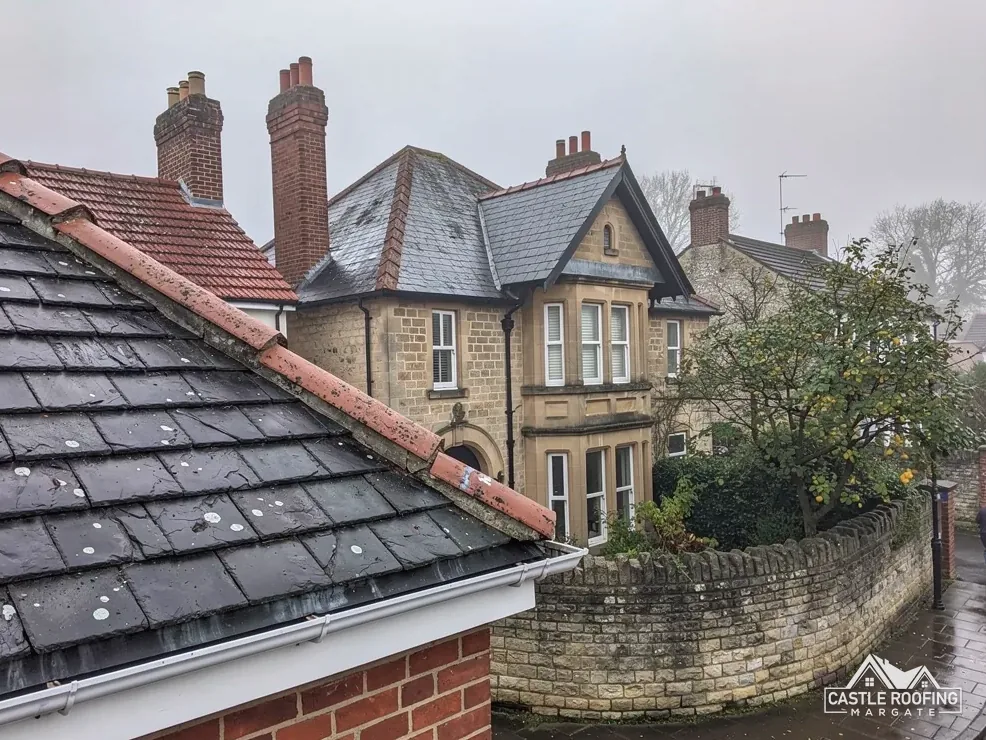
Starred listings, six areas and two Deal directions
Grade II*
Church of St George and Queen Anne House were both listed on 1 June 1949, so the entry comes first.
Two directions
Dover has Article 4 directions for Middle Street and Nelson Street in Deal, and they can reach roof alterations facing the street.
Scheduled
Artillery Castle, within about 500 metres of the centre, is a scheduled monument, which has its own consent route.
Deal parish
A parish of 20,342 people and 321 listed entries to check
| Council | Dover District Council |
|---|---|
| Building control | Dover District Council's own building control team |
| Scaffold and skip licences | Kent County Council |
| Conservation area | Deal - Middle Street; Deal - Nelson Street; Deal - Victoria Road & Wellington Road; Walmer - Seafront; Deal - Princes Street Extension; Deal - Nelson Street Extension |
| Population, 2021 | 20,342 (Deal parish) |
| From Margate | 15.6 road miles, about 27 min |
| Listed within 900 m | 321, National Heritage List |
| Grade II*, first listed 1949 | Church of St George; Queen Anne House |
| Scheduled monument | Artillery Castle at Deal |
| Environment Agency map | Flood Zone 3 within about 250 m |
Deal is a town in Dover District, with 20,342 usual residents in its parish at the 2021 Census. Dover District Council is both the planning authority and the building control team, which keeps the paperwork under one roof.
Sources: ONS Census 2021, Dover District Council, Kent County Council, OSRM road routing.
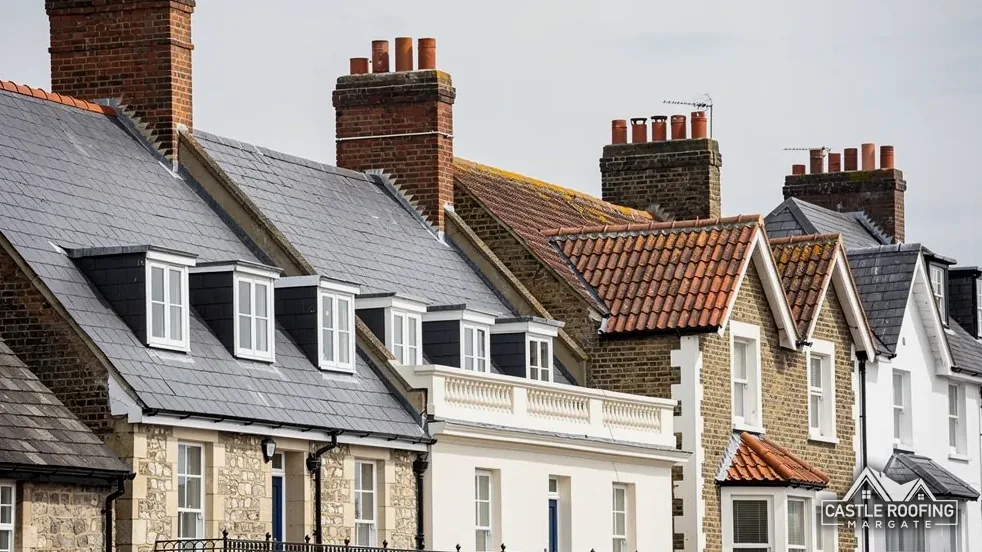
Deal, listing to licence
Deal roofs, from the starred listings and the Middle Street direction to the scaffold on the road outside
The listed buildings and the monument, the six conservation areas with Dover's building control line, and the scaffold, skip and Manston weather rules, in three chapters.
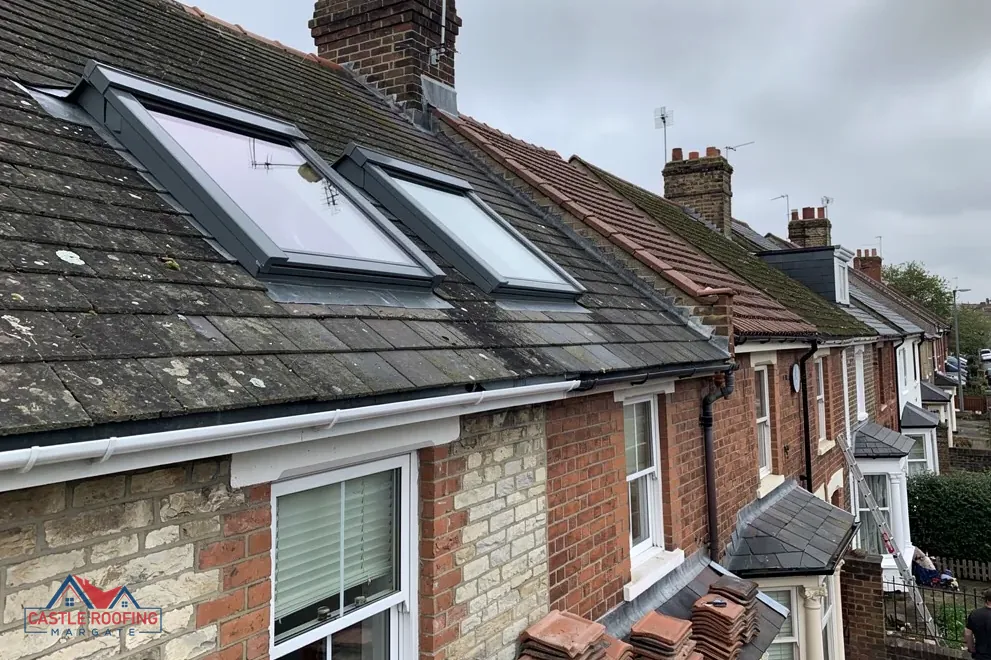
Chapter 01 of 03
321 listed entries and the starred houses of Deal
Historic England's National Heritage List shows 321 listed entries within 900 metres of the centre of Deal, which is a great many buildings to check a roof against. The named ones show the spread. Church of St George and Queen Anne House were both first listed on 1 June 1949 at Grade II*, and St George's Church Memorial Cross, Deal, followed on 12 March 2015, also at Grade II*. Deal parish counted 20,342 usual residents at the 2021 Census, so the town is large enough that the list becomes a street-by-street question. In practice the entry for a Deal address is read before the survey, not after it.
A listing covers the whole building, and section 7 of the Planning (Listed Buildings and Conservation Areas) Act 1990 asks for listed building consent when work would affect its character. Up top, character means the slate or tile itself, the ridge (the top line), the hips (the sloping lines at the corners of a hipped roof), the stacks and the lead flashings round them. A different slate or tile, a changed lead code, or a stack taken down to the roofline can each count. Dover District Council decides the application, and our slate roofing page covers the material side.
St George's holds Church of England services, so for as long as that continues its roof sits outside listed building consent and goes through the faculty system, because section 60 of the same Act lifts listed building controls from a church in ecclesiastical use. Catholic, Methodist, URC and Baptist congregations each keep a procedure of their own for their buildings, while Quaker and Unitarian meeting houses, and any church the Churches Conservation Trust holds, return to listed building consent. Which of those fits a chapel turns on who owns it and how it is used today, and that is settled before any roof work is described.
Artillery Castle at Deal is different again. Historic England records it as a scheduled monument within about 500 metres of the centre, and under section 2 of the Ancient Monuments and Archaeological Areas Act 1979 it is an offence to carry out works to one unless they are authorised, so scheduled monument consent comes first. A house near it is judged on its own record, and we read that before we price.
| Entry | Grade | First listed |
|---|---|---|
| Church of St George | II* | 1 June 1949 |
| Queen Anne House | II* | 1 June 1949 |
| St George's Church Memorial Cross | II* | 12 March 2015 |
Source: Historic England, National Heritage List for England
Chapter 02 of 03
Six conservation areas and Dover's rule on like-for-like
Six conservation areas lie within about 0.75 km of the centre of Deal: Middle Street, Nelson Street, Victoria Road and Wellington Road, Walmer Seafront, the Princes Street Extension and the Nelson Street Extension. Dover District Council counts 57 conservation areas across its district. Inside one, some work that is normally permitted development needs an application, and the council's page gives building roof dormers as an example. Our roof window planning guide sets out the conditions for roof windows. With six areas packed into one small stretch of town, two neighbours can sit either side of a boundary line, which is why the check is made house by house and not street by street.
Article 4 directions are the sharper tool. Dover's page records an Article 4(2) direction for Middle Street in Deal, confirmed on 1 March 2000, and one for Nelson Street dated 13 December 2017. It explains that a direction can cover altering the roof of a dwelling, and that this bites on any part of a home that looks onto a street, a waterway or public open land. On a terrace facing the street, the front slope is exactly such a part. Which direction applies to your address, and what it takes away, is for Dover District Council to answer, and we ask before we price.
Myth
A like-for-like re-roof in Deal never needs approval.FactDover District Council puts a replacement roof covering on its approval list, matching or not.
Myth
A conservation area stops roof changes.FactIt removes some rights, dormers for one; a plain re-covering turns on its effect on the outside.
Myth
An Article 4 direction covers all of Deal.FactDirections cover defined areas, and Dover says they can reach street-facing roofs.
Source: Dover District Council, building control and conservation area pages; Planning Portal
Dover's own line on re-roofing
Dover District Council names a replacement roof covering, like for like or not, as work needing approval, so a Deal address has its route confirmed before any re-roof starts. That is stricter than the Planning Portal's test, which asks only whether under 25 per cent of the building envelope and under 50 per cent of the roof is touched, and Dover's line applies to Dover addresses only. Dover District Council's own building control team handles the inspections.
Weight matters on top of that. A new covering that makes the roof 15 per cent or more heavier needs approval under the Planning Portal's wording, whichever council you are in, and an old frame under a heavier slate is a case for an engineer or surveyor to look at before work starts. That is the point at which a roof replacement becomes a design question rather than a repair.

Chapter 03 of 03
Scaffold, skips and weather on a Deal street
Standing scaffold on a Deal footway or carriageway requires a licence under section 169 of the Highways Act 1980, and the authority is Kent County Council, not Dover. On Kent County Council's page the scaffolding firm is the one that submits the application, with dates agreed once the survey is done. The council charges £52 per week for 2026 to 2027, and wants applications, renewals too, 5 working days before the start. Public liability cover of £5 million is a condition, and a site inspection, where the council decides one is needed, is £78. On a narrow Deal street, the 1.2 metres the conditions require between scaffold and carriageway decides where the scaffold can go.
Skips have their own permit from Kent County Council: £45 per week for 2026 to 2027, applied for 5 working days ahead, no more than 5 metres long and 2 metres wide. Stripped slates, battens and underlay are loaded into it, and the footway is swept before it leaves. Put a skip in the road unpermitted and Kent County Council charges £120 for the inspection and £45 for a retrospective permit, so the permit comes before the skip is ordered. A roof stripped in a wet week is a roof at risk, so the weather forecast and a plan for covering the open slopes at the end of each day are part of the programme. Footway skips are a special case: express permission is required, and a 1.5 metre pedestrian walkway has to stay open.
The weather figures we use are the Met Office averages for Manston, 1991 to 2020: rainfall of about 613 mm a year across 110.05 days of 1 mm or more, a mean wind at 10 metres of 9.86 knots (11.21 knots in January), and 21.43 days with an air frost. Deal lies on the Kent coast, and Cupa, the slate maker, grades buildings in coastal areas and on slopes, hills or tall sites at a higher exposure. Under BS 5534 that raises the question of fixings, which are calculated for each roof, never copied from a neighbour's.
The four steps below show how a Deal re-roof is ordered once the record has been checked. Each step waits for your agreement.
From first look to a clear street in Deal
Inspect, then pictures
The roof is looked at from the street and close up, and you see what we saw.
Check the record
List entry, conservation area, any Article 4 direction and Dover's building control line.
Licence and permit
The scaffolder applies to Kent County Council; any skip gets its own permit.
Work and clear-up
Fixings are set for the roof, and the waste goes with us.
10-Year workmanship guarantee. In writing
Around Deal
Along the Dover District coast from Deal
Deal shares Dover District Council, its own building control team and Kent County Council's highway licences with Walmer, Sandwich and Dover itself, so the route a roof takes through the offices is the same along that stretch.
Deal directions, listings and Dover's rule
Which Deal roofs do the Middle Street and Nelson Street Article 4 directions touch?
Dover's page records an Article 4(2) direction for Middle Street, confirmed on 1 March 2000, and one for Nelson Street dated 13 December 2017. Directions can reach the roof of a dwelling where it looks onto a street, a waterway or public open land. Dover District Council confirms whether yours does, and we put the question before any price is given.
Does Dover's like-for-like rule apply to my house in Deal?
Yes. Dover District Council counts a replacement roof covering, even a matching one, as work needing approval, so a Deal address is checked with its building control team. The Planning Portal's 25 per cent and 50 per cent test is the national one, and it is not Dover's wording at all.
Does a repair on the roof of a Deal church go through listed building consent?
Not always. A Church of England building in current use, such as the Church of St George, goes through the faculty system instead. A Catholic, Methodist, United Reformed or Baptist chapel follows its denomination's own procedure; a Quaker or Unitarian meeting house, or a Churches Conservation Trust church, comes back to listed building consent; and works at Artillery Castle, a scheduled monument, need scheduled monument consent. The first step is establishing which applies.
Whose job is the scaffold licence on a Deal terrace?
The scaffolding firm sends the application to Kent County Council, the highway authority, giving 5 working days' notice. The fee for 2026 to 2027 is £52 per week, public liability cover of £5 million is required, and the scaffold must stand 1.2 metres or more from the carriageway. For questions beforehand, Kent County Council highways are on 03000 41 81 81.
How many listed buildings could affect a roof job in Deal?
Historic England's National Heritage List shows 321 entries within 900 metres of the centre. The only one that matters for your roof is the entry for your own address, if there is one. If there is, section 7 of the 1990 Act requires listed building consent for any work that touches its character, and Dover District Council decides.
Pictures first for a Deal roof
Tell us the street and what you can see from it, and a visit to Deal ends in one written total.