
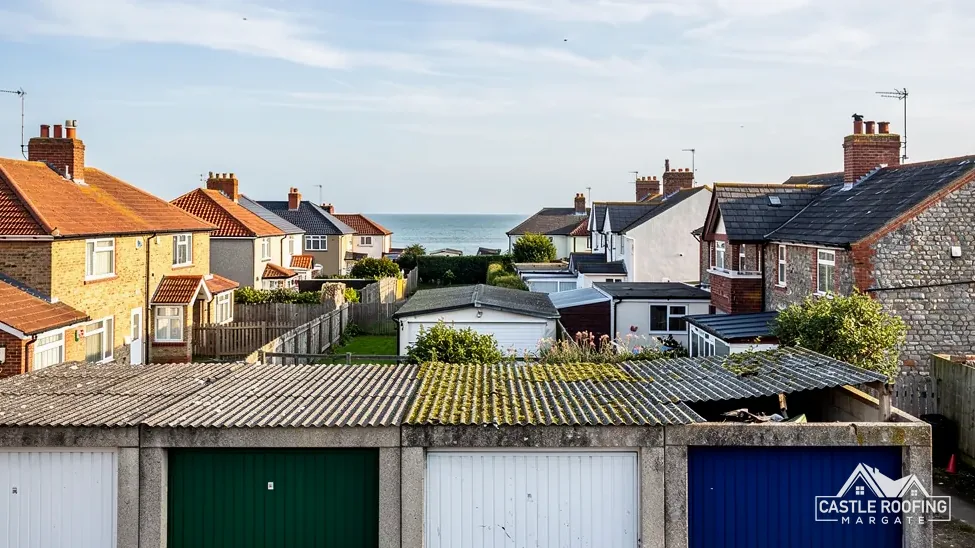
Garage Roof Replacement in Margate
New roofs for garages across Margate and Thanet, from one felted lock-up behind a terrace to a whole row of corrugated cement sheets on a garage block.
Garage and shed roofs
The parts of a garage roof we put right
- Corrugated cement sheets
- Felt and EPDM coverings
- Timber deck and joists
- Edge trims and drips
- Gutter and downpipe
Old cement sheet roofs lifted off whole and sent away on the right paperwork, flat decks re-covered in EPDM, GRP or felt, steel sheet roofs fitted, and leaks traced and repaired on garages, sheds and lock-up blocks.
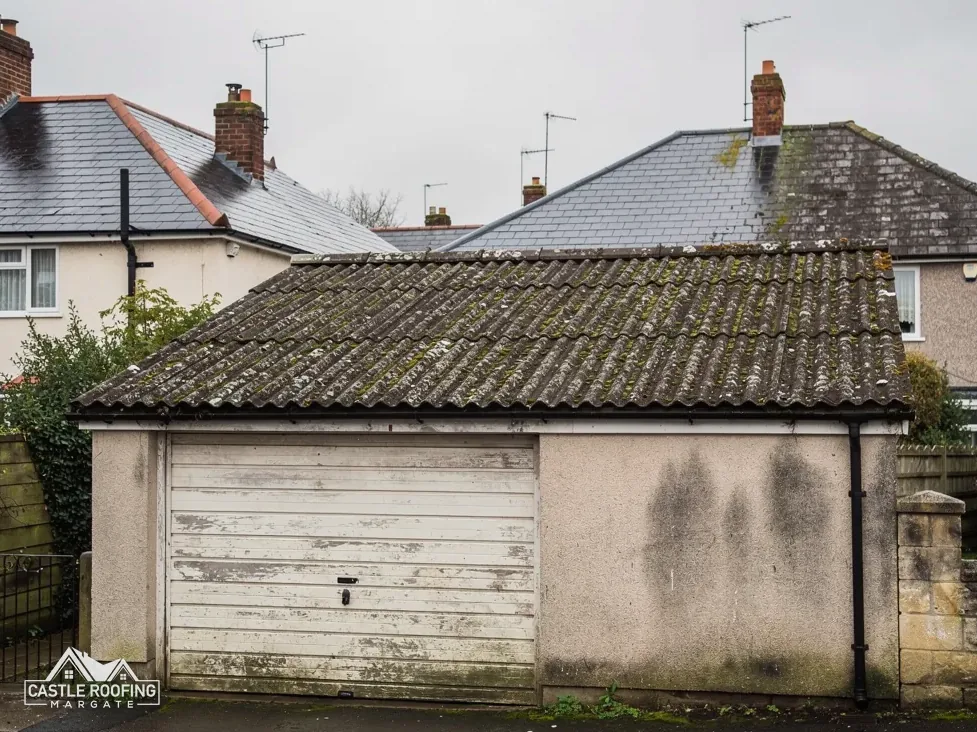

When a garage roof is close to the end
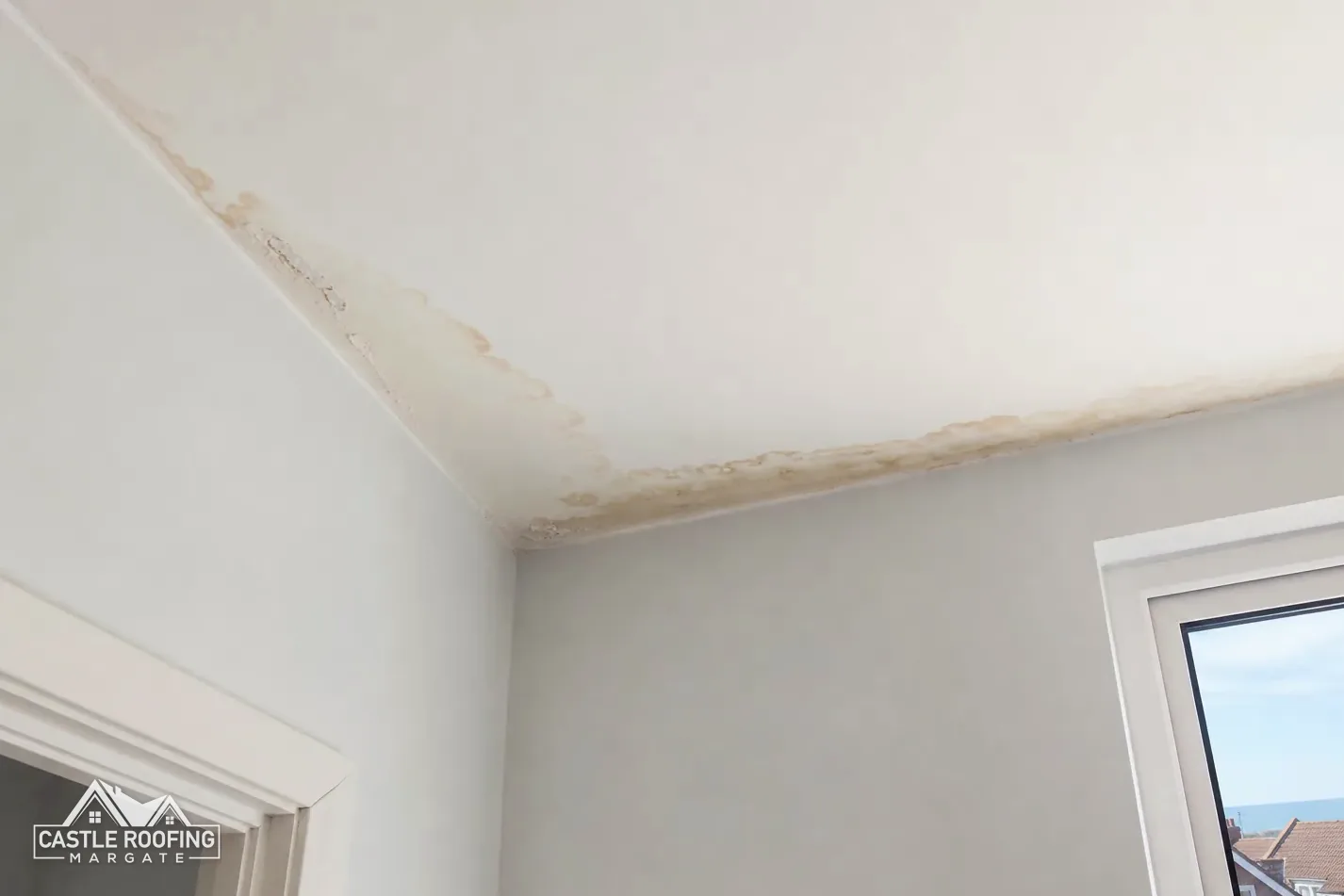
Drips with no rain
Water forming under bare steel or cement sheet is condensation, and it rots whatever it lands on.
A dip between joists
A deck that sags or flexes underfoot has been taking in water for a long while.
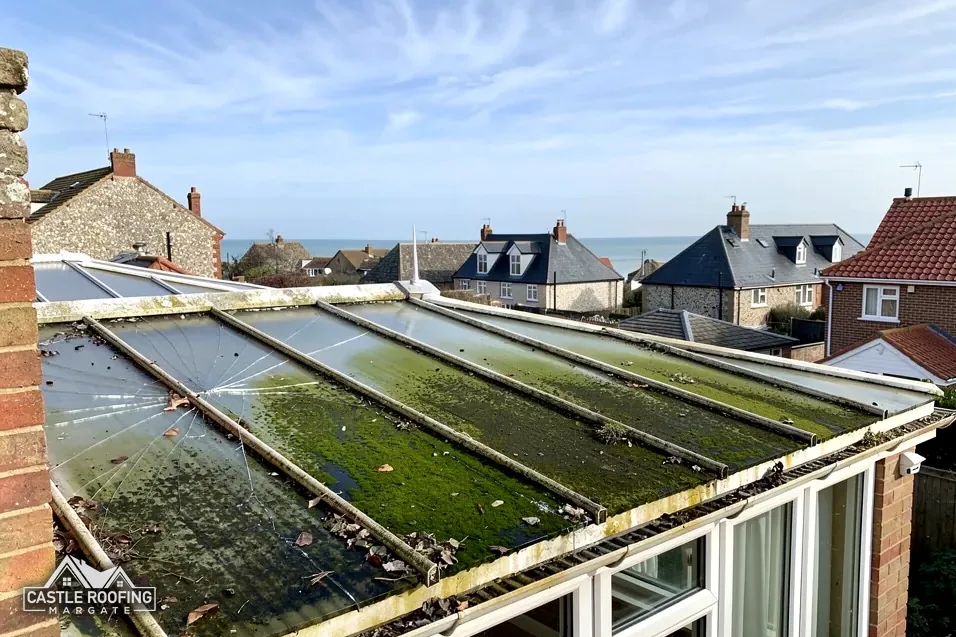
Cracks and lifted laps
Split felt, an opened sheet lap or a cracked cement sheet lets the next shower straight in.
The garage roof guide
How garage roofs in Thanet are built, taken off safely and covered again
Six chapters on the roof over your garage, from spotting asbestos cement to picking the new covering and what sets the cost. Start with the one that fits.
Chapter 01 of 06
What sits on top of a Thanet garage
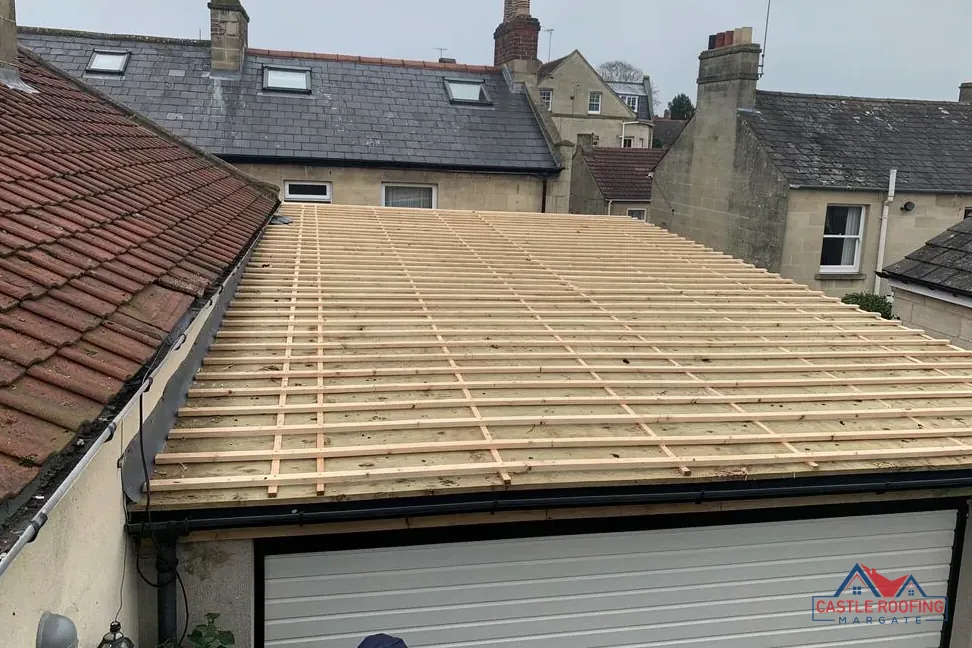
A garage roof is the plainest roof on a property and often the one left longest without anyone looking at it. It sits low, out of sight from the front door, so a cracked sheet or a lifted edge can go unnoticed for years. Climb a ladder at the back of a garage in Margate, Ramsgate or Broadstairs and you will find one of a handful of coverings: corrugated sheets bolted down to purlins, which are the timber or steel rails running across the roof; a flat timber deck with a waterproof layer laid over it; or the shallow sheet roof that came as part of a precast concrete sectional garage kit.
Corrugated sheets come in several materials that look alike from the ground. The grey cement sheet with a deep, even wave is the one to treat with care. The HSE's rule of thumb is to presume asbestos is present wherever a building went up, or was refurbished, before 2000. A garage counts as a building here, so a grey cement sheet roof on a garage of that age is handled as asbestos cement until a laboratory test of a sample says otherwise. Newer fibre cement sheets are made without asbestos, and from the path the two can be impossible to tell apart. Our page on telling whether roof sheets contain asbestos sets out the clues and why only a test settles it. Steel box-profile sheets, with their square ribs, and black corrugated bitumen sheets turn up on garages and sheds too.
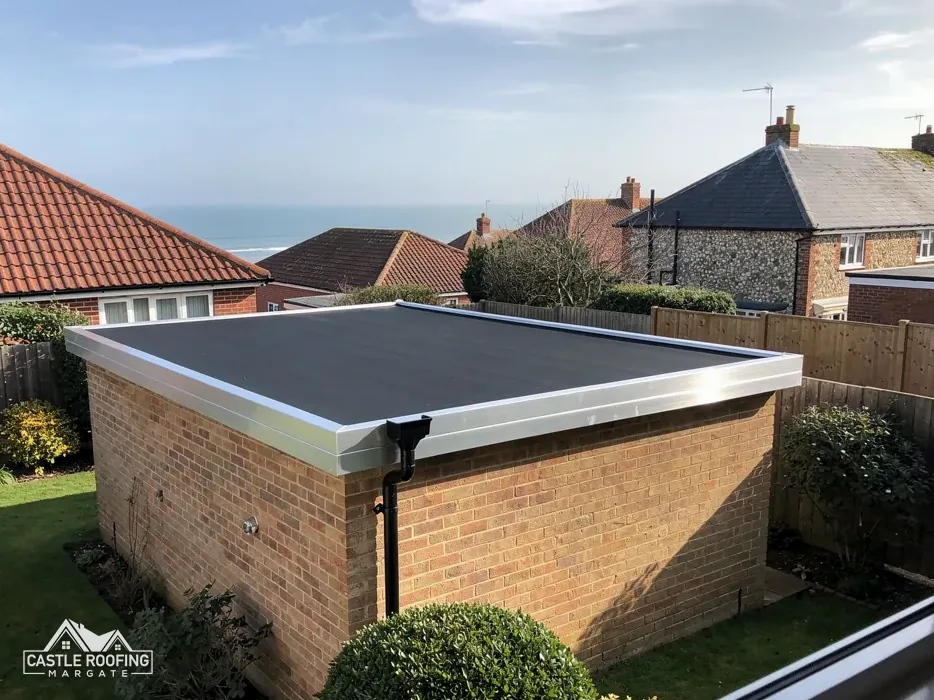
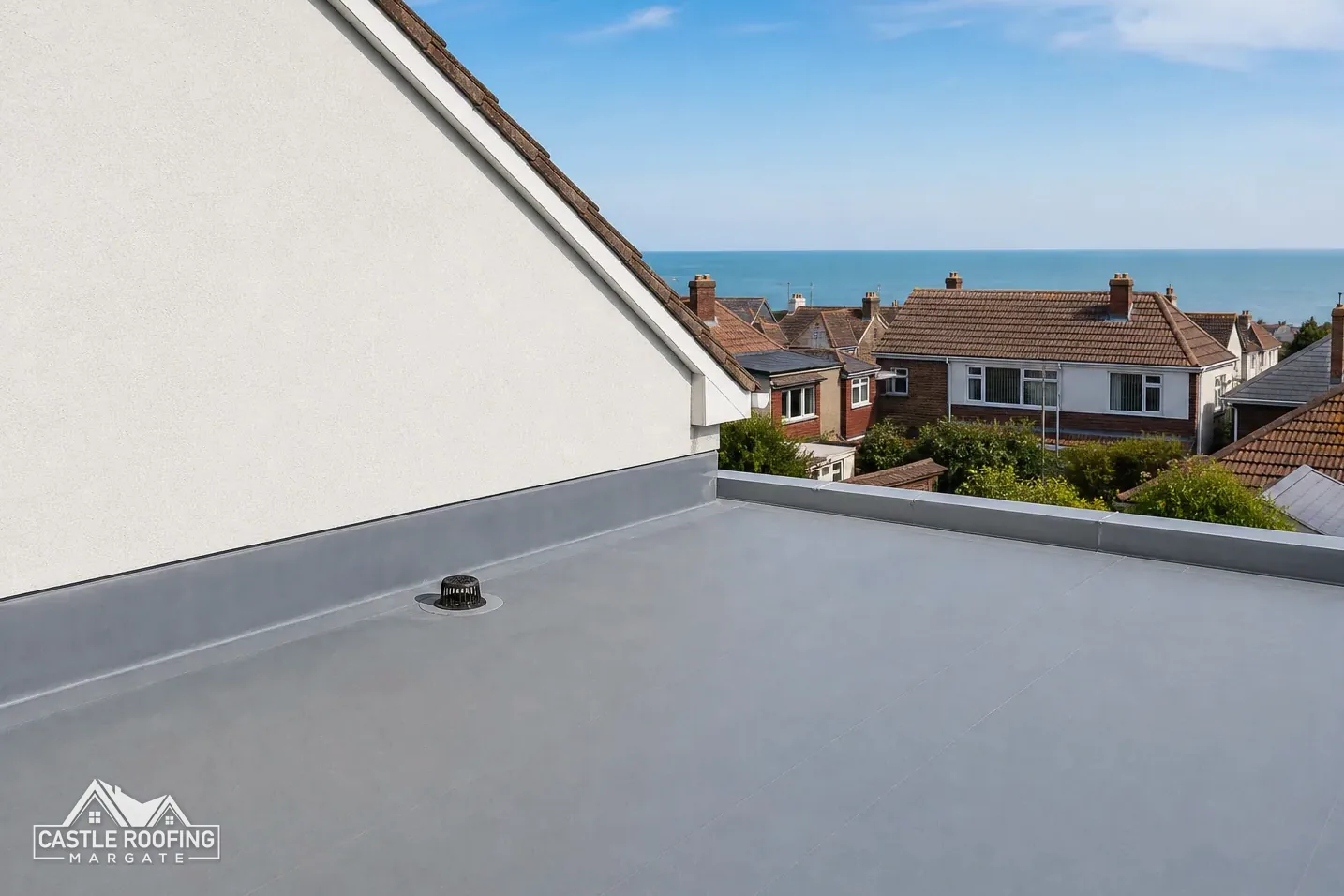
Flat garage roofs follow the same pattern as a flat roof on a house extension, only smaller. Joists span from wall to wall, boards are fixed over them to make the deck, and a covering keeps the water out. That covering might be bitumen felt in two or three layers, a single sheet of EPDM (a synthetic rubber membrane), or GRP, which is glass-reinforced plastic laid wet over the boards and left to cure hard. At the edges a metal or plastic trim throws rain clear of the wall, and where the garage meets the house an upstand, the covering turned up the wall, sits under a flashing that seals the joint. Our flat roofing page covers the same coverings on extensions and dormers.
Whatever the covering, nobody should climb onto it to take a look. HSE guidance A14 puts it in five words, "AC roofs are always fragile", and an old cement sheet can give way under one person's weight. A felt deck that has been wet for years can be no better. The Work at Height Regulations 2005 require every employer to take suitable and sufficient measures to prevent falls, so we survey a garage roof from a ladder at the edge, from a platform or from an upstairs window, and the photos we take come to you with a plain account of what each one shows.

Chapter 02 of 06
The HSE categories for cement sheets and boards
- 2000Built before it: assume asbestos
- 40 yearsRecords kept for notifiable work
- 5 sacksFree each month at Kent centres
Source: HSE; Kent County Council
The HSE sorts asbestos work by how much fibre it is likely to release, and a garage roof can fall into more than one category. Its page on work that needs no licence includes "asbestos cement products, (eg roof sheeting and rainwater goods) provided the material is carefully handled/removed without breaking up". Sheets that have greyed and grown moss with age still sit in that group, provided nothing worse has happened to them, and it is the route for careful removal of an ordinary cement sheet garage roof.
Where sheets have been substantially damaged or broken up, or will be during the work, the job becomes notifiable work, called NNLW, which still needs no licence but has to be notified before it starts, and the HSE says registers of work, the health records, must be kept for 40 years. A storm-smashed roof or one that has had sheets pulled off in pieces can tip a simple job into this category. Because the material decides the category, the HSE's age test matters here too: on a garage dating from before 2000 we treat the sheets as asbestos cement until the laboratory result comes back.
The board sometimes found under the eaves is another matter. Asbestos insulating board, or AIB, is softer and looser than cement sheet, and the HSE names external soffits as one place it turns up. The HSE treats work on AIB as licensable unless the risk assessment puts it in the short-duration class. Where a garage has board soffits or a board ceiling as well as a sheet roof, we bring in an asbestos contractor who holds a licence for that part, and our own work stays with the roof covering.

Chapter 03 of 06
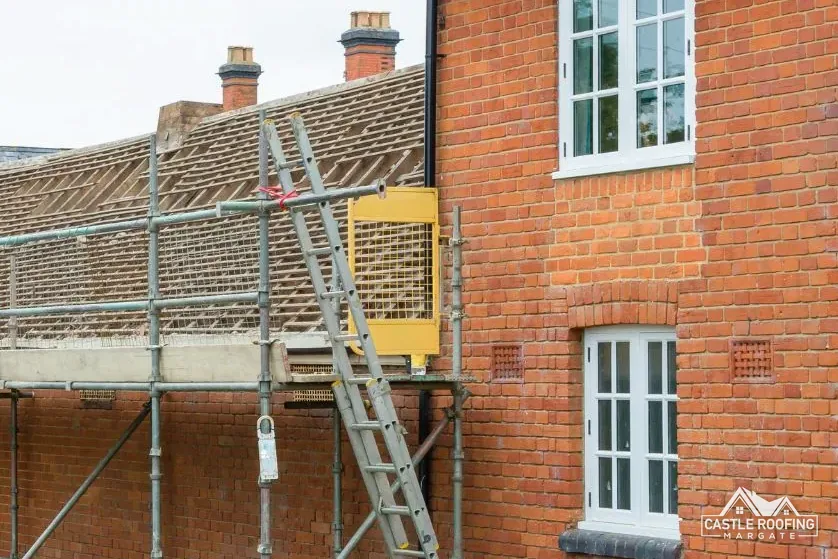
Taking a cement sheet roof off in the right order
Removal starts before anyone touches a fixing. A sample from a sheet edge goes to a laboratory, and while we wait for the result we photograph the roof, the gutter, the walls the sheets sit on and the route the waste will take out to the road. If the garage backs onto a neighbour's garden or a shared access lane, we agree with them when the work will happen, and where the sheets will be stacked and wrapped, so nobody walks through the working area. Where a skip has to stand on the road, Kent County Council's skip permit costs £45 per week for 2026 to 2027, needs 5 working days' notice and limits the skip to 5 metres by 2 metres, and the skip company makes the application. Paperwork runs alongside: under CDM 2015, regulation 7(1), the duties of a domestic client pass to the contractor where there is only one, and regulation 15(5) has that contractor draw up a construction phase plan, so the written plan for your garage is ours to prepare, not yours.
An asbestos sheet roof, in order
Sample and test
A piece from a sheet edge is tested before work is booked.
Agree access
Neighbours, shared lanes and the skip position are settled first.
Lift sheets whole
Fixings are unscrewed or cut so each damp sheet comes away intact.
Wrap and label
Every sheet is double-wrapped in heavy plastic and labelled.
Lock it away
Wrapped sheets go into a lockable skip or closed vehicle.
Carrier and note
An upper-tier carrier takes the waste on a consignment note, copied to you.

Chapter 04 of 06
EPDM, GRP, felt or steel for the new garage roof
With the old covering gone, the question is what goes back on. On a flat garage the three common choices are EPDM, GRP and felt, laid over new deck boards if the old ones have softened. EPDM is a synthetic rubber sheet, and on a single garage it can often be laid in one piece, so there are no joins in the open roof to fail. It is bonded to the deck, dressed round the edges and finished with trims. Our page on EPDM rubber roofs for garages goes into the details.
GRP is fibreglass matting wetted out with resin on the roof and left to cure into one hard, jointless skin with a pigmented topcoat. It needs dry weather and careful mixing, but it copes well with ladders, leaves and the odd foot. Felt is the long-standing choice: layers of bitumen membrane, torched or bonded one over another, finished with a mineral cap sheet. It costs less to lay and has a shorter life, so a felt roof suits a garage you expect to change or rebuild within a decade or so.

For a typical life, HomeBuilding gives EPDM 25 to 30 years and Less puts it at 30 to 50 years. For GRP, HomeBuilding gives 25 to 30 years and Less 25 to 40 years. For torch-on felt, HomeBuilding gives 10 to 15 years and Less 10 to 20 years. These are ranges, not promises, and a roof laid on a wet or poorly supported deck will fall well short of any of them.
Every flat roof needs a fall, the slight slope that sends rain to the gutter. BS 6229:2025, the code of practice for membrane flat roofs, replaced the 2018 edition, and the standard keeps a minimum finished fall of 1:80 across the open roof. IKO advises designing the roof for a fall of 1:40. On a garage we create the fall with firring pieces, tapered timbers fixed along the joists, and check it with a level before the boards go down.
Steel and fibre cement on sheet roofs
| Covering | HomeBuilding | Less |
|---|---|---|
| EPDM rubber | 25 to 30 years | 30 to 50 years |
| GRP fibreglass | 25 to 30 years | 25 to 40 years |
| Torch-on felt | 10 to 15 years | 10 to 20 years |
Source: HomeBuilding, Sep 2025; Less, Oct 2026
Chapter 05 of 06
Repair or replace: leaks, drips and soft decks
Not every leaking garage roof needs replacing. A single split in sound felt, a lap that has lifted at the edge, a trim that has come loose or a flashing that has pulled away from the house wall can each be repaired on their own, and a repair is the better buy while the deck below is dry and firm. We tell you which of those you have, show you the photos, and leave the decision with you.
Replacement becomes the sensible answer when the fault is in the structure rather than the surface. If the boards flex or sag between joists, water has been getting into them for some time, and a patch on top only hides the rot underneath. Several patches in a row on one roof usually mean the covering as a whole has reached its end. On a cement sheet roof, a crack can be sealed as a stopgap, but drilling, cutting or scraping the sheet is exactly what the HSE's categories are there to control, so we keep repairs to that sheet as light as possible and talk to you about replacement.
Thanet's weather explains why small faults grow. The Met Office's averages for its Manston station, 1991 to 2020, give about 613 mm of rain a year spread across 110 days with 1 mm or more. On a low garage roof that rain has nowhere to go but the gutter, so a blocked outlet or a gutter laid without a fall leaves water sitting against the edge of the deck. Brett Martin, the rainwater maker, sets a small, steady fall along every gutter run, and getting that right on a short garage gutter costs very little. A leaf guard over the outlet helps where trees overhang the lane.
Garage roof repairs worth doing
The roof repairs that pay back on a garage are the unglamorous ones. Re-dressing an upstand that has slumped away from the house wall and refixing the flashing over it stops the damp patch that tends to appear on the inside of that wall. Replacing a cracked edge trim lets rain drip clear of the brickwork again. Clearing moss from the laps of a steel sheet roof and replacing a few corroded fixings with sealed ones keeps the sheets tight. Each of those is a short job, and we price it as a repair rather than talking you into a new roof.
Some drips have nothing to do with rain at all. If water appears inside the garage on a dry, cold morning, the likely cause is condensation forming on the underside of bare steel or cement sheets, which our guide on why a garage roof drips when it is not raining explains. Sealing the outside will not stop it; airflow, a lined sheet or insulation will.
Myth
A leaking felt garage roof always needs a whole new coveringFactA single split or a lifted edge on sound felt can be patched; once the deck underneath has gone soft, a patch only hides the rot.
Myth
Water inside on a dry morning means there is a hole in the roofFactUnder bare steel or cement sheet, damp air condenses on the cold underside and drips; airflow or a lined sheet cures it, not a sealant.
Chapter 06 of 06
What a new garage roof costs, and where we work
Garage roof prices vary more than the size of the job suggests, because the covering is only part of the cost. Which? Trusted Traders, surveyed in November 2025, priced felting a single 6m x 3m garage at £1,400 to £3,500, and a PVC or EPDM covering laid on fresh boards at £1,950 to £4,000, both ex VAT. Which? and HomeBuilding both place South East prices above the national middle, and that includes Kent. Those are typical UK ranges for a straightforward flat garage roof; a sheet roof, a double garage or a pitched garage roof sits outside them, and the condition of what is underneath matters as much as the size.
What moves the cost of a garage roof
The biggest swing is what has to come off first. A felt roof over a sound deck is a simple strip and re-cover. A cement sheet roof adds the sample test, the wrapping, the lockable skip and the registered waste carrier, and MyJobQuote gives around £2,750 for removing an asbestos roof (Sept 2026). Rotten boards or joists, a new fall, a fresh gutter and downpipe, an awkward rear lane or a skip on the road all add to it. When you compare quotes, check that each one includes VAT and the disposal of the old roof, so you are comparing the same job. A quote that leaves out the old roof, or says nothing about where asbestos sheets will go, leaves the largest unknown open until the day the work starts, and that is a poor moment to discover it.
Garage blocks and garages across East Kent
Rows of lock-up garages behind flats and terraces raise a different question: who is responsible for the roof. That is set by the lease or the title, and it can sit with a freeholder, a management company or each owner for their own bay. One roof often runs over several garages, and patching one bay at a time leaves the joins between bays as the weak points, so the whole run is easier to treat as one job. We price the whole block for whoever holds the duty, and our page on repairs to a block of garages covers how shared roofs are handled. Larger sheet roofs on workshops and units sit with our commercial roofing work.
We replace garage roofs in Margate, Cliftonville, Westgate-on-Sea, Birchington, Broadstairs and Ramsgate, and further out in Sandwich, Deal, Canterbury, Whitstable and Herne Bay, across Thanet and East Kent within about 30 road miles. The same survey, the same photos and the same choices apply to a single garage behind a Cliftonville terrace and a long row of lock-ups behind a block of flats in Herne Bay. For guide figures beyond these, our garage roof replacement cost page sets out the national ranges side by side.

Send us a photo of the garage
WhatsApp a picture of the garage roof or book a visit; we look at it, test any cement sheet, then send one written price.
Our guarantee
10-Year workmanship guarantee. In writing
- We look at the roof before we price it
- One written price, one total
- We tell you before any extra work
Find us on Google (opens Google Maps in a new tab) What the guarantee covers
Asking about a garage roof in Thanet
What does it cost to replace a garage roof in Margate?
MyJobQuote puts replacing a garage roof between £750 and £3,500 (Oct 2026), a wide range because a lean-to over one car and a double garage with rotten boards are very different jobs. If the old roof is asbestos cement, MyJobQuote gives around £2,750 for its removal and £325 for an asbestos survey (Sept 2026). These are typical UK figures, and prices in the South East tend to run higher.
Is felt the lowest-cost way to replace a garage roof?
It is usually the lowest price to lay. Which? priced a felted 6m x 3m garage at £1,400 to £3,500, against £1,950 to £4,000 for a rubber or PVC roof on fresh boards, ex VAT (Nov 2025). Felt also has the shortest typical life, 10 to 15 years on HomeBuilding's figures, so over a couple of decades a rubber or fibreglass roof can work out cheaper.
How can I tell whether my garage roof is asbestos?
You cannot tell for certain by looking. The HSE's guidance is to presume asbestos in a building dating from, or refurbished, before 2000, and grey corrugated cement sheet on a garage of that age is the usual suspect. A small sample tested by a laboratory settles it. Do not drill, cut, scrape or jet-wash the sheets while you wait, and never stand on them.
Can an asbestos garage roof be covered over rather than removed?
Over-cladding leaves the cement sheets in place under a new skin, so the asbestos is still there for whoever takes the roof down later, and fixing the new covering means working over sheets the HSE calls always fragile, where no fixing may crack them. Whether it makes sense depends on the condition of the sheets and the frame. We look at both and set the two routes out in writing so you can compare them.
EPDM, GRP or felt: which suits a flat garage roof?
EPDM suits a garage you want to forget about: one rubber sheet, few joins and a long typical life. GRP gives a hard surface that takes ladders and foot traffic, but it has to be laid in dry weather. Felt is the lowest outlay and the quickest to lay, with a shorter life. Size, shape, access and anything fixed to the roof, such as a rooflight, decide which suits your garage.
Is planning permission needed to re-roof a garage?
Section 55(2)(a) of the Town and Country Planning Act 1990 leaves out of development any works that make no material change to how the building looks from outside, so a like-for-like new covering is normally not a planning matter. Changing a flat roof to a pitched one, or raising its height, does change the look. A garage at a listed building or belonging to a flat should be checked with the council first.
Can I take an asbestos garage roof down myself?
Kent County Council lets householders bring their own asbestos to its recycling centres, except Sheerness, by booking. It must be double wrapped in heavy-duty plastic and taped, kept damp, and no piece may be larger than 3 metres by 1.5 metres. Gloves and a face mask are required, and the council says not to break or cut it. Large amounts need a specialist contractor.
Who repairs the roof over a row of shared garages?
Look at the lease or the title deeds first. The duty can sit with a freeholder, a residents' management company or each owner for their own bay, and a shared roof is far easier to fix in one go than bay by bay. We can survey and price the whole run for whoever holds responsibility, and copy the photos to every owner who needs them.
Read more
Garage and asbestos roof guides and answers
 Guide · 9 min readWhat a garage roof replacement costsThe published ranges for replacing a garage roof, from MyJobQuote and Which?, what pushes a price within them, and what to check…
 Guide · 9 min readRemoving an asbestos cement garage roofAn asbestos cement garage roof can be taken down as non-licensed work if the sheets come off whole. This guide covers the…
 Guide · 9 min readHow to dispose of asbestos in KentKent County Council takes householders' own asbestos at its recycling centres under strict wrapping, booking and quantity rules, while trade waste follows…
- GuideEPDM rubber roofs for garages
- GuideSteel sheet roofs for garages
- GuideFelt roofs on garages: re-felting and repairs
- GuideWhat an asbestos survey costs and covers
- GuideThe roof on a garage conversion: insulation and approval
- GuideReplacing the roof on a shed or garden room
- BlogAsphalt shingles in the UK: felt shingles on sheds, garages and garden rooms
- BlogIs my garage roof asbestos? What to do before any work
- BlogThe cheapest sensible way to replace a garage roof
- AnswerIs an asbestos garage roof dangerous?
- AnswerCan I remove an asbestos garage roof myself?
- AnswerDo you need a licence to remove an asbestos cement roof?
- AnswerCan an asbestos garage roof be over-clad instead of removed?
- AnswerWhy is my garage roof leaking?
- AnswerHow can I tell if my garage roof sheets contain asbestos?
- AnswerDoes a new garage roof need planning permission?
- AnswerCan a flat garage roof be changed to a pitched roof?
- AnswerReplacing the roof on a concrete sectional garage
- AnswerWhy does my garage roof drip inside when it is not raining?
- AnswerWho is allowed to carry away asbestos waste?
- AnswerWhat should I do if an asbestos roof sheet is broken?
- AnswerCan a garage roof be insulated?
- AnswerAre corrugated bitumen sheets good for a garage roof?
- AnswerCan a garage roof be replaced in winter?
- AnswerWho is responsible for repairing the roof on a block of garages?
- AnswerDoes a garage roof need a gutter?
- AnswerCan a rooflight be fitted in a garage roof?
- AnswerCan I sell a house with an asbestos garage roof?
- AnswerAre felt shingles a good choice for a shed roof?
Other work on the same property
- Flat roofingFlat roofs on Margate and Thanet extensions, dormers, bays, garages and shop units, repaired or re-covered in GRP, EPDM rubber, torch-on felt or single-ply…
- Roof replacementRoof replacement and new roofs for houses, flats and shops across Margate and Thanet, from re-covering one tired slope to stripping the whole roof…
- Commercial roofingCommercial roofers for shops, parades, industrial units, warehouses and church halls in Margate, Thanet and East Kent, covering flat roofs, single ply, profiled sheet,…
- Guttering, soffits & fasciasGutter repairs and clearing, plus removal and new installation of fascias, soffits, bargeboards and downpipes, done by roofers who check the felt and rafter…
Tell us about the garage
Say which town the garage is in and what the roof is made of, if you know, and we will arrange a look.