Where the water goes without a gutter
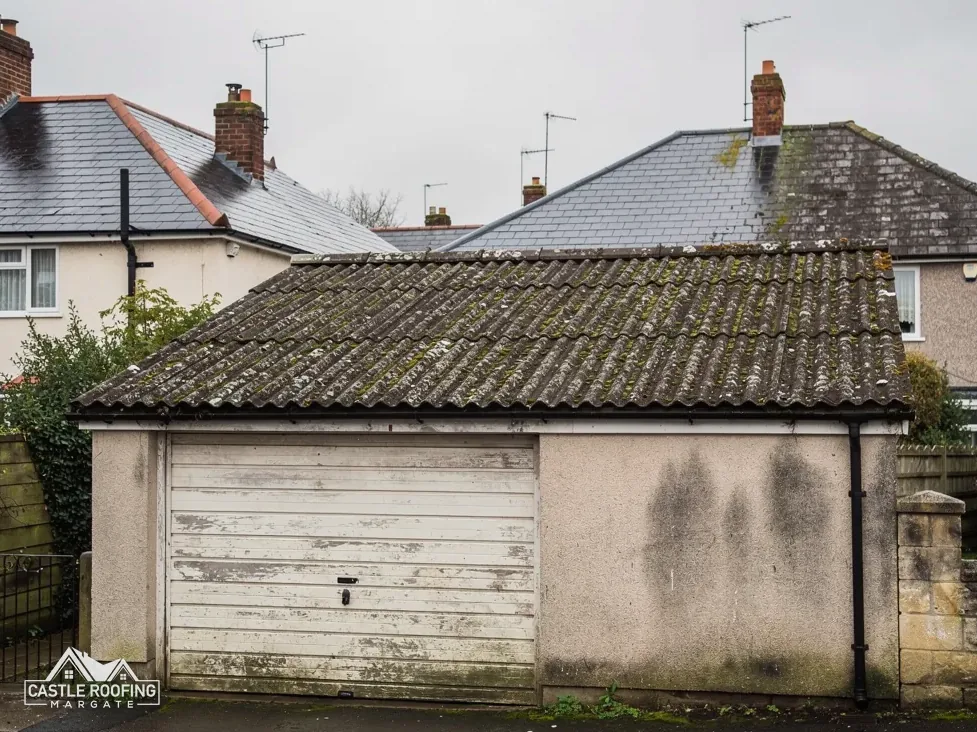
Rain that lands on a roof has to leave it somewhere. On a garage with no gutter, it runs to the lowest edge and drops. The sheets or tiles shed it in a sheet along the whole eaves, and it hits the ground in a line beneath.
That has consequences you can see over time:
- Splashing on the base of the wall, which wets the lower courses and can stain or green the brickwork.
- A wet strip along the door or the path, which turns slippery in cold weather.
- Soaked ground beside the foundations, which is worse on a clay or poorly drained plot.
- Run-off onto a neighbour's side, if the garage stands against a boundary.
None of these is a disaster in a single shower. They are what builds up across many wet winters. Met Office averages for Manston (1991 to 2020) give about 613 mm of rain a year and 110 days with 1 mm or more, so the water arrives often.
A garage that sits close to a boundary or a path has the strongest case for a gutter, because the water has fewer places to go without causing a problem. An isolated shed far from anything has the weakest case.
Fall: how a gutter is laid so it drains
A gutter that holds water is a gutter that fails. Standing water gets heavy, sags the brackets, stains the fascia and breeds moss and silt. The cure is fall: the run is set slightly lower at the outlet end, so water travels towards the downpipe.
Brett Martin's installation guidance gives the fall as 1 mm for every 600 mm of gutter. On a garage gutter 3 metres long, that is about 5 mm lower at the outlet than at the far end. It is a small difference, and it is easy to get wrong with a spirit level held by eye.
| Run length | Drop at outlet |
|---|---|
| 3 metres | 5 mm |
| 4.8 metres | 8 mm |
| 6 metres | 10 mm |
The same maker is the source for the figure, and a different system's instructions may differ, so the data for the gutter you buy is what to follow.
The brackets matter too. They have to be fixed to something solid, such as a fascia board or a rafter end, and spaced as the maker directs. A gutter fixed to a thin sheet edge or a crumbling lip will not hold its line.
Downpipes and where the water ends up
The downpipe is the other half of the system. A gutter is only as good as the outlet it drains to, and a garage downpipe needs three things.
- An outlet at the low end of the gutter, sized for the roof area it serves.
- A pipe that runs clear down the wall, held by brackets, with no sharp bends to trap debris.
- A destination: a drain gully, a soakaway or a water butt, not a puddle against the wall.
Where the destination is a drain, check that the drain takes rainwater. Joining a roof outlet to the wrong sewer can cause trouble, so ask the building control team at your council before connecting. A water butt is the simplest way to put rain to use, provided its overflow goes somewhere sensible.
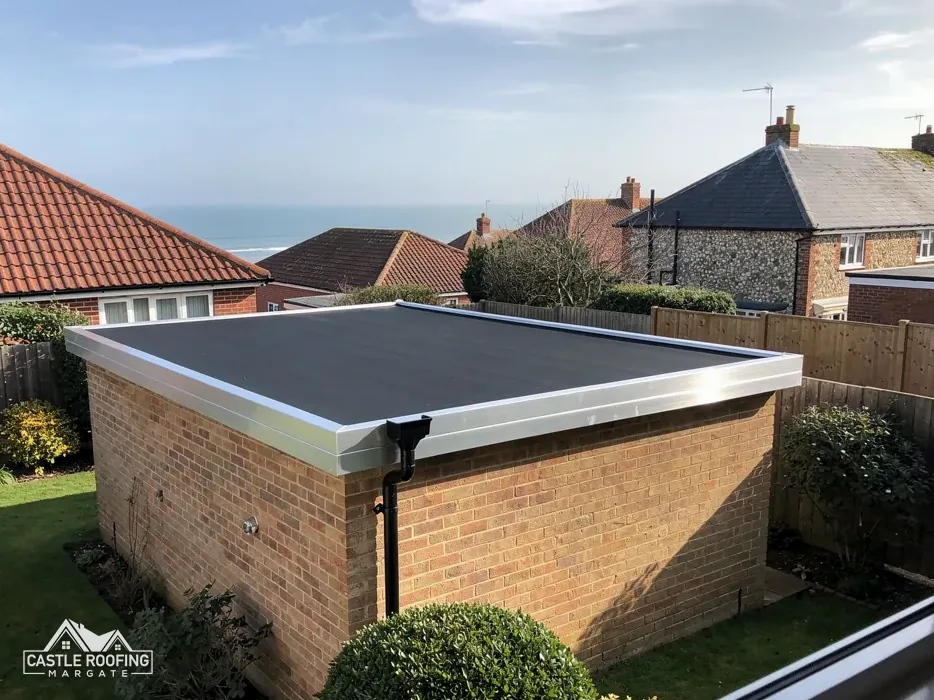
A gutter of the right size for a small garage roof can be fitted along a fascia, or, where there is no fascia, on brackets fixed to a board added for the purpose. On a flat roof, the edge trim and the gutter are designed together, which our page on felt garage roofs touches on.
Looking after the system matters too: leaves and silt need clearing so water can reach the outlet.
Cost and when to fit one
Gutter prices are national guides, not ours. MyJobQuote (October 2026) gives around £1,000 to £1,600 for replacing guttering on a house, a typical UK range, and Which? Trusted Traders, in November 2025, give £75 to £350 ex VAT for a clear-out of every gutter on a house. A single garage run is smaller than either figure describes, so these show scale and not a quote.
The best time to fit a gutter is when the roof covering is renewed. The eaves are bare, the fall can be set with the sheets off and the brackets can be fixed to the new fascia or batten. Fitting afterwards means working around a finished edge.
If the sheets are grey cement from before 2000, HSE says to treat them as asbestos until identified, and nobody should drill into the edge to fix a bracket. Our page on garage roof condensation covers a different drip problem, and the garage and asbestos roofs hub covers the roof itself.
The price depends on run length, access and what is behind the gutter, and the survey sets it.