Read this before you decide between patching and re-felting. It explains the layers in a felt roof, the lifespans published for felt, the signs that point to repair or renewal, and the range Which? gives for a single garage.
Felt is a long-standing garage covering, and it is still laid when one is replaced. The word hides a lot of variety. A garage roof may carry a single thin sheet nailed down decades ago, or two or three bonded layers finished in a gritty mineral surface. What you can do about a leak depends on which of those you have, and on how much of it is still sound.
For garage owners from Birchington to Dover and out to Canterbury, this page keeps to general terms. It does not name a roll or a maker. It describes how torch-on and mineral felt are put together, how long two published guides say felt lasts, when a repair is enough, and what a full re-felt looks like from the first day to the last.
Felt is one of several materials we deal with on garages, alongside EPDM, GRP and sheet roofs, all under our garage and asbestos roofs service. The survey is where the choice between them is settled, and it starts with the roof as it stands rather than with a product.
Torch-on and mineral felt in plain terms
Modern felt is a bitumen-based sheet reinforced with a fibre core. Bitumen is the black, tarry waterproofing material; the core stops it tearing. Two descriptions come up on quotes, and they describe different things.
Torch-on describes how the sheet is fixed. A gas torch heats the underside of the roll so the bitumen softens and bonds to the layer below as it is unrolled. The method needs care near timber, so a surveyor should tell you how the flame is managed and what is below it.
Mineral felt describes the top surface. The cap sheet, which is the final layer, carries a coating of small stone chips that shields the bitumen from sun and weather. Where those chips have worn off, the black underneath is exposed and ages faster.
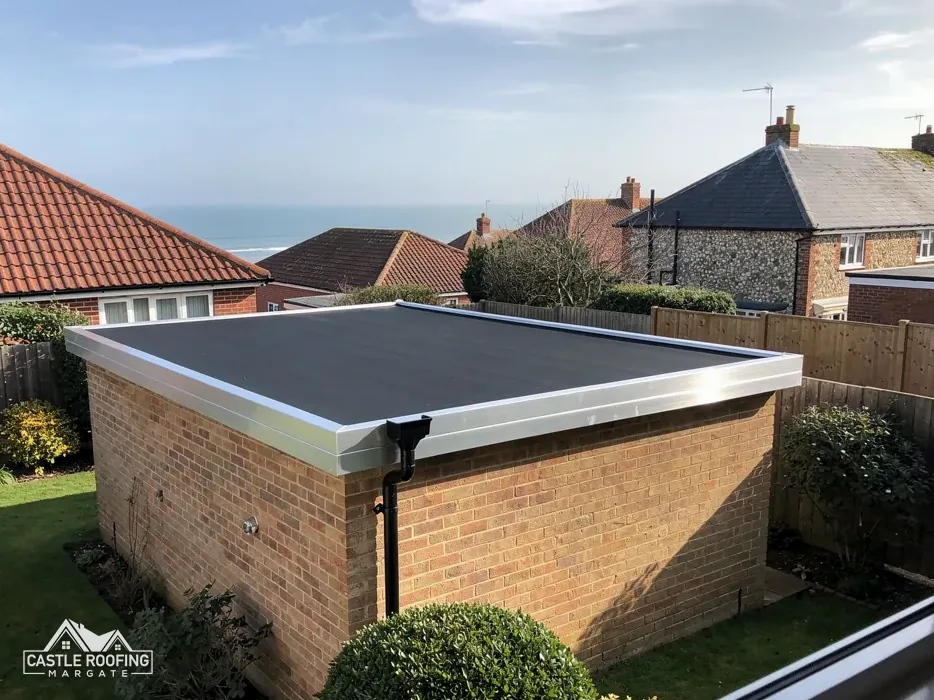
A built-up garage roof usually has these layers, from the bottom up:
- the deck, the boarded surface over the joists
- a base layer of felt, bonded or nailed to the boards
- a cap sheet of mineral felt, bonded over the base layer
- edge trims and any flashings turned up the house wall
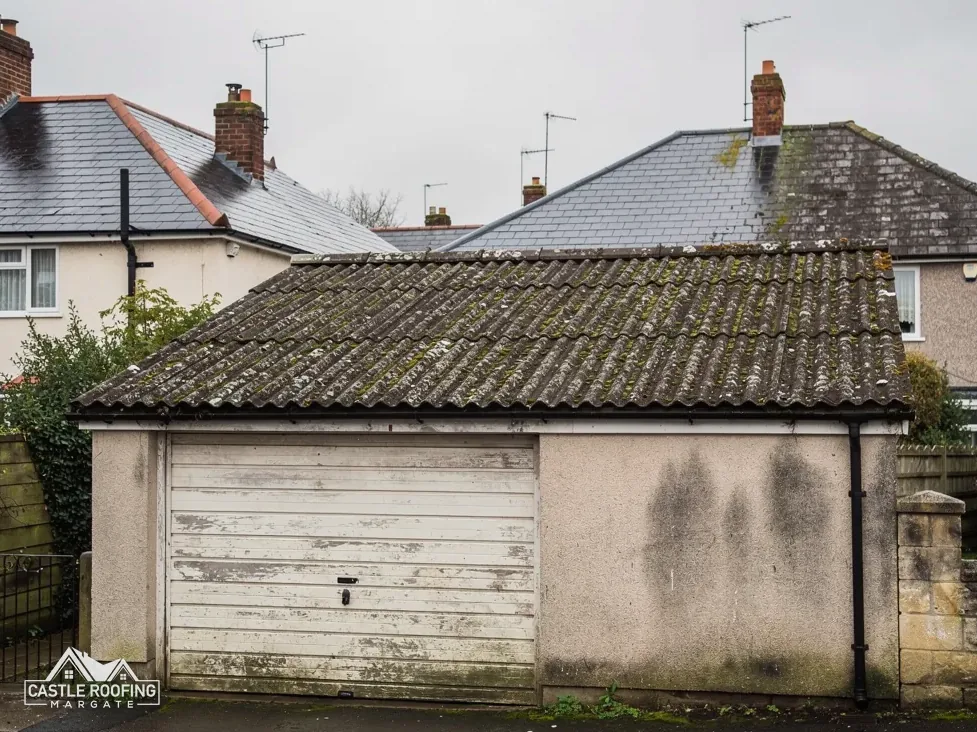
An older garage often has a single layer of lighter felt with no cap sheet, nailed to the boards and coated over the years with black paint. That is a lighter system with a shorter life, and it is the one that most needs watching. If you are not sure which you have, look at the edge of the roof or at the wall upstand, where the layers can be counted.
How long felt lasts, according to two guides
Both guides give felt the shortest typical life among the usual flat roof coverings. HomeBuilding gives a typical life of "10-15 years" for felt (torch-on). Less, a flat roof cost guide updated on 27 October 2026, gives "10 to 20 years".
| Covering | HomeBuilding | Less |
|---|---|---|
| Felt | 10-15 years | 10 to 20 years |
| EPDM | 25-30 years | 30 to 50 years |
| GRP | 25-30 years | 25 to 40 years |
Each is a typical range and none is a promise. A felt roof that drains well, with a sound deck beneath it and a clear gutter, can sit at the top of the range. One with standing water, a rotten edge or a split at the wall can fall short of the bottom.
A lifespan is also not a warranty. The figure says how long such a covering might last under ordinary conditions. It does not describe what anyone will repair or replace if it fails earlier.
The practical use of these numbers is to place your own roof. If the felt went on 15 years ago and is now splitting, it has done what the guides say felt does. If it is five years old and already failing, something other than age is at work, and the survey should find it before a new layer is laid over the same fault. Ask when the roof was last done, and look for any paperwork the previous owner left.
When a patch is enough
Not every leak means a new roof. A repair makes sense when the damage is local and the felt around it is still flexible and well stuck down. Replacing a whole garage roof to cure one leaking corner would be paying for the wrong job.
The signs that point to a repair:
- a single split or open lap, with firm felt either side of it
- a blister the size of a hand, where trapped moisture has lifted the top layer
- a flashing that has lifted from the house wall along a short length
- a gap at the edge trim where the felt has come away from the fascia
A repair works when the deck below is dry and the surrounding felt is not brittle. If the felt cracks when you press it, or the blisters are scattered across the whole roof, patching tends to chase the leak around the garage from one weak spot to the next.
Surface coatings are a related option on a roof in fair condition. Our guide on coating a felt flat roof explains where a coating helps and where it only hides a problem.
The survey sets the price for the repair that suits your roof, whether that is a patch at one lap or a new section along a wall. A repair is written up the same way as a re-felt: one total, with the work described, and photos of what was found before anything is done. Ask for the photos either way.
When the whole garage roof wants re-felting
The case for renewal builds when the faults are everywhere rather than in one place. A roof that has been patched three times, felt that is soft and sagging between the joists, and a ceiling stained beneath in several spots all say the same thing: the covering is spent.
A full re-felt on a garage runs through a fixed order of work:
- The old felt is stripped back to the boards and taken away.
- The deck is checked, and any board that has gone soft is replaced.
- Edge trims are fitted and any upstand against the house wall is prepared.
- A base layer of felt is laid and fixed, with its laps staggered.
- The mineral cap sheet is torched over it, working across the roof and up the upstands.
- The edges and the gutter line are finished and the roof is swept clear.
Whether to strip or to lay a new layer over the old depends on the state of what is there. Covering the old felt adds weight and can trap moisture in the layers beneath, so a roof that is wet or blistered inside is stripped. The survey decides, and you see photos of the deck once it is bare.
Ask whether the weather forecast is clear for the days booked. Felt goes down on a dry deck, and the work should not start if rain is expected before the roof is closed in. A roof opened up and left under a tarpaulin overnight is a risk to the garage and its contents, so the stripping is planned in sections the crew can close up before they leave.
Edges, upstands and the gutter line
The field of a felt roof, the big flat area in the middle, is the easy part. Leaks on garages often begin at the edges, where the felt meets something else.
The upstand is the strip of felt turned up the wall where the garage roof meets the house or a boundary wall. It is held by a flashing, which is a strip of metal or bitumen fixed over its top edge to shed water away from the joint. If the top of an upstand is loose or has no cover, water runs in behind it, and the ceiling inside stains in a line along the wall.
At the front edge, the felt runs over a trim and into the gutter. Drips onto the fascia are a sign that the sheet stops short, or that the trim has lifted. A sagging or blocked gutter then returns the water to the roof, so the gutter belongs in the same survey. Our guide to the gutter on a garage roof looks at the options.
Details worth checking on any felt garage roof, from the ground and from the ladder:
- the top edge of the upstand and whatever covers it
- the corners, where felt is folded and most likely to crack
- the line of the edge trim, for gaps or lifting
- the outlet or gutter, for leaves and sag
None of these needs special tools to spot. A torch inside the garage on a bright day shows daylight through any gap at the wall, and a stain on the ceiling that follows the line of the wall points to the upstand.
The Which? range for a single garage
Which?, in a roofer cost guide based on a survey of 11 traders in November 2025, gives £1,400 to £3,500 for a single garage of 6m x 3m roofed in felt. That excludes VAT, and Which? notes that South East prices run above its national picture. For the same garage in other materials with new boards, its range is £1,950 to £4,000, again excluding VAT. MyJobQuote, in a guide dated 26 October 2026, gives £750 to £3,500 for garage roofs more broadly.
Those are national typical ranges from third-party guides. They are not a price for your garage. What moves a figure within them:
- the size of the roof, and whether it is a single garage or a double
- how many layers of old felt must come off, and the state of the boards below
- access, and whether scaffolding has to stand on the highway or the drive
- the upstands, trims and outlets that need detailing
When a quote arrives, check that it says whether VAT and any scaffold are included, and that it names the felt system. Two quotes for the same garage can describe quite different roofs, one with a base layer and a cap sheet and one with a single layer, and the totals will differ for that reason alone, which is why the system should be written down. Citizens Advice advises collecting at least 3 written quotes for a job of this kind.