Use this to judge an EPDM quote for a garage. It covers the sheet itself, the lifespan figures two named guides publish, the boards and slope underneath, and what to settle before any price is agreed.
A garage roof is an easy flat roof to forget. It sits at the back of the drive, the covering goes grey, and one wet winter a stain spreads across the ceiling beside the up-and-over door. When the time comes to replace it, EPDM is one of the materials offered. It is a single-ply synthetic rubber membrane, which means one layer of waterproof sheet in place of the several bonded layers of a built-up felt roof.
The pages below are for owners of detached, integral and lean-to garages from Margate round to Deal and Dover who are weighing that choice. They do not claim rubber is always the answer. They set out what the sheet is, what two published guides say about its life, why the boards and the slope under it matter more than the rubber on top, and how to read the price you are given.
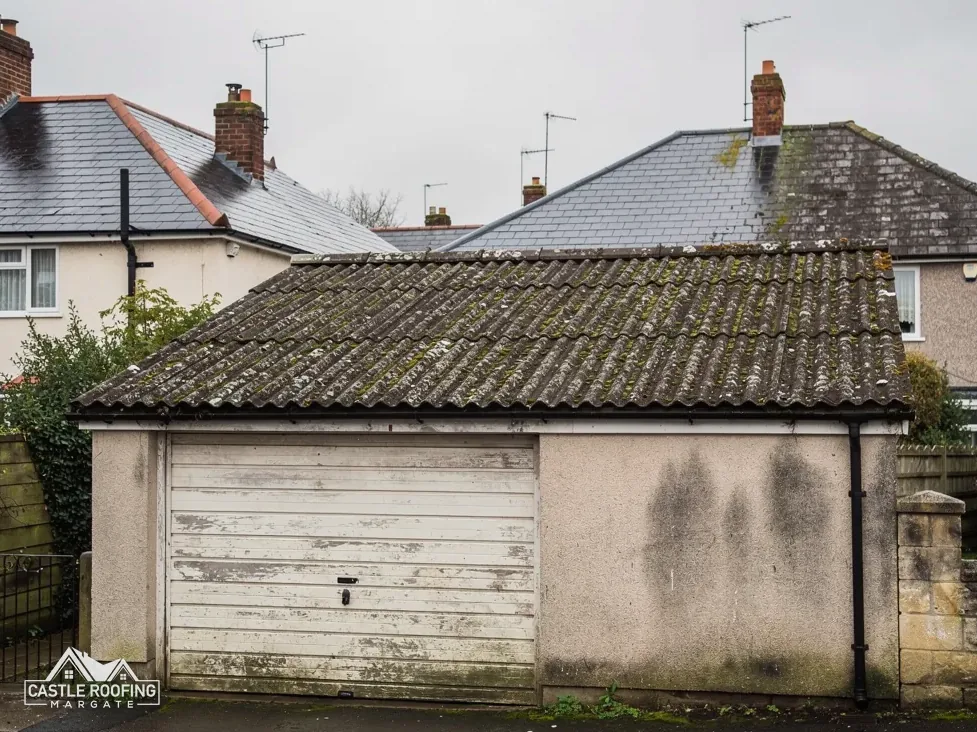
EPDM sits within our garage and asbestos roofs work, next to felt, GRP and the corrugated sheet roofs found on older garage blocks. Each material suits a different garage, and the survey decides which.
What the rubber sheet actually is
EPDM arrives on site as a roll of black synthetic rubber. On a garage roof it is laid over a prepared deck, which is the boarded surface the waterproofing rests on, and held down with adhesive. Because it is single-ply, the sheet itself is the waterproofing layer. There is no mineral surface to weather off and no flame is needed to fix it.
That changes what can go wrong. A felt roof tends to fail at its laps and blisters. A rubber roof is more likely to fail at its details: where the sheet turns up a wall, wraps round a corner or meets a rooflight upstand. A decent quote spends its words on those edges.
What to look for in the roof once the sheet is down:
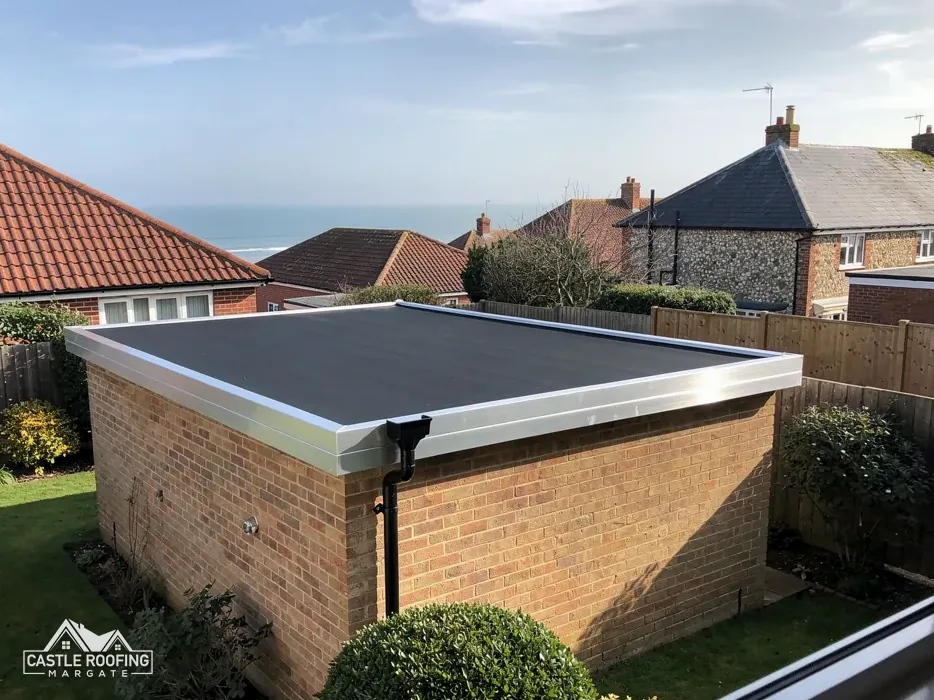
- one clean piece of rubber across the main field, so there is no join in the middle of the garage
- the sheet turned up the house wall or the parapet, with the top edge sealed and covered
- neat folded corners, never cut and patched
- edge trims fixed at the eaves, with the sheet dressed over them and into the gutter line
Fixing methods differ between makers, and a maker's data sheet governs the detail. Ask for the product by name so you can read the data sheet yourself and check the roofer is laying it the way its maker describes. A name on the quote also tells you the material is a branded product with published instructions, not an unnamed roll.
Two guides, two lifespans for EPDM
Published lifespans for rubber roofing do not agree, so this guide quotes two and names both. HomeBuilding gives EPDM a typical life of "25-30 years". Less, in a flat roof cost guide last updated on 27 October 2026, gives "30 to 50 years". The two ranges overlap at 30 years and part company either side of it.
| Guide | EPDM | Felt, for comparison |
|---|---|---|
| HomeBuilding | 25-30 years | 10-15 years |
| Less | 30 to 50 years | 10 to 20 years |
Treat both as typical ranges, never a promise for one garage. How long a roof lasts is a different question from how long a maker backs its product, and the two should never be mixed up when you read a brochure. Only the first is about your garage.
What shortens a rubber roof in practice is rarely age alone. Standing water at a low point, a corner that was never properly folded, and foot traffic from someone clearing leaves all play a part. A garage roof gets visited less than a house roof, which is a good reason to look at it after a storm and to clear the outlet or gutter before the first autumn gale. A sheet that is kept clear of debris and ponding is likelier to land near the top of either range, while one under a sagging gutter or a tree can fall short.
The deck underneath decides the finish
Rubber follows whatever is beneath it. Lay it over a sagging or lumpy deck and every dip shows as a pond, and the sheet is blamed for what the boards did. For that reason the survey looks at the deck before it looks at the covering, and the underside gets checked from inside the garage where that is possible.
On an older garage the deck is usually boarding fixed across timber joists, with the old covering on top. Once the old covering is stripped, the boards can be seen for the first time. The questions are plain ones:
- Are the boards dry and firm, or soft underfoot where water has been getting in?
- Do any joists show rot at the wall plate, the timber bedded on the wall that carries them?
- Are there gaps, loose boards or old nail heads that would mark the rubber?
- Is the surface flat enough to lay on, or does it need packing out?
Boards that fail the test are replaced before any rubber goes on. You see photos of them as they come up, so any new boarding has a reason you have already seen. The Which? roofer cost guide separates the two cases: for a single garage of 6m x 3m it gives one range for felt and a higher one for other materials, with new boards included. Both are covered in the price section below.
If the deck is sound, it stays. If it is partly rotten, the bad boards go and the rest remain. Either way the finished surface is checked with a straight edge before the adhesive comes out.
Falls: how the water gets off a garage roof
No flat roof is dead level. It is laid to a slight slope called a fall, which carries water to the edge and into the gutter. Without one, water sits on the membrane, and standing water ages any covering faster.
BS 6229:2025 is the current British Standard for roofs waterproofed by a membrane over a continuous deck. It does not cover lead, which follows a different route. Roofing trade guidance on the 2025 update keeps a finished fall of at least 1:80 across the general roof area and into internal gutters. That is a minimum for the finished surface, not a design target. IKO, a membrane maker, advises a 1:40 design fall.
On a garage the fall is usually set from front to back or side to side, towards the gutter. If the existing deck is flat, a tapered layer of timber firring pieces (long thin strips cut to a slope) can be laid on top to create the slope. If the garage has a low parapet on three sides, the fall must also reach an outlet, since the water has nowhere else to go.
Ask the person surveying the roof which way the water will run, and where it leaves the roof. A clear answer is a good sign. A vague one suggests the fall has not been thought through, and a rubber sheet will show the difference faster than almost any other covering, because its surface is smooth and any pool on it is easy to see after rain.
Laying the sheet: the order of work
A garage roof is a small area, so a rubber re-cover can be a short job, but the order of work still matters. Doing it out of sequence is how shortcuts creep in at the edges.
- Strip the old covering and take it away, then clear the deck of nails and debris.
- Inspect the boards and joists, replace what has failed, and set the fall.
- Fix the edge trims and any upstands the sheet will turn up against.
- Unroll the rubber loose and let it relax before it is bonded, so there is no tension in it.
- Fold back half, apply adhesive to the deck and the sheet underside, then press the sheet down as the adhesive reaches its working stage.
- Dress the corners, wall upstands and any penetrations, then finish the edges.
The adhesive has a working window set by its maker. Applied in cold or damp weather, it may not grip, so a competent roofer will not push on if the deck is wet. In East Kent the Met Office Manston averages show 110.05 days a year with 1 mm or more of rain, so a dry spell is worth waiting for rather than racing the weather.
Once the sheet is down, the gutter and any downpipe should be checked, so the water the roof now sheds has somewhere sound to go. Our guide to the gutter on a garage roof covers that side.
What guides say a rubber garage roof costs
Prices are published as national typical ranges. Which?, using a survey of 11 traders gathered in November 2025, puts a single 6m x 3m garage covered in EPDM or PVC, with new boards, at £1,950 to £4,000. That guide excludes VAT. For felt on the same garage it gives £1,400 to £3,500. Which? warns that South East prices run higher than its national picture, and Thanet is inside that area.
MyJobQuote, in a rubber roofing guide dated 9 October 2026, puts EPDM at around £60 per square metre. A per-square-metre rate is a way of comparing guides, not a way of pricing your roof. Size, access and the state of the boards all move the real figure, so it cannot simply be multiplied by the garage's area. For a repair, Checkatrade gives EPDM rubber repairs at £120-£170 per m², ex VAT, up to a maximum of 3m².
What a quote for your garage depends on:
- the roof area and how much of the deck needs replacing
- access to the back of the garage, and whether a scaffold is needed
- the edges, upstands, outlets and rooflights that must be detailed
Scaffolding is priced after a survey. One written total comes after it. Read any quote for the maker's product name, whether VAT and scaffold are in, and what becomes of the old covering. Citizens Advice advises getting at least 3 written quotes.
If the garage dates from before 2000 and has corrugated sheets, HSE says to assume asbestos until tested, and that changes the job. See how to tell if roof sheets are asbestos.