Read this if your garage has corrugated sheets from before 2000. It explains what careful removal means, what changes if the sheets break, where the waste can and cannot go, and what one published guide gives for the cost.
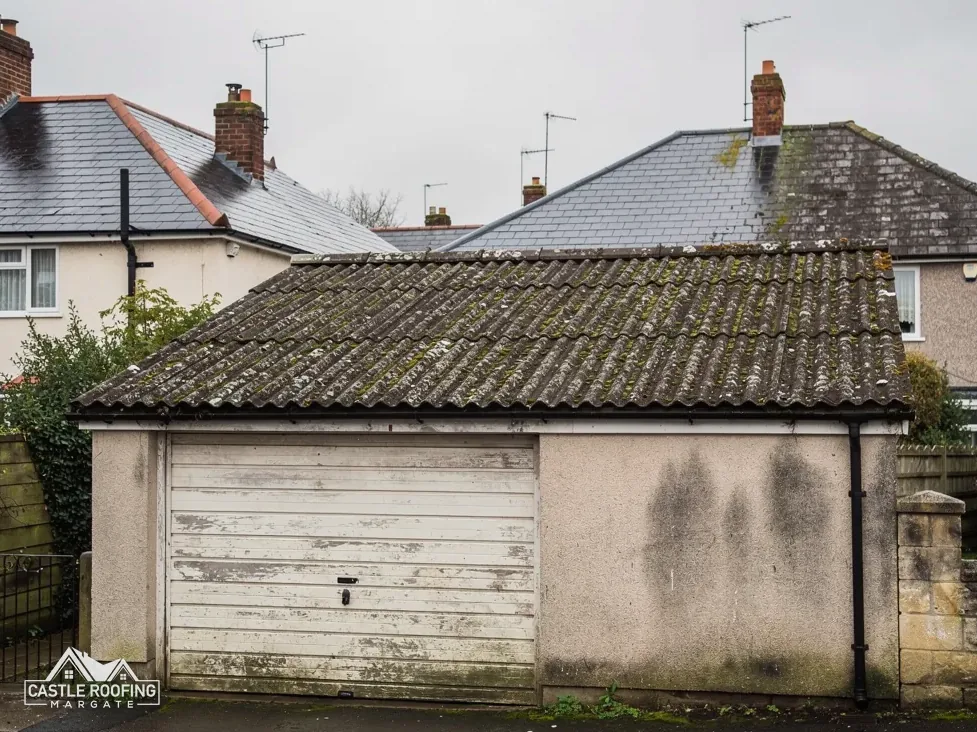
Corrugated sheeting on a garage roof, grey and often streaked with moss, is a roof that some Thanet owners take on with the house. Some of those sheets are asbestos cement, a mix of cement and asbestos fibre. Left intact, the sheets are not the problem. The risk comes when they are broken, drilled or scrubbed and the fibres are released into the air.
The HSE's advice is direct: a garage put up or altered before 2000 should be assumed to contain asbestos until proved otherwise. The HSE also treats asbestos cement roofs as fragile every time, whatever their age, so nobody should walk across one, and a ladder or a crawling board does not make that safe on its own.
This page follows a removal in order: how to check what you have, what the HSE allows without a licence, the point at which damage changes the rules, how the sheets come down and where they go. It belongs to our garage and asbestos roofs work, where an asbestos cement roof is often replaced with a fresh covering.
First, find out what the roof is
You cannot tell asbestos from the ground. A sheet of old cement-based corrugated roofing and a modern fibre cement sheet look nearly the same from a driveway, and a layer of paint or an overcladding sheet can hide the original. The age of the garage is the first clue, and the HSE's before-2000 line is the working rule until a test says otherwise.
A roofer taking on a job like this should see the roof, check its age and, where the material is uncertain, have it sampled and analysed before any work begins. Taking a sample is itself a job to do with care, which is why a surveyor does it and not the owner with a screwdriver. Our guide on telling whether roof sheets are asbestos lists the clues.
Look for these before you book anyone:
- the age of the garage, from the deeds, a seller's pack or the neighbours
- corrugated grey sheets, fixed through the high point of each wave
- an eaves board or soffit under the sheets, which may be a different asbestos product
- any previous patching, painted coats or overcladding laid over the original
If anything on that list rings true, treat the roof as asbestos cement. That means no scraping off moss, no cleaning of the sheets by any method, no drilling and no breaking up of sheets to make them fit a skip. A leak is an annoyance that can wait for a proper plan. A roof that has been scrubbed or scraped has put fibre where it should not be.
What the HSE calls careful removal
The HSE separates asbestos work into three groups. For a garage roof, the one that matters is the first, non-licensed work, because it is the route for most intact asbestos cement. Its non-licensed work page lists asbestos cement products, with "roof sheeting and rainwater goods" as its examples, so long as the sheets are handled and taken off carefully and not broken up. The same page says cement that has weathered, but is not otherwise substantially damaged, stays in the group.
Two things stand out in the HSE's wording. Weathering alone does not move a roof out of the non-licensed group, so moss, algae and surface wear are not the deciding factor. And the whole route depends on the word "carefully": sheets are undone and lowered, not smashed and thrown. A roofer who offers to knock the sheets down quickly is describing a different job, with different rules.
Non-licensed does not mean unregulated. It means the work itself does not need a licence, while the care, the waste route and the fibre control are still required. Where a licence is needed, the work goes to a specialist firm that holds one.
On a garage roof of sound sheets, careful removal is the normal route, and it is slow by design. A sheet taken off in one piece is a sheet that has released nothing, and a day that ends with every sheet wrapped and none broken is a good day on this kind of roof.
When breakage makes the job notifiable
The line moves if the sheets are damaged. The HSE's notifiable non-licensed work page picks up asbestos cement that is substantially damaged or in pieces. That is a different category from careful removal, with extra duties attached. The HSE states one of them plainly: the register of work, which holds health records, must be kept for 40 years. A breakage on the day can therefore change what has to be reported and recorded.
| Group | Garage example |
|---|---|
| Non-licensed | Whole, weathered cement sheets lowered intact |
| Notifiable non-licensed | Sheets substantially damaged or broken up |
| Licensed | Insulating board where the job is not short |
This is the reason the order of work matters so much. A roof that has already collapsed in places, or one where a previous owner has driven sheets through with a hammer, can fall into the middle group before anyone has touched it. The survey records the condition sheet by sheet, and you see the photos, so you can follow why the work falls where it does.
The third row is not the same as the first two. Asbestos insulating board, often shortened to AIB, turns up in external soffits. For the HSE, work on it needs a licence unless the job turns out to be short, as judged in the risk assessment. A garage with an AIB soffit may need a split job, with the licensable part done by a specialist and the roof sheets done as their own careful removal. The survey says in advance which parts fall where, so the two are never muddled on the day.
How the sheets come down
The order of work follows a simple idea: nothing is broken, and nothing falls. A typical removal runs as below, and the survey fixes the details for your garage.
- The site is set up. The area around the garage is cleared, gutters and downpipes noted, and the route for lowered sheets planned.
- Edge protection or a safe working platform is put in place, because the roof is fragile and no one should rely on the sheets to hold weight.
- The fixings are undone, working from the fixing points, not by breaking the sheet at the bolt.
- Each sheet is lowered whole, by hand or on a hoist, and never dropped.
- Sheets are stacked flat, wrapped as they come down and labelled as asbestos waste.
- The timbers or purlins underneath are checked and the debris around the garage is cleaned up by the correct method.
The Kent County Council household recycling centre guidance for householders carries the same spirit: material must be kept damp, and the council says "do not break or cut it". That wording is the council's instruction to the public delivering to a site, but it states the principle behind the whole job.
The labels matter as much as the wrap. A bag marked as asbestos waste tells everyone who handles it later what is inside, and nobody opens or moves it casually. Only after the roof is clear does the new covering start. The deck, purlins and any boards underneath are inspected first, because a replacement sheet or membrane is only as good as the support below it.
Wrapping, skips and paperwork
Asbestos waste does not go into an open skip, a builder's bag or the back of a van. The HSE's guidance in EM9 says to wrap it twice and label it, and its sheeted-roof guidance, A14, wants larger quantities held in a lockable skip. A lockable or sealed container keeps the sheets from being broken by other loads and from being dipped into by anyone else.
From there the route depends on who holds the waste:
- A householder's own small amount can go to a Kent County Council household waste recycling centre other than Sheerness, with limits: double-wrapped, booked ahead, and a free allowance of 5 sacks (or equivalent) per month.
- A roofer's waste from a customer's roof is trade waste. It moves on a consignment note with a carrier registered at upper tier.
- Larger amounts, the council says, are a matter for the Asbestos Removal Contractors Association, which can name a company near you.
Which of the first two applies to a full garage roof is a question for the job itself, because a whole roof does not fit the recycling centre limits. Our guide to disposing of asbestos in Kent sets out the centres, the limits and the paperwork in full.
You see photos of the sheets wrapped and loaded, and the paperwork that follows them is kept with the job. A wrapped stack left uncovered in the rain or in a garden for a week is still a risk, so the collection is arranged before the first sheet comes off.
What it costs and what to ask
MyJobQuote, in September 2026, gave a typical UK figure of around £2,750 for removing an asbestos roof. That is a national average from one cost guide, for a general case, and a garage in Kent can sit above or below it. Which? and HomeBuilding both say prices run higher across the South East, and Kent belongs to that region.
What moves the figure on a real garage:
- the footprint of the roof and how many sheets cover it
- the state of the sheets, and whether any have cracked
- the access, and how far sheets go to the lockable skip
- the soffits, fascias and any AIB that needs a specialist
- the replacement covering, which is a separate decision from the removal
Ask three things of anyone who quotes for the removal. Do they say how the sheets will be lowered and wrapped? Do they name the lockable or sealed container for the waste? And do they hold a licence for any licensable work, or pass it on to a firm that does? A vague answer to any of them is worth noticing, because the safe method is a specific one.
The written price follows a survey and arrives as one total for the whole job, with the new roof included if you want one, so there is no second figure waiting after the sheets have gone. A good place to begin is a photo of the garage roof from the lane.