Why the condition of the sheets is the whole question
In asbestos cement the fibres are held inside a cement matrix. HSE's list of low-risk, non-licensed tasks describes removal where the material is in reasonable shape, is not being broken up on purpose and keeps its fibres firmly bound into something like cement. Put simply, the risk climbs when the cement stops holding them in.
That is why HSE's non-licensed page names asbestos cement that has weathered without being badly damaged. Age and moss alone do not push a roof into a higher category. Serious damage does, and so does smashing the sheets during work, which HSE places under notifiable non-licensed work.
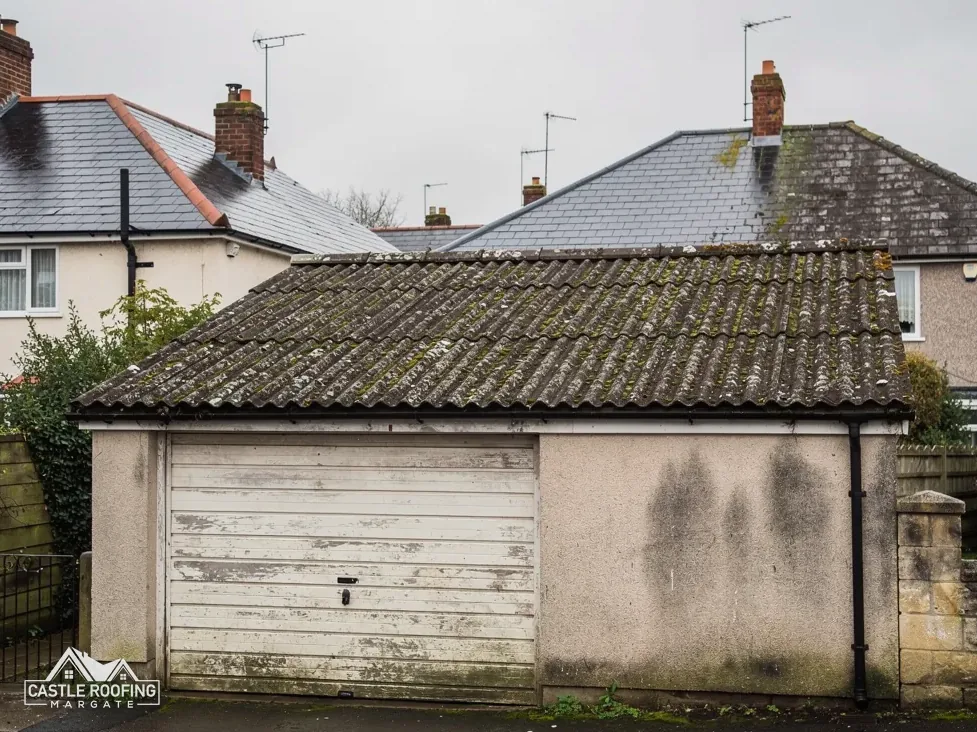
An old, mossy roof can therefore sit in the same category as a newer one. What you want to know is whether sheets are cracked, holed, flaking at the edges or lying in pieces on the ground. A surveyor answers that with a sample and a close look, and you answer nothing by climbing up to see.
Not sure what the sheets are? Our page on telling if sheets are asbestos sets out the steps.
What turns a quiet roof into a hazard
Several ordinary jobs break or abrade asbestos sheets, and breaking or abrading is what releases fibres:
- Drilling or screwing through a sheet to fix a bracket, an aerial or a light.
- Pressure-washing or scrubbing the moss off: do not do either, because both strip the surface and throw fine debris about.
- Cutting or snapping a sheet to make an opening or fit a rooflight.
- Stepping onto the roof, which HSE's guidance for taking asbestos cement down describes as fragile and unable to bear weight.
- Resting a ladder on the edge of a sheet.
The walking point matters twice. A sheet that gives way is a fall hazard for the person, and the broken sheet then becomes a hazard for the garden and the neighbours.
Kent County Council's advice to householders taking asbestos to a recycling centre includes gloves, a face mask and leaving the material uncut. That is a handy rule of thumb on the roof as well: if a job means breaking a sheet, stop and get a survey first.
What to do with a damaged or cracked sheet
If a sheet has cracked, or a piece has come down, treat it as a job for a professional, not a tidy-up. Keep children, pets and visitors away from the area, and do not sweep or vacuum the fragments. Dry sweeping and household vacuums both lift fine dust into the air.
A cracked roof also lets rain through, so the garage contents may need moving. Cover them where you can without climbing onto the roof or leaning anything on the sheets, and photograph the damage from the ground. Those photos start the conversation with us, and they show a surveyor what they are being asked to look at.
Once the extent is known, HSE's categories decide the route. Careful removal of whole sheets is non-licensed. If the material has been, or will be, substantially broken up, the work becomes notifiable non-licensed work. Asbestos insulating board is a different material again, and is licensable unless the work is short in duration.
Our page on a broken asbestos roof sheet covers the immediate steps in more detail.
A survey before any work, and who does the job
Any plan for the roof, whether a repair, a covering or removal, starts with a survey, because the plan depends on the material and its condition. For a garage built or refurbished before 2000, assume asbestos is present until the result says otherwise.
MyJobQuote's September 2026 guide gives £325 as a typical survey cost, and around £2,750 for taking an asbestos roof off. Both are national guide figures and not a price for your garage.
Our first look is from the ground, and the survey result then decides the method. Anything in the job that proves licensable is passed on to the firm that holds that licence. For more on the choices, see asbestos garage roof removal, and the main garage and asbestos roofs page for the full range.
Leaving a sound roof alone is a legitimate choice. If that is your decision, keep the survey report, keep people off the sheets, and never be tempted to drill or wash them for a small improvement. A roof that stays whole stays in its lower-risk category, and the report shows anyone who comes after you exactly where it stood on the day it was tested.