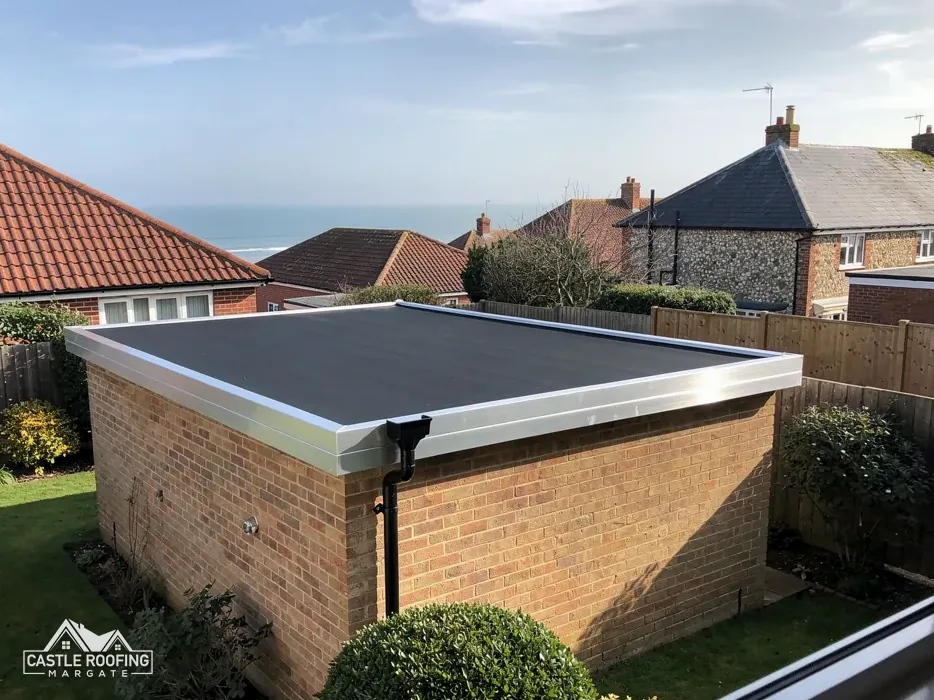
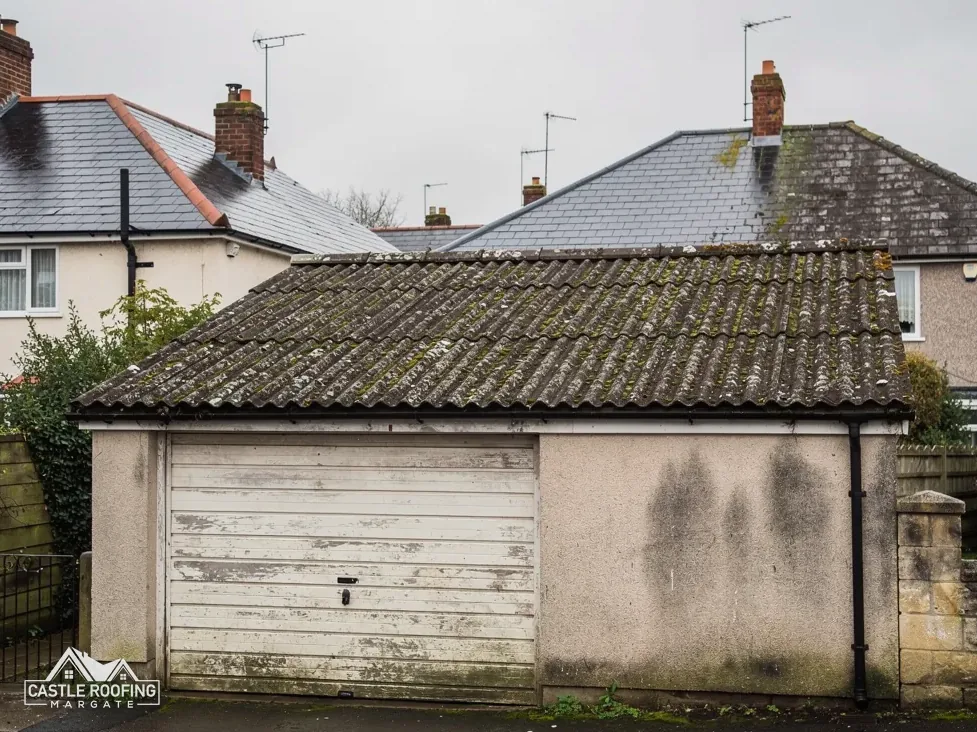
A side-by-side look at the four coverings that come up for a garage, the typical UK cost ranges two published guides print, what to check on the old roof first, and how to read the quote you are handed.
A garage roof gets less attention than the one over the bedrooms, until the ceiling boards go soft or the felt lifts in the corner. Then the question is simple: what is the lowest outlay that still leaves a dry building for years? The answer is rarely the smallest figure on the table, because a covering that fails early can cost more over time than a dearer one that keeps going.
This piece compares the four coverings that come up for a single or double garage: bitumen felt, EPDM rubber, profiled steel sheet and over-cladding. It gives the typical UK ranges two published cost guides print, sets out what pushes a garage figure up or down, and explains why the old roof deserves a proper look before anything is chosen. If you are weighing the job now, our garage and asbestos roofs page covers the whole service, and the sections below take the decision one step at a time.
What the published garage figures cover
Two national guides give a feel for the scale. MyJobQuote's guide to replacing a garage roof (October 2026) puts a typical UK range at between £750 and £3,500. Which? Trusted Traders (November 2025) prices a 6m by 3m single garage re-covered in felt at £1,400 to £3,500. The same guide gives £1,950 to £4,000 where the job uses another material, PVC or EPDM, along with new boards. The Which? figures are ex VAT, and Which? adds that prices run towards the top of its scale in the South East, which includes Kent.
The two ranges overlap but do not match, and the gap is the point. Because a garage roof covers so little ground, the fixed parts of any job (getting materials to site, setting up safe access, taking the old covering away) weigh heavily against the square metres. A bigger garage does not always cost proportionally more, and a small one is rarely proportionally cheap.
Neither range is a price for your garage. They are third-party guides, and what a particular roof costs depends on what is found once the old covering is looked at: the state of the boards, how the water leaves the roof, what has to be taken away. That is why a sound written price follows a survey rather than a phone description, and why a figure quoted from a doorstep glance deserves a raised eyebrow.
Felt, EPDM, steel and over-cladding side by side
Each covering suits a different garage. The table sets out what the published guides say about life, and where they say nothing it says so plainly.
| Covering | Typical life | Suits |
|---|---|---|
| Bitumen felt | 10 to 15 years (HomeBuilding); 10 to 20 (Less) | Flat or near-flat decks, short horizons |
| EPDM rubber | 25 to 30 years (HomeBuilding); 30 to 50 (Less) | Flat decks wanting a one-piece sheet |
| Profiled steel sheet | Set by the maker's coating | Pitched garages and outbuildings |
| Over-cladding | Set by the sheet used | Sound frames under an old sheeted roof |
The felt and EPDM lives are the guides' own typical ranges, and the two guides disagree on EPDM, so both are named. A life is never a promise, and a length of cover offered by a maker is a different thing from the working life a roof achieves in practice.
Steel sheet and over-cladding have no single published life to quote. Ask the supplier of the sheet for the coating's rating and read exactly what it covers. EPDM is a rubber membrane in a single ply, supplied as one sheet, which is why it suits a plain flat garage so well: there are few seams to fail. MyJobQuote's rubber roofing guide (October 2026) gives around £60 per square metre as a typical figure, and the guide gives it as a fully installed average, a sense of scale and never a rate to multiply by your garage.
Our pages on felt garage roofs and EPDM garage roofs go through each in turn, and the steel sheet page sits in the same section.
What moves a garage quote up or down
Because the covering is only one part of the job, the same material can produce very different figures on two garages that look alike from the road. The usual drivers are these:
- The deck underneath. Boards that are sound can take a new covering as they are. Boards that are soft, stained or sagging have to be replaced first, and that adds a stage of work before the covering goes on.
- The shape of the roof: a plain flat rectangle, or one with upstands, a parapet, a rooflight or an abutting wall that needs a flashing.
- Access. A garage down a terrace lane with no vehicle reach is slower to supply and to clear than one on a drive.
- Waste. Old felt, boards and sheets have to leave the site on a lawful route, and some old garage sheets need special handling, covered below.
- Edge details: the fascia, the drip trim and the gutter, if the garage has one.
Where a job needs scaffolding, the figure comes once the survey is done. If the garage fronts a lane or the road and scaffold must stand on the pavement, the permit comes from Kent County Council with the application made by the scaffolding company. Kent's fee for a scaffold permit is £52 per week for 2026 to 2027, and it asks for 5 working days' notice. Ask any roofer whether the garage needs access equipment at all, since a low single-storey roof often does not.
Look at the old roof before choosing the new
The choice of covering is the second decision. The first is what is already up there, because it changes the route, the cost and who can do the work.
Garages put up or refurbished before 2000 may have asbestos cement sheets. HSE's advice is plain: for a building of that age, assume there is asbestos in it. Its guidance also says cement roofs are always fragile. Never walk on one, and do not drill, scrub or break it. MyJobQuote gives a typical asbestos survey cost of £325 and a typical asbestos roof removal cost of around £2,750 (September 2026), which shows how far the picture can change once sheets are involved.
Taking cement sheets off with care, without breaking them up, is non-licensed work in HSE's terms. It still has rules about wrapping, labelling and where the waste goes, and a lockable or sealed container is needed, never an open skip. Our guide on whether your garage roof is asbestos sets out what to do before any work starts.
If the sheets might be asbestos, do not let anyone start until they have been identified. A laboratory sample costs far less than getting the order of work wrong.
A garage that came with the house, or was built by a previous owner, often has a roof nobody has written the history of. Looking at the sheets from the drive will not settle it, so the building's age and a laboratory result make the safer guide. Ask for the identification before a price is agreed, not after the first sheet has cracked.
Once the old roof is known, the choice of new covering becomes a shorter conversation, and the quote you receive is for a job that actually matches the garage.
Fall and drainage: flat is not level
A garage roof that holds a pool of water after rain will age faster, whatever is laid on it. The covering sets part of the answer, and the fall built into the deck sets the rest.
For membranes, BS 6229:2025 is the current standard for flat roofs finished in a membrane laid on a continuous deck. A published summary keeps 1:80 as the minimum finished fall across general areas, and the single-ply maker IKO advises designing for 1:40, since the roof as built ends up shallower than the drawing. The 2018 edition of the standard is withdrawn, so a quote that leans on it is out of date.
In practice, that leads to a few questions to put to anyone quoting:
- Is the existing deck flat or falling, and does it hold water now?
- If the fall is poor, does the quote include firring strips or new boards that correct it?
- Where does the water leave the roof, and is the gutter or outlet sized and fixed to carry it?
- How will the covering finish at the edges and against any wall?
Brett Martin's guidance for gutters is a fall of 1 mm for every 600 mm of run, which is worth knowing when a garage has a gutter at its low edge. A level deck under a new membrane can look tidy on the day and leave water standing for years.
Reading the quote you are handed
Three quotes that look alike on the last line can describe three different jobs. Before comparing totals, check what each one says it covers.
- VAT. Which? figures are ex VAT, and the standard rate is 20%, so a total without VAT is not the same as one with it.
- The deck: whether boards are replaced, or only covered over.
- The edges: trims, flashings, fascia and the gutter.
- Waste: that old materials are taken away, and how.
- Access: whether the figure includes scaffold or a tower.
Citizens Advice advises collecting written quotes from a minimum of 3 different traders before you choose. Weigh each total against what it says it covers, because a low total can leave out the part that is dearest to put right later.
Check the order of work too. A sound quote says when the old covering comes off, how the open deck is kept dry if rain arrives mid-job, and what happens at the edges overnight. A garage stripped on a Monday and left under a sheet until Friday is a risk to the ceiling and to anything stored below it.
Ask also who does the work. A roofer who sends a photo report of the old deck, the corners and the edges is giving you something to compare against. One who only gives a number is not. Our order is survey first, then photos of your own garage roof sent back to you, then one written price covering the whole job.