Read this if you have sprayed insulation in your roof and an equity release plan in view. It explains the RICS statement from March 2023, what it leaves unsaid, and the questions to put to your own provider.
If you have spray foam under your roof and you are thinking about equity release, you may have met a worrying headline. The source worth reading is a press release from RICS, the professional body for chartered surveyors, which came out alongside a consumer guide on spray foam insulation.
That release is short, and the sentence people quote from it is shorter still. Because homeowners make real decisions on the strength of it, it is worth reading word for word and not through a headline. What it says is narrower than the stories built on it, and what it leaves out matters just as much.
This guide quotes RICS exactly, explains why a covered roof structure is a question for a valuer, lists what to ask your mortgage or equity release provider, and shows where removal fits in. We are roofers, not lenders or financial advisers, so the money questions stay with your provider. The roof questions belong to our spray foam removal service.
What RICS published on 3 March 2023
RICS issued a press release dated 3 March 2023 announcing a new spray foam consumer guide. The release explains why the guide was needed. One reason it gives is, in its words, that "there has been concern within specific sectors of the lending market, such as equity release mortgages, which is now having a wider impact on lenders."
An equity release mortgage is a way of borrowing against the value of your home, with the loan repaid later and not month by month. It is a product with its own rules and its own providers.
The consumer guide that sits alongside the release is addressed to homeowners. Two of its points matter here: a sprayed roof structure is hidden from a full inspection, and it sends owners to their mortgage provider to find out whether lender policy permits such products.
Three facts are worth holding on to:
- the date is 3 March 2023, so this is a statement from some time ago and not a current notice of lending rules
- the author is RICS, a surveyors' body, not a lender and not a regulator of lending
- the sentence names equity release as one example, using the words "such as", so it does not limit the concern to that product
Anything you read that goes further than those three facts has come from somewhere else, and it is fair to ask where.
What the wording says and what it leaves out
Read slowly, the RICS sentence reports concern. It does not report a ban, a refusal or a rule. It places the concern "within specific sectors" of the lending market and says it is "now having a wider impact on lenders". Those are careful words from a body describing a trend, and each one limits the claim.
It is easy to turn that into something stronger than RICS wrote. You may see it said that spray foam homes cannot be mortgaged, or that lenders turn them down. The RICS release says neither of those things.
What the release does tell you is that the lending side noticed spray foam, and that equity release was the sector RICS chose to name. The practical reading is that policy varies from provider to provider and can change over time. One provider may be relaxed about a documented installation, while another may want more information. Neither position can be assumed from outside.
RICS says in its guide: "Do check with your mortgage provider whether their lender policy allows the installation of such products."
That line is the useful part. It sends you to your own provider, because only your provider can say what its policy is today and how it applies to your property.
It also shows what the guide is for. RICS is not telling you what to decide. It is telling you who to ask.
Why a covered roof is a question for a valuer
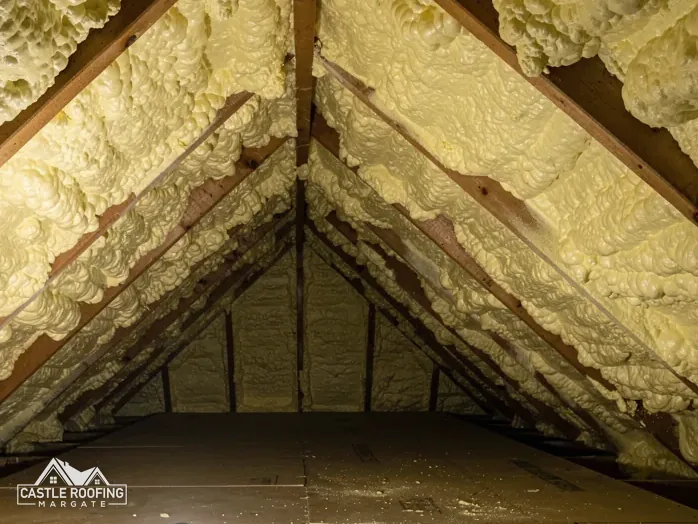
A lender relies on a valuation, and a valuation relies on a surveyor being able to see the property. The RICS guide makes a point that bears on this. Foam that covers the timber roof structure leaves a surveyor unable to examine it in full from the loft. The roof structure is the rafters, the purlins, the wall plates, and the felt and battens above them. When foam is sprayed onto the underside, a surveyor standing in the loft is looking at insulation, not at timber. Any damp, decay or movement beneath it is out of sight.
This matters whatever a given lender's policy turns out to be, because a hidden defect is a risk nobody can price. The Energy Saving Trust describes how one could arise. Foam sprayed hard against the rafters seals the wood in part, and if a leak sends water into that pocket, the timber will decay. The trust calls the risk "much lower" for open-cell foam, which is lower and not nil.
None of that means your roof is damaged. It means the roof cannot currently be shown to be undamaged by looking, and for some purposes that is the very point at issue. A valuer who meets foam may ask for an independent report on the roof before giving an opinion, which is a reasonable thing to prepare for.
It helps to think of the valuer's position. They are asked to put their name to a figure for the whole house, roof included. If they cannot look at the structure, they either ask for more evidence or write the limitation into their report. Neither is a verdict on your roof, and both are easier to deal with when you already hold photos and records of what is under the foam.
Questions to put to your provider
Because the answer sits with your provider, the most useful step is a clear set of questions put in writing. Keep the replies with your roof papers, so that anyone who asks later can see what was said and when.
- Does your lending policy allow a property with spray foam insulation under the roof, and is that policy written down?
- Does the answer change with the type of foam, open-cell or closed-cell?
- What documents do you want about the installation, such as the contract, the installer's calculations and any test certificate?
- Would you want an independent specialist report on the roof timbers?
- If the foam were removed, what evidence would you need that the roof is sound and re-insulated?
- Does anything change if the property is listed or in a conservation area?
You do not have to know the answers yourself. If you are unsure which foam you have, say so. A survey of the loft can find out, because the two types look and behave differently once set. If a surveyor has already commented on the foam in a report, hand that report to your provider along with your questions. It saves a round of back and forth and lets the provider answer about your actual roof.
Ask for each answer by email or letter. A phone call is easily forgotten, and a written reply can be shown to a solicitor or a valuer if the question comes up again.
Where removing the foam fits in
Removal is one of the options you can put to a provider, and it is better raised before the work than after. Ringing a provider with a plan already half made leaves little room to change course if the answer is unwelcome. Whether it is needed depends on your provider's answer, on your plans for the property, and on what the survey finds.
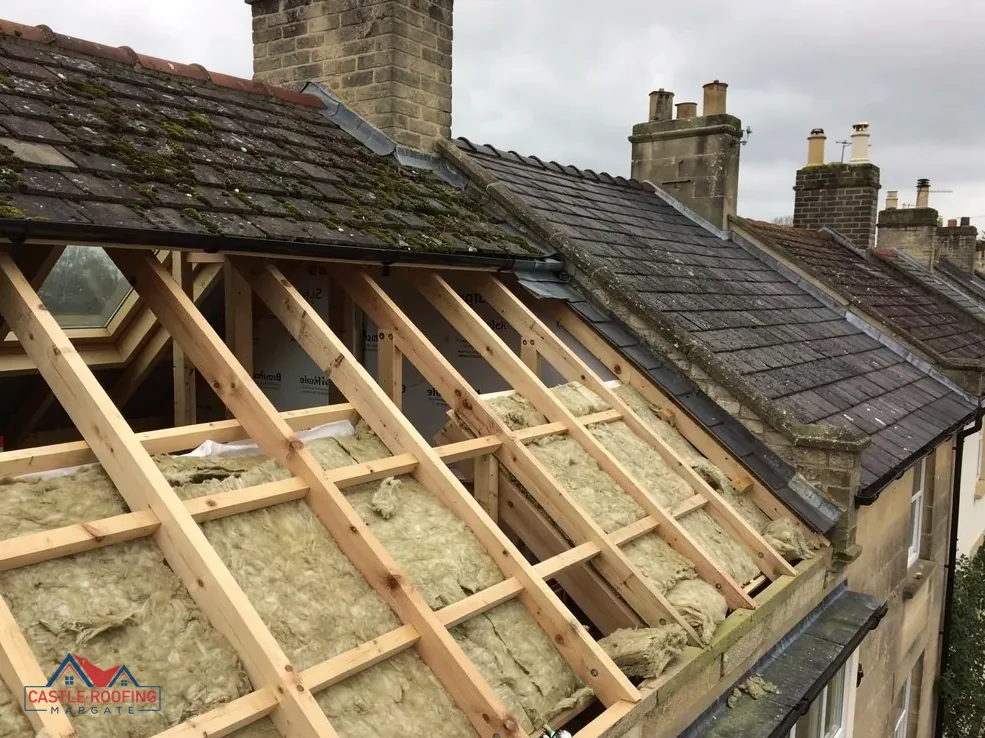
When the foam is off, the timbers can finally be seen. That is the practical gain: the rafters and plates can be inspected, photographed and, if needed, repaired. The roof is then re-insulated in a form that leaves the structure visible and ventilated, with the air paths set under BS 5250:2021, the standard that covers moisture in buildings.
For your own records, ask for:
- photos of the timbers once the foam is removed, before anything covers them again
- a note of any timber repair carried out
- details of the new insulation and the ventilation fitted
- the written quote and the finished invoice, kept together
Those papers give a valuer something concrete to read, which a covered roof cannot offer. We do not tell you what a provider will accept. We make sure the roof can be shown to be sound, and we hand you the evidence.
If your plans are not settled, a survey costs you nothing in options. You learn what is under the foam, how far it reaches and what condition the roof is in, and you can carry that information into any later conversation with a provider. A survey also tells you whether a partial removal could be enough, for example where foam has been used on one slope only.
Reading a headline against the source
Spray foam stories change shape as they are repeated, so a short checklist helps when you meet a new one. Go back to the source, which is usually a RICS page or the provider's own policy, and compare the claim with the exact words.
| You may read | RICS wrote |
|---|---|
| Lenders refuse | Concern in specific sectors |
| All foam is a problem | Foam can hide the roof timbers |
| Nothing can be done | Check with your mortgage provider |
The same habit works for a cold caller. Whoever tells you that you must act today to keep a mortgage option open should be asked to put the claim in writing, with the policy it comes from. You can then take that paper to your provider and ask whether it is right, which costs you nothing and commits you to nothing.
For the survey side of the same question, see our page on the homebuyer survey and spray foam. For the wider mortgage picture, there is a guide on spray foam mortgage problems.
Neither replaces a conversation with your own provider, but both help you arrive at it with the right questions. Write the questions down before you call, note the name of the person who answers, and ask them to confirm the reply in writing. A clear paper trail is worth more than any summary we could give you, because it records your provider's actual position on your actual property.