You will see why covered timbers limit any inspection, which checks still work in general terms, what a written report should contain, and how to decide your next step once the report is in your hands.
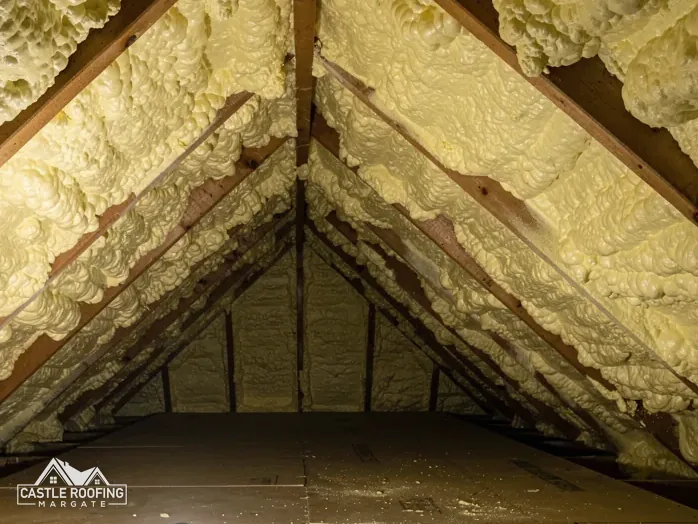
Installers spray the foam onto the roof from inside the loft, so it coats the rafters, the battens and frequently the underside of the covering. That is the whole attraction: one visit, no gaps. It is also the difficulty when someone later needs to know what condition the roof is in, because the parts a surveyor would normally look at are now under a layer of insulation.
A survey of a foamed roof is therefore a different job from a loft inspection of an open roof space. Some of it is ordinary roofing: looking at the covering from outside, at the flashings, at the gutters, at the ceilings below. Some of it is about the limits of what can be known, and a good report says plainly where those limits sit.
This guide covers the purpose of the survey, the checks it can use, and the written report that comes out of it. It sits under our spray foam removal work, because a survey can come first, with the decision about removal after it.
What the survey is meant to answer
Three situations can lead to a survey. A buyer's surveyor or a lender has asked about the foam. A leak has shown up on a ceiling and nobody knows whether the water is travelling behind the insulation. Or the owner has read about spray foam and wants to know where the roof stands before deciding whether to leave it alone.
In each case the question is the same: what can be said about the roof structure when part of it is hidden? RICS, the professional body for surveyors, puts the limit plainly in its consumer guide: timbers buried in foam cannot be fully seen or inspected. Every survey of a foamed roof starts from that limit.
So the survey does not promise to certify the timbers. It builds the best picture available from the evidence that can be reached, and it separates three things in writing:
- what was seen directly, such as the outside of the covering, the gutters and any exposed timber at the eaves or gable
- what was measured, such as moisture readings taken where a meter could reach
- what could not be reached, and why
That separation is what makes the report useful to a buyer, a lender or you. A report that reads as if every timber had been examined, when the foam covers them, would be worth less than one that says where the gaps are.
Starting outside and below the foam
The first checks do not touch the foam at all. A surveyor walks round the building and looks at the roof from the ground, then from a ladder or a scaffold if the covering needs a closer look. A tile or slate that has slipped, a cracked hip, a ridge with open joints, a valley (the dip where two slopes run together) clogged with debris: each is a way in for water, and each is visible from outside.
Flashings come next. A flashing is a length of lead or other metal worked over a joint, at a chimney stack or a wall, to keep rain out. A failed flashing above foamed rafters matters more than usual, because the water has nowhere obvious to show itself.
Inside, the survey looks at everything that is still open to view:
- ceilings and walls below the roof slopes, for staining, tide marks or flaking paint
- the loft hatch, the floor and any boarded areas, for damp or a musty smell
- gable ends, party walls and chimney breasts where the foam stops
- any gap between the foam and the wall plate at the eaves
- roof lights and soil pipes passing through the foam
None of these tells you the condition of a rafter under the foam. They tell you whether there is a reason to suspect water is getting in, which is the thing a rafter's condition depends on.
Weather matters to timing. A ceiling stain that appears only after a spell of heavy rain points to a defect in the covering or a flashing, while a stain that comes and goes with cold mornings may be condensation. A surveyor who visits in dry weather can still note the marks, but may ask you what you have seen at home and when.
Sampling and moisture checks in general terms
Where the foam hides the timber, the only ways to learn more are indirect or small. A moisture meter gives a reading from the surface of a material it can reach. A surveyor may take readings on any exposed timber, on the wall plate where it is accessible, and on plaster or brick near the roof line, and compare them with readings from the same building where nothing is wrong.
Sampling means looking at a small piece rather than the whole. In a foamed roof it can mean an opening made at an agreed spot, so a surveyor can see the face of a rafter and the foam against it, then closing it again afterwards. It only ever shows that one place. A clean rafter at one point does not clear the rest of the roof, and a damp one at another does not condemn it.
Treat any survey that says more than the method allows with caution. Put these questions to whoever carries the survey out:
- Which readings will be taken, and where?
- Will any opening be made in the foam, and who repairs it?
- How will the report mark areas that could not be reached?
- Does it say what the readings mean for this roof, or only list them?
We use moisture readings as one input, not as a verdict, and the report says which parts of the roof they speak for.
Access shapes all of this. A low eaves space, a boarded loft or a roof light with foam round it can make a reading impossible at the very spot you most want it, and the report should say so in those words rather than leave the gap unmentioned.
The written report, section by section
A survey on a roof with foam only helps you if the result is on paper. A lender, a buyer's solicitor or the next surveyor will want to read it without you in the room, and you will want to look at it again in six months. A report that is clear about its limits is far more use than a confident phone call.
This is the shape a useful one takes:
| Part | What it records | Why it matters |
|---|---|---|
| Scope | What was inspected and how | Shows the limits |
| Findings | Defects seen outside and inside | Points to water paths |
| Readings | Where moisture was measured | Backs up the findings |
| Unseen areas | Timbers behind the foam | States what is unknown |
| Next steps | Leave, monitor, repair or remove | Lets you decide |
With us, the roof is surveyed first, and the photos are of your own roof, which lets you check the report against what is actually up there. Any price for work follows as one written total.
If you are selling, our guide to spray foam and a sale covers how a report like this is used.
Keep the report with your other house papers. A solicitor acting for a buyer may ask for it, and a second survey in a few years is much easier to compare against the first when the first set out its limits and its readings clearly.
Lenders, buyers and what to ask first
A survey often exists because of a third party. In March 2023 RICS reported concern in particular sectors of the lending market, equity release among them, which by then was affecting lenders more widely. It does not follow that your lender will object, and nobody can say so for you.
The RICS guide asks owners to confirm with their mortgage provider that its policy permits spray foam at all. That check costs a phone call and is worth making before you pay for any report, because the provider may say exactly what it wants to see.
Questions to put to the lender or the buyer's side:
- Do you need a report from a chartered surveyor, or will a roofer's written survey do?
- What must the report cover for you to be satisfied?
- Will you accept a report that lists the unseen areas as a limit?
- Does the answer change if the foam is partly or wholly removed?
We do not speak for any lender, and our survey does not replace a chartered surveyor's report if one is required. What it gives you is a clear account of the roof as it stands, which makes the conversation with your lender easier to start. Our page on spray foam and mortgage problems covers the topic in more depth, including what RICS said in March 2023 about concern in parts of the lending market.
After the report: leave, watch or remove
The report ends with a choice, and the choice depends on what it found rather than on the foam being there.
If the outside of the roof is sound, the ceilings are dry and the readings are ordinary, leaving the foam in place is a reasonable decision, with a plan to look again after the next winter. If the survey finds a failed flashing or a slipped slate, the first job is to fix the leak, and the foam does not need to come off for that. The Energy Saving Trust is blunt about the order of events: on a leaking roof, it does not recommend spraying at all.
Removal comes into the picture when the report cannot clear the roof and a buyer, lender or your own judgement needs the timbers to be seen. Taking foam off exposes the rafters, battens and wall plates, and a roofer can then repair or replace what is damaged and refit the underlay and insulation.
Three outcomes, then, and the thing that decides between them:
- Leave: dry ceilings, sound covering, a lender with no objection
- Repair and watch: a defect found outside, foam kept, a re-check planned
- Remove: unseen timbers that someone needs to see, or signs of water behind the foam
To book a survey, send photos of your loft and the outside of the roof. A written price follows the survey, never comes before it.