
You will see what RICS published in March 2023, why a surveyor cannot fully inspect covered timbers, what to ask your mortgage provider, and how leaving the foam, having it inspected or having it removed each play out.
Some owners had spray foam fitted to the underside of the roof because it promised a warmer loft and lower bills. Years later, a different question arrives. A buyer's surveyor looks into the roof space and asks about the foam, or a lender wants to know what sits under the slates. The owner then finds that a choice about insulation has become part of the sale.
It is worth being clear about what is known and what is not. There is no blanket rule that spray foam homes cannot be sold or mortgaged. What exists is a body of professional concern, set out publicly by RICS in 2023, and a patchwork of individual lender policies that change over time and that only your own provider or a buyer's lender can state for your house.
This piece covers the published position, the practical steps and the options. It is general guidance and not advice on any single sale. For the work itself, see our spray foam insulation removal page.
What RICS said in March 2023
RICS, the professional body for chartered surveyors, issued a press release dated 3 March 2023 to launch its consumer advice on insulation sprayed on as foam. It reported worry among certain lenders, naming equity release products as an example, and said the worry was by then having a wider impact.
Put simply, some lenders, equity release ones among them, had reservations about spray foam, and the unease was reaching other lenders. That is the extent of what the release states. It does not say that lenders refuse to lend, it names no lender, and it sets out no rule that applies to every mortgage.
The consumer guide that went with it gives the practical steer. The guide tells you to raise it with your own mortgage provider and find out if its policy permits foam installations. The guide leaves the detail to each provider, and a policy that suited a lender last year may have changed since.
Two points follow for an owner.
- The question belongs to the lender, so ask the lender and get the answer in writing.
- The surveyor's worry is a technical one about what can and cannot be inspected, and the next section turns to it.
Nothing in the 2023 release, or the guide, promises that any given lender will accept or reject a foam roof. Treat anyone who says otherwise, in either direction, as guessing.
The release also dates the position. It is a statement from March 2023, and what lenders do now is for each lender to confirm. A date on the advice is a reason to ask again, not to rely on what a neighbour was told last year.
Why covered timbers matter to a surveyor
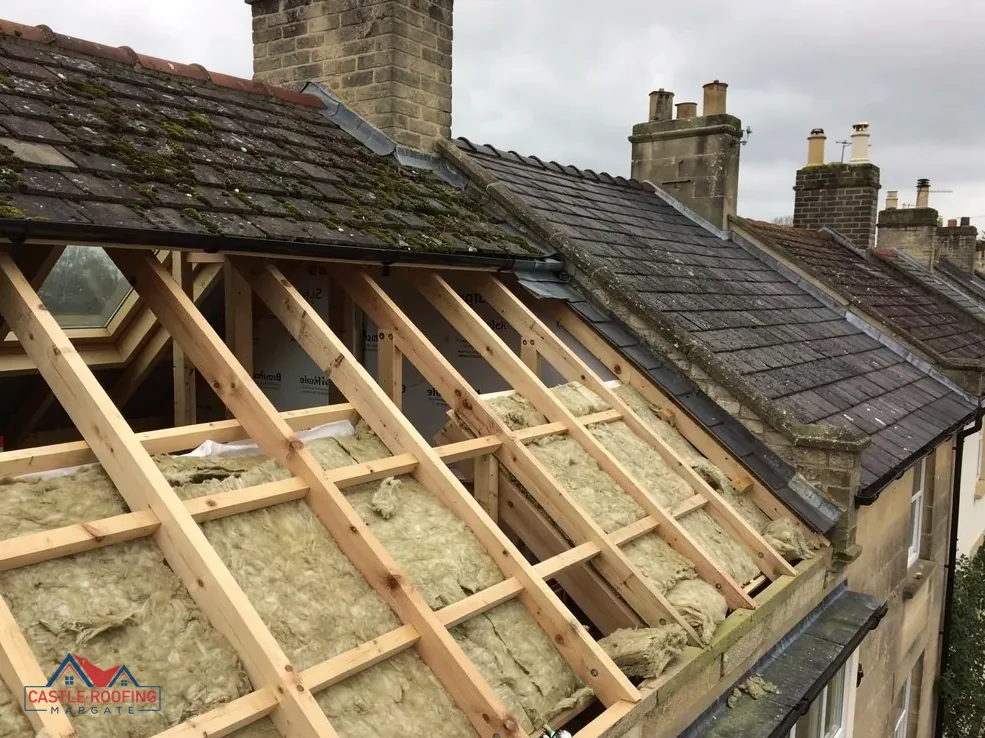
A surveyor's job in a roof space is to look at the structure. Rafters, purlins (the horizontal timbers that carry the rafters), wall plates and the back of the roof covering all tell the surveyor about the state of the house. Insulation that lies on the floor leaves those timbers visible.
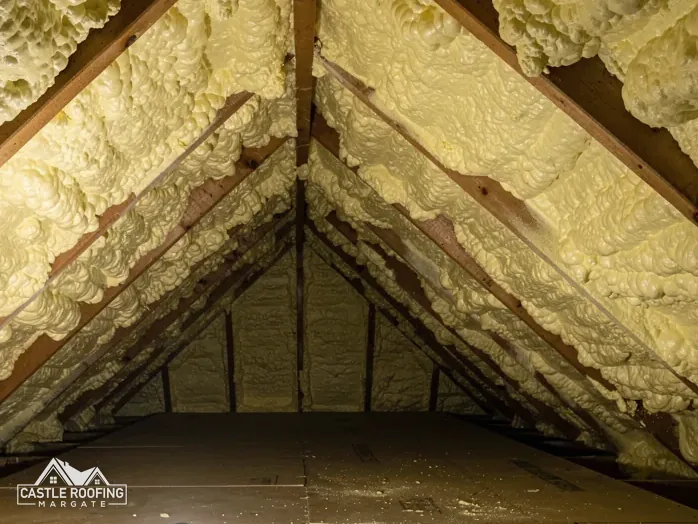
Foam sprayed onto the underside of the roof does not. A surveyor can see the foam but not through it, and the RICS guide accepts the limit, since a full check of timber beneath a foam coat cannot be made. Whether it is dry, sound or decayed cannot be judged by eye.
That is a limit of the survey, not a finding of decay. It does mean the report may state that the roof structure could not be inspected, and a buyer or lender may then want more information before going ahead.
The Energy Saving Trust describes the worry underneath. Its concern is that a leak above sprayed timber could set rot going, because the foam partly seals the wood. With open-cell foam it sees the risk as much lower, never as nil, and it advises against spraying a roof that already leaks. Where the foam is open-cell the worry shrinks, though a surveyor still cannot see what lies beneath it. Our page on spray foam and the homebuyer survey shows how this appears in a report, and why a surveyor words it the way they do.
Selling a house with spray foam in the loft
A sale is one point where the foam can come to light. A buyer's surveyor opens the hatch, sees foam on the roof slope and notes it. The buyer's lender is then told, and the sale can slow while someone decides what is acceptable.
You can get ahead of this with a few steps taken before the house goes on the market:
- Find the paperwork for the installation: who fitted it, when, which product, and whether it was open-cell or closed-cell.
- Look for any sign of a roof leak, such as stains on ceilings or damp patches, since a sound roof is what the foam is judged against.
- Ask a roofer or a surveyor to look at the roof covering and the foam, so a written view is ready to hand to a buyer.
- Tell your agent and solicitor early, because a buyer's solicitor will ask what has been done to the property.
None of this guarantees a sale or a lender's approval, and nobody can promise either. What it does is replace an unknown with a document.
A buyer who sees a report that says the roof covering is sound and foam is present can weigh it up. A buyer who sees only a note that the structure could not be inspected is left to guess, and guesses tend to drag a price down or a sale out. A tidy file of papers will not remove every question, yet it shortens the list of questions that remain.
Remortgaging: ask your provider before you apply
A remortgage works the other way round. The lender is already chosen, and it will value the house on its own terms. A provider may ask about spray foam at that stage, or the subject may not come up.
RICS advises asking your mortgage provider if its policy accepts spray foam. That is as specific as the published guidance gets, so a call or an email is the right first step. When you ask, write down:
- Who you spoke to, the date, and what they said about foam in the roof.
- Whether the answer depends on open-cell or closed-cell foam.
- Whether the provider wants a specialist report on the roof structure, or a removal.
- Whether it will accept a roof survey you arrange, or insists on its own valuer.
If the answer is that foam is not accepted, ask what would change it. The usual next questions are an inspection of the covered timbers, or a removal with a record of the condition underneath.
Equity release, the sector RICS named, is the one to raise earliest. Ask early in the process, not on the day the valuer visits, since an answer that needs a roof report takes time to arrange. Keep the answer, because staff change and a verbal comfort will not help if a valuer later takes a different view. If a broker handles the application, pass the question to them as well. Our page on spray foam and equity release covers the point, and spray foam mortgage problems looks at the wider picture.
Your options when a lender or buyer objects
If the foam becomes a sticking point, the choices are fewer than the worry suggests. They differ in cost, disruption and what they prove.
| Option | What happens | What it settles |
|---|---|---|
| Leave it | The foam stays as it is | Nothing, unless the lender accepts it |
| Inspect | A survey of the roof covering and the visible foam | The roof's condition, not the covered timber |
| Partial removal | Foam is taken off selected areas to look at timber | The state of those areas only |
| Full removal | All foam off, timbers checked and recorded | The timbers are seen and the loft can be re-insulated |
Each has a place. Leaving the foam in is fair when a lender has confirmed it is content. Inspection helps when the roof is young and sound. Removal is the route when the lender wants to see the timbers, or the owner wants to know what is under there. Each option also costs time, so it helps to decide early which one fits your sale date.
The work is priced once the roof has been surveyed, and the price is then given in writing. A partial removal is the smaller job for owners who want a sample first.
A variation on leaving it is to do nothing until a buyer or lender actually asks. That suits an owner with no plans to move, and it carries a risk: the roof is then checked under time pressure, with a sale or a completion date waiting on the answer.
After removal: re-inspection and what comes next
Removing foam is only half of the job for a sale or remortgage. The point is to give a surveyor and a lender something they can read, and that means a record of the roof once the timbers are exposed.
A roofer working to that end checks and notes:
- The condition of the rafters, battens and underlay, with dated photographs of each slope.
- Any decayed or damp timber, and what was repaired or replaced.
- The state of the roof covering as seen from below: nail points, gaps and leak marks.
- What replaces the foam, and how the roof will be ventilated afterwards.
The photographs and a short written note are what you hand your solicitor or lender. They turn a matter of what could not be seen into a record of what was. A new insulation layer then goes in, often mineral wool or boards, so the loft is warm again, with the ventilation planned to BS 5250.
None of this makes a lender accept a house, and nobody can promise it will. It does mean that, if the concern is hidden timber, the evidence is now on paper. A call to your provider with that paper in hand is a very different conversation from a call without it, and it gives your solicitor something to attach to the file. Keep the photographs with the house papers for the next owner too. Ask the roofer to date every photograph and to say which slope and which bay each one shows, so someone who was not there can follow the record later.