Read this before you ask anyone for a figure. It lists what raises or lowers the cost of getting foam out of a pitched roof in Thanet or East Kent, so you can judge a quote by what it covers.
Price is a fair first question about spray foam removal. The difficulty is that two apparently similar roofs can cost very different amounts to clear, and the reasons are not visible from the street or from a photo of the outside.
The price depends on the roof you have and what the foam has done to it. A small, sound roof sprayed in open-cell foam is one job. A large, complicated roof with closed-cell foam bonded to the felt is another. Neither can be priced fairly until someone has been up there and looked.
So instead of a figure, this guide gives you the list of things that decide one. It runs through the area of foam, the type, the access, the condition of the felt and timbers, and the insulation that goes back afterwards. With that in hand you can read any quote, ours included, and see whether it covers what your roof needs. The wider service is described on our spray foam removal page.
Why one removal never costs the same as another
Spray foam removal is not a standard product with a standard rate. It is labour on a particular roof, with a particular amount of material to take out and a particular amount to put back. Each of those is different from house to house, and from one slope of the same house to the next.
A figure offered by a stranger, based on a postcode and a number of bedrooms, would only be a guess. It would leave out the factors that really move the price, and it would let you discover them later as extras. We would rather you knew them now.
The main ones fall into five groups:
- the area of roof that is sprayed, and how thick the foam is
- the foam itself, in its open-cell or closed-cell form
- how the roof is reached, from the loft or from outside
- the state of the felt, battens and rafters once the foam is off
- what replaces the foam, and the ventilation that goes with it
The sections below take each in turn. If your roof has several of the harder features at once, they add to one another, which is why the range between a simple job and a difficult one is wide.
None of this has to be settled before a survey. The list is a prompt to ask what each quote assumes about the five, so that you compare like with like.
Area and depth of the foam
The most obvious driver is how much foam there is. A single slope over a rear extension is a small job. Every slope of a detached house, sprayed deep enough to fill the rafter depth, is a large one.
Two measurements matter. The first is the area, which sets how long the work takes. The second is the depth, which sets how much material has to come out and go away in the skip. Foam sprayed to fill the rafters makes far more waste than a thin coat on the underside.
Shape counts as well as size. A plain pitched roof with long clear rafters is quicker to clear than one with hips, valleys, dormers and a chimney, because every junction needs hand work to get the foam out cleanly without damaging the timber. Hips, the sloping ridges that run down the outside corners of a hipped roof, each add cut rafters that must be cleared by hand. We measure from the loft during the survey and record the depth in several places, so the quote is based on what is actually there and not on an average. If the foam covers only part of the roof, a partial removal may be possible, and our page on partial spray foam removal explains when that makes sense.
Photos of the measured areas are sent with the quote so you can see what has been allowed for.
Open-cell or closed-cell foam
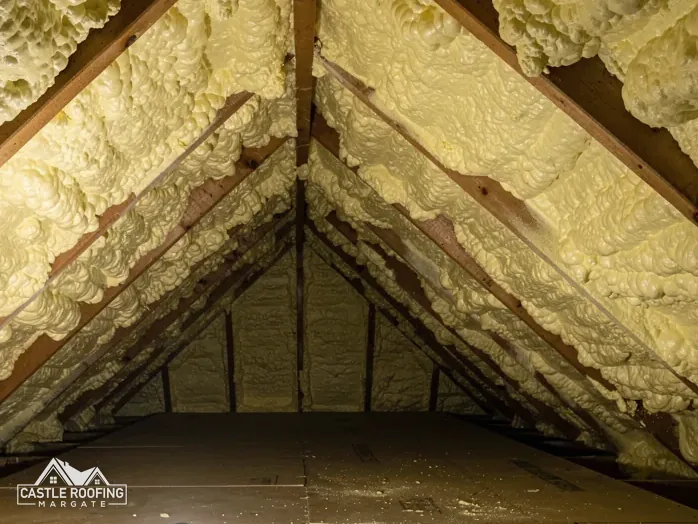
The two types are different materials and behave differently when you try to remove them. Open-cell foam is lighter and more flexible. Closed-cell foam sets rigid, and it grips the surface it was sprayed onto.
That difference changes the method, and the method changes the time. Foam that peels or cuts away in sections is a quicker job than foam that has to be worked off the surface in small pieces. The Energy Saving Trust treats open-cell foam as the lower rot risk of the two, but that is a point about moisture and not about how easy the foam is to take out. A lighter foam is not always a quicker removal, because depth and bonding count as much as type.
If you do not know which you have, the survey will tell you. We look at the foam's texture and thickness, and at how it has set. Please do not rely on the name on an old invoice, because the paperwork does not always record it.
The type also affects what can be saved. Where foam has bonded firmly to felt or to timber, a little of the surface may come away with it, and that has to be allowed for in the repair that follows. A roof with several coats applied at different times can hold both kinds, so the survey samples more than one spot. Our page on removing closed-cell foam describes the harder method, which shows why the cost differs between the two.
Access, scaffold and the Kent licence
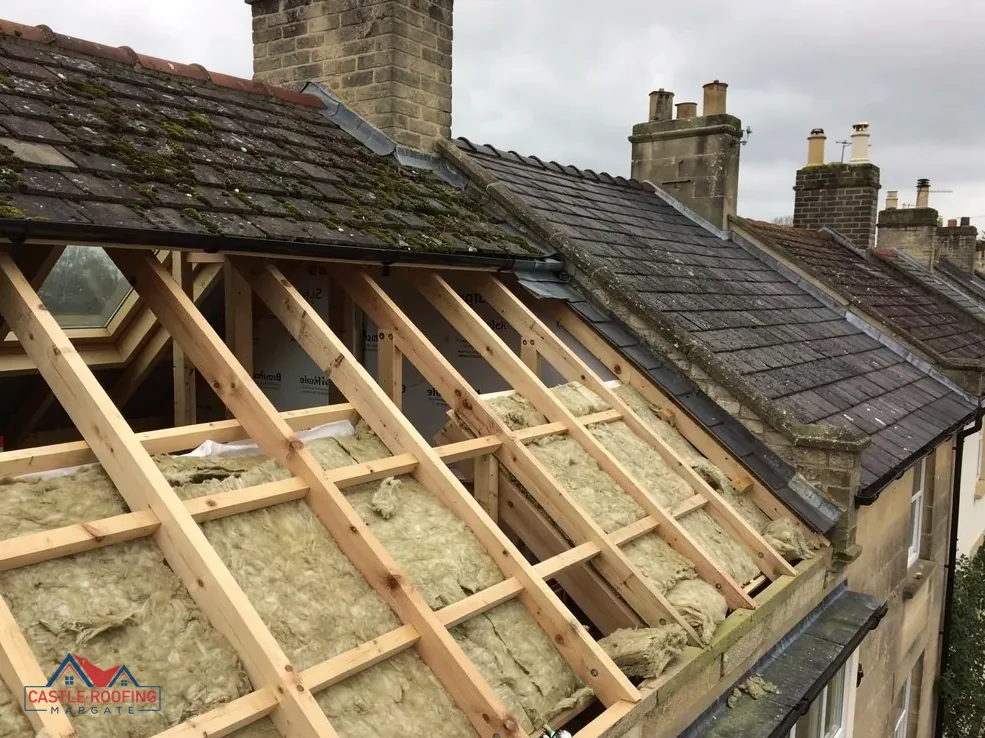
How the foam is reached is the next factor. From the loft, the work needs only a safe way in, space to move and a place to put waste. From outside, it needs scaffold, and a stripped slope needs weather protection while it is open.
Where scaffold stands on or over the pavement, a licence is required under section 169 of the Highways Act 1980. Kent County Council issues it once the scaffolding firm has applied. The council asks for 5 working days' notice and charges £52 per week for 2026 to 2027, which is one more reason the length of the job matters to the price. A slope that stays open longer because of weather can carry the scaffold into another week of that fee.
A few features make access harder and so push the price up:
- a loft hatch too small for the equipment or the waste
- a low or cut-up roof space with little room to work
- a house that opens straight onto the pavement
- a tall or steep roof that needs a taller scaffold
When you compare quotes, check that scaffold and VAT are included. The standard VAT rate is 20%, and a quote that leaves either out will cost more than it first reads.
Skips have their own rules where they stand in the road, so ask who will arrange the permit and where the waste will wait between loads. Foam is bulky and light, so a lot of it fills a skip quickly, and more than one collection may be needed on a large roof. Whether that is allowed for in the quote is worth a direct question.
Felt, timbers and re-insulation afterwards
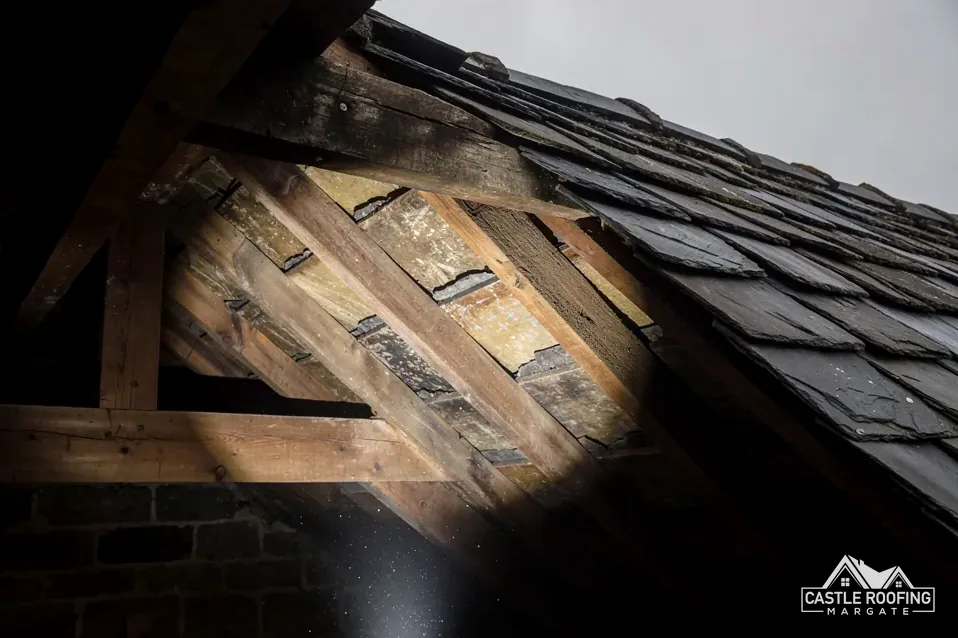
Removing the foam is only part of the work. What lies beneath it decides the rest, and it is not known until the foam is off. The felt may have come away with it, the timbers may need repair, and the roof then has to be insulated again.
| What is found | What it adds |
|---|---|
| Torn or bonded felt | New underlay and battens |
| Damp or soft timber | Repair or replacement |
| Poor ventilation | Eaves and ridge work |
| Bare roof | New insulation |
Each of these is a decision that depends on what we find. Our guide to re-felting after spray foam removal explains the felt side, and the insulation that goes in has to satisfy the Building Regulations, with ventilation set under BS 5250:2021.
The point for your quote is simple. Ask what is allowed for if the felt or the timbers turn out to be worse than the survey could see. A good answer explains it in plain words and in one total, and not in a string of surprises added after the work starts.
Ask, too, who decides when something extra is needed, and if you will be told before it is done. You should be, with a photo of the timber or felt in question, and you decide on what you can see.
Keep in mind that the survey sees the roof from the loft and the outside, and the foam hides what is behind it. A sensible quote says plainly where that limit lies and what happens when the foam comes off and shows more.
Setting several quotes side by side
With the five factors in hand, you can put quotes next to each other on a fair basis. Citizens Advice recommends collecting at least three written quotes, and for a job like this that advice is worth following.
Look for these things in each:
- Whether the roof was inspected before the price was given, from the loft and from outside
- Which type of foam the quote assumes, and what was done to find out
- Whether the felt, timbers and new insulation are part of the price or left out
- Whether scaffold and VAT are included
- What happens to the waste
A very low figure that leaves out the re-insulation, or assumes the felt will be fine, can end up the dearest. Equally, a high figure should come with photos of your roof that explain it. Both the cheap-looking and the expensive-looking quote deserve the same questions.
The 14-day cancellation period for off-premises contracts covers an agreement made at home after a survey. Citizens Advice runs a consumer helpline on 0808 223 1133 if you want to check your rights before you sign.
Keep the quotes and the photos together. If you later change your mind about the route, they show what each person assumed, and they give the next surveyor a head start. Add the dates the quotes were given, since a price held for a short time may not hold once scaffold dates or material prices move.