Why the answer lives in your policy
Home insurance is a contract, and the contract is the policy document plus its schedule. What it says about alterations, about roof condition and about the kinds of damage it covers is what counts. A summary on a website, ours included, cannot override it.
Insurers differ, policies differ, and the terms can change from one renewal to the next, so the answer for your own house sits in the wording of your own policy.
Three places carry the answer: the policy booklet, the schedule that names your property and any extras, and the insurer's helpline or secure messaging. Words to look for in the booklet include alterations, structural changes, wear and tear and gradual damage, because those are the clauses that decide how a hidden problem under a roof is treated.
If the foam went in before you bought the house, the question still applies. A policy is written for the property as it stands today, not as it stood when the foam was sprayed, so put the question to whoever insures the house now, whatever the seller was once told.
What to put in your message to the insurer
A vague enquiry gets a vague answer. A short, specific message gets one you can rely on later. Include these points:
- the address and your policy number, so the reply goes on the right file
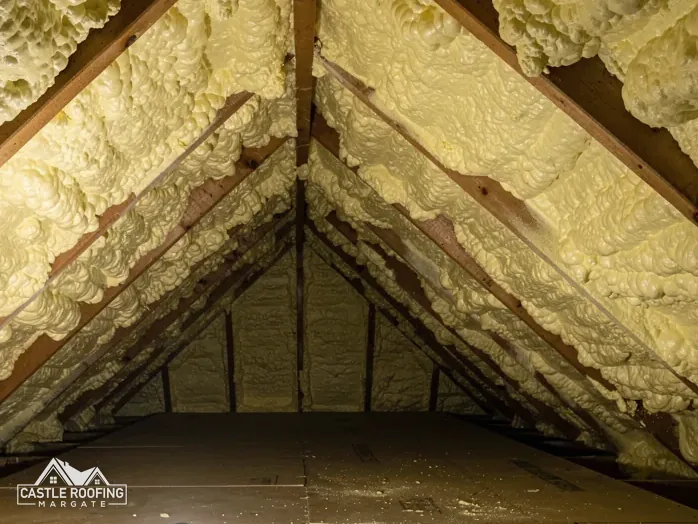
- that spray foam insulation is on the underside of the roof, and whether you believe it is open-cell or closed-cell
- the date it was installed, if known, and who installed it
- whether any leaks, stains or repairs have been reported on that roof
- what you want to know: whether the foam affects cover, and what the insurer would want if it came out
Send it by email or through the insurer's portal so you have a dated copy. If you phone, note the time, who you spoke to and what was agreed, then send a short email confirming it.
If you cannot tell what kind of foam you have, that is worth saying too. A survey of the loft can usually identify it, and our page on the spray foam survey explains what the visit looks at.
Roof damage and what your policy calls it
When a roof problem is found under foam, the first reaction is often to ask whether insurance pays. Whether a claim is accepted depends on the policy's own definitions and on what actually caused the damage, and nobody can promise an outcome in advance.
On the Financial Ombudsman Service's list of usual policy exclusions sit wear and tear and slow deterioration. Its guidance on storms points out that some insurers count only winds above a certain point on the Beaufort Scale, so the wording in your own policy matters more than any general idea of a storm. If you are unsure how a policy applies, the Financial Ombudsman Service helpline is 0800 023 4567.
For sudden damage, such as storm damage to a roof, the advice from the Institution of Structural Engineers runs in order: contact the insurer first, make things safe, and keep photographs and receipts. Photographs matter because they are evidence of the damage as it was.
Moisture that has built up slowly over years behind foam is harder to date. That is one more reason to ask the insurer about it directly, and to ask before a problem appears rather than after.
Paperwork worth keeping after removal
If the foam is taken out, a small file of documents helps with insurers, mortgage providers and future buyers alike. It also saves you reconstructing events from memory.
- The written price and the scope of work, showing what was removed and from where.
- Dated photographs of the timbers and the felt once they were exposed, before anything was covered again.
- Notes of any repairs, such as patched felt, replaced battens or renewed sections of rafter.
- Receipts, and details of any new insulation and ventilation that went in afterwards.
- The insurer's reply to your original question, and any follow-up after the work.
Our page on removing spray foam describes how the work proceeds, and the main spray foam removal page covers the whole job.
Tell the insurer when the work is finished and ask whether they need anything further. What they want is for them to say, and finding out costs one email. Keep that reply with the invoice and photographs in one folder, so the whole story can be handed over in minutes if a buyer or lender ever asks for it.