You will see where roof rot really starts, what the Energy Saving Trust says about leaks and open-cell foam, why RICS worries about timbers nobody can see, and what a survey looks for in a foamed loft.
Roof timbers are sound for as long as they stay dry. They are softwood, and softwood that is wet over a long period decays. That was true of every Thanet roof before spray foam existed, and it stays true now. The new part is the layer of foam under the slopes, and the worry that it hides a problem until the problem is large.
So the honest answer to the question in the title has two halves. The foam is not itself said to rot a roof. But when water does get in, the foam changes how easily the owner finds out, and, according to the Energy Saving Trust, how the timber behaves once it is wet.
This guide looks at where the water comes from, what the published sources actually say, and what a roofer checks when a foamed roof is suspected of having a leak. It belongs with our spray foam removal pages, and it is general information, not a diagnosis of your roof.
Where roof rot starts, with or without foam
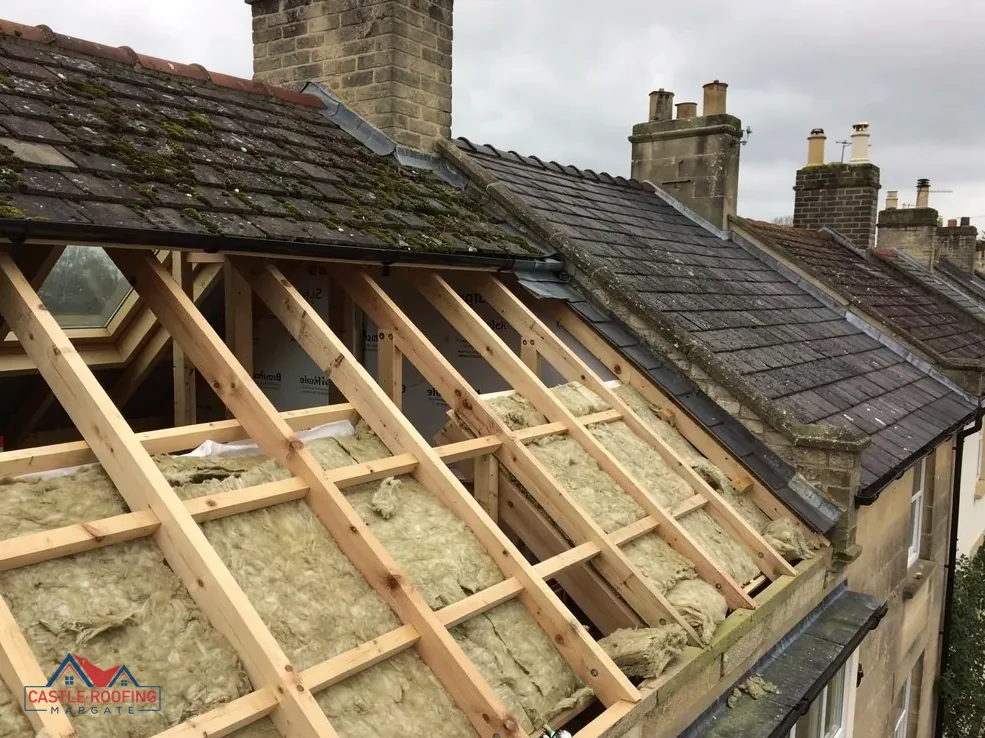
A rafter, a batten or a wall plate does not rot by itself. Something wets it, such as water entering from outside: a slipped slate, a cracked tile, a failed flashing, a blocked valley, a gutter that overflows behind the fascia board. Condensation from damp air in the roof can do the same in a poorly ventilated space.
Timber at the lowest edge of the roof takes the first hit. The wall plate, the timber that sits on top of the wall and carries the rafter feet, lies under the eaves, where water from a slipped course or a bad gutter arrives first. The same goes for the ends of rafters, the timbers around a chimney and the framing of a valley.
In an open roof, a leak leaves signs that can be read from the loft:
- a dark stain on the underside of the covering or the underlay
- a drip mark or a wet patch on the insulation or ceiling
- a musty smell after rain
- softness in a timber when it is pressed with a screwdriver
These are the clues a roofer uses without even thinking. With foam on the underside they are covered, which is where the question about rot really begins.
Age and ventilation play a part as well. A roof that has been damp for years is likely to show it in the timber long before a leak appears at a ceiling, and a roof space with no air movement keeps that dampness in. Neither of those is a feature of foam. They are why roofers ask how long a stain has been there before they talk about causes.
What the Energy Saving Trust says about leaks
The Energy Saving Trust, the UK body that advises households on energy, covers spray foam on its advice pages. It describes spraying the underside of the roof as something that partially seals the timber. On the question of water it is direct: a leak means wet timbers, and wet timbers rot.
That wording matters because it puts the cause where roofers already put it. The foam is a layer over the wood, and what comes through the covering is what wets the wood.
Read that carefully. The Trust's point is that a leak is what causes rot, and that foam in place does not remove the consequence of a leak. It does not claim that every foamed roof rots, and it does not say how long rot would take.
Open-cell and closed-cell foam
The same advice makes a distinction between kinds of foam. For open-cell foam, which the Trust treats separately from closed-cell, it says the risk of rot should be much lower where open-cell foam has been used. Much lower is not none, and the Trust does not say none. A roof with open-cell foam and a persistent leak should still be looked at.
On the order of work, the Trust's roof and loft advice says that spraying a leaking roof is something it does not recommend. The sensible sequence therefore runs:
- Find and fix the source of water.
- Check that the timbers are dry.
- Only then insulate, with the product and method chosen for that roof.
For an owner who already has foam on a roof that has leaked in the past, the same order applies in reverse: confirm the leak is fixed, then find out what the water reached before deciding anything about the insulation.
Our guide to open-cell and closed-cell foam sets the two types side by side.
Why covered timber is a surveying problem
Rot is slow, and it is quiet. By the time a timber gives way or a ceiling stains, a good deal of damage may already be present. For that reason, roofers and surveyors look for early signs, and they depend on being able to see the wood. A rafter that has gone soft at the foot can still look fine from a few feet away.
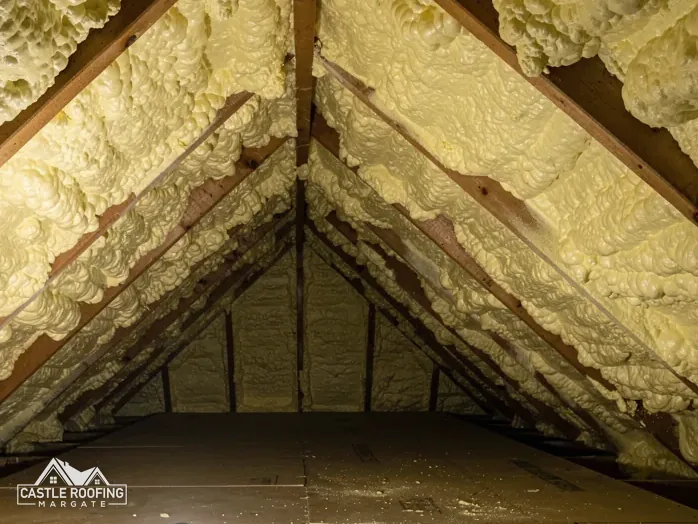
Foam adds a second difficulty to that one. The tools a roofer would use on bare timber, a torch, a probe and a hand on the wood, cannot reach a rafter that has been sprayed, so the usual early warnings never arrive.
RICS is the professional body for surveyors. Its consumer guide on spray foam states that once foam covers the roof timbers, a surveyor cannot fully see or inspect them. That is a statement about visibility, not about decay. A surveyor asked to comment on the condition of a roof cannot do so for timbers out of reach.
This is why a clean-looking loft with foam on it does not settle the matter. Foam can hide:
- a stain where a flashing has been leaking for several winters
- softened wood at the wall plate that would be visible in an open loft
- wet insulation or a damp rafter foot at the eaves
- fixings or nails showing early corrosion
Equally, an absence of visible signs is not proof of a problem. The point is narrower: without a view of the wood, nobody can offer more than an informed opinion about it. A survey that can see some of the timber narrows that opinion, and one that can see none of it says so in writing.
The places water gets in above foamed rafters
If you want to know whether your own roof is at risk, start with the outside, because that is where water gets in. The table shows the usual routes and how each shows itself, so you can look from the ground or from a bedroom window before anyone climbs a ladder.
| Entry point | What it looks like outside | Sign inside |
|---|---|---|
| Valley | Debris, moss or a split lining | Stain on a ceiling corner |
| Chimney flashing | Lifted or gapped lead | Damp on the breast |
| Slipped slate or tile | A gap in the courses | Spot stain below |
| Ridge or hip | Loose or cracked capping | Drip near the apex |
| Gutter outlet | Overflow staining on the fascia | Damp at the wall head |
A fascia is the board that runs at the foot of the roof and holds the gutter brackets. If you see overflow marks on it, or the wall below is green with algae, the water may be running in behind it rather than away.
Gutters deserve a second mention. A gutter that overflows at a corner or a joint can soak the same short length of wall plate every winter, and that patch of timber sits right behind the foam at the eaves. Clearing and realigning the gutter is a small job that protects it.
Not every one of these ends in a problem for the timber. A leak can be small, and a repair at the right time is a much smaller job than replacing rotted wood. That is the real case for looking early: a minor job on the covering is easy to put right, while the timber beneath it is not.
Look after rain, not before it. A dry spell shows nothing, but an hour after a downpour a quick check of the ceilings upstairs, the walls under the gutters and the loft hatch will tell you more than a month of dry weather.
What a survey looks for in a foamed loft
A survey for rot on a foamed roof works from the outside in, because the outside is where the evidence is still open. It joins the covering, the flashings, the gutters and the ceilings into a single account of whether water has had a route in. Our page on the spray foam survey covers the method in full.
In summary, the roofer will want to see:
- the roof covering, for slips, cracks and failed joints
- every flashing and valley, where water can find a way in
- the gutters and downpipes, for overflow or blockage
- the ceilings and walls under the slopes, for any stain or damp
- any exposed timber at the eaves, gable or hatch, for softness or colour change
- moisture readings, taken where a meter can reach
The order of the visit matters too. Outside checks come first, since they cost nothing and often explain what the loft shows. Then comes the ceiling and wall check, then the readings, and only after those does anyone discuss opening up the foam. A survey that starts by cutting into insulation has started at the wrong end.
None of that proves the state of a covered rafter. It builds a case, in either direction, that the owner can weigh up. A dry set of readings, a sound covering and clean ceilings all point towards a roof that has stayed dry. Stains, a failed flashing and high readings point the other way and justify a closer look.
If the evidence leaves doubt, removal is the way to settle it, because it exposes the timbers for a proper look and for repair where needed. We suggest it only when the survey calls for it, and the reasons are written down before you decide.