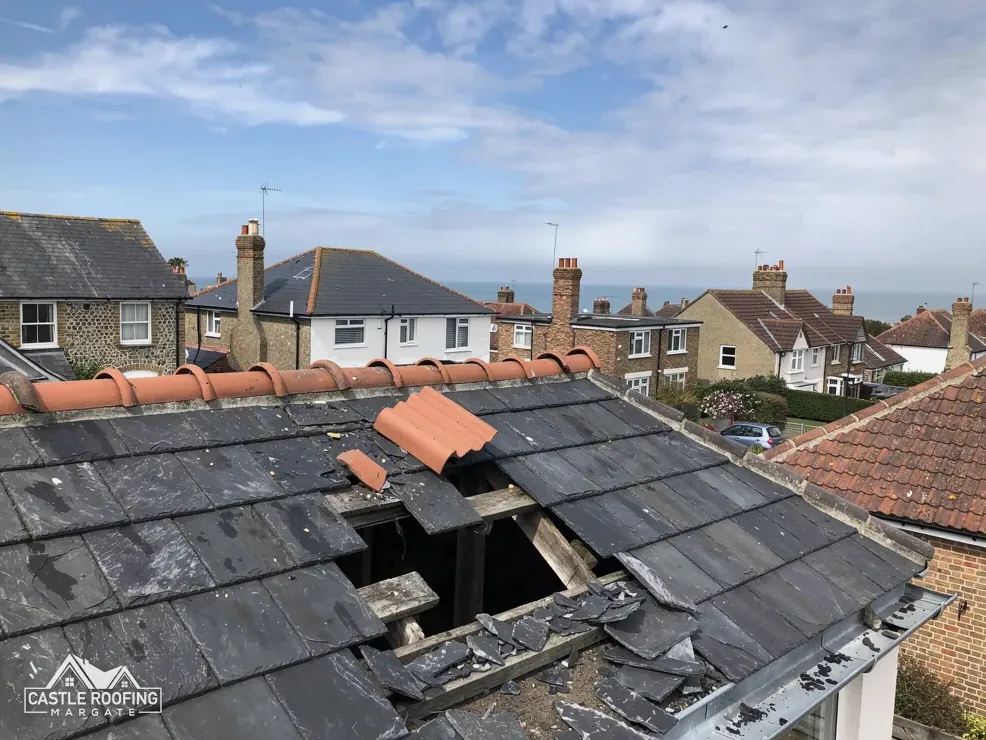
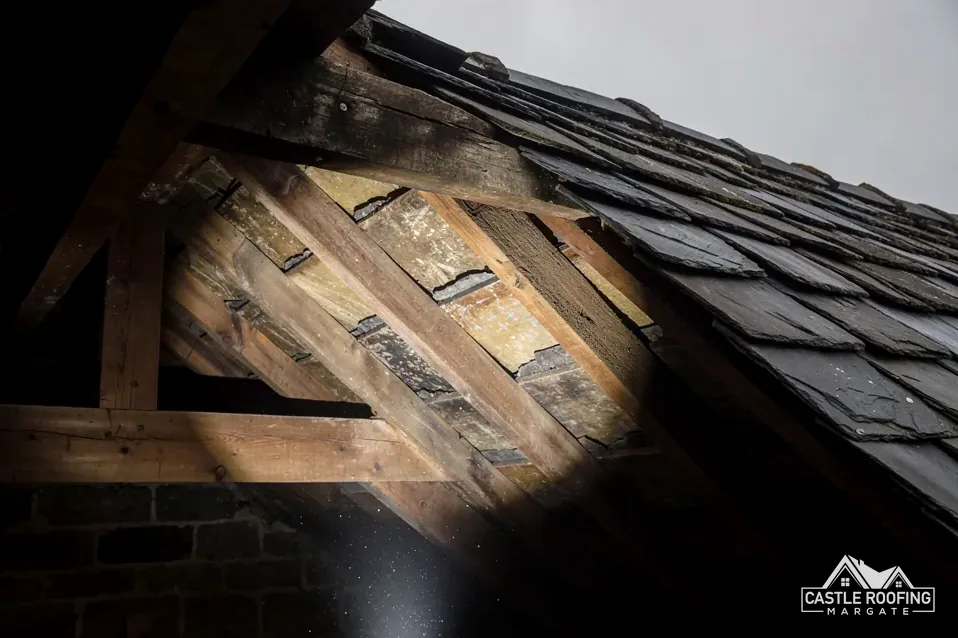
How freezing water splits a slate
Slate is a layered stone, and it can only be harmed by frost if water gets inside. A dense, well-made slate takes in very little. A poor one, or an old one that has begun to open along its layers, can draw in water through its face, its edges and the nail holes. Water that turns to ice takes up more room than it did as liquid, and the stone is pushed apart.
One freeze does little. Repeated cycles of wetting, freezing and thawing do the work, prising the layers further apart each time until a slate flakes at the tail or splits in two. The damage grows from the outside in, which is why a slate can look sound until a cold spell reveals it.
Where it happens matters. Slates at the eaves and in gutters hold water longest, and a slate on a north-facing slope that stays wet through the winter has the longest exposure.
This is a material fault, and it is not the same as a fixing failure. A slate that has slid down because its nails gave way differs from one that has laminated, and so does the repair. The delaminating slates page covers the layer-splitting form in more detail.
What East Kent winters bring
The Met Office climate station at Manston, in Thanet, gives averages for 1991 to 2020. They describe that station, not every street in Thanet, but they show the kind of weather a roof here faces.
| Measure | Figure |
|---|---|
| Air frost | 21.43 days a year |
| Rain of 1 mm or more | 110.05 days a year |
| Rainfall | about 613 mm a year |
Put together, those figures mean a roof here is wet on a great many days and below freezing on a smaller number. Frost damage needs both at once: wet slate and a cold night. Neither number says a roof will fail, and they are averages, so some winters are milder and some harsher.
Treat them as a reason to look at the slates after a hard winter, not as a prediction. A sound slate is not threatened by 21 nights a year. A slate that is already taking in water is, and it shows up first at the eaves and on the slopes that stay wet longest.
Telling frost damage from other causes
Not every broken slate is a frost casualty. Looking at what has happened to the slate tells you which cause you are dealing with:
- Thin flakes or layers peeling from the tail or the edges, often found in the gutter, point to frost working on a slate that takes in water.
- A slate cracked straight across usually has an impact or a footstep behind it.
- A slate that has dropped down with its nails still in the batten, or left a gap, points to a fixing failure.
- A soft, crumbling, rust-stained surface suggests the slate itself is ageing.
The slate edge is the clue. Frost-damaged slate opens along the layers like a book, while an impact break goes through them.
A roofer looks at several slates before deciding, because the cause is only clear when the failed slates are compared with their neighbours. If many in one area are flaking, the stone is the problem. If only a few have, with sound slates around them, a patch repair will do. The same method appears in the broader guide on slate roof lifespan.
Replacing the slates that have failed
A frost-damaged slate cannot be repaired. It is lifted out, and a replacement of the same size and colour is fixed in its place, using a tingle or slate hook where the nails cannot be reached. The skill is in matching the new slate to the old ones around it and fixing it properly.
Quality matters on the replacement. A poor slate will fail the same way again, so the supplier's information on the slate and its source is worth asking for. Quality varies between quarries and between grades.
If frost has taken only a handful of slates, replacing them is the sensible repair. If slates are flaking across a slope, the stone has run its course, and individual replacements will not keep up. At that point re-slating the slope, using new or sorted reclaimed slate, makes more sense, and the cost of scaffold and labour is better spent once.
A survey separates the two cases, and the photographs record what the surveyor found. For the decision itself, see re-slate or repair, and for the whole service the slate roofing page.