Read this to learn what delaminating slates look like from the ground and in the hand, the causes behind it, how a survey separates age from a poor batch, and when a repair stops being enough.
A slate is a thin sheet of rock that splits easily along flat planes. That is how it is made into roof covering, and it is also how it fails. When water, frost or poor stone work at those planes, the surface lifts off in layers, and this is called delamination. The slate looks like a pastry that has been left out in the rain: flaking, scaled and thinner at the edges than it started.
A flaking slate is not always a failing roof. A few slates that have lost a layer may still shed water well, while a roof covered with them is on its way out. The skill lies in telling which of those you have, and in knowing whether the cause is age or a weak batch of stone laid when the roof was built. The two are treated differently, because an old roof of good slate can often be mended slate by slate, while one with a poor batch may need the whole slope stripped.
This guide describes the signs, the causes and the repair options in general terms. It belongs with our slate roofing work, and the pages on slate roof lifespan and slate roof repair cost go further on the two questions that follow.
What delamination looks like
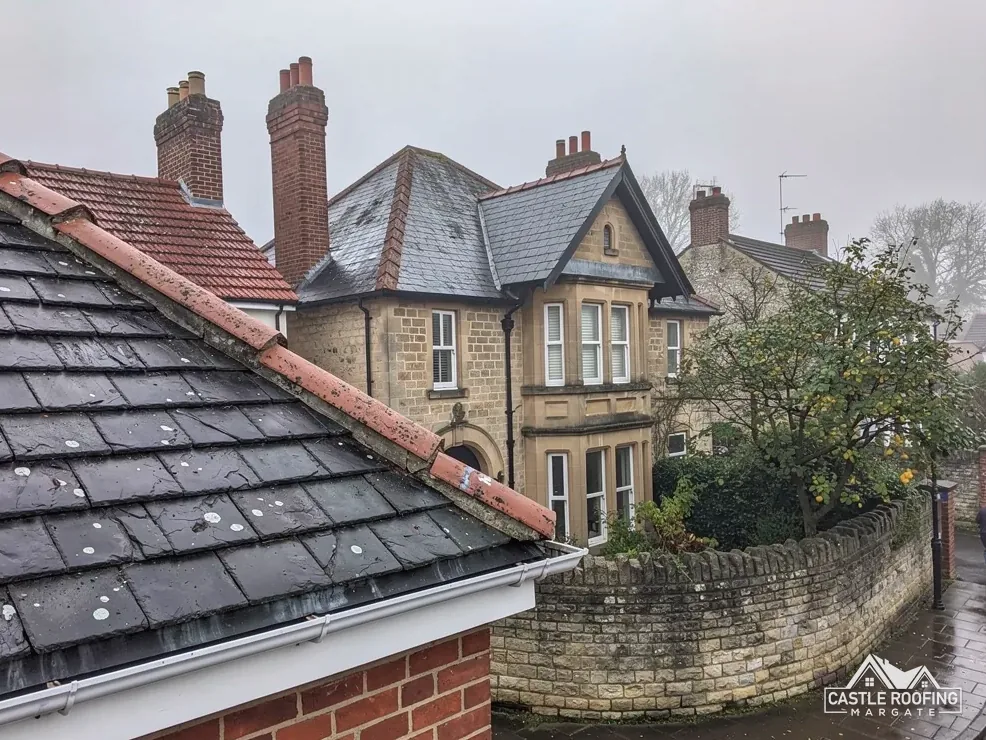
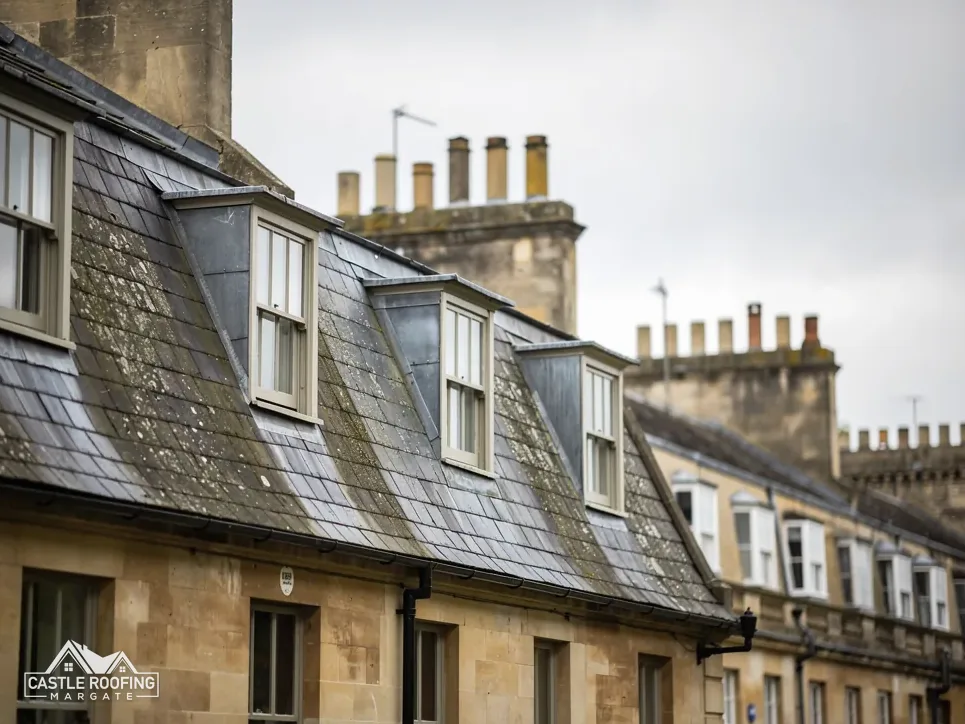
From the ground, delaminating slates are easy to miss. You may see a roof that looks patchy, with some slates paler or rougher than their neighbours, or a scatter of grey flakes in the gutter and on the path below. Up close, the signs are clearer, and a few of them separate delamination from a simple crack.
- The surface lifts in thin sheets, leaving a rough, stepped face where the layers have come away.
- The lower edge, the tail, looks frayed or crumbly, as though it had been worn with a file.
- Flakes or powder gather in gutters, hopper heads and valleys.
- A slate that was dark looks pale and chalky in patches, with rust-coloured staining.
- The slate sounds dull when tapped, not ringing, and may break in the hand with little force.
A crack is a clean break across a slate, often from a foot or a falling branch. Delamination goes sideways through the thickness of the slate instead, and it tends to affect several slates in the same area. If you see a row of flaking slates at one height on the slope, the cause is likely a batch or a shared point of weakness and not a single knock.
Delamination also changes how the roof behaves in rain. A slate that has lost a layer is thinner and holds less water on its surface, but it is also weaker at the nail hole, where it is held to the batten. A thinned slate at a nail hole can slip, and that is when the signs on the ground turn into slipped slates and a damp patch under the roof.
Why a slate splits into layers
Slate is a layered rock, and that is the root of it. It splits cleanly into thin plates because its structure runs in parallel planes, called the cleavage. Roof slates are cut along that cleavage, so every slate on a roof carries planes along which it can part.
Several things act on those planes over the years.
- Water. Rain gets into the surface of the slate at the tail and the nail holes, and wet and dry cycles work at the layers.
- Frost. Water that has got in expands when it freezes, and a repeated freeze prises the layers apart. The Met Office records an average of 21.43 days of air frost a year at Manston, for 1991 to 2020.
- Mineral content. Some slate carries mineral inclusions that rust or weather faster than the rest, which shows as staining and flaking around them.
- Thin or poorly selected stone. A slate cut thin, or taken from a weak part of the rock, has less material to lose before it fails.
- Fixings. Corroded nails stain the slate and loosen it, and a slate that moves in the wind wears at the nail hole.
Rain is a part of the picture here. The Met Office climate station at Manston averages about 613 mm of rain a year, and 110.05 days with 1 mm or more, across 1991 to 2020. Manston's figures describe one weather station, and they say nothing exact about any single roof. They do show that a slate roof in East Kent spends a great many days wet.
No single one of these condemns every slate. A good slate takes decades of wet and frost without losing its surface. A roof where many slates are flaking at once is pointing at the stone more than the weather.
Age or poor-quality slate
The question that decides the repair is whether the roof is simply old, or whether the slates were poor from the start. The clues overlap, so the table below sets out what a surveyor looks for. It is a guide, not a test: a roof can show signs from both columns.
| Clue | Points to age | Points to a poor batch |
|---|---|---|
| Where it shows | Spread across the roof | Patches of the same slate |
| Surface | Even wear, rounded tails | Flaking in layers, rust stains |
| Nails | Corroded, slates slipping | Nails sound, slates still flaking |
| Spare slates | Sound when lifted | Crumbling in the hand |
Age is not a fault in itself. HomeBuilding quotes typical lives of 100+ years for Welsh slate, 75 to 100 years for Spanish and 50 to 80 years for reclaimed Welsh. These are typical ranges, not promises for any one roof, and a slate that has reached the end of its range will show wear whatever its quality.
A poor batch tends to give itself away early. If slates on a roof only a few decades old are already scaling, or if slates of one colour are flaking and the rest are sound, the stone is at fault. The repair for that is not more patching, because the replacements may come from the same poor source and fail the same way.
The distinction is useful when you are quoted for work. A roof of sound slate with failing fixings is a different job from a roof of failing slate with sound fixings, and a quote should say which one the roofer found.
How a survey tells them apart
Telling age from a poor batch takes a look at the roof from above, from the loft and in the hand. We climb up, handle the slates, and wherever the loft gives access, check the battens and nails from underneath. Photographs of the slope are passed to you, so you can check each finding yourself.
- Walk the slope and note where the flaking sits: all over, in patches, or on one aspect.
- Lift a few slates at the edge of the affected area and check the thickness, the tails and the nail holes.
- Check the nails and the battens. Corroded nails with sound slates point to a fixings problem, not a stone problem.
- Look in the gutters and the valleys for flakes, which show how far the loss has gone.
- From the loft, look for daylight through slates, damp staining on the underlay and any flakes that have dropped inside.
- Compare the sound areas with the failing ones to see whether they are the same stone.
The result decides between three outcomes. If the damage is limited, the failed slates are replaced one by one. If the fixings are the problem, the slates may be reusable once the roof is re-battened and re-nailed. If the stone itself is failing across a slope, that slope is stripped and re-covered.
A survey should end with a clear statement of which outcome applies and why, with photos. Where the answer is a repair, a repair is what should be quoted. A whole-roof price for a roof that needs a dozen slates replaced would not be an honest quote, and one for a roof that needs stripping should say so plainly.
Replacing failed slates
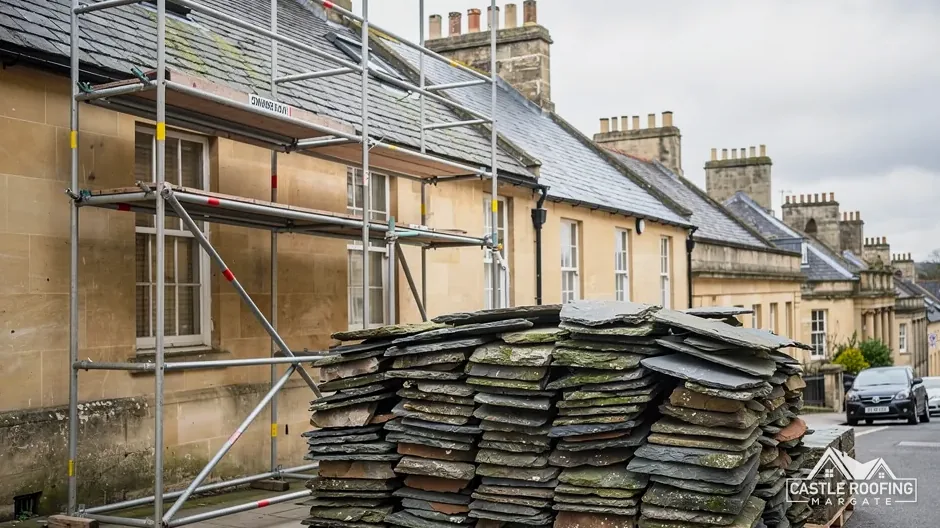
Replacing a slate means taking out the failed one, which is held by nails, and slotting in a new one under the course above. The old slate is usually released with a tool called a slate ripper, which hooks the nails and cuts them without lifting the slates around it. The new slate is held either by a nail through the batten or by a clip, depending on what is left to fix to.
The replacement has to match the slate beside it in four ways.
- Size. Length and width have to suit the course, or the gauge and lap are thrown out.
- Thickness. A thicker or thinner slate sits proud or lies flat against its neighbours and changes how water runs off it.
- Colour and weathering. A new slate next to an old one looks different at first, which is why slates saved from elsewhere on the same slope are often used for the repair.
- Quality. A good replacement for a poor batch is the whole point of the job.
Fixings follow BS 5534:2014+A2:2018, the current slating and tiling standard. The slate maker Cupa says BS 5534 indicates a minimum pitch of 20 degrees for natural slate, based on moderate exposure with a 500 mm slate and a 115 mm lap, and rules out hooks on a slope shallower than 25 degrees. A shallow slope is checked against those limits before the replacement method is chosen.
The repair should end with the repaired area shedding water as well as the rest of the slope, and the gutters free of flakes. If the area is on a roof in a conservation area or a listed house, the matching matters more, and our page on man-made versus natural slate covers when a different slate is acceptable.
Repair, or re-roof the slope
The choice between repair and replacement turns on how much of the roof has gone and whether the cause will recur. A repair is the right answer where the failing slates are few and the rest are sound. Re-covering is the right answer where the stone is failing across a slope, because each repair would only buy a short time before the next slate lets go.
The figures that follow are national guide ranges and never a price from us. Checkatrade, in its June 2026 repair guide, gives natural slate repairs at £150 to £220 per m², with the rate applying up to a maximum of 3 m² and excluding VAT. HomeBuilding, in September 2025, said replacing a 65 m² three-bedroom semi in Welsh slate might reach £18,000, and MyJobQuote, in October 2026, gave around £7,800 for a slate roof. Sources differ widely, which is why a written quote after a survey matters more than any guide figure.
For a Thanet house, the council's conservation area page ties like-for-like work to a reduced chance that planning permission is required. Work on a listed building also needs listed building consent if it alters the character, and a conservation area can carry an Article 4 direction, so check with the council for your address before you start.
The gutter below a delaminating roof often shows the problem first. Clearing the flakes out of it is cheap, and a handful of grey scales in the clean gutter a month later is a sign that the loss is continuing. If that is what you find, send a photo, and the roof gets surveyed before any number is given.