How a slate breaks under a boot
A slate is a thin plate of rock split along its grain. It is strong when it lies flat and is supported under its whole length. It is weak when a load bears on the part that overhangs, the tail, which has only air and the slate below it to rest on. One heel on that unsupported tail can snap the slate across its width.
The damage often does not show. The slate may crack hairline across the width and stay in place until the next frost or storm moves it. A look at the roof can cause a leak weeks later.
Slope and surface add to the problem:
- a wet slate or a film of moss gives almost no grip;
- a steep pitch means a slip becomes a slide;
- loose slates, rotten battens or nails that have corroded can all give way under weight, with no warning;
- old slates that have started to delaminate flake apart as they are stepped on.
Roofs with asbestos cement slates are a special case. In HSE's A14 guidance, a roof made of asbestos cement counts as fragile in every case, and for any building from before 2000, or refurbished before then, HSE says to assume asbestos is there. Our page on asbestos cement slates covers that.
Getting onto a slope the way roofers do
A trained roofer rarely walks across a slate slope on its own surface. They spread weight and work from something that holds them.
The usual equipment includes:
- A roof ladder that hooks over the ridge, so the person climbs on the ladder and not on the slates.
- Crawling boards, long planks laid on the slope and held on battens, so weight is carried across several slates.
- Scaffold at the eaves, with a working platform and edge protection against a fall.
- A harness and anchorage where scaffold cannot be used, set up by someone who knows the system.
The choice turns on height, pitch, the state of the slates and the job itself. A single slate on a low outbuilding differs from a chimney stack on a three-storey terrace.
Scaffold over a Thanet footway needs a Kent County Council licence, which the scaffolders request with 5 working days' notice. That lead time is one reason a repair is booked, not done on impulse.
None of this is for the homeowner to improvise. Hiring a ladder and stepping onto the slates is how both the roof and the person get damaged.
The duty on whoever sends people up
A fall from a roof can cause serious injury, and work at height has its own regulations. Regulation 6(3) of the Work at Height Regulations 2005 makes the employer responsible for preventing a fall that could cause injury, within what is reasonably practicable.
An employer here includes a roofing firm sending its people up. For a householder who hires one, CDM regulation 7(1) moves the homeowner's duties as client over to the contractor where one firm does the work.
In plain terms, you are not asked to run the safety plan, and the roofer is. It is fair to ask how they will reach the slope. Their answer should name a roof ladder, scaffold or similar, not just "a ladder".
If the roofer plans to work from a ladder alone at eaves height, a short job may be reasonable. For anything higher or involving a chimney, you should expect scaffold or a tower. That affects the cost, so check whether a quote includes the scaffold and VAT before you agree. A tower or scaffold also gives the roofer somewhere safe to put tools and slates down.
Looking without climbing
You can learn a lot about a slate roof with your feet on the ground. Choose a dry day with good light and walk round the house, looking up at each slope.
Signs worth photographing:
- slates out of line with their row, or with a visible gap beneath;
- missing slates, or pieces lying on a path or in the gutter;
- moss in patches, which holds water and makes slates slippery;
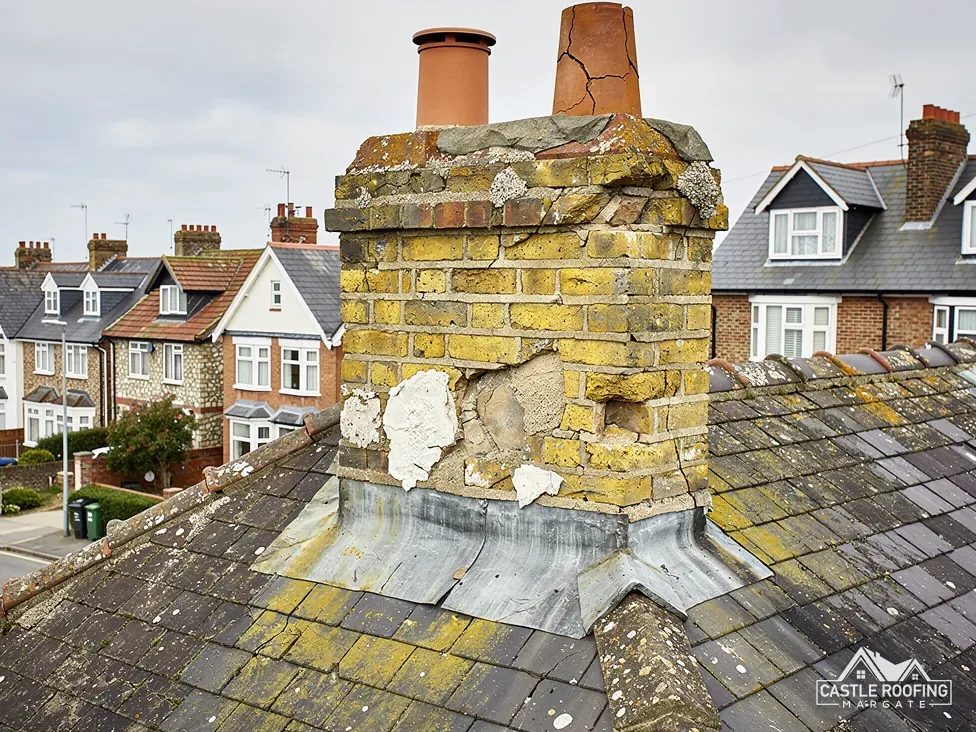
- lead flashings round the chimney that have lifted;
- sagging in a ridge line or a slope.
A pair of binoculars, or a phone held at full zoom, brings the slope much closer. From inside, the loft can show daylight through the slates or damp on the underside of the battens, but keep to the joists and do not step between them.
Nothing here needs you on the roof. If you find damage, send the photos to a roofer rather than going up to fix it, and make sure no one walks under a slate that looks ready to fall. Our pages on slate roof surveys and broken slates before a re-roof show what a roofer checks once they are safely up, and the slate roofing page covers the work.