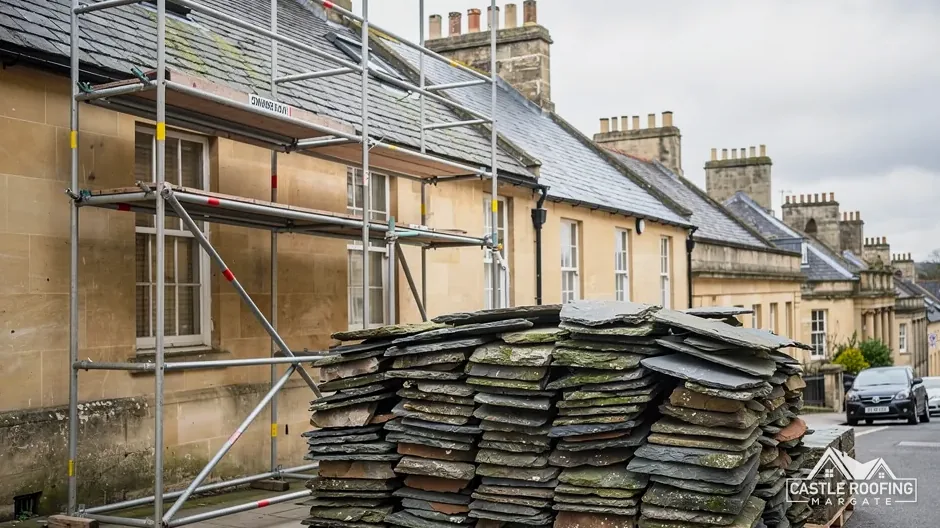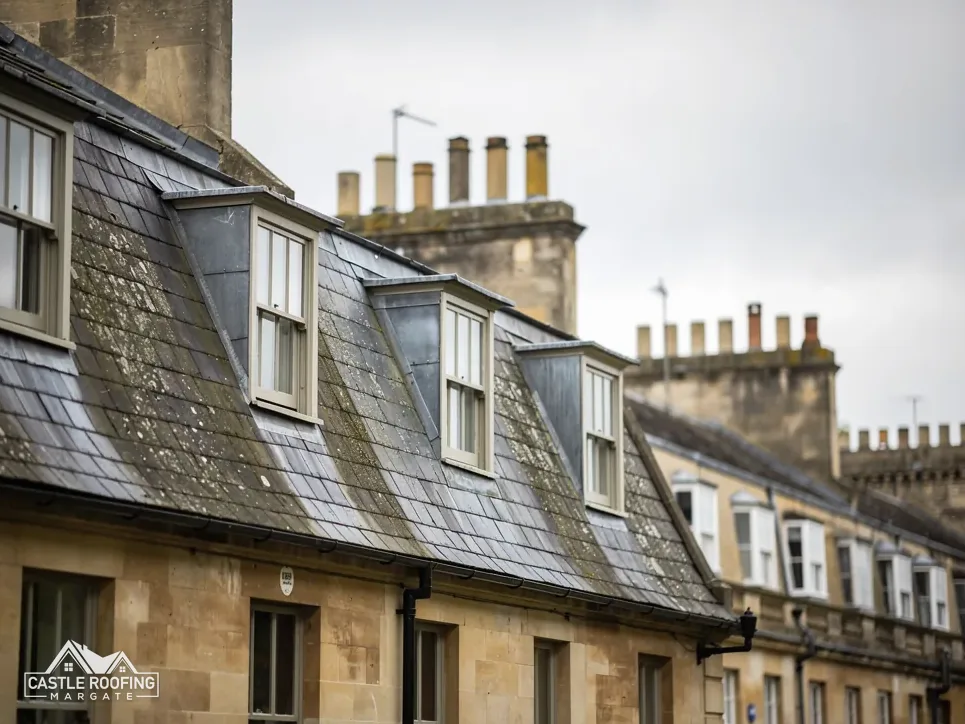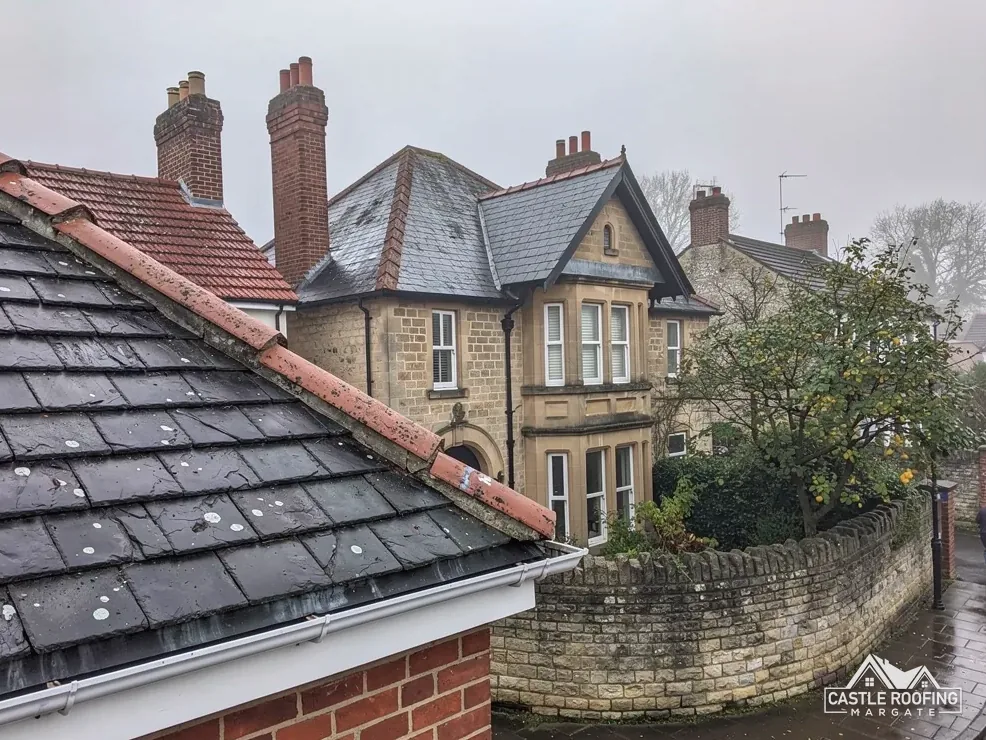
Read this to learn what a typical slate life means for your own roof. It gives the published ranges by type of slate, then goes through the parts that tend to wear out first and the signs that show from the ground.
Ask how long a slate roof lasts and the usual answer is a century or more. It is a fair answer for the slate and a misleading one for the roof. A slate is a piece of rock, and rock does not rot. The roof is a system of slates, nails, battens, underlay, lead and ridge, and several of those parts have shorter lives than the slate they carry.
That gap is where the surprises sit. An owner is told the slates are a century old and in good order, then learns that the fixings holding them have given up. The slates are not the trouble and the roof is, which is why the survey goes beneath the slates as well as over them.
This guide gives the published ranges first, for Welsh, Spanish and reclaimed Welsh slate, then takes the parts of a Thanet roof one by one. It belongs to our slate roofing work. Two nearby pages go deeper: one on what nail sickness is, one fault that can end a roof early, and one on how long Welsh slate lasts, the longest-lived row in the table below.
What the published ranges say
HomeBuilding sets out typical lives for natural slate in a costings article that was last updated on 30 September 2025. It gives Welsh slate "100+ years", Spanish slate 75 to 100 years, and reclaimed Welsh slate 50 to 80 years.
| Slate | Typical life |
|---|---|
| Welsh | 100+ years |
| Spanish | 75 to 100 years |
| Reclaimed Welsh | 50 to 80 years |
Read each row as a typical range and never as a promise for one particular roof, since two roofs of the same slate can age very differently. The ranges describe the material. They say nothing about how the slates were fixed, how well the roof space breathes, or how the covering has been treated since it went on.
Warranty and lifespan are different measures, too. A maker's paperwork describes what it will stand behind for a set period, while a lifespan describes how long the material tends to last in service. Marley makes this point about its own tiles, and it applies just as well to any figure printed on a data sheet.
So the numbers are a guide to what to expect from the rock, and they are a starting point for the survey rather than an answer. A roof that is poorly fixed or poorly ventilated may fall short of its row. The survey photographs are what turn a range into a view about your own roof.
Nails, battens and underlay wear first
A slate hangs on a fixing. Traditionally that is a nail driven through a hole near the head of the slate into a timber batten, though hook fixings exist for steeper slopes. When a nail corrodes or a batten softens, the slate loses its hold and slips, even though the slate itself is sound. A roof described as tired can be one whose fixings have reached the end of theirs.
Underlay lies under the battens and acts as a second line of defence, shedding any rain the wind has driven past the slates. It ages as well. Choosing between a breathable membrane and HR underlay, which is non-breathable, also settles how the loft is ventilated, and BS 5250:2021 is the code that deals with moisture in buildings.
That is why a survey does not end at the slate surface. Where the loft can be entered, the roof's underside is inspected from within, and the signs below are the ones that matter:
- slates slipping in a line along one batten
- rust marks or dark staining where a nail head sits
- daylight or damp patches seen from the loft
- a soft or sagging batten once the roof is opened up
When these are widespread, a re-roof saves the sound slates and renews the fixings beneath them. Slates that lift off unbroken can be laid again, so the old covering is not wasted. The guide on nail sickness explains one form of this fault, and the survey records which slopes it has reached.
Weather and the East Kent roof
Slate is a durable covering, but a roof still meets the weather every day. Met Office averages for the Manston station in Thanet, covering 1991 to 2020, show about 613 mm of rain a year, 110.05 days with 1 mm or more of rain and 21.43 days of air frost. At Manston the Met Office's mean wind speed at 10 m is 9.86 knots, and 11.21 knots in January.
These are averages for a single station, and they describe no particular street or storm. They do show a roof that is rained on for around a hundred and ten days a year and sees frost as well, which is why the details at the edges earn their keep. The page on frost-damaged slates covers what the cold can do to one.
Wind is the other test. BS 5534:2014+A2:2018 supplies formulas for wind uplift and a way of working out how a covering should be fixed, and Cupa, the slate maker, rates buildings on slopes, hills or coastal ground as more exposed, as it does tall ones. For a re-roof here, the fixings are worked out from how exposed your site is, and not lifted from a table written for somewhere else.
None of this makes slate a poor choice. It explains why fixing matters to where a roof lands in its range, and why neighbours with roofs of equal age can show very different wear.
Lead, ridge and verge: the short-lived details
The places where one part of a roof meets another can wear out well before the slate. Lead sheet bridges the gap between the slope and a chimney or wall. Where two slopes run into each other at an inward angle, a lead-lined valley carries the water away. Both jobs are hard on the metal.
MyJobQuote says lead flashing can run beyond 80 years, and that figure reads as a minimum, never as a limit or a forecast for your house. It only holds when the lead was fixed properly and has been left undisturbed. The Royston Lead table sets lead by thickness code, from Code 3 at 1.32 mm to Code 8 at 3.55 mm. It marks Code 3 as suited to soakers only, which are the small lead pieces tucked between slates, and the specification for the job decides which code goes where on everything else.
Ridge and verge
At the very top, a capping of ridge pieces closes the join between the two slopes. In the past it was bedded in mortar, but since the 2015 amendments to BS 5534 mortar bedding by itself has not counted as enough to hold a covering down, Marley explains. BS 8612:2018 sets out dry-fix systems, where mechanical fixings take the load.
An old mortar ridge can crack and let go long before the slates beneath it have aged. Putting a ridge right is a smaller job than drying out a wet loft, and a dry ridge is the alternative to a new mortar bed.
Verges, where the slating finishes against a gable wall, face the same question as the ridge, and the same standard applies to them.
Foot traffic, cleaning and other damage
Slate is hard, but it is thin and it is brittle. A foot placed in the wrong spot can crack a slate in a way that cannot be seen from the ground, and the break lets water in at the next rain. That is why a slate roof is surveyed and repaired from a ladder, a roof ladder or a scaffold, instead of by anyone wandering across the slope.
Cleaning follows the same logic. Marley advises against jet washing slate, since the blast can damage its surface and take a large bite out of its life, and a gentle method protects the covering better. The roof and everything that touches it deserve gentle treatment, because a small injury early can start a long chain of repairs.
What shortens a slate roof's life from the outside:
- cracked slates left in place, which let water into the battens
- gutters blocked with moss or debris, so water backs up under the eaves
- trees that drop branches onto the slope
- fixings pulled loose by wind at the edges
- repairs made with the wrong slate, which sit unevenly and slip
Each of these is easier to put right early than late. The survey photographs show you what was found, so you can judge for yourself how urgent each item is.
Moss and lichen on a slope are worth watching too, since they hold moisture against the slate and can block gutters when they fall, so a quick look from the ground each season is worthwhile. Keep invoices and photographs from past repairs together in one folder.
Reading your own roof's age
Nobody can tell the age of a slate roof from the street. What can be judged is its condition, and that points to the next step. A roof with a handful of slipped slates and a sound frame is a repair. A roof where the slipping is widespread, the battens are soft and the lead has failed is at the end of one life and the start of another.
On the survey we look at four things and report each with photographs:
- the slates: cracked, flaking or sound, and whether they can be saved
- the fixings and battens beneath them
- the lead at every chimney, valley and abutment
- the ridge, hips and verges
HomeBuilding's ranges give a rough idea of where a roof sits in its life, but a roof of any given age can be in very different condition. Where slates have been taken off and put back over the years, the date of the roof tells you less than its repair history, so any records the house has are worth keeping, along with the dates of any past re-slating or lead work.
After the survey, the quote arrives as a single written total. A repair is a repair and a re-roof is a re-roof, and the survey says which one the roof needs.
If the answer is a repair, our guide to what slate roof repairs cost shows the typical ranges the cost guides publish.