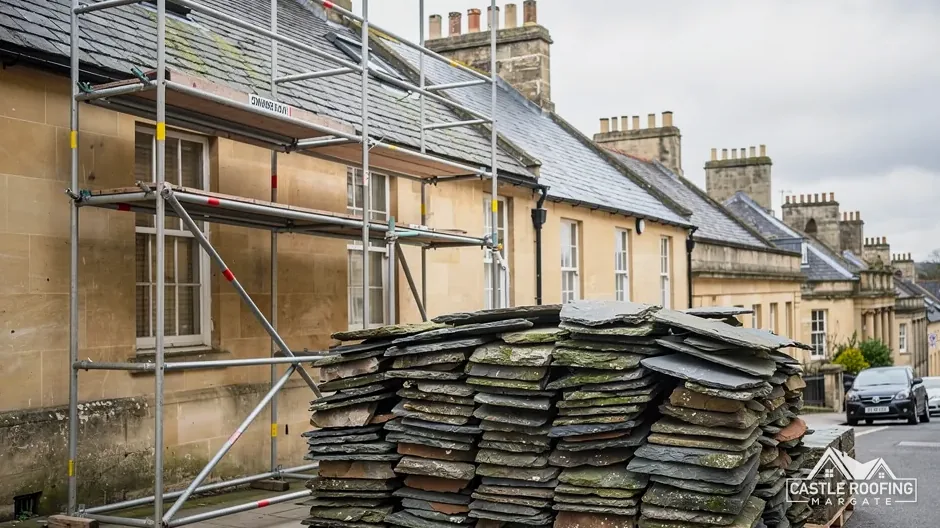
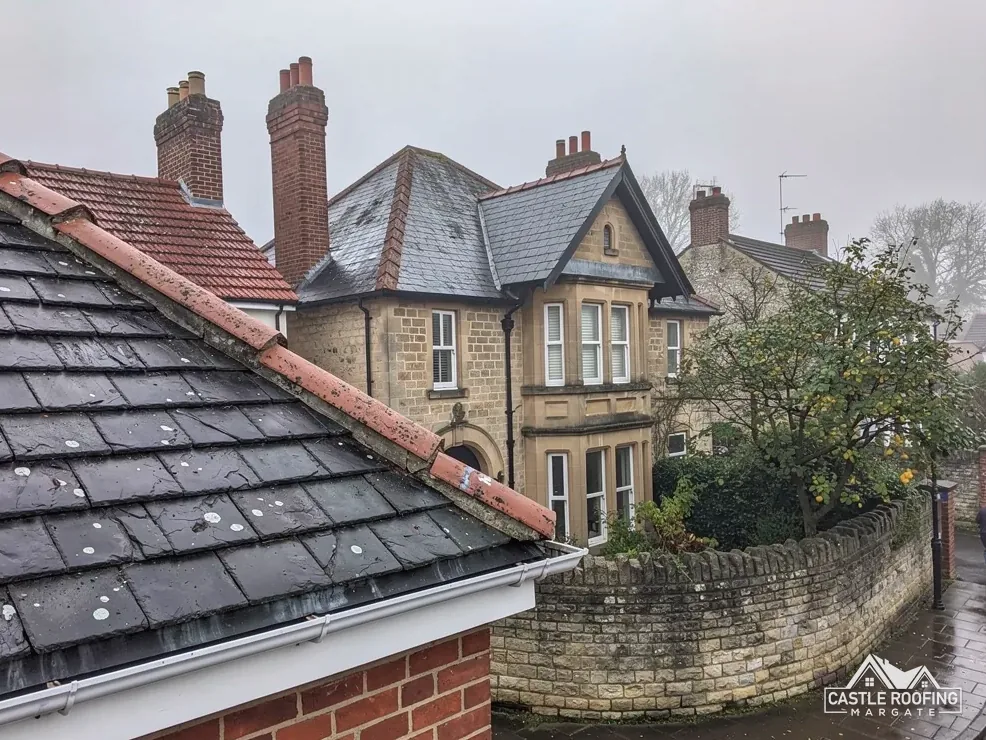
How a nail fails inside a slate roof
Each slate hangs from nails driven through its head into a batten, a slim timber lath running across the rafters. Those nails sit in the dark, under the course above, and the air round them is often damp. Over decades they can rust or become thin, and a nail that was once firm is only a stub that holds on by its corroded shaft.
The slate does not wear out in the same way. The slate itself can outlast its nails by a wide margin. HomeBuilding gives Welsh slate as 100+ years and Spanish slate as 75 to 100 years, which are typical lives and not promises. The fixings can give up first.
When a nail finally fails, the weight of the slate and the push of the wind tug it downward. It slips until it hangs from whatever is left, and then it falls. The next slate depends on its own nails, which have had the same decades of damp, so they tend to go in the same area.
Slates can keep dropping from a roof that looked sound, one after another, as the same fault works along the slope. The remedy lies with the fixings, not the covering above them.
What shows from the ground
Nail sickness is hard to see because the nails are hidden. What you see is the result: slates that move. Look at the roof on a dry day from the pavement or the garden.
Signs that suggest failing fixings:
- slates sitting lower than their row, with a gap above the tail;
- slates missing in more than one place, not just one;
- small pieces or rust-coloured grit lying in the gutter or by the front door;
- rows that look wavy, where the line of tails dips;
- slates that clatter in the wind, which you may hear from inside the loft.
In the loft you may see the points of nails or bits of slate on the insulation, and daylight at slipped slates. Keep to the joists and use a torch.
One slipped slate on its own can have other causes, such as a knock or a branch, as our page on replacing a single slate shows. A pattern across the slope is different. It points to the nails, and a roofer confirms that only after lifting a few slates to see them. No one can judge nail condition from a photo alone, though a photo shows the slipped tails well.
Repair, or take the whole slope up
What to do depends on how far the problem has spread and how sound the slates are. There are three broad answers.
- Spot repair. If only a few slates have slipped and the nails around them hold, they are re-fixed with tingles or hooks and the roof carries on.
- Refix a section. Where one slope or area is affected, the slates there are lifted, the battens checked, and every slate re-fixed.
- Re-slate. Where the nails across the roof are failing, the slates come off, the battens and underlay are renewed and the sound slates go back, with new ones mixed in.
Slates that are in good condition are worth keeping. Cupa says hooks should not be used below 25 degrees, so the pitch also decides the fixing for each case.
The costs do not move in a straight line. A string of small repairs can add up to more than a planned job, and our page on re-slating or repairing helps you weigh them. Checkatrade lists natural slate repair at £150 to £220 per m² in its June 2026 table, ex VAT and only up to 3m², so a re-slate falls outside that rate.
Planning for the work is better than chasing slates one winter after another.
Stopping the next slate from going
You cannot undo corrosion, but you can slow the damage and avoid surprises. Regular checks from the ground, after storms and at the turn of each season, catch a slipped slate while it is still one.
A short routine:
- walk round the house after high winds and look up at each slope;
- clear gutters of slate pieces and note where they came from;
- check the loft for daylight and for damp patches after heavy rain;
- photograph any change, with the date, so a roofer can compare.
Met Office figures for Manston, averaged over 1991 to 2020, give a mean wind of 9.86 knots (11.21 in January) and 110.05 wet days a year at 1 mm or more. A Thanet roof asks its fixings to hold through that wind and damp year after year.
Do not climb up to test the slates yourself. Slate is brittle and a wet slope is slippery, which is covered on our page about walking on a slate roof. For the whole service, see slate roofing.