What Class C gives an ordinary house
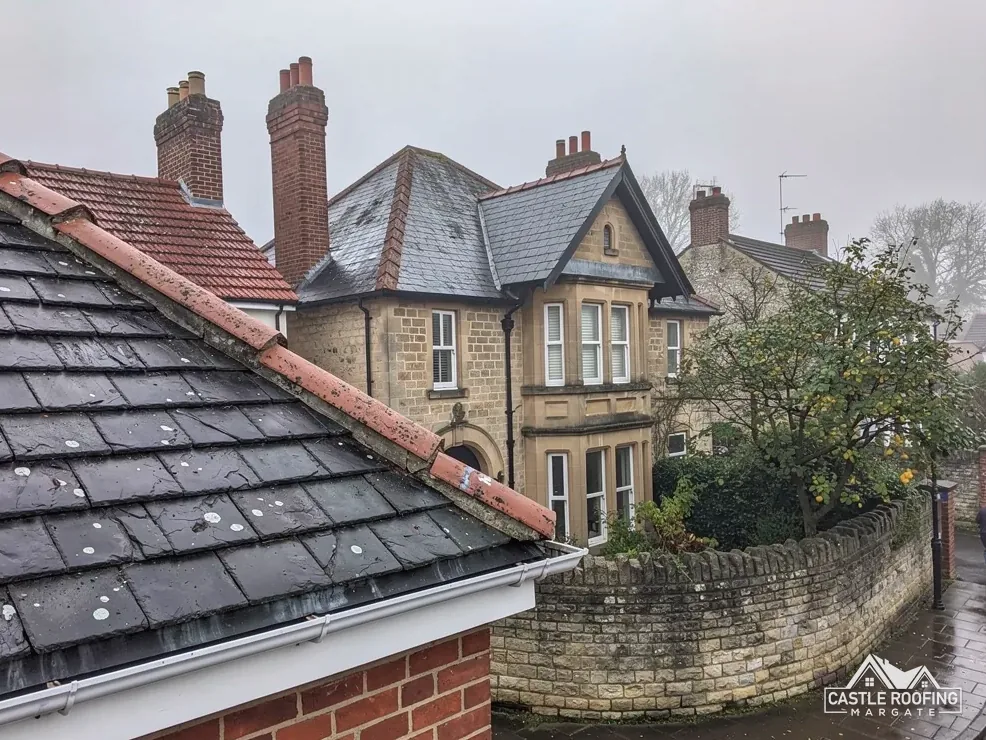
Planning permission is permission to carry out development. Many house alterations are granted in advance by a national order, the General Permitted Development Order, so nobody has to apply. Part 1 of Schedule 2 lists the roof changes a householder may make without applying. Class C picks up roof alterations that no other class covers, and slates replaced with slates sit inside it, so the work is normally permitted development.
Building Regulations are a separate matter. Approval is normally not needed while less than 25 per cent of the building envelope is affected and less than 50 per cent of the roof is affected, in the Planning Portal's words. A covering that adds 15 per cent or more to the weight calls for approval whatever the area. Dover District Council's building control page puts even a like-for-like covering swap on its approval list, which goes beyond the national test. That is for Dover addresses only.
None of those is a planning rule. A re-slate can need no planning application and still call for building control.
If your roof is a house roof outside any special designation, the council's planning team has nothing to approve. Our page on whether to re-slate or repair deals with the decision itself.
Where the answer stops being simple
Four situations change the position. Check which describes your home before the work is booked.
- A flat or maisonette. Flats and maisonettes sit outside the order, because its meaning of a house excludes a flat and any building containing one. Canterbury City Council makes the same point: a flat has no permitted development rights, so outside changes need an application.
- A listed building. Listed houses keep their Class B and C rights, but works affecting the building's character need listed building consent under section 7 of the Planning (Listed Buildings and Conservation Areas) Act 1990.
- A conservation area. Conservation areas take away the right to build dormers, not Class C. They do bring more scrutiny, and Thanet District Council's conservation area page takes a softer view of like-for-like work, calling an application less likely.
- A street with an Article 4 direction. That is a council's power to take specified rights away for a defined area.
Where two apply together, such as a listed flat in a conservation area, each route applies in full, and the council can say which in one conversation.
Article 4 directions, Faversham and Dover
Where an Article 4 direction covers roofs, a change of covering can need an application that a house elsewhere would not.
Roof-specific detail is published for two places. In the Faversham conservation area, Swale's Article 4 direction reaches doors, windows and roof coverings on front elevations that look out on a public highway. Dover District Council's conservation area page adds that its directions can cover a roof alteration on any part of a home that fronts a road, waterway or public open space.
Elsewhere in our area, the position is to ask:
- In Thanet the council's Article 4 directions sit in the Pegwell, Ramsgate Marina extension and Ramsgate conservation areas, and the classes involved are best confirmed with Thanet District Council.
- Canterbury City Council shows its Article 4 areas on a map.
- Folkestone & Hythe District Council can confirm for its own streets.
- Ashford Borough Council publishes its directions on its interactive map, and Swale answers for streets outside the Faversham conservation area.
What a direction covers can only be read from the council's own record. Do not assume a rear slope escapes. Asking costs a phone call, and an answer before the work starts is worth more than one after it.
Asking the council before the scaffold goes up
The route to certainty is short. Ring or email the planning team of your own council, say whether the house is a flat, listed or in a conservation area, and ask whether an Article 4 direction covers your street. The Planning Portal's guidance and the council's maps will help you frame the question.
Helpful details to have on hand:
- The full address and which slope faces the street.
- The present covering and the one you intend to use, in the same material or a different one.
- Whether the house is listed, and its grade from the list entry.
- Any conservation area name on the council's map.
Changing material needs more care, because a different covering changes how the roof looks from the road. A like-for-like re-slate with matching slates is the easier case.
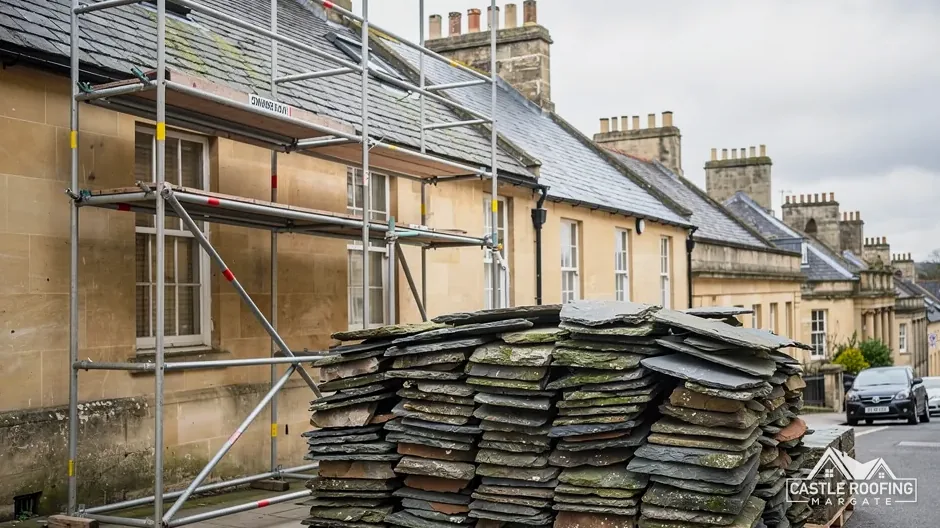
Scaffold is a separate licence. Kent County Council issues it, the scaffolding company applies, and it asks for 5 working days' notice.
Our slate roof in a conservation area and listed building slate roof pages cover those two cases, and the slate roofing page has the wider picture.