You will learn what is happening to the nails under old slates, which signs show from the pavement, how a repair with tingles differs from a re-slate, and why the pitch of the roof decides between them.
After a rough night, a neighbour's drive is littered with grey slates, and the roof above them looks fine. The slates did not shatter. They let go. That detail matters, because it points at the fixing rather than the stone. Welsh slate lasts 100+ years in HomeBuilding's typical range, yet each slate hangs from one or two small nails, and those nails are the part with a limited life.
Roofers call the slow failure of those nails nail fatigue, or nail sickness. It is the usual reason an old slate roof starts shedding slates in ones and twos, long before the slates themselves are worn out. The trouble is that the damage sits under the slate, out of sight, so it often goes unnoticed until the first gap appears.
This piece explains what is going on under the slates, what you can check safely from the ground, and how the choice between a patch repair and a full re-slate is made. It sits alongside our wider slate roofing guidance, and it draws on the Cliftonville Clifftop conservation area appraisal published by Thanet District Council.
What the nail is actually doing
Each slate is pierced with two holes near its head and hung from a timber batten (the thin strip fixed across the rafters) by two nails. The slate above covers the nail heads below it, so the fixings are shut away under a layer of stone and spend their lives in the damp, dark gap between one slate and the next.
Nails in that gap live a hard life. They get wet, dry out and get wet again with every shower. An iron nail slowly turns to rust, flakes away and loses section, so the shank that once carried the full weight of the slate ends up a fraction of its first thickness. The timber around it also moves with the seasons and grips a little less each year.
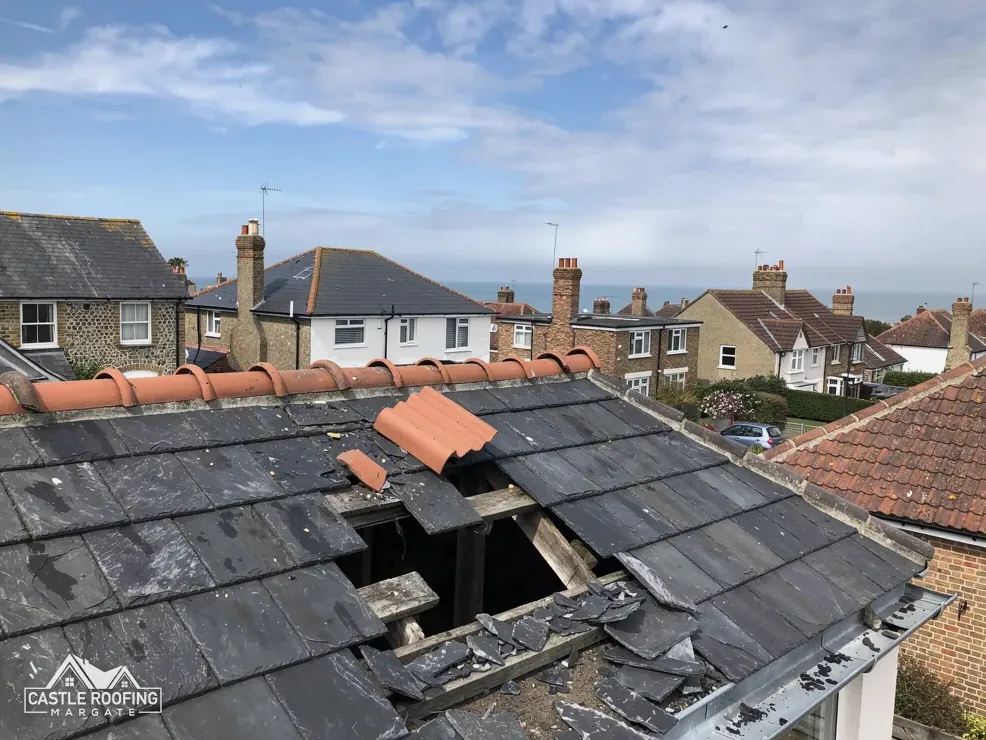
The slate does not need a dramatic push to come away. A gust that lifts the lower edge for a moment is enough to tear the thinned nail through its hole or snap it at the neck. The slate then slides down, and often catches on the one below, so you see it standing proud rather than lying on the lawn. The word fatigue fits: metal that has been loaded and relaxed thousands of times fails at a load it once carried easily.
Rust is also why a slipped slate is rarely a one-off: the nails beside it went in at the same time, in the same metal, and have lived the same life. The point for an owner is that nails and slates age at different speeds. The stone may be sound for a long time after the fixings have gone, which is why a roof can look tired yet still be worth saving.
Signs you can read from the pavement
A first read on a slate roof can be taken without leaving the ground. From the pavement opposite, or the far end of the back garden, scan each slope in good light. A short list of signs separates a roof with a few unlucky slates from one with a fixing problem:
- Slates standing slightly out from the course around them, with a dark shadow line under the lower edge.
- Gaps in the pattern where a slate has already gone, especially two or three along the same course (a course is one horizontal row).
- Broken slate in the gutter or down on a lower flat roof, with a clean, straight break across the top near the nail holes.
- Rust streaks or stained slate faces below a joint, which show where water has been running off corroded metal.
- Slipped slates bunched near the eaves, the ridge or the verge (the sloping edge beside a gable wall), where the wind pulls hardest.
Photograph what you see with a phone and zoom in, rather than leaning out of a window. A roofer who sends photographs taken from the ladder is handing you the same evidence you would get standing on the slope. Check the same places again after the next strong wind, because a roof that looked quiet in July can look different in November.
One slipped slate on its own does not prove a fixing problem. It might be a single bad nail or a slate cracked by a falling branch. A run of them across one slope usually does, and so does a slate that moves when it is lightly pressed from below.
What the Cliftonville Clifftop appraisal says about local roofs
Cliftonville Clifftop is one of Thanet's conservation areas, and the council's appraisal for it calls the roofs a mixture, naming natural slate alongside red clay tiles. It adds that many tall chimney stacks survive.
The appraisal is worth reading for what it leaves out. It does not say slate is the main material, and it gives no age. What it tells an owner is that slate sits beside clay tile on the same streets, so a neighbour's roof is no guide to your own. The only reliable evidence is the roof over your head, looked at closely.
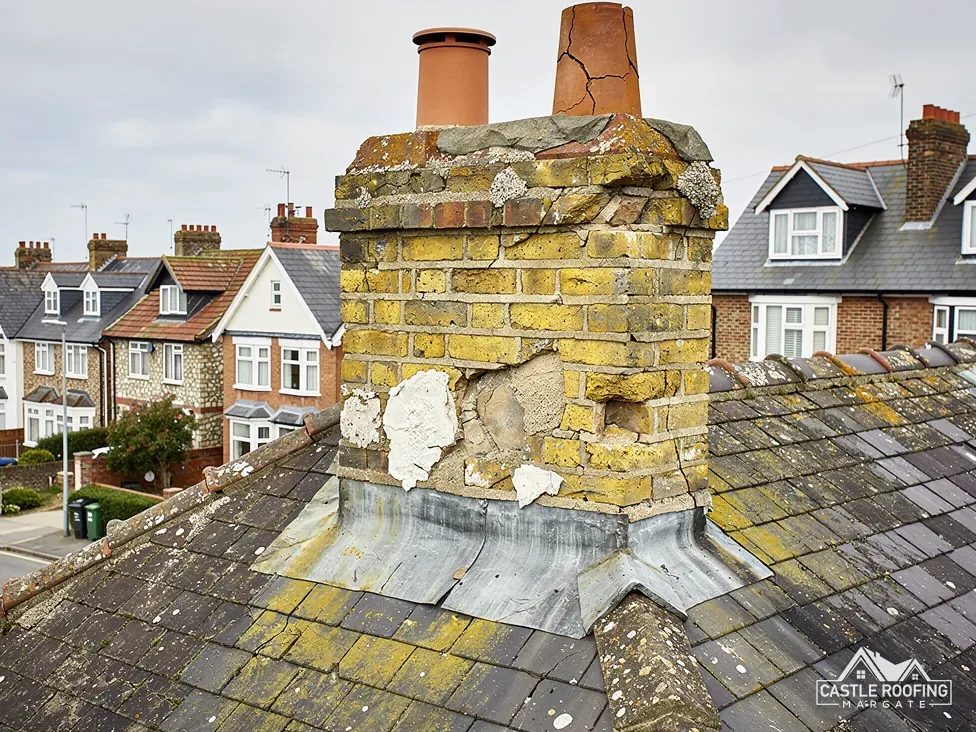
The tall stacks matter for nail fatigue too. Slate meets brickwork at a chimney through lead flashings and soakers (small pieces of folded lead that slip under each course), and a slipped slate beside a stack tends to let water into that junction. A slate that has moved near a chimney deserves a prompt look, because the leak it causes runs down inside the stack and the wall below.
If your house is in a conservation area, check with Thanet District Council before altering how a roof looks. Repair on a like for like basis is a different matter from a change of covering, and the council can tell you which one applies to your address. Thanet's conservation area page adds that work matching what is already there is less likely to need a planning application, though the council has the last word on any one address.
Tingles, hooks and re-slating compared
Once the nails are known to be failing, there are three broad answers. The right one depends on how many slates are loose and on the pitch of the roof, which is its angle from level.
| Option | What it is | Suits |
|---|---|---|
| Tingle | A strip of metal nailed to the batten and bent up over the slate's lower edge | A few slipped slates on a roof that is otherwise sound |
| Hook | A metal clip that catches the slate's tail and fixes to the batten | Pitches of 25 degrees or steeper only |
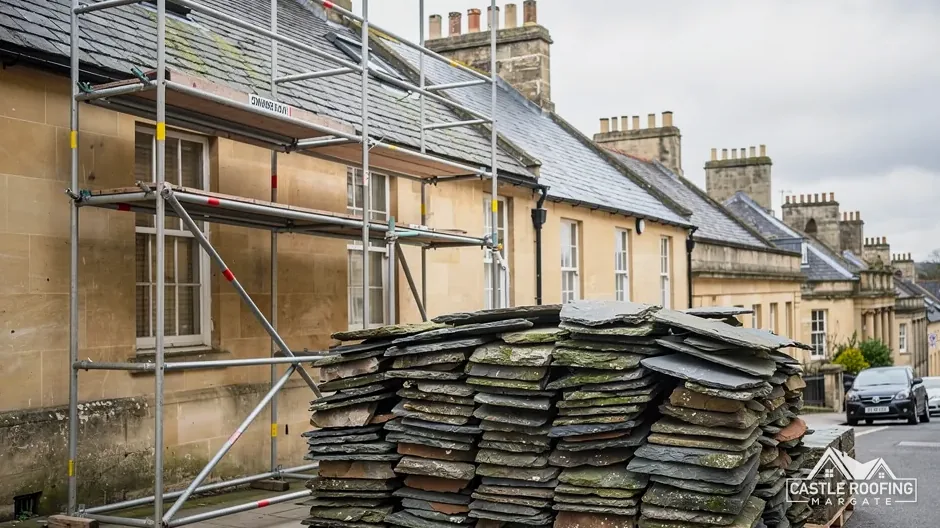
| Re-slate | Stripping, re-battening and relaying the sound slates with new fixings | Widespread nail failure, or tired underlay and battens as well |
The limit on hooks comes from the slate maker Cupa, which advises against them on any roof pitched below 25 degrees. Cupa also reports that BS 5534 puts the minimum pitch for natural slate at 20 degrees, for a 500 mm slate with a 115 mm lap at moderate exposure. A shallow slate roof therefore has fewer options, and a roofer should measure the pitch before suggesting a hook.
Tingles are the traditional patch for a handful of slipped slates. They show if you look for them, and they are not meant to hold a whole slope together. When the loose slates start to outnumber the sound ones, patching is the wrong tool, and the money is better spent once on the whole slope.
Fixings, wind and the standard roofers work to
Slating work follows a code of practice, BS 5534:2014+A2:2018, which is current. It is not itself a law, yet it is the document a careful roofer works to, and its 2018 amendment widened the scope to cover everyday re-roofing and repairs. Part C of the Building Regulations adds a plain expectation that roof coverings are fixed in a suitable way.
What counts as suitable depends on the site. The standard contains wind uplift calculations, and a slate maker's guidance grades exposure higher for buildings on slopes, hilltops or the coast. Fixings for a Thanet address are specified against that site's own exposure under BS 5534, not lifted from a general table.
For a sense of the weather these nails face, the Met Office's Manston station recorded a mean wind speed of 9.86 knots over 1991 to 2020, with January at 11.21 knots. Those are averages, and a gale lifts a slate far harder than an average does. They explain why a fixing that was adequate for a calm decade can fail in one rough night.
A repair that adds new slates but leaves the old nails in place just shifts the failure further down the slope.
That is also why a surveyor or roofer should look at the fixings, and not only at the face of the roof, before saying how long a repair will hold. A promise made from the ground about nails nobody has seen is a guess.
What a survey and a repair visit should cover
A sensible visit goes in a set order. You can use the list as a check on any roofer who comes to look at slipped slates:
- Photographs of the roof as it stands, and a count of loose and missing slates by slope.
- Lifting a sample of slates to look at the nails, and the battens and underlay behind them, rather than judging from the surface.
- A measurement of the pitch, which settles whether hooks are even an option.
- A recommendation: tingles for a few, or a re-slate where the nails are failing across a slope.
- One written total price for the whole job, which you can check includes VAT and scaffold.
For a small patch repair, Checkatrade's June 2026 guide gives natural slate repairs at £150 to £220 per m², exclusive of VAT, as a typical UK range. Its rates stop at 3 m², so they say nothing about a re-slate. A bigger job is priced after the survey, and the price reaches you in writing. Treat the patch rate as a guide to scale only, since access, pitch and the number of slates to be replaced all move a real price.
For more on the fault itself, and what to do next, our page on nail sickness goes through it, tingles against hooks covers the fixings in more detail, and re-slate or repair helps with the larger decision when the survey has been done.