Use this when a roofer proposes tingles or hooks for loose slates. It explains what each one is, where each suits, the pitch rule for hooks, and the signs that neither will last on your roof.
A slate that has slipped was once held by two nails through its head. The nails are buried under the course above, so a slipped slate cannot simply be nailed back. Something else has to hold it, and the usual candidates are a tingle or a hook. Both are small, and both are cheap next to a re-roof.
They are not interchangeable. Each has a different way of gripping the slate, each shows differently on the slope, and one of them comes with a pitch limit that comes straight from the slate maker. A repair that suits a steep main roof can be wrong on a shallow dormer or back addition, and the reverse.
This guide describes both in general terms, sets them side by side, and then deals with the case that matters most to anyone with a failing roof: when neither is the right answer and re-slating is. It belongs to our slate roofing pages, which cover the small repairs and the large jobs alike.
What a tingle is and what it does
A tingle is a narrow strip of metal, usually lead or a similar soft metal, that is nailed to the batten beneath the slate. Its free end is then bent up and over the lower edge of the slate. The slate is held by its tail, and the tingle takes the job the rusted nails used to do.
Because a tingle is soft metal, it is shaped by hand on the roof to suit the slate, and the bent end is visible as a small curl at the foot of the slate. If you spot that curl on your own roof, it is a sign that a slate has been repaired before.
A tingle suits a job where one slate, or a handful, has slipped in an otherwise sound slope. It can be fitted without lifting a long run of slates, because the roofer only has to reach the batten under the slipped slate. That is why it is the traditional answer to a single slipped slate.
The limits are the limits of soft metal. A tingle can work loose if the nail in the batten is poor, or if the slate above it shifts and drags it, and a bend that is too sharp can crack. The repair is only as good as the batten it is nailed into. Where the batten is soft or split, a tingle has nothing to bite on, and the survey should say so before the repair is chosen.
What a slate hook is and what it does
A slate hook is a formed piece of stiff metal. It is fixed to the batten, and the lower edge of the slate sits against it, so the slate hangs from the hook rather than from a nail. In general terms it does the same work as a tingle, gripping the tail of the slate, but it is made to a set shape in the factory rather than bent to fit on the roof.
The hook is firmer than a strip of lead. It does not move once it is in, and it is fixed at one point on the batten. Hooks are also used in new work, where slates are laid with hook fixings from the start, and that use is covered by the slate maker's own rules.
The main rule is on pitch. Cupa, the slate maker, keeps hook fixings off pitches under 25º. That is five degrees above the lowest pitch it gives for natural slate, which is 20 degrees under BS 5534 for moderate exposure with a 500 mm slate and a 115 mm lap.
So there is a band of pitches, from 20 degrees up to 25, where slate is allowed but hooks are not. A shallow dormer cheek, a lean-to or a back addition can sit in that band. The pitch is therefore measured on the survey and not assumed from the main roof. A digital level on the rafter or batten gives the figure in a moment.
Tingles and hooks side by side
The table sets out how the two compare in general terms. The choice on a real roof also depends on the batten, the slate and the exposure, which the survey records. Read the table as a starting point for the conversation with your roofer, never as a ruling on its own.
| Point | Tingle | Hook |
|---|---|---|
| Made of | Soft metal strip | Stiff formed metal |
| Shaped | By hand on the roof | To a set pattern |
| Shows as | A curl at the slate foot | A small clip at the foot |
| Pitch limit | Set by the batten and slope | Not below 25º (Cupa) |
| Suits | A few slipped slates | Steeper slopes, firm battens |
Neither choice is a fix for the underlying cause. A slate slips because its nails have corroded or its batten has failed, and a tingle or hook only compensates for that on the one slate it holds. The neighbouring slates are held by nails of the same age, so a survey looks at the nails around the slipped slate before the repair is agreed.
Matching matters as well. Where a repair mixes old and new, the replacement should match its neighbours in type, size and colour, or the patch shows from the street and weathers differently. Our page on matching old slates explains why that is not always simple on an older roof with weathered slates.
Exposure, movement and how long a repair lasts
Wind lifts slates at the tail, and a slate held by a tingle or hook is held at exactly that point. BS 5534:2014+A2:2018 is the code of practice for slating, and Marley says the standard sets out how to calculate wind uplift on the fixings. On an exposed slope the fixing matters more than on a sheltered one.
A tingle or hook is a repair fixing. It is not the calculated fixing a new slate roof is given, and nobody should call it one. For a slate or two on a sheltered slope the difference is small. For a run of slates on an exposed gable, it is large enough that the survey should ask whether the slope as a whole is still fit to be patched.
Three questions help decide how far to trust a small repair:
- How many slates are involved, and are they together in one patch or spread across the slope?
- Are the battens under them dry and firm enough to hold a nail?
- Is the slope exposed, tall or on a steep gable where the wind works at the tails?
Weather adds to this. Rain driven sideways pushes water up between courses, and a slipped slate that has been held with a worn fixing lets it in at the tail. A repair that suits a calm spring can fail in the first winter gale on a slope facing the open, so exposure is part of the choice and not an afterthought.
HomeBuilding lists Welsh slate at 100+ years, Spanish at 75 to 100 years and reclaimed Welsh at 50 to 80 years, as typical ranges. A sound slate can outlast its fixings by decades, which is exactly why a cheap repair to the fixing is often sensible. It stops being sensible when the fixings are failing everywhere at once.
When neither is right and re-slating is
A tingle or hook buys time on a slate that is itself in good order. When the fixings across a slope are going together, repairing slate after slate becomes an endless round. Each visit fixes one problem and leaves the cause where it was, and the bills for call-outs add up while the roof carries on ageing.
The signs that point to re-slating are these:
- slates slipping again in new places a season or two after a repair
- nails that are rusted to stubs when slates are lifted at test points
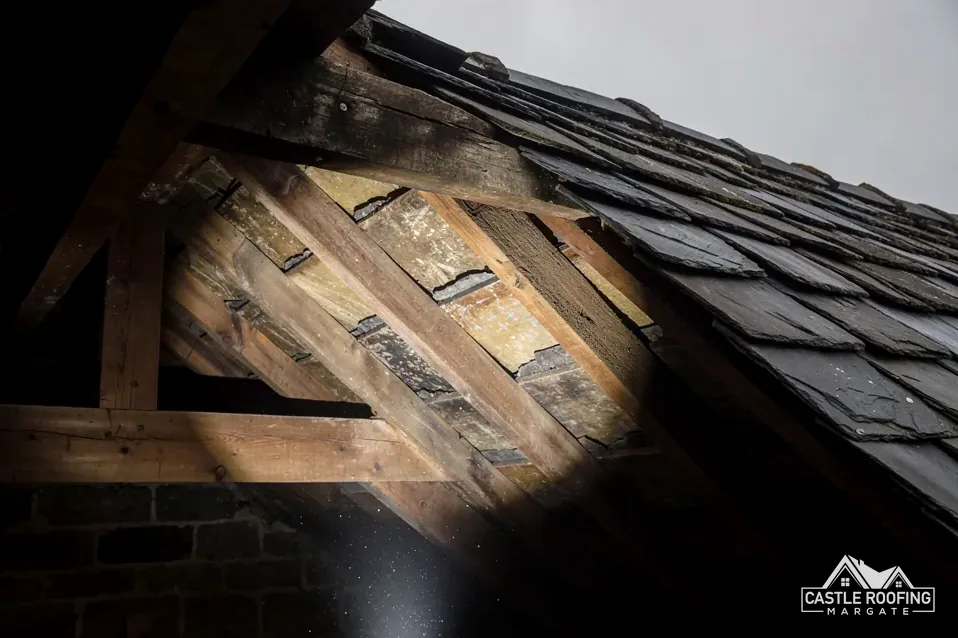
- soft, split or stained battens seen from the loft
- underlay that is torn, brittle or missing at the laps
- a slope with a pitch below the hook limit, where the repair that might suit is not allowed
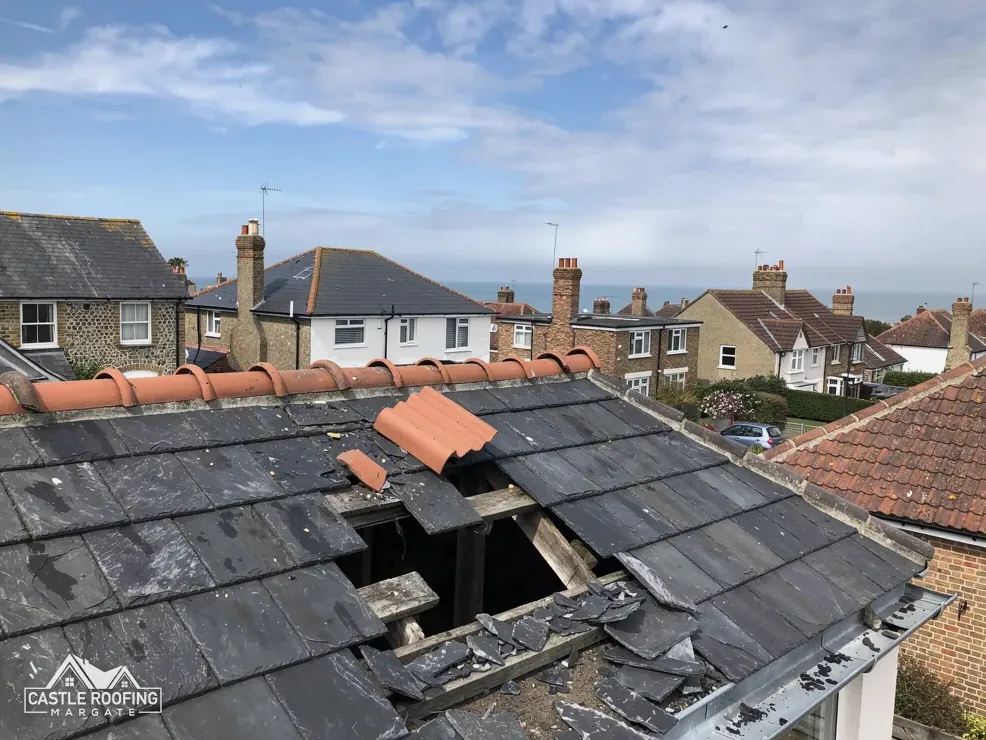
Re-slating takes the slates off a slope, replaces the battens and underlay beneath, and puts slates back with calculated fixings, so the roof is rebuilt on timber that can hold a nail. Sound slates can often be reused, which is where the cost of the job is kept down. Where slates are delaminated or cracked, they are replaced, and the roof is not asked to carry them. Each reused slate is checked over for hairline cracks before it goes back.
Our page on nail sickness explains the fault itself, while re-slating or repairing lays out the whole decision. The survey is what separates the two: it is the first thing that happens, and the written price follows from it.
Questions to put to a roofer proposing either
Whoever suggests tingles or hooks for your roof should be able to answer a few simple questions. The answers tell you whether the proposal rests on a survey or on a guess.
Put these to them before agreeing:
- What is the pitch of this slope? If hooks are proposed, the answer should be 25 degrees or more, the line Cupa sets. An unmeasured pitch means a premature proposal.
- What is under the slipped slates? A tingle depends on a firm batten, and so does a hook. Nobody can judge a batten without looking from the loft or lifting a slate, and a fixing chosen unseen is a guess.
- How many slates are involved, and where? A neat patch of three slates in one place is a repair. Thirty scattered across the slope are a symptom of something larger.
- Can I see photos? A set of photos of your own roof, showing the slipped slates, the fixings and the battens, lets you test the proposal against the roof itself. If the photographs show a sound slope with a few loose slates, the small repair is the right one, and we will say so. If they show something else, the survey will say that too.
Answers like these cost the roofer nothing to give. If they cannot be given, the survey has not yet been done. A clear answer on each point, with photos to back it, is the sign of a proposal worth accepting, and it also gives you something to hold up against a second opinion.