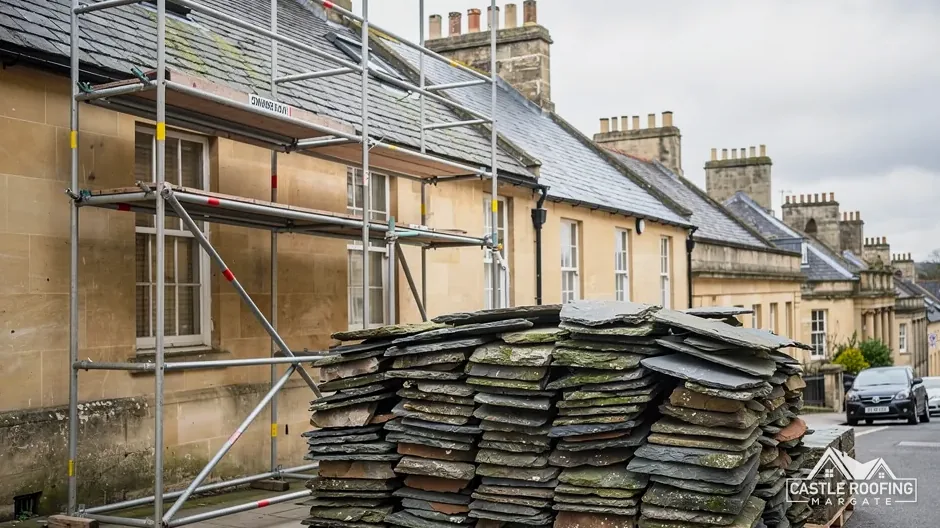
What the layer under the slates is for
Slates are laid with overlaps, not sealed joints. Wind-driven rain, snow blown fine as powder and condensation all reach the layer below the battens, the timber strips that the slates are fixed to. Underlay is the secondary defence. It sheds that water down the slope to the gutter, and it is laid over the rafters, the sloping timbers of the roof.
It does more than keep rain out. Underlay also affects how moisture behaves inside the roof. Moisture from cooking, bathing and breathing drifts up into the loft, and when it has nowhere to go it settles as condensation on cold timber. Which underlay you choose changes where that vapour goes.
On a new roof, the underlay is chosen with the slates, the battens and the ventilation as a set. On a repair the question is smaller, since you are matching what is there, but on a re-slate it is a live choice. An old roof may carry felt that has hardened and split, and a re-slate is the chance to renew it.
Our page on condensation under a slate roof shows what happens when that choice goes wrong.
HR underlay, and why it needs air at the eaves
An HR underlay is non-breathable. Moisture vapour that rises into the loft cannot leave through it, so it has to be carried out by air moving through the roof space instead. Roofers call this a cold roof, with a ventilated gap under the underlay.
For an HR underlay in a cold roof, Marley asks for a ventilation opening along the eaves line. The size depends on the pitch:
- pitches of 15 degrees or less: a 25 mm opening along the length of the eaves;
- pitches steeper than 15 degrees: a 10 mm opening along the length of the eaves.
Natural slate has a minimum pitch of 20 degrees by the BS 5534 indication Cupa quotes, so slate roofs fall in the second band. The figures are Marley's for its own system, and a roofer will confirm what applies to your roof.
Blocked eaves defeat the arrangement. Insulation pushed hard into the eaves, a soffit vent painted shut or a bird's nest in the gap all stop the airflow. An HR underlay laid on a roof with no ventilation is a fault that turns up later as damp. The slate roofing page covers the checks a roofer makes first.
Vapour-permeable options and what BS 5250 says
A vapour-permeable underlay, sometimes called breathable, is made to let water vapour through while keeping liquid water out. Some of the moisture from the house can then escape through the roof covering, instead of leaning wholly on air at the eaves.
It is not a cure for every roof. Ventilation, insulation and the way the loft is used still matter, and a permeable underlay under a sealed, unventilated loft can still trap moisture. The product maker's data sheet sets out how each type is meant to be used, which the roofer reads before ordering.
The standard that governs moisture in buildings is BS 5250:2021, which the British Standards Institution lists as current. It is a code of practice for managing moisture, not an instruction to use one product, so the roof is judged as a whole, with the house's use and heating in mind.
- BS 5534:2014+A2:2018 covers slating and tiling, and its scope takes in repair and normal re-roofing work too.
- Marley points out that it is not the law, though it is the benchmark a roofer follows.
- Where an old slate roof is only repaired, the existing underlay stays.
Our page on slate roof surveys explains what is looked at before a choice is made.
Picking an underlay for your slates
No single answer fits every house. What sets the choice is the roof's construction, its present ventilation, the insulation in the loft and whether the loft is lived in. A roofer who has looked in the loft can tell you more than any table.
Questions worth asking before a re-slate:
- Which underlay is proposed, and is it HR or vapour-permeable?
- Where does the air enter and leave the roof space?
- Will the loft insulation be moved, and does it stay clear of the eaves?
- Do the maker's data sheets cover the pitch and slates chosen?
The Met Office's Manston station, an airfield site in Thanet, averages 613 mm of yearly rain and a 9.86 knot mean wind over 1991 to 2020, so an underlay here meets wind-driven rain as well as vapour from below.
Foam sprayed under the slates changes the whole picture, because it fills that void. If that applies to your house, see our page on spray foam under slates, which covers what to do about it before any slate is touched.