Read this before you compare quotes for slate work. It gives the typical UK ranges that cost guides publish, names each source and date, and explains why a written price follows a survey and not a rate card.
A slate roof is priced by what is wrong with it, and a number quoted by someone who has never seen the slope is a guess. Two houses on one street can need very different work: the first has three slipped slates, the second has a failed lead valley over a bedroom. The national cost guides are useful for scale, and for nothing more.
This page collects the figures those guides publish, each with its source and date, and presents them as typical UK ranges. They are not Castle Roofing Margate prices, and none of them allows for what only a survey finds: the height of the eaves, the state of the battens, the lead round the chimney. Which? says South East work is likely to land near the top of its price scales, HomeBuilding says labour is dearer there, and Kent is in that region.
It also marks the point at which a repair stops being the better buy. The page belongs to our slate roofing work. A neighbouring guide covers how a single slate is replaced, and another weighs slate against tile on cost.
What the published repair rate covers
Checkatrade's roof repair cost guide lists natural slate repairs at £150 to £220 per m², in a table dated June 2026. The basis matters more than the number. The guide says its rates apply up to a maximum of 3m², and that every cost excludes VAT, which has to be added at 20 per cent.
That rate describes a small patch. It is a way of pricing repair to a limited area, and it is not a rate for a whole slope or a whole roof, so it is never multiplied up. Multiplying it produces a figure that no guide publishes and no survey would support.
For scale, the same table shows clay tile repairs at £110 to £160 per m² and ridge tile repairs at £50 to £70 per metre, so slate sits at the upper end of the repair rates it lists.
Three points to hold on to when you meet a figure like this:
- It is a national typical range from a cost guide, not a quote.
- It assumes a repair of 3 m² or less.
- It leaves VAT out, so the bill will be higher than the rate suggests.
A price from us follows a survey of your roof and arrives as one written total, so you never have to work back from a rate. The area of a repair is measured at the survey, not estimated from the pavement, and the measurement is what the price rests on.
Typical figures for common slate jobs
The table gathers the published figures that bear on slate work, each with its source and date. They are typical UK ranges. The Which? ridge price is ex VAT as published, as is the slate repair rate in the section above, while MyJobQuote states no basis, so none is added to its figures.
| Job | Typical figure | Source |
|---|---|---|
| New ridge tile | £80 to £300, ex VAT | Which?, Nov 2025 |
| Roof ridge tiles | £225 to £550 | MyJobQuote, Oct 2026 |
| Chimney leadwork | £350 to £920 | MyJobQuote, Sep 2026 |
| Roof valley | around £540 | MyJobQuote, Sep 2026 |
| Whole slate roof | around £7,800 | MyJobQuote, Oct 2026 |
Where two guides cover the same job, as with the ridge, they differ, and the gap shows how much depends on the roof. Which? gathered its prices in November 2025 from a survey of 11 traders and says they cover labour and materials but not VAT.
None of these is a quote for your roof. Their use is to tell you whether a number you have been handed is in the right region, or whether it is far enough out to deserve a second look.
The last row is a different kind of figure from the rest. It describes a whole roof, and a repair is a fraction of it. Between the repair rows and the whole-roof row sit jobs of every size, so the survey comes first and the price second.
What moves a slate repair price
The same repair can cost more on one house than next door. The reasons are rarely mysterious, and a survey puts a name to each one. A repair that looks small from the street can prove larger underneath, and the reverse happens too.
- Access: the height of the eaves, and whether the work needs a scaffold or can be reached from a ladder.
- The number of slates involved, and whether they are slipped or cracked, since a cracked slate has to be replaced.
- The slate itself: a matching slate for an old roof can be hard to find, and a reclaimed one has to be sourced.
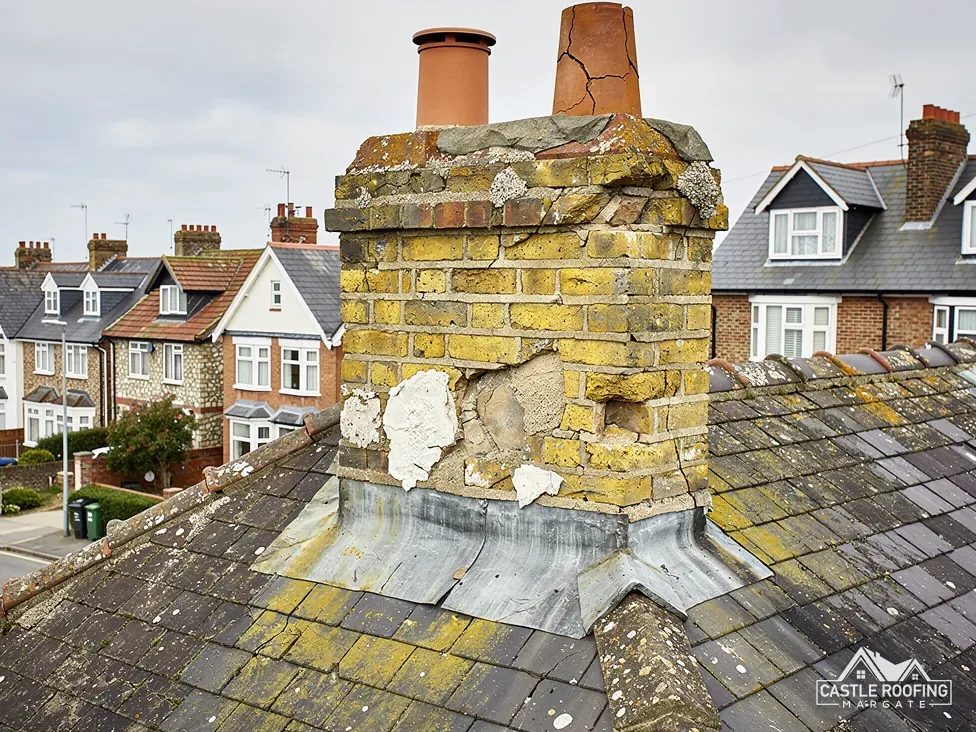
- The lead at chimneys, valleys and walls, which is a separate job from the slates.
- The state of the battens and nails beneath, which can turn a patch into a larger repair.
Scaffolding gets its price at the survey, since height and street position drive it. A scaffold over the pavement needs a Kent County Council licence, charged at £52 per week for 2026 to 2027; Kent County Council wants the scaffolding company to apply, with 5 working days' notice.
That licence is one reason a repair needing scaffold can cost more than the slates alone suggest, and why a ladder-height repair and a scaffold repair should not be compared as though they were the same job.
A roof that has been patched before is also harder to read, since old repairs can hide the original fault. The survey records whether repair is the right buy, which leads to the last two sections.
Storm damage and emergency repairs
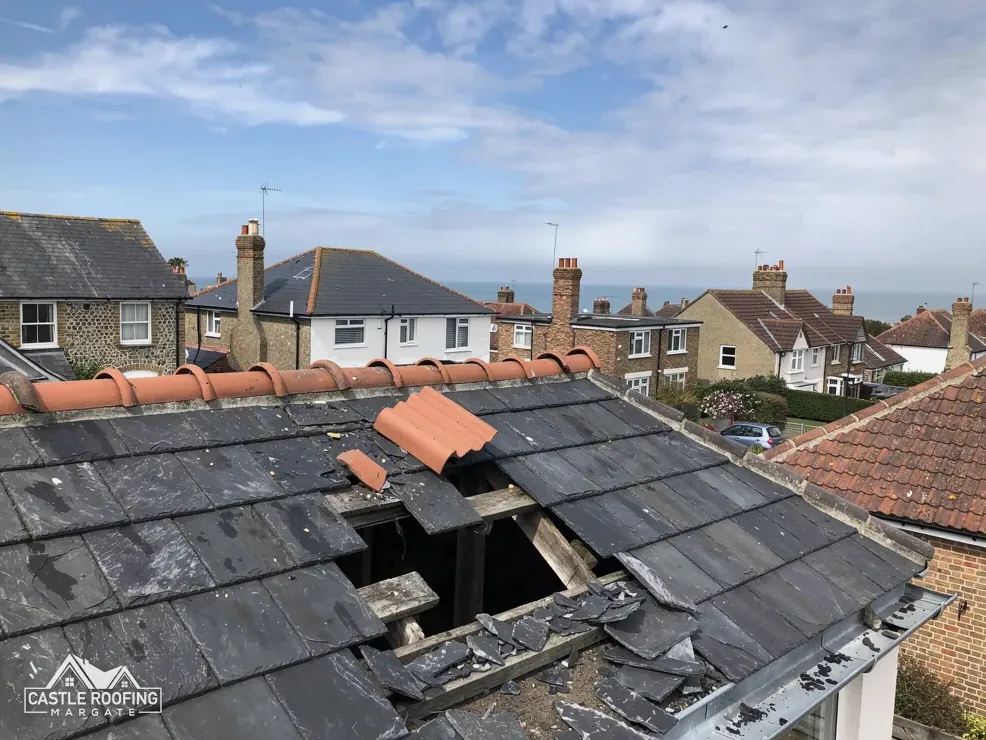
After a gale, making the roof safe comes before anything is done to the slates. MyJobQuote publishes emergency figures that put the cost in context. Its emergency roofer page gives call-out costs of £150 to £300 as typical, with extensive storm damage repairs reaching £1,200 or more, and its table has storm repairs starting at around £300. That £1,200 is for extensive damage, not for a handful of slates.
Its roof maintenance page puts the average repair at around £650 in 2026. Ask whoever makes the roof safe to say what they did, and keep their notes with your photographs. The three figures sit at different points because they describe different jobs: a call-out to attend and inspect a roof, a repair of a defined fault, and widespread damage after a storm.
If a storm has damaged your roof, the order of steps matters more than the first number:
- Contact your insurer before arranging anything, then make the roof safe.
- Photograph the damage and keep every receipt; IStructE calls photographs vital evidence for an insurance claim.
- Check your policy's own storm definition before assuming anything.
- Have the roof surveyed so the repair is priced for what is actually wrong.
The Financial Ombudsman Service treats violent winds, normally with rain, hail or snow, as the typical storm, though it allows that rain, hail or snowfall on its own can be enough. Whether a payout follows depends on the policy, and nobody can promise one.
When a repair stops being the better buy
Repair wins where the damage is confined to one area and the roof beneath it is sound. It stops winning when repairs keep returning, which points to nails, battens or underlay failing across the slope. Paying for patch after patch can cost more in the end than one proper job.
The whole-roof numbers mark the other end of the scale. MyJobQuote's slate roof guide gives around £7,800, dated 6 October 2026, while HomeBuilding says replacing the roof of a 3-bed semi of 65 m² in Welsh slate "might reach £18,000". Sources differ widely, which is why each is named. Which? gives £7,000 to £21,000 ex VAT for a full replacement on an average three-bedroom home.
Those are replacement figures, and a repair costing a few hundred pounds belongs to another league. The survey is what tells you which side of the line your roof is on, and a few markers are worth knowing:
- slipped slates in lines across a slope, not singly
- nail heads rusted through or missing
- a loft showing daylight or damp across a wide area
- lead that has split or lifted at a chimney or valley
Ridge and lead repairs follow the same logic: one failed detail is a repair, while a pattern of failed details points at the roof as a whole. Our guide on whether to re-slate or repair goes through how the decision is made. Nothing is priced until the slopes have been inspected, and the written total reflects what that inspection found.
Reading a quote and getting one written price
A good quote is easy to read. It says what is being done, to which part of the roof, and what the total is. Citizens Advice recommends collecting at least 3 written quotes from different traders before deciding, and for slate work that is sound advice, because the quotes will show whether the scope and the numbers agree.
When you compare, check what each quote contains:
- whether VAT is included, since it runs at 20 per cent
- whether scaffold and the Kent County Council licence are part of the price
- whether waste is taken away
- which slates are used, new or reclaimed, and whether they match the existing roof
- whether lead work is included or left out
A quote that looks lower because it leaves out the scaffold is not lower. A rate per square metre on its own is no quote, since the area depends on a survey.
Our own process is short. We go up and look first, you are shown photographs of what we found, and once the survey is done, one figure arrives on paper. Where repair is the better buy, that is what it covers, and where the answer is a new covering, the photographs show why. Ask any trader to say what happens if the strip shows more work than the survey could see, and to put the answer in writing.
For more on how one replacement slate is done, see how a single slate is replaced.