A plain comparison of typical lifespans from HomeBuilding, how to match an existing roof, what a conservation area or a listed house changes, and the cost figures a guide has published for slate.
When a slate roof reaches the end of its fixings, the owner faces a choice that sounds simple. Do you put back what was there, or use something different? Natural slate comes from three main routes: new Welsh slate, new slate imported from Spain, and old slate salvaged from other roofs. From the street they can pass for one another, yet each is a different product.
The decision turns on four things. How long you want the roof to last, what the existing roof looks like and whether it has to be matched, whether the house sits in a conservation area or is listed, and what the whole job will cost. None of those has a single right answer for every house, so this guide sets the facts out side by side and says where a survey is needed to settle the rest.
It sits alongside the other slate roofing pages. Where a figure appears it is a published typical UK range with its source named, never a Castle price, because the price of your roof depends on the roof.
How long each kind of slate lasts
HomeBuilding's roof cost guide, last updated on 30 September 2025, gives typical lifespans for each route. They are ranges for planning, not promises, and a slate's real life depends on the nails and battens holding it as much as on the stone.
| Slate | Typical life | Comes from |
|---|---|---|
| Welsh | 100+ years | New, quarried in Wales |
| Spanish | 75 to 100 years | New, imported |
| Reclaimed Welsh | 50 to 80 years | Salvaged from old roofs |
Reclaimed slate has the shortest range, and it has already spent decades on another roof. Its remaining life depends on how that roof was taken apart and how carefully the slates were sorted afterwards.
Lifespan is also not the same thing as fixing life. A slate with a century in it still hangs from nails that may give out far sooner, so a re-slate should specify fixings to suit the slate, and the battens behind them should be sound. Ask for the life range to be quoted with its source, so you can see it is a published figure and not a promise.
Read the figures as bands that meet or overlap at their edges. A Spanish slate that lasts 90 years is not a failure beside a Welsh slate, and a well-sorted reclaimed batch can outlive a poorly fixed new one. What the table does show is the order of caution. If you want the longest published range, new Welsh is where the guide puts it.
Matching a roof that is already there
A re-slate may not be on a blank roof. It can sit beside a neighbour's roof in a terrace, or next to a section that stays, or on a house whose look the street has grown used to. Matching is therefore more than choosing a colour.
Four things show whether a new batch of slate will sit comfortably with old:
- Size and proportion: slates come in set sizes, and a different size changes the pattern of courses (the horizontal rows) across the whole slope.
- Thickness: older slates are often thicker or more uneven, which gives the roof its softer, rougher surface.
- Colour and weathering: new slate looks darker and cleaner for some years, and a new roof beside an old one can look patchy at first.
- Edge and shape: a decorative pattern such as fishscale needs cut slates in the right shape, which are not a stock item.
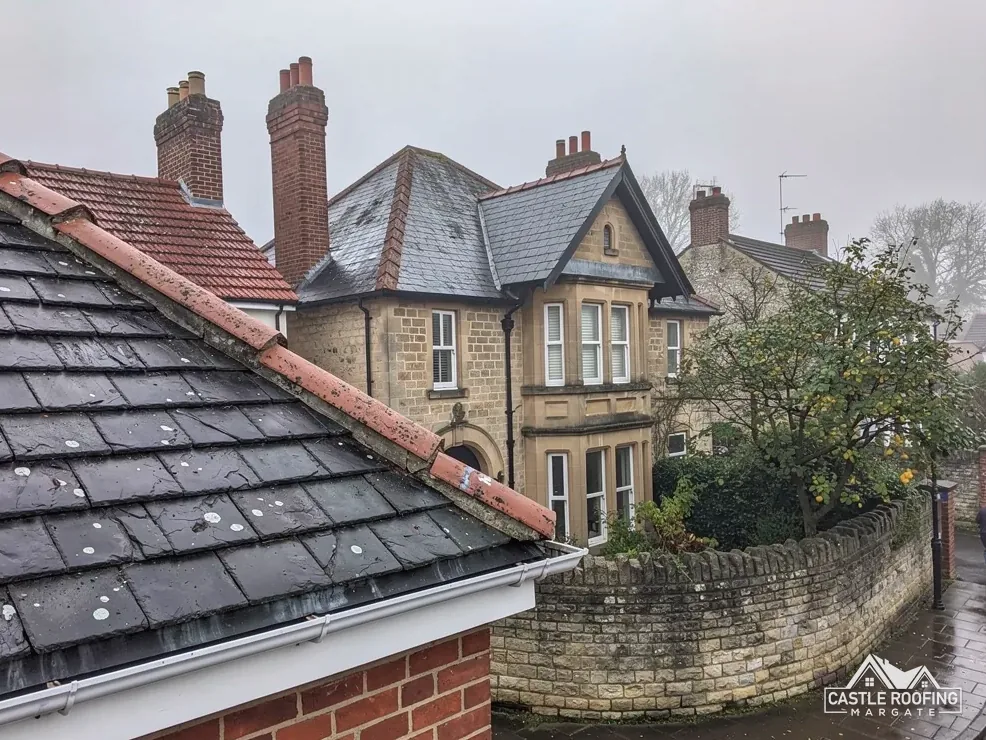
This is where reclaimed slate earns its place. A roof that has to look like its neighbours often reads best with salvaged material, because the ageing is already done. A mismatched slope is easy to see and hard to undo, and the join beside a neighbour's roof is the part everyone notices. It is also where a roofer should ask to see sample slates laid against the existing roof before anything is ordered. Ask for the slate's source and size to be written into the quote, and keep a spare handful of slates in the shed for later repairs, since a matching one can be hard to find in ten years. Our page on matching old slates goes through how that is done.
Conservation areas and listed houses
Thanet District Council lists 27 conservation areas, and Margate, Cliftonville, Broadstairs and Ramsgate each have at least one. Living in one does not stop you re-slating. Class C of the permitted development rights normally covers a re-roof on a house. What changes is how much care the choice of slate needs.
On Thanet's conservation area page the council says that where the work matches what is already there, permission is less likely to be asked for. Swapping a Spanish slate for a Welsh one is the sort of change worth raising before you order, since the colour and texture of the roof would change. If the change would alter the roof's appearance, ask Thanet District Council whether it needs permission.
Listed houses sit under a stricter system. Listed buildings keep their Class C rights, but listed building consent is needed for any works that affect the character of the building. A re-slate with a different slate can well do so, which makes consent the first step, and the council can say what slate it expects. If you are not sure whether the property is listed or falls in an area with extra controls, the council's planning team can tell you from the address. Ask before the scaffold goes up and not after the old slates are off. Some conservation areas also have Article 4 directions. Thanet's list of them covers Ramsgate and its Marina extension, plus Pegwell, and the council can say what each one covers.
A sourced look at slate costs
Cost weighs on every re-slate, and the published guides give a wide spread. Treat these as typical UK ranges rather than what any one roofer charges, and the sources are not measuring the same job.
- HomeBuilding (30 September 2025) prices a three-bedroom semi with a 65 m² roof. Plain concrete tiles may cost between £10,000 and £15,000, and Welsh slate might reach £18,000.
- MyJobQuote (October 2026) gives around £7,800 for a slate roof.
- Which? Trusted Traders (November 2025) gives £7,000 to £21,000 for a full re-roof of a typical three-bedroom house, excluding VAT.
The three do not agree, and they should not be averaged. Which? and HomeBuilding both put prices higher in the South East than elsewhere in Britain, and Kent falls within that region. Do not turn a per-square-metre rate from any guide into a total for your own house, because the size of the roof, its pitch, the scaffold, the chimney work and the condition of the battens decide the figure.
A slate type is only one cost factor. The type you choose changes the price of the slate, but the stripping, battening, underlay, lead and labour are common to all three. Your price is one written total, given once the survey is done. Slate is a long-term purchase, and the lowest price on the day is not always the lowest cost over the life of the house. A quote should say which slate it covers and where it comes from.
Which slate suits which situation
Putting the points together gives a rough guide. It is a starting position for a conversation, not a rule, because each roof has its own history.
- A detached house with no street to match, where you want the longest published life: new Welsh slate is the option to price first.
- A roof where budget and a long life both matter and a modern look is acceptable: Spanish slate has a published range of 75 to 100 years.
- A terrace or a conservation area where the new roof must blend in at once: reclaimed slate deserves a serious look, with its shorter range understood.
- A roof with decorative bands or fishscale patterns: cut slates in the right shape are needed, and the maker or salvage yard has to be asked.
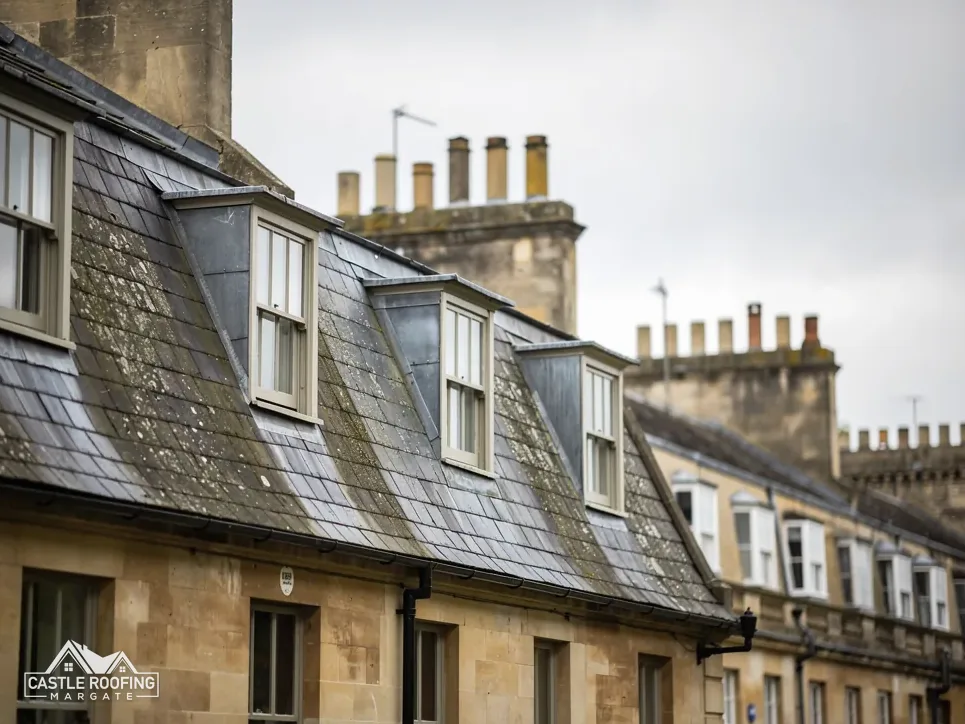
For Thanet, the council's appraisal of the Northdown Road conservation area describes roofs there as usually slated or tiled, many of them screened from the street by parapets, and notes that some carry fishscale slates. It is worth knowing if you have a parapet roof, because a parapet changes what can be seen from below but not what the weather does to the slates. Fishscale is a pattern of rounded-tail slates, and it needs matching shapes.
Whichever you choose, ask for the slate's size and source in writing, so the quote shows what is going on the house. Ask too what happens if a batch of reclaimed slate runs short, since matching a second delivery is harder than matching new.
Questions to ask before you order
A re-slate is a large purchase, and the slate is the part you cannot easily change afterwards. A short set of questions makes sure the choice is made on facts, with a written quote that names the material:
- Which slate is quoted: where it comes from, its size and its thickness?
- For reclaimed, how were the slates sorted, and how many spares are allowed for breakage?
- Will samples be laid against the existing roof, or against a neighbour's, before the order?
- What is being fixed to what, and does the specification follow BS 5534 for the exposure of the site?
- Is a consent route needed, and who contacts the council?
Citizens Advice recommends collecting at least 3 written quotes before choosing a trader. For slate that advice has an extra point: make sure each quote names the same slate, or you are comparing different roofs.
Keep the replies with your papers. If a dispute arises later, a quote that names the slate, its size and the fixings is far easier to hold a job against than one that says only natural slate roof. The same questions apply whichever of the three you favour, and asking them before the order turns a choice of colour into a choice of specification.
Our pages on how long Welsh slate lasts and whether reclaimed slate is worth it go further into each choice, and a survey of your own roof settles which one fits.