Use this to judge a cleaning method before anyone climbs a ladder. It sets out what each method does to a tile or slate, when to stop and look harder, and what should happen once the growth is off.
Moss lifts the surface of a tile, holds water against it and packs the gaps between courses. Taking it off sounds simple, yet the method chosen decides whether the roof ends up cleaner or merely wetter. Some methods only remove growth that is already there. Others treat the surface so growth is slower to return, and one or two wear away the very surface they are meant to clean.
This guide follows the order a cleaning visit uses: a look at the roof first, then hand scraping, then soft washing, then the gutters, then any tiles that the moss had been hiding. It is written for houses around Margate, Ramsgate and Broadstairs, though the order holds across East Kent.
Cleaning is one strand of our roof cleaning and moss removal work. Each stage below says what to expect, and the table in the third stage lets you hold a quote up against the method it names.
Reading the roof before a method is chosen
The method follows the roof, so the first visit is a look rather than a clean. We check the covering (concrete tile, clay tile or natural slate), how steep each slope is and whether the moss is a thin film or a thick mat. A mat that has grown for years can hide cracked tiles and slipped slates, and none of that can be judged until the growth is off.
Access matters as much as the covering. A pitched roof with a flat-roofed extension below it, a narrow side return or a front wall straight onto the pavement all change how the work is reached. Regulation 6(3) of the Work at Height Regulations 2005 puts a duty on employers to prevent falls wherever that is reasonably practicable. On a roof clean we settle edge protection or scaffold before the first scraper touches a slope.
Three things stop a clean before it starts:
- sheeting that may be asbestos cement, because HSE guidance says a building that dates from before 2000, or was refurbished before then, should be assumed to contain asbestos, and that a roof of asbestos cement is always fragile
- a bat roost or a nest in use, dealt with in the note below
- slates or tiles so loose that a person's weight would move them
Bats and the places they roost or rest are protected by law, and GOV.UK lists work on a roof as one of the activities that can affect them. Birds get protection too: under section 1 of the Wildlife and Countryside Act 1981, intentionally damaging or destroying a nest that is occupied or being built is an offence.
Hand scraping, slope by slope
Hand scraping removes the most growth with the least water. A flat scraper or stiff brush lifts moss from the top of the slope, working down so loosened growth falls away from the roof rather than being dragged across clean courses. A course is one horizontal row of tiles or slates.
Working by hand also lets the person on the roof feel the covering. A tile that rocks, a slate that has slipped on its nail or a hairline split shows under the scraper long before it shows from the ground. Anything found goes into the photos you are sent of your own roof, so the evidence for a later repair is on your phone before the scaffold comes down. Where a ridge tile, the capping along the top of the roof, moves under the hand, it is marked and left for the repair stage rather than scraped round.
The usual order on a slope:
- Loose moss is scraped or brushed from the ridge downwards, one row at a time.
- Valleys, the inside angles where two slopes meet, are cleared by hand so debris does not pack the channel.
- The back of each flashing, the lead dressed over a joint at a chimney or wall, is checked and cleared without bending it.
- Fallen growth is collected from the roof and the scaffold, never washed into the downpipes.
Scraping has a limit. It takes off the bulk of the growth, but the thread-like roots left in the surface of a porous tile stay behind, and so does the green film of algae. That is why hand work is usually followed by a treatment rather than left alone, and why it suits a roof where the growth is thick but the surface under it is sound.
Soft washing and treatment in general terms
Soft washing applies a cleaning solution at low pressure and lets the solution do the work. The rinse that follows runs at roughly the force of a garden hose, not a jet. It reaches the algae and lichen that scraping leaves, without a hard jet's force on the tile face.
Biocide, a treatment that kills moss, algae and lichen, is the other half of it. Applied after scraping, it deals with what remains in the surface. Applied on its own, it kills the growth but leaves the dead mat sitting on the roof until rain shifts it, which can take a while and can end in the gutters. Our page on roof biocide treatment goes further.
| Method | What it does | Watch for |
|---|---|---|
| Hand scraping | Lifts thick growth | Roots left behind |
| Soft washing | Low-pressure solution | Run-off to the ground |
| Treatment alone | Kills, mat stays | Slow, clogs gutters |
| Hard jetting | Strips the surface | Shorter tile life |
Run-off is the practical snag with any wet method. The solution and the debris land on the ground, so plants, ponds, cars and neighbours' washing are covered or moved before the first wash, and the downpipes are watched so nothing runs where it should not, because a stream of treated water can mark a path or a render wall. On a terrace with shared gutters, that watching includes the neighbour's side of the run.
Why hard jetting is treated with caution
Hard jetting is quick, and speed is its appeal. A jet narrow enough to blast growth out of a tile face can also wear the face itself, and Marley, which makes both slates and tiles, does not recommend high-powered jet washes, warning that harm to the surface of a slate or tile cuts its expected life considerably. A covering is laid to shed rain, and a gentle clean leaves its face intact.
Coverings differ in how they cope, and the differences are worth raising when you read a quote:
- Porous concrete can lose its face under a hard jet, which leaves the body open to fresh growth.
- Old clay has weathered for decades and can flake along its edges.
- Thin, aged slate can crack, and a jet can loosen the nail that is the only thing holding it.
Asbestos cement sheeting is not cleaned with a jet or a wire brush. HSE's non-licensed work guidance covers asbestos cement that is carefully handled without being broken up, so a roof with doubtful sheeting waits for the right advice before anyone touches it.
None of this makes water pressure a banned tool. Used low on a sound surface, it can have a place. What matters is that the quote names the method proposed for your covering and says why. If a quote proposes it, ask for the pressure and the distance in plain words, and compare the answer with the table above.
Gutters cleared once the roof is done
Whatever comes off the roof ends up in the gutters, so they are cleared last, after the slopes are finished and not before. Clearing them earlier only means doing it twice. Moss, grit and loosened granules gather at the outlets and in the low spots, and a gutter that holds standing water is a gutter that is not falling properly towards its outlet.
Brett Martin's installation advice gives a fall of 1 mm for every 600 mm of gutter, so a gentle slope towards the outlet is part of how a run drains. A gutter that has drifted flat shows up as a pool after rain, and cleaning alone does not cure that. The page on moss blocking gutters deals with the cleaning side.
What gets checked as the gutters are emptied:
- the outlets and the tops of the downpipes, where debris packs first
- joints and brackets, which show as drips or sagging once the weight is out
- any run holding water after rain, which points to a fall that has drifted
- the back of the gutter, where overflow stains the fascia behind it
On cost, Which? Trusted Traders (November 2025) gives £75 to £350, ex VAT, for emptying the gutters along both the front and the rear of a property. That is a typical UK range. The same guide expects the upper end of its scale for London and the South East, which takes in Kent.
Damaged tiles replaced, then the roof is signed off
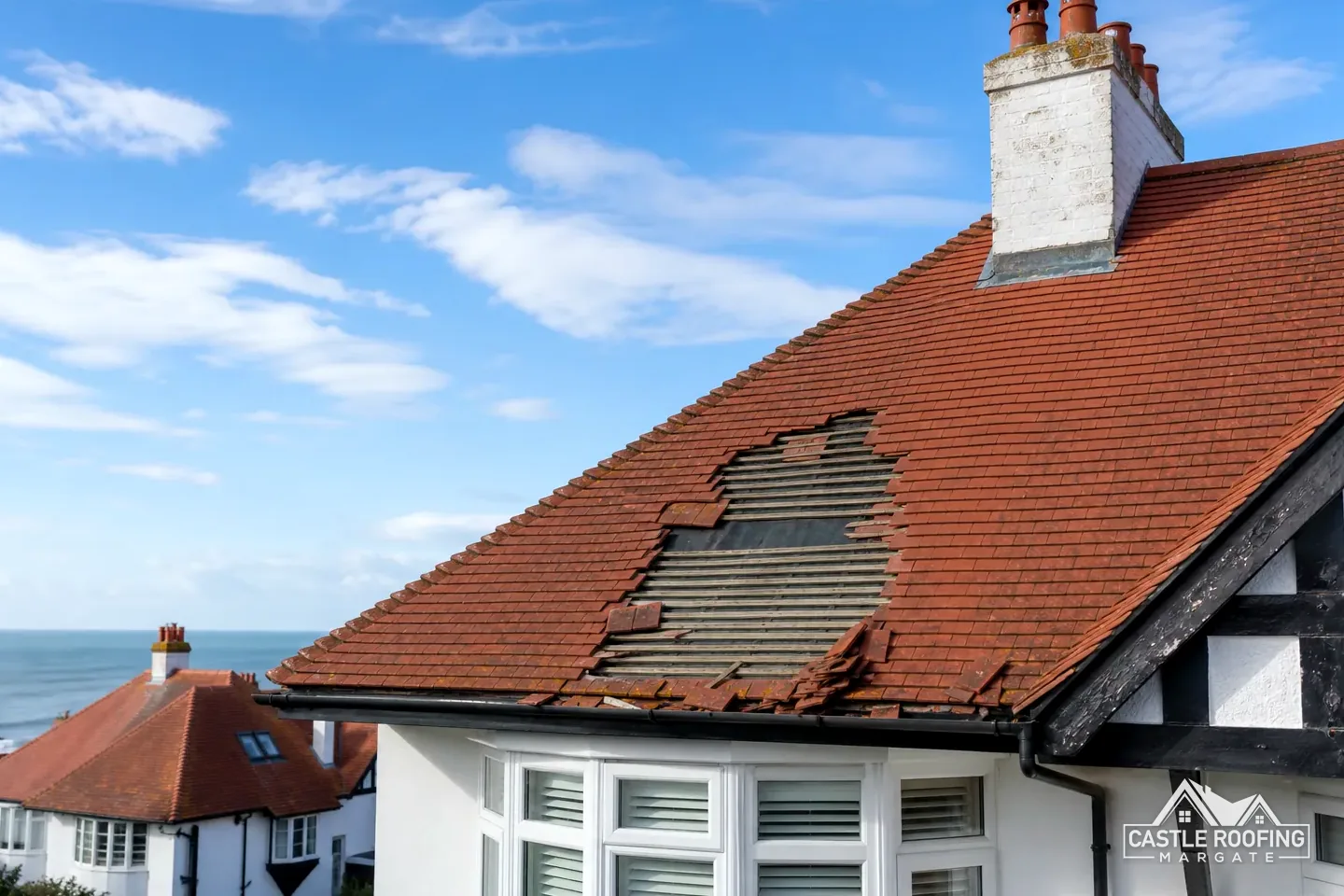
Moss often hides the damage that matters. Once a slope is bare, cracked, chipped or missing tiles show up, and a clean that ignores them leaves the weak points open to the next gale. Broken ones come out and sound ones go in while the scaffold or access is still in place, which spares you a return trip and a second booking of the scaffold.
On price, Which? Trusted Traders (November 2025) gives £75 to £400, ex VAT, for swapping out a handful of broken or absent tiles, one to six of them, on an ordinary roof. MyJobQuote's page, last updated in October 2026, gives an average of around £215 for replacing roof tiles. Both are typical UK ranges, not a quote for your house. Wider damage changes the answer, and our page on cleaning a roof before repairs explains why the clean usually comes first.
Before the visit ends you are sent:
- photos of the cleaned slopes, valleys and flashings
- photos of every tile or slate replaced, and of the ones left
- a note of anything the clean showed that needs a separate repair
The skip, if one was needed, leaves with the waste, and the pavement and drive are swept. When a quote arrives, check that it says whether scaffold and VAT sit inside the figure, so the total shown is the total you pay at the end of the job.