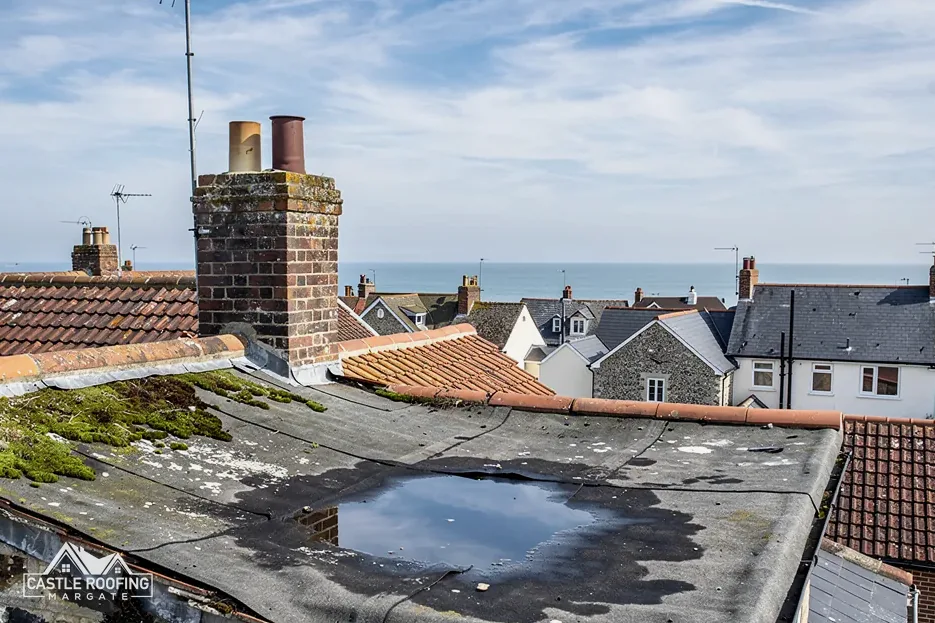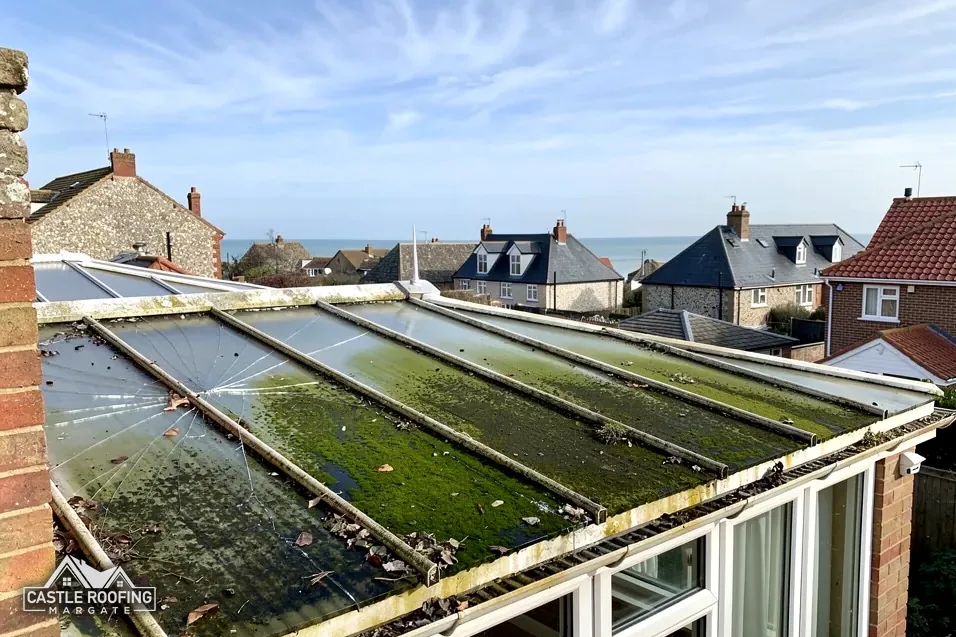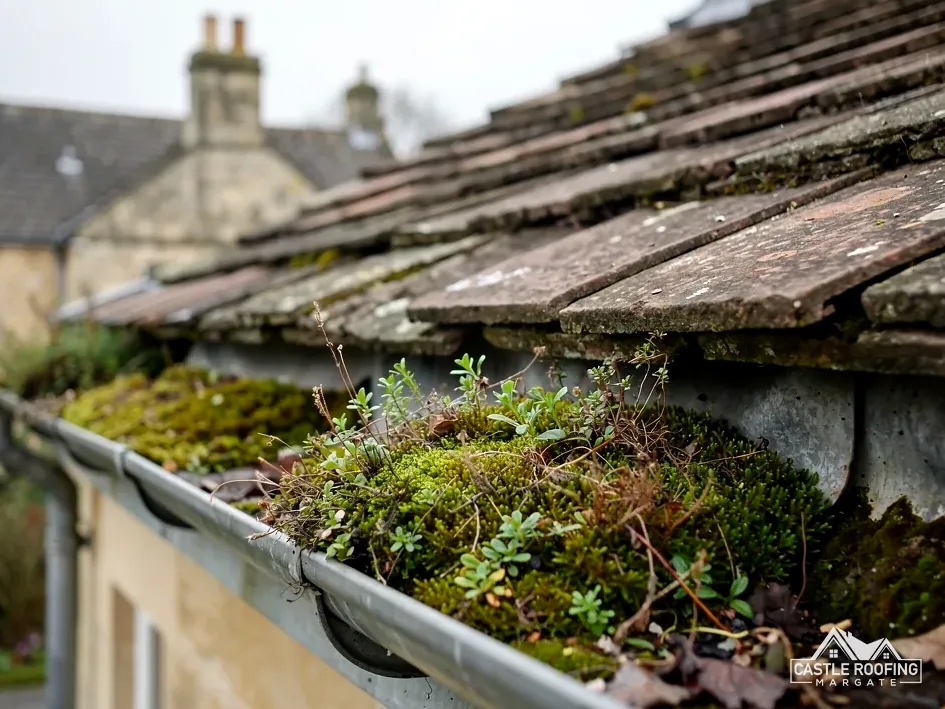
Read this to see how growth on the tiles turns into a blocked outlet, what a gutter clear-out costs as a typical UK range, and the order of work that keeps a clean gutter clean.
A roof and its gutters are one drainage system. Rain lands on the tiles, runs down to the eaves, drops into the gutter and leaves through the downpipe. Moss sits at the very start of that path, and everything that loosens from it travels the same way. Clumps, crumbs of old growth and the grit that tiles shed all end up at the lowest point of the roof, which is the gutter.
That is why a roof that looks only mildly mossy can sit above a gutter that is half full. The water has nowhere to go, so it spills over the front, runs down the wall or backs up under the first row of tiles. Moss on the slope is not the part that damages the house; the blocked outlet it eventually causes is.
This guide follows the debris down the slope. It covers where moss collects, what a clear-out costs as a typical UK range, and why the cleaning is best done as one job rather than two. It sits within our roof cleaning and moss removal work.
How moss gets from the tiles into the gutter
Moss does not stay put. It grows in a thick mat that holds water, and when the weather turns dry the mat shrinks, cracks and lets go in pieces. Wind, rain and the weight of the next shower carry those pieces down the slope until the eaves stop them. If the gutter is the first thing they meet, it takes the lot.
It is not only the moss itself. Cushions of growth hold fine grit, old leaf litter and the loose particles that age and weather knock off the tile surface. That mixture packs down into a dense, damp sludge that sits in the bottom of the run. Fresh moss then starts to grow in the sludge, so a gutter can become a small garden of its own.
The pieces travel in a predictable way:
- loose moss slides towards the eaves and lodges in the first length of gutter it meets
- grit and crumbs wash along the run towards the outlet, where the water drains
- the outlet narrows, so more material is caught there than anywhere else
- the downpipe fills from the top, and a plug forms where the pipe bends
Roofs with a long unbroken slope send more debris to one gutter than a short slope does, and a gutter below a shaded, mossy slope is the one most likely to fill first. You can see the evidence from the ground: a green line at the eaves and a dark stain beneath the gutter joint mean it is already overflowing.
What a blocked gutter does to a house
A gutter is designed to carry water to the downpipe. Brett Martin, a gutter manufacturer, gives the usual fall as 1 mm for every 600 mm of run, a slope so slight that a small build-up of sludge is enough to hold a pool of water. The pool then spills over the lip instead of draining.
The effects show up in the places you would expect:
- water running down the wall below the gutter, leaving green and black streaks
- damp patches on the inside of an upstairs wall or on a ceiling near the eaves
- a sagging gutter, as the weight of wet debris pulls on the brackets
- water backing up beneath the first course of tiles and soaking the timber behind it
- fascia and soffit boards that stay wet and start to decay
None of these is dramatic on the first day, and none of them is cheap to put right once the timber behind the gutter has been wet for months. They accumulate over a winter, and the damage tends to be found when a stain appears inside the house rather than when the gutter first clogs.
Moss itself is also a clue. If the first row of tiles above the gutter is thick with growth, the moisture is often held there by a gutter that is not draining. Clearing the gutter and cleaning the roof both address that, whereas treating the tiles alone leaves the cause in place. Our page on guttering, soffits and fascias covers the repair side when the board or bracket has already given way.
What clearing gutters costs
Which? Trusted Traders, in a survey of 11 traders gathered in November 2025, gives £75 to £350 for clearing every gutter on the front and rear of a house. Which? states that its prices exclude VAT, and it adds that they are likely to be at the upper end of the scale in London or the South East, which includes Kent.
That is a typical UK range for the clear-out alone, and where a house falls within it depends on the property:
| Factor | Why it matters |
|---|---|
| Length of run | More gutter, more time |
| Height | Tall fronts need a tower |
| Amount of debris | Packed sludge takes longer than loose leaves |
| Downpipes | A plugged pipe adds work |
Replacing the gutters is a different order of spend, and it is worth keeping in mind when a clear-out looks like a small bill. MyJobQuote, in October 2026, puts gutter replacement at around £1,000 to £1,600. A clear-out that catches a problem early is the cheaper route, but it cannot fix a gutter whose fall has gone or whose joints have failed.
These figures are for orientation only. What we charge is set by looking at your roof and gutters, and the written price is one total sent after the survey. When you compare any two quotes, check that each says whether VAT is included and whether access is covered.
Cleaning the roof and the gutters together
Cleaning only the gutters while the moss stays on the roof means the work is undone by the next heavy shower. Cleaning only the roof sends a fresh load of debris into gutters that are already full. The sensible route is one visit that deals with both, and the order of work matters.
- Survey from the ground and from above, noting tiles that are loose or cracked before anything is disturbed.
- Take the thick moss off the roof by hand or using a stiff-bristled hand brush, starting at the ridge and moving downwards, so the loose growth drops towards the gutter.
- Apply the roof treatment according to the product label and leave it to work.
- Clear the gutters and downpipes last, removing everything that has come off the roof and everything that was there already.
- Run water down the roof and through the outlets to check the flow, and look at the joints for leaks.
Clearing the gutter last is the point. If it is done first, the roof work refills it, and the clean gutter is only clean until the first rinse.
The same access serves both jobs. A tower or scaffold that reaches the eaves is the thing that puts a person in a safe position to reach the roof and the gutter, and sharing it keeps the work to one set-up. Our guide on roof cleaning access explains what the options look like on a terrace, a semi and a bay-fronted house.
Access, scaffold licences and safety
Gutters sit at the lowest, most awkward edge of the roof, where a ladder alone is a poor choice, because a rooftop clean involves a long reach, wet debris and a person leaning outward. A proper tower or a scaffold reduces the risk of falling, and regulation 6(3) of the Work at Height Regulations 2005 requires an employer to guard against a fall that could injure a person, so far as that is reasonably practicable.
Where a scaffold must stand on or over the public highway, a licence is needed first. Kent County Council issues scaffold licences for Thanet and the other districts we work in, and the scaffolding company applies. The council's fee is £52 per week for 2026 to 2027, with 5 working days' notice. Our answer on the Kent scaffold licence goes into the detail, and the fee is only part of the cost of a job where the front of the house meets the pavement.
Access also decides what gets cleared. A gutter is not fully cleared if only the part within easy reach has been dealt with, so ask whether the whole run, including the back of the house and any porch or bay, is covered.
Before any gutter is cleared, the fixings are checked. A gutter full of wet moss is heavy, and a bracket that has weakened will give way under a person's weight or a pole. If a bracket is loose, we tell you before the gutter is touched.
Keeping the gutters clear afterwards
Once the roof is clean and the gutters are open, a little attention keeps them that way. The quickest win is a look from the ground after heavy rain. A gutter that is working shows a clean line of water at the front and no overflow. One that is not working shows a stain, a drip or a plume of water where there should not be one.
A short routine helps:
- look at the eaves after autumn leaf-fall and again after the winter, when any growth has made its mark
- watch for green lines at the front of the gutter, which show where water has been sitting
- check the downpipe base during rain, because a trickle where there should be a flow is the earliest sign of a plug
- trim back branches that overhang the roof, since they add leaves faster than any moss
A gutter guard or cover is sometimes suggested. It can reduce the leaves that reach the gutter, but it does not stop moss from sliding down the slope and it can hide the growth that builds on top of it, so it does not replace a check.
How often the roof itself needs cleaning is a separate question, and it turns on the shade, the tree cover and the tile. Our guide on how often a roof should be cleaned works through it. If your gutters are already overflowing, send a photo of the eaves and we will say what we see.