You get the conditions that suit the job, what the Met Office averages for Manston say about finding them, the nest and bat checks that come first, and when to hand it to a roofer.
Gardening advice tends to name a month for every job. Moss on a roof does not work that way. It grows wherever tiles stay damp and shaded, so it can thicken through autumn and winter and still be there in a wet spring. So the title gets a weather for an answer, not a date: a run of dry days, no frost on the roof, little wind, and time before the next rain.
That is easy to say and harder to find on the east Kent coast, where settled spells are rarely long. This piece sets out what each condition does to the job, what the long-run weather figures from Manston tell you about your chances, and the checks that belong ahead of any brush or spray: nests, bats and the safety of getting at the roof. It ends with the sensible line between a job for a homeowner and a job for a roofer.
If you are weighing the whole question, our roof cleaning and moss removal page sets out how a roof is assessed before a clean is recommended.
Weather matters more than the calendar
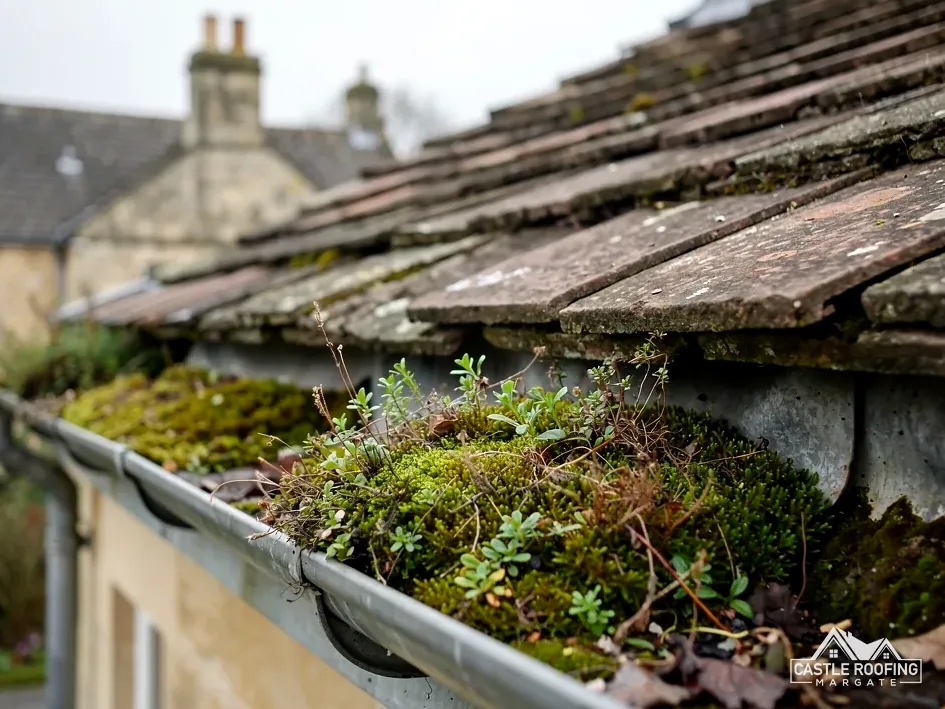
Moss spores settle on any roof. Whether they take hold depends on moisture and light. A north-facing slope under a tree stays wet for days after rain, and moss spreads there first. A sunny slope can dry in an afternoon and stay almost bare. So the same house can have a thick green patch on one side and clean tiles on the other, and the right time to clear it depends on conditions on the day, not on the season.
For the job itself, four conditions count. The surface should be dry or drying, because a treatment spread on a wet roof dilutes and runs off. The air should be above freezing, both during the work and afterwards. The wind should be light enough that a spray stays where it is aimed and a ladder stays steady. And the forecast should offer a gap before the next real rain, so that the treatment is not rinsed away before it has done its work.
Spring and early autumn often give that mix, which is why many people pick them. Midwinter can give it too, on a still, mild, dry day, and midsummer can fail it with a thunderstorm. Treat a season as a hint and a forecast as the decision.
If you are tempted to wait for the perfect month, remember that moss left to thicken is heavier to remove. Our answer on removing moss in winter takes that question on directly.
A simple go or wait guide
When a clear day arrives, run through these conditions before you book or begin. A single failed condition is enough to wait.
| Condition | Effect | Decision |
|---|---|---|
| Dry, still, frost-free spell | Treatment dries on, access is safe | Go |
| Rain forecast for later | Treatment is rinsed off early | Wait |
| Frost on the roof | Wet tiles are icy underfoot | Wait |
| Gusty wind | Spray drifts, ladder moves | Wait |
The same table works for a roofer as well as for a homeowner with a ladder. A good roofer will tell you plainly when the day is wrong, and move the booking, because a job done in poor conditions has to be repeated.
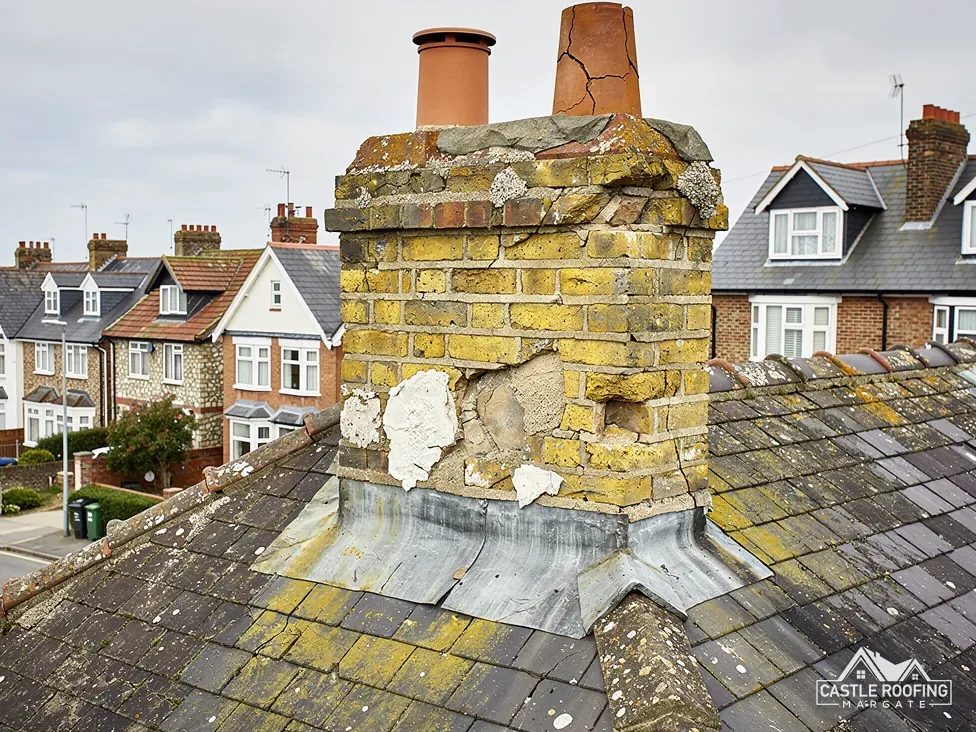
It also helps to look at the roof first. Moss can hide cracked tiles, slipped tiles and crumbling mortar at the ridge. Clearing it exposes them, and a roof that needs a repair before cleaning is better repaired first. Photographs from the ground, taken in good light, show where the growth is heaviest and whether the gutters are carrying fallen debris, and they give you a record to compare with after the work.
- Check the forecast for the day of the work and for the day after.
- Look for frost on the lawn or car at first light; if it is there, the roof is colder still.
- Take photographs of the slopes before any work begins.
- Look at the gutters, since loosened moss falls into them.
What the Manston records say about your chances
The Met Office climate station at Manston, 49 m above sea level in Thanet, gives 1991 to 2020 averages. They describe a long run, not any given week. At Manston, the average year brings about 613 mm of rain, spread across 110.05 days with 1 mm or more, and 21.43 days of air frost.
Read plainly, that means wet days are common but not constant, and frost is a real constraint on a minority of days, mostly in the colder months. Dry, frost-free windows therefore exist in every season, and the figures cannot tell you when the next one arrives. They do suggest not to book a clean for a fixed week far in advance, since a fixed week may land on a wet or frosty day.
Manston's mean wind speed is 9.86 knots, with January averaging 11.21. Inland South Farnborough, over the same period, shows 7.07 knots and 715 mm of rain. Manston is windier and drier, and wind is the other condition that stops a spray job.
- Rain: 110.05 days with 1 mm or more in an average year.
- Frost: 21.43 days of air frost in a typical year at Manston.
- Wind: Manston's mean of 9.86 knots, with January higher.
Use these as a reminder to stay flexible rather than as a calendar. Ask for a booking that can move by a day or two either side, and settle beforehand what the fallback is should the weather turn.
Nests and bats come before the brush
Wild birds nest in gaps under tiles, in gutters and on ledges, and moss can hide a nest in a way that surprises people. Section 1 of the Wildlife and Countryside Act 1981 makes it an offence to intentionally harm a nest that is occupied or still being built, whether by taking it, damaging it or destroying it. The word that matters is intentionally. GOV.UK adds that there are no licensing purposes to permit development or construction, so a licence does not answer the problem.
The sensible habit is to look before you start. From the ground, watch for birds flying in and out of the same gap, listen for chicks, and check the gutters. If a nest is in use, the work waits until the birds are done with it. Nests are found by looking at the roof, not by checking a date.
Bats are a separate matter. GOV.UK says bats and the places where they breed and rest have full legal protection, and it names roof repair work among the activities that can affect a roost. The Habitats Regulations 2017, regulation 43, make it an offence to damage or destroy a breeding site or resting place, and intent is not needed for that.
- Look for droppings under the eaves or against the wall, or for staining at a gap.
- Stop and ask for advice if you see signs of a roost.
- Do not seal gaps until you know what is in them.
Our answers on roof cleaning and bird nests and bats go into the detail.
Treatments, labels and getting the product right
Moss is removed in two broad ways: it is scraped and brushed off by hand, or it is treated with a product that kills it and then allowed to loosen. Many jobs combine the two. Neither depends on the month, but both depend on the product and the way it is used.
A moss treatment is a chemical, and chemicals come with a label. The label states what the product is for, how it should be applied, how long it needs and what to keep clear of, such as ponds, pets and plants. Follow the label for your product, because dwell times and rinse instructions differ and are the manufacturer's to set.
One point matters for a homeowner in particular. Some products are sold for professional use only. They are not for a domestic buyer to track down and apply, and a roofer using one should be able to say why. For your own roof, use only a product whose label allows domestic use, and ask a roofer which product they are using before work starts. Our guide to roof biocide treatment explains what the different treatments are.
- Read the whole label before buying, not just the front.
- Keep treatment away from the garden, drains and neighbours' washing.
- Clear the gutters afterwards, as loosened moss ends up in them.
- Do not scrub hard at old tiles; a brush with firm bristles is enough.
After treatment, moss often loosens and falls away over the following weeks, and the roof then looks cleaner. If it grows back, damp and shade are usually the reason, and the underlying cause is worth addressing.
Moss jobs that need a roofer on site
Clearing moss from a garage or a low outbuilding is a job some owners can do from a safe ladder or from the ground with a long-handled brush. A pitched house roof is different. Tiles are brittle, the surface is slippery when wet, and a fall from a pitch is serious. Moss makes it worse, since it holds water against the surface.
Hand it over when any of these apply:
- The roof is above the first floor, or the pitch is steep.
- You would need to stand on the roof, not on a ladder at the eaves.
- The tiles are old, cracked or shifting.
- The growth is thick enough to hide the tiles beneath.
- There are signs of nests, bats or asbestos cement sheets.
Asbestos cement is a particular warning. HSE's A14 guidance treats asbestos cement roofs as fragile in every case, and an older garage or outbuilding roof may be made of it. Never brush, scrape or walk on one; get advice first.
On price, roof cleaning is priced after a survey. What sets it is the roof area, the pitch, the access, how much growth there is, whether scaffold is needed and how much gutter clearing sits alongside. For comparison, Which? Trusted Traders (November 2025) gives a typical UK range of £75 to £350, ex VAT, to clear the gutters of a house, front and back. Our pitched roofing answers cover the repairs that sometimes follow a clean.