
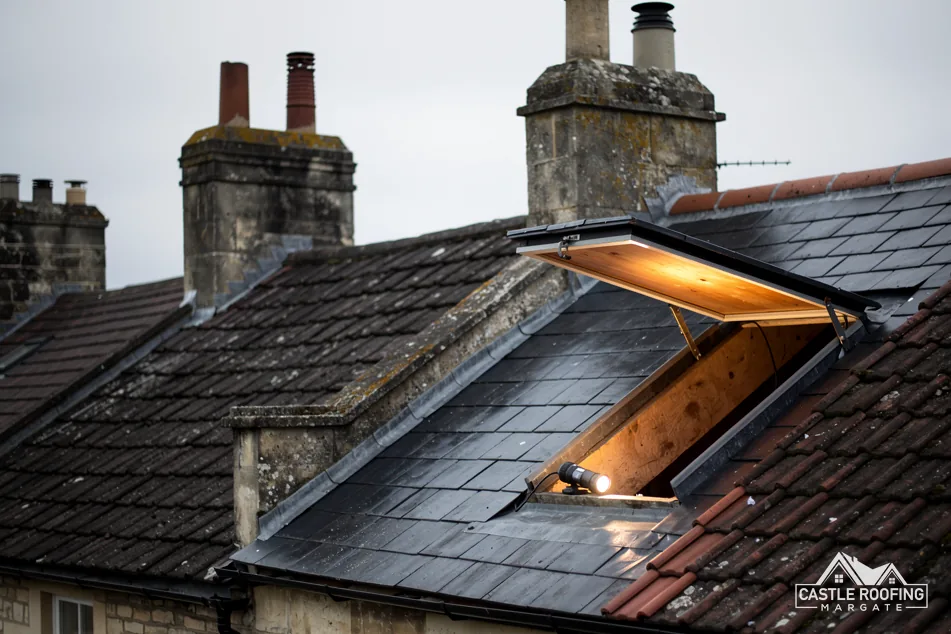
Read this before you ask for a slate roof to be cleaned. It explains which methods protect the slate, what a good cleaner looks for on the way, and why the access matters as much as the wash.
Slate is a hard stone but a brittle roof covering. It is split into thin sheets, each slate hangs from a nail or hook through a small hole, and each one overlaps the slates below it. The surface is smooth and does not hold dirt as readily as clay or concrete, yet it still collects moss in the laps, lichen on the face and a green or dark film on the slopes that stay damp.
Cleaning slate asks for more care than cleaning most tiles, because the covering depends on small fixings and edges that a careless hand breaks. A slate that cracks under a boot or a jet is a leak waiting for the next storm. The right job takes growth off the surface without loading, lifting or blasting the slates.
This guide sets out the gentle methods that suit slate, what is done when cracked or slipped slates turn up during the work, and why walking on a slate roof is a risk both to you and to the roof. It belongs to our roof cleaning and moss removal work, where the survey looks at the slates before any method is chosen.
Why slate needs a gentler hand
A slate is held on the roof by very little. Each one is nailed through a hole near its head or hung on a hook, and the slates above lie across its top edge to keep it from lifting. The overlap, called the lap, is what makes the roof weatherproof. Slate also splits along its layers, so a crack can run through a slate without showing much on the face.
Pitch limits what can be done as well. Cupa, a slate maker, reads BS 5534 as setting a floor of 20 degrees for natural slate, at moderate exposure with a 500 mm slate and a 115 mm lap, and rules out hooks below 25º. A shallow slate roof therefore has less margin for water to run off a damaged slate, and the cleaner has less room for error.
Four features of slate drive the method:
- It is brittle, so point loads from feet, ladders and tools can snap it.
- Nail holes and edges are the weak points, so scraping at an edge can chip it.
- The laps trap moss and silt, so brushing has to go with the lap and not against it.
- The surface can lose its finish if it is scrubbed hard or blasted.
None of this makes slate hard to look after. Slate roofs last well. HomeBuilding gives a typical life of 100+ years for Welsh slate, 75 to 100 years for Spanish slate and 50 to 80 years for reclaimed Welsh slate, as typical ranges. The covering often outlives the fixings, so a clean is a chance to look at both.
Gentle methods in general terms
The aim is to take growth off without moving a slate. A cleaner on a slate roof usually works in stages, starting with the lightest method and going further only where the first has not done enough.
| Method | What it does | Care needed |
|---|---|---|
| Hand brush | Lifts moss and loose silt | Brush down the slope, with the lap |
| Soft wash | Low-pressure rinse with a cleaning solution | Control the run-off |
| Biocide treatment | Kills lichen and algae so they release over time | Plan for the garden below |
Hand work comes first on slate because it lets the cleaner feel each slate as it is cleared. A stiff scrape under a lap would snap a thin slate, so moss is eased out of the laps by hand and the slate is lifted no more than it needs to be.
A soft wash uses a low-pressure flow to carry a cleaning solution over the slope and rinse it off. It keeps force off the slate, and that matters: Marley advises against high-powered jets on slate, which can scar its face and shorten its life considerably. The guide to water pressure on a roof goes into how much a covering can take.
A biocide treatment can finish the job. It leaves lichen and algae to die back over weeks, not minutes, and it is the least physical method. Because the cleaning solution runs off the roof, the gutters and the garden below are planned for before it is used.
Walking on slate: risks to you and the roof
A slate roof should not be walked on by an owner, and a roofer does it only with equipment. A slate that is dry is slippery enough. One coated with algae or damp moss is far worse, and the roof is usually steep. Falls are the principal danger of any cleaning job.
The roof itself suffers too. A foot placed in the middle of a slate puts a point load on a thin, layered stone with air beneath it. The slate may crack straight away or be weakened for the next storm. A hidden crack can run a long way before it opens, so damage done today may only show as a leak months later.
Regulation 6(3) of the Work at Height Regulations 2005 puts the duty on employers to prevent falls so far as is reasonably practicable. On a slate roof that means planned access before the first step. What that looks like in practice:
- Scaffold or an access tower at the eaves, so the cleaner can reach the slope without climbing it.
- Roof ladders or crawling boards, which spread weight across several slates and give a foothold.
- Harness points where the pitch and the edge call for them.
- No stepping on slates that are known to be cracked or loose.
If you can see moss from the road and are tempted to deal with it yourself, leave the roof alone. Moss left for another season is a smaller problem than a broken slate. Our guide to access for roof cleaning covers how the work is reached.
Cracked slates found on the way
Cleaning shows the roof as it really is. Moss and silt hide hairline cracks, and a wash often reveals slates that were already broken or have slipped out of line. Finding them is a benefit of the clean, and it should be a stated part of the job.
A cleaner working on slate looks for:
- Cracked or snapped slates, with the lower part sitting on its neighbour.
- Slipped slates, held at the head by a corroded nail that has let go, so the slate hangs a little out of line.
- Chipped tails, where the lower edge has broken off and water can be drawn up under the lap.
- Gaps in a course where a slate has gone missing altogether.
- Lead flashings that have lifted or split at chimneys, abutments and valleys.
A damaged slate is not pushed back into place. It is taken out with a tool that cuts or draws the nails without disturbing the slates around it, and replaced with a matching slate fixed with the right nail or clip for the position. Where the old slates are reused, they are checked first. Reclaimed slate has its own range of typical lives, which HomeBuilding puts at 50 to 80 years for Welsh.
For small repairs, Checkatrade, in June 2026, gave £150 to £220 per m² for natural slate, ex VAT, on repairs up to a maximum of 3m². That is a rate for a small area, and it cannot be scaled into a price for a whole slope. You see photos of what was found, and you decide what is repaired.
After the wash: ridge, lead and gutters
A cleaned slate roof is easier to read, so the clean-up ends with a check of the parts around the slates, which age at their own pace. The ridge, hips, valleys and lead are where leaks start, so they are checked while the roof is clear.
The checks to expect once the slates are clean:
- The ridge: are the capping pieces secure, and is the bedding sound or crumbling?
- The valleys: is the lead intact, and is the channel clear of silt?
- The flashings at chimneys and walls: is the lead lifted, split or pulled out of its chase?
- The gutters and downpipes: are they holding fallen moss and silt?
- The eaves: are the first courses secure, and the gutter edge dry?
Gutters need the most attention because they take all that has come off the roof. Moss and silt carried into an old gutter can block the outlet, which backs water over the eaves. Our guide to moss removal methods describes how the debris is handled so that it stays out of the drains.
Lead lasts well, and MyJobQuote puts lead flashing at over 80 years, a lower bound. Even so, a flashing can lift from age or movement before it reaches that age, and checking it is easy once the scaffold is in place.
If the survey finds that many slates have failed, the honest answer may be a re-cover, not a clean. We say that at the survey, with photos.
What sets the price of a slate clean
A slate clean is priced after a survey. What moves the price is roof size, pitch, how much moss there is, how the roof is reached and whether any slates need replacing as part of the work. Scaffolding is another variable that is priced after a survey, and a quote should say whether it is in, along with how the debris is cleared away and whether the gutters are cleaned in the same visit.
When scaffold or an access tower stands on the pavement or in the road, the licence comes from Kent County Council and the scaffolding firm applies for it. The fee is £52 per week for 2026 to 2027, with 5 working days of notice, plus £78 where the council considers an inspection necessary.
Questions to put to any quote for cleaning slate:
- Which method will be used, and is the pressure kept low?
- How will the roof be reached, and does the price include the access?
- What happens if cracked slates are found, and who decides?
- What happens to the debris and the run-off, and are the gutters cleared at the end of the visit?
The written price follows the survey. We look at your roof before anything is priced, photos of your own slopes come to you, and the quote is one total price. If slates need replacing as the work goes on, you hear about it before it is added.


