A plain split of chimney work between a sweep, a roofer and a bricklayer, with the points where the jobs overlap and the two rules that catch people out on a breast removal.
Ring three firms about a damp chimney and you may get three answers. The sweep says the flue is fine. The bricklayer says the stack wants pointing. The roofer says the lead has gone. Each may be right, because a chimney is a flue, a column of brickwork and a roof detail at once, and each trade covers a different layer.
Roofers do repair chimneys, but with a boundary. The work that falls to a roofer is the part where the stack meets the roof and the part at the very top: flashings, soakers, flaunching and often the pots and cowls. When the brickwork itself is failing, the repair becomes masonry, and the firm you want is one that can do stack work, which is often a roofing firm that employs bricklayers or works with one. The inside of the flue belongs to the sweep and, for lining, a specialist. This page sorts out which is which so you can ask for the right visit first. The hub page on chimney repairs shows how we handle the roof-side work.
What a roofer repairs on a chimney
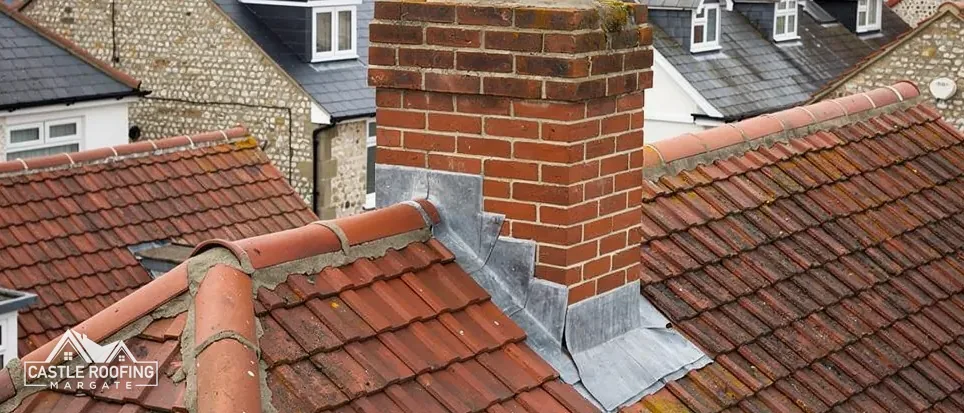
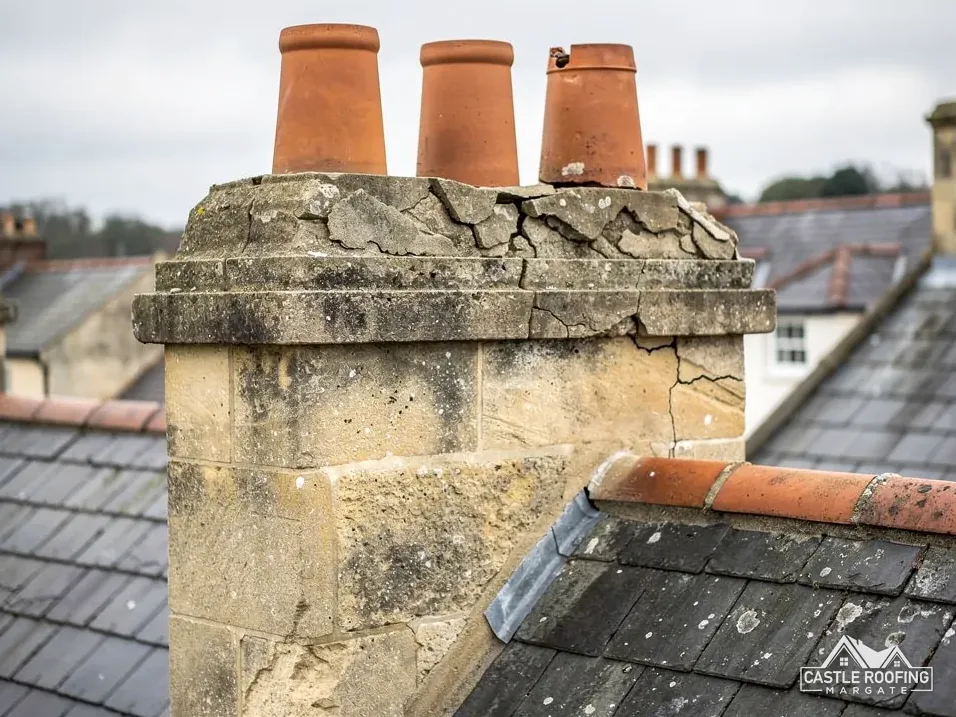
A roofer works where water is shed, and on a chimney that means three places. At the base, where the stack meets the slope, the roofer fits and renews lead flashings and soakers. Flashing is lead worked into the brickwork and laid over the covering, and soakers are little folded lead pieces tucked beneath successive courses of tile or slate beside the stack. At the top, the roofer rebuilds the flaunching, the mortar fillet round each pot base that sends rain away. Between them, a roofer will usually replace or refix pots and fit a cowl, the cover over a pot.
These are the jobs that leak when they fail, and they are the ones a roof survey picks up. A roofer is also the right call for:
- A slipped or cracked slate or tile next to the stack.
- A lifted ridge tile where the ridge meets the chimney.
- A gutter or valley that sheds water onto the stack.
- A make-safe sheet over a stack after a storm.
Where one stack serves two houses, the roofer looks at both sides of it, because the lead on each side is dressed into the same brickwork.
Lead work has its own detail. The Royston Lead brochure recommends Code 3 for soakers alone, while every other detail on a stack takes the code set in the specification. Our overview of chimney flaunching repair and the answer on cowls and pots go through the roof-side tasks in more detail.
Where the sweep fits in
A chimney sweep deals with the flue, the passage inside the stack that carries smoke. The sweep brushes soot and debris out of the flue and can tell you whether it is clear. That is a separate service from repairing the outside of the stack, and it does not stop rain coming in through a failed flashing or a cracked cap.
Call a sweep when you plan to use a fireplace or stove again, when a flue has been shut for a long time, or when a bird has been nesting in the pot. Nests call for care: it is an offence under section 1 of the Wildlife and Countryside Act 1981 to intentionally damage or destroy a wild bird's nest that is occupied or still being built. A pot with an active nest is therefore left alone until the birds have finished, and a cowl fitted afterwards stops a repeat.
A sweep may spot signs of a problem worth passing on, such as cracked flue liner pieces or a stack that looks out of true. Those are reasons to ask a roofer or a builder to look at the outside, not a reason to skip the sweep. A sweep is also the sensible first call after a long period of disuse, before the flue is connected to a stove or a fire, because a blocked flue is a hazard of its own. Our note on birds nesting in a chimney explains the next step.
Brick, pointing and rebuilds
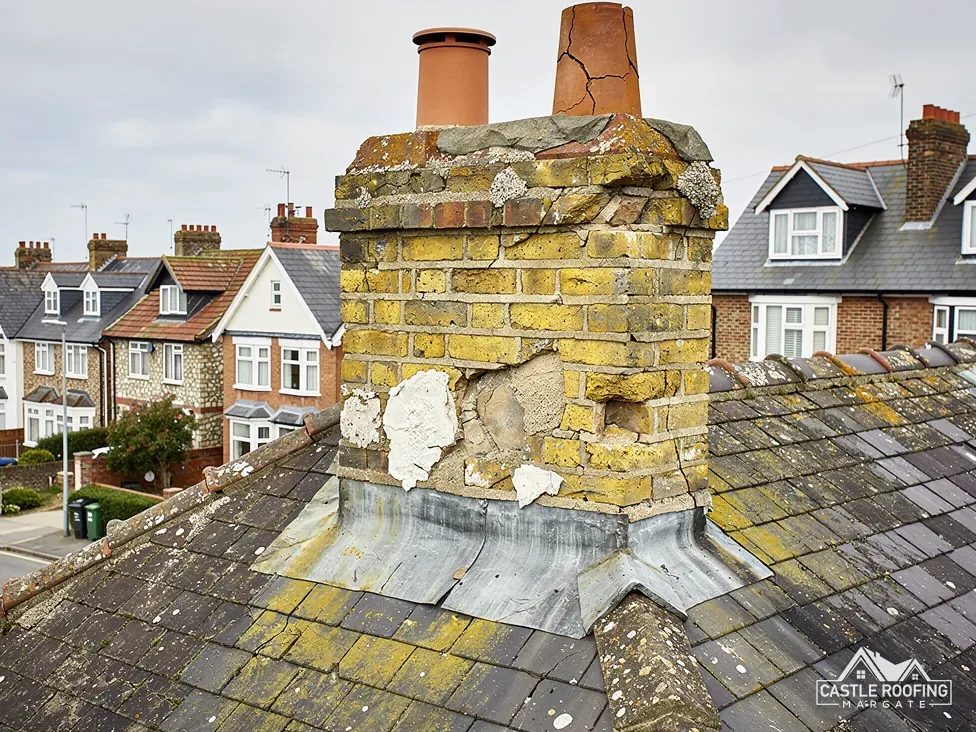
When the stack itself has failed, the job moves from roofing to bricklaying. Joints that have eroded need repointing. Bricks that have flaked or spalled, where the face breaks off in layers, need replacing. A stack that leans or has shifted out of line may need taking down and rebuilding from the roof line up, reusing whichever of the old bricks are sound.
Whether a roofing firm does this depends on the firm. Some roofers repoint a stack as part of a roof job, and some employ bricklayers; others bring in a separate mason. The useful question is who will be on your stack and what they will do. Ask the firm to show you photos of the brickwork before they start, and to describe what is being replaced.
| Fault | Trade |
|---|---|
| Lifted lead at the base | Roofer |
| Cracked cap around the pot | Roofer |
| Eroded joints | Roofer or bricklayer |
| Flaking bricks | Bricklayer |
| Leaning stack | Bricklayer, with a survey |
| Soot, blocked flue | Sweep |
A price for stack work is given after the stack has been inspected. The price turns on the height of the stack, the number of faces to work on and how the scaffold goes up, so a figure given over the phone is a guess. Ask for photos of each face of the stack before and after, so the work can be checked from the ground. Photos of the failing bricks, taken in daylight with a zoom lens from the ground, are enough for a first opinion.
Removing a breast: approval comes first
The breast is the inner section of the chimney, the bulge that stands out from the wall of a room. Taking it out is a structural job and not a roofer's call. The Planning Portal says approval under the Building Regulations will "always apply" when a breast is removed, because it forms part of the structure. So approval is sought before the work, through your council's building control team or a registered building control approver.
A roofer enters the picture at the top. If the breast comes out but the stack stays, the stack above needs support, and if the whole stack goes, the roof must be made good where it stood. That second job is roofing: new rafters or battens to close the gap, then the covering, lead and ridge brought back to a sound finish. Our page on chimney stack removal covers the roof-side steps, and the note on chimney breast removal covers the inside.
MyJobQuote's figure for taking out a chimney breast, updated in August 2026, is £1,200 to £3,500 as a typical UK range. That is a national guide and not a price for your house. If the stack goes down below the roof line, ask who will make good the ceiling and the fireplace opening, because that part of the job crosses between trades.
Where the house also needs a planning check, for example in a conservation area, that is separate again. Our short guide chimney rules explained sets out which rule applies to which job.
When next door has to be told
In a terrace or a semi, a chimney breast often sits on the wall between two houses. Cutting into it is then covered by the Party Wall etc. Act 1996. Section 2(2)(g) allows an owner to take away any chimney breast, jamb or flue projecting from the wall, and section 3(2) sets two months as the minimum warning before the work begins.
A short list of what follows from that:
- Notice is given to the adjoining owner in writing, before work starts.
- Under section 3(3)(a), an earlier start is possible with written consent from the neighbouring owners and occupiers.
- GOV.UK warns that a lack of reply should not be read as agreement.
- If you cannot agree, surveyors are appointed to settle it.
Notice comes from the owner having the work done, so agree early who will draft and send it. A friendly word first costs nothing, and a letter that says what, where and when is useful evidence later. Where a stack is shared, one owner's repair can still change the other's, which is a further reason to talk. Party wall questions go to a party wall surveyor, not building control. A roofer who is repairing the outside of a shared stack, without cutting into the party wall, is in a different position, and the neighbour is still best told as a courtesy because the scaffold may stand on their side. Our guide to shared chimney stack repairs explains that case.
Booking the right visit first
An easy mistake is booking the wrong trade first. A short rule of thumb helps.
- If water is coming in beside the stack or on the breast, book a roofer. The lead and the cap are the first places to look, and a roof survey checks both.
- If smoke, soot or a blocked flue is the problem, book a sweep.
- If the survey says the brickwork itself is failing, ask the firm who will do the stack work and what the plan is.
- If you want a breast or a stack removed, check consent and approval before booking anyone to start.
Access decides a lot. Kent County Council's licence for a scaffold on the pavement costs £52 per week in 2026 to 2027, and the scaffolders apply with 5 working days' notice. Planning that into the schedule explains why a stack repair is not usually done on the day it is found.
Citizens Advice suggests asking at least 3 traders for written quotes. Compare what each says is wrong with the stack, and whether the repair described matches the photos you were shown. Put the same questions to every firm, so the quotes can be compared on what they actually cover. If two of them describe the fault differently, that is a reason to have the stack looked at again, not to pick the lower figure. Ask, too, whether the quote includes VAT and the scaffold, since those can differ from one quote to the next. Send us photos of the stack and the damp. If the weather is the worry, see our answer on chimney repairs in winter.