For owners who have been told the flaunching has gone. It explains the job the mortar does, the causes of cracking, the signs that matter, the steps of a repair and when more is needed.
Look up at a chimney stack and you will see pots standing on a grey mound. That mound is the flaunching, and it is easy to ignore until a roofer points it out. It also sits where the stack has least shelter, and it has a great deal of work to do.
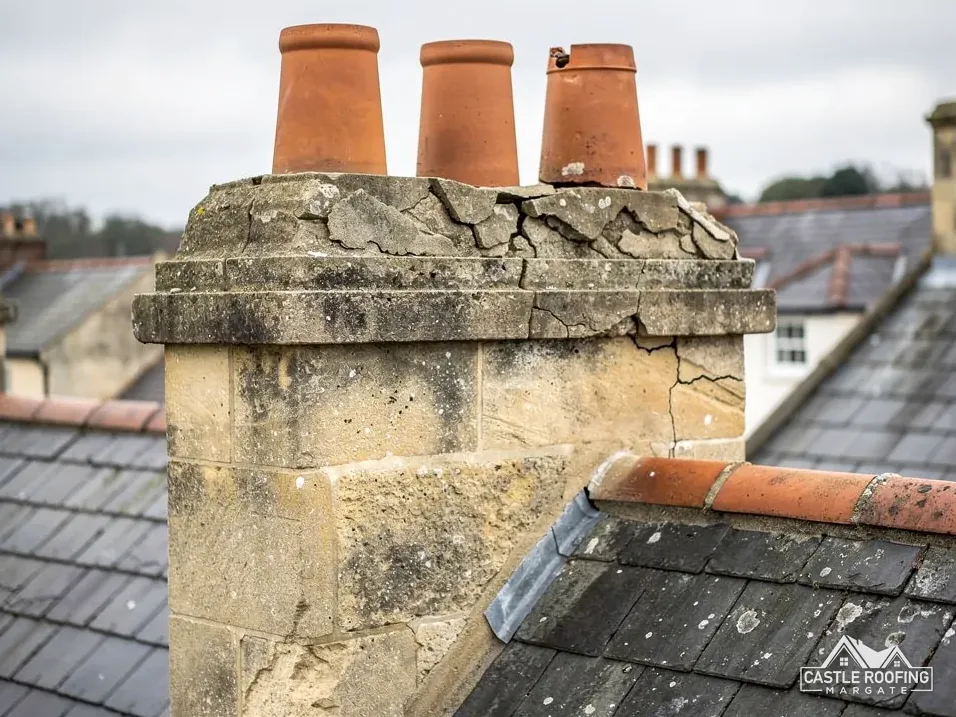
Flaunching is a collar of mortar that surrounds the base of each pot and slopes down to the edge of the stack. It does two things at once. It holds the pot upright and in place, and it carries rain off the top of the stack so that water runs away instead of sinking in. When it cracks, both jobs start to fail, and the damage tends to show indoors before anyone looks up.
On a house on the Thanet coast, the top of a stack stands clear of the ridge, open to wind and rain from every side. This guide covers what flaunching is, why it fails, how to see the signs from the street, and the steps of a repair. It is part of our chimney repairs work, and the stack below the flaunching comes into it as well.
The job flaunching does at the top
A stack is built of brick and mortar, and the top course is cut flat. A pot placed on a flat top would sit there with a joint around it that water could enter, and nothing to stop it sliding in a gale. Flaunching fills that gap. It is trowelled up around the pot's base in a smooth mound, and it is made to slope outwards, down to the edge of the stack.
The slope matters as much as the mortar. Rain landing on the pot runs down the clay, meets the mound, and carries on over it and off the stack. A flat or hollow bed lets water sit against the pot, and any small crack soon takes the standing water in.
The parts you can see from the ground, and what they tell you:
- The pot: if it leans, the bed under it has moved.
- The flaunching: a mound that is cracked, hollow, or missing at one side has failed.
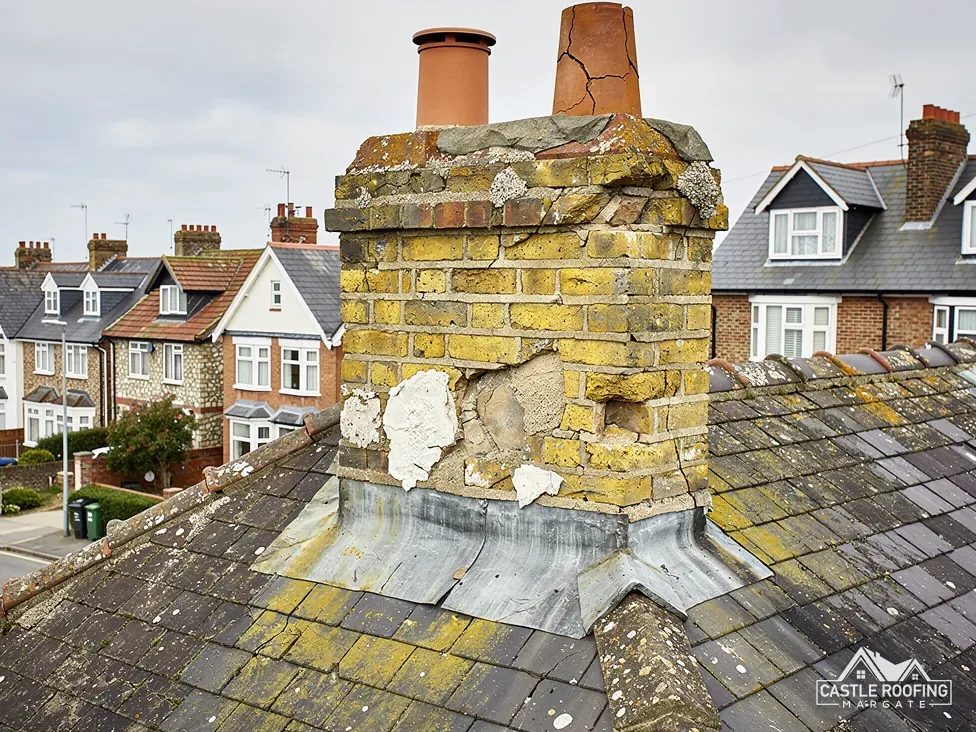
- The stack top: loose bricks or open joints mean water is already inside.
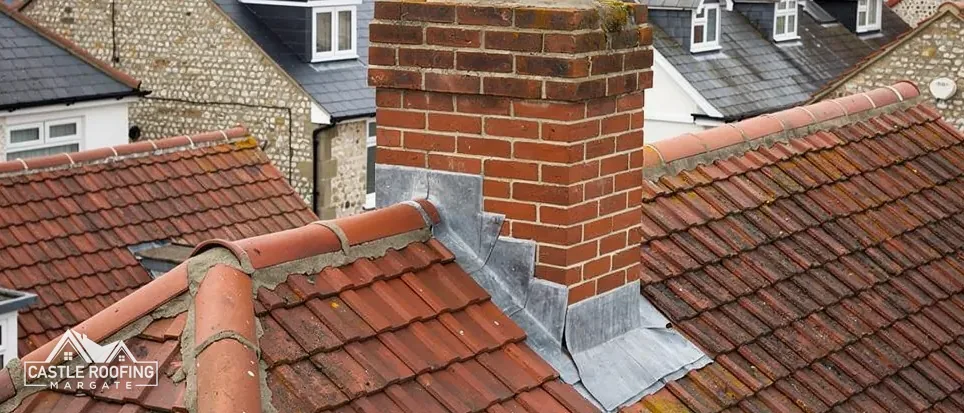
- The flashings: the lead collar where the stack leaves the slope is a second layer of protection.
When several pots share one stack, the flaunching often forms one continuous bed across the top. It then carries rain from all the pots to the edge, so a crack in one area can drain water into the rest.
Our short answer on what flaunching is gives the plain definition; the rest of this guide deals with when it fails and what to do.
Why flaunching cracks
No single cause, usually. Flaunching is a thin, hard layer of mortar on the crown of the stack, and it is under attack from several directions together.
Frost comes first. Water that enters a hairline crack freezes, expands and widens it, then thaws and runs further in. The Met Office's Manston station averages 21.43 days of air frost a year for 1991 to 2020. Those are averages for Manston, not a count of freezes on any one stack top, but they give a sense of how often frost comes in an ordinary year.
Wind and rain add to it. A mean wind speed at Manston of 9.86 knots, with January at 11.21, and about 613 mm of rain a year, mean a stack is wetted from several sides and dried by wind each time. Repeated wetting and drying shrinks and swells the mortar.
Other causes are down to how the bed was made:
- A mix that was too strong for the brick, so it cracks away from it instead of moving with it.
- Too thin an application, which dries fast and cracks along the edges.
- Poor bonding to a dirty or dry brick, so the collar parts from the stack.
- A pot that moved after it was set, usually because the stack beneath it is loose.
- Old age: mortar in a hard exposed position wears out like any other surface.
None of these sets a timetable. A bed laid well on sound brickwork can last a long time; one laid badly can fail in a few winters. The state of the bed, not the date, is what a roofer reads.
What a cracked bed lets in
Water is the whole story. A crack in the flaunching is a way in for rain, and the stack is a column of brick that soaks it up. The wet moves down through the stack, finds the flue lining, the back of the breast, the party wall and the ceiling, and then shows itself where it can.
On the inside, the signs of water coming down a stack are familiar:
- a brown stain on the chimney breast that darkens after rain
- damp patches at the ceiling where the breast passes through it
- peeling paint or wallpaper on one side of the room
- soot or tar-coloured staining that seeps through the plaster
The staining is not always from the flaunching. Lead flashings that have lifted, gutters that overflow and porous brick can all do it, which is why the roof and stack are looked at together, and why guessing from indoors is unreliable. Our short answer on a damp chimney breast goes through the possible causes.
Outside, the damage builds slowly. A bed that has opened lets water into the top courses of brick. Frost then breaks off the faces of the brick, a process called spalling, and the pointing between them turns to powder. A leaning stack has gone past the point where a new bed alone would help.
A repair at the flaunching stage is a small job. A repair after the stack has started to move is a bigger one, so a cracked bed is worth acting on early.
Spotting the signs from the ground
You do not need to climb to judge whether a stack top is in trouble. A pair of binoculars on a dry, bright day does most of the work, and a phone with a good zoom does the rest. Stand where you can see the stack from two sides, and look at each pot in turn.
| Sign | What it suggests |
|---|---|
| Hairline cracks in the mound | Early failure, water entering |
| A gap between mound and pot | The bed has parted from the clay |
| Bare brick showing | Mortar has fallen away |
| A leaning pot | Bed has moved or stack is loose |
Look for grey crumbs of mortar in the gutter, on a flat roof below or on the ground, which are a sign that the mound is breaking up. After a gale, look again, because a bed that was cracked may have lost a piece.
If you live in a terrace, check the stack on either side as well. Stacks on a terrace are often shared, and what is happening on the neighbour's side tells you about yours.
Do not go onto the roof to check, and do not lean a ladder on the stack. A roofer coming to look works under the Work at Height Regulations 2005 and will bring proper access. If that means a scaffold on the pavement, the licence comes from Kent County Council on the scaffolding company's application.
Photograph what you can see and keep the photographs. They show whether the damage is getting worse.
How re-flaunching is done
Re-flaunching is the repair that puts a sound bed back under a pot. The detail is for the person doing the work, and it is set after a look at the brick, but the order is much the same each time. This is a general description, not a method statement.
- Set up safe access: a scaffold or tower, with the area below kept clear.
- Check the pot. If it is sound and plumb, it can stay; if it leans or is cracked, it is lifted off and set aside, or replaced.
- Chip out the old flaunching to the brick, until only a clean, firm surface is left.
- Deal with the top course. Loose bricks are rebedded or replaced, and open joints are repointed.
- Dampen the brick and the base of the pot so the old materials do not pull water out of the new mortar.
- Form the new bed: a mortar mix suited to the brick, built up around the pot and sloped to the edge in a smooth fall.
- Finish the surface without gaps, and leave it to cure, protected from rain and frost.
The mix is chosen to match the brickwork. A soft old brick wants a mortar that is no harder than itself, so that the brick does not take the strain. This is why a surveyor asks what the stack is built of before specifying anything.
Re-flaunching usually goes with other small jobs. If the pot is being replaced, our guide to chimney pots and cowls covers that part. The same visit is the moment to check the pointing down the sides and the flashings that seal the stack into the slope.
When flaunching is not the whole answer
Some stacks need more than a new collar. A roofer who looks at the whole stack and not just the top will find the other faults, and an honest repair deals with what is wrong, not what is quickest to price.
The signs that the flaunching is a symptom and not the cause:
- Loose or crumbling pointing down the sides of the stack, which wants repointing.
- Faces of the brick flaking off, which points to spalling and may need replacement bricks.
- A stack that leans or has a step crack running through it, which needs a structural opinion.
- Lead flashings that are split, lifted or missing at the base.
Each of these has its own page in our chimney section. The sensible order is to repair the stack and then the top, so that a new bed sits on firm brick. Setting new flaunching on a loose top course wastes the work.
Leadwork at the base is a separate job. MyJobQuote's September 2026 guide gives chimney leadwork as between £350 and £920, which is a national typical range and not a Castle price. Code 3 suits soakers, and the specification sets the code for each of the other details, since the sheet is graded by thickness.
What the repair costs depends on access, the number of pots, the condition of the top courses and whether anything else needs doing. Flaunching alone is a small job, and how the stack is reached weighs in the price too. Your quote is one written total once the stack has been looked at, so the whole stack is priced together.