A guide for owners looking up at a cracked, leaning or missing pot. It explains each part at the stack head, the choice of cowl, the flaunching beneath, and the access the work needs.
The pot is the last piece of the chimney, and the first to feel the weather. It sits at the very top of the stack, taller than the roof around it, and takes wind, rain and frost with nothing to shelter it. When one cracks or tips, the first sign is often a piece of clay in the gutter or on the path below.
Replacing a pot sounds like a small job. It is, in the sense that the parts are small, but the work happens at a height where a slip is serious, and the pot sits in a bed of mortar that has to be right if it is to stay put. A cowl or bird guard on top changes how the flue behaves in wind and rain, and which one suits depends on what the flue is for.
This guide looks at when a pot needs replacing, the kinds of cowl and guard, the flaunching that seats the whole arrangement, and the way the work should be reached. It forms part of our chimney repairs service, and the stack beneath the pot is dealt with there.
What the pot and cowl are for
A chimney pot extends the flue above the brickwork. It lifts the opening clear of the stack top, which helps smoke leave cleanly and keeps the rain running off the brick instead of into the flue. Pots are usually clay in older houses and metal or concrete in newer work, and they come in many shapes: round, square, tapered, or with a decorative crown.
A cowl is a cover that fits on top of the pot or in place of it. Its job is to keep rain out, or help smoke escape in gusty weather, or both, depending on the pattern. A bird guard is a mesh cap that stops birds entering without closing the flue to air.
The terms get used loosely, so it helps to separate them:
- The pot is the clay or metal outlet seated on the stack.
- The cowl is a hood or cap fitted over the pot, either fixed or turning with the wind.
- The guard is a mesh basket on the rim that keeps nesting birds out.
- The flaunching is the sloped collar of mortar that beds the pot to the brick.
Which parts a chimney needs depends on how the flue is used. A flue serving a stove or boiler needs a pot and cowl that suit that appliance, and the installer will know the rules for it. A flue serving an open fire still wants an outlet that draws well. A disused flue may be capped instead, and our guide to capping a disused chimney covers that case.
Signs that a pot needs replacing
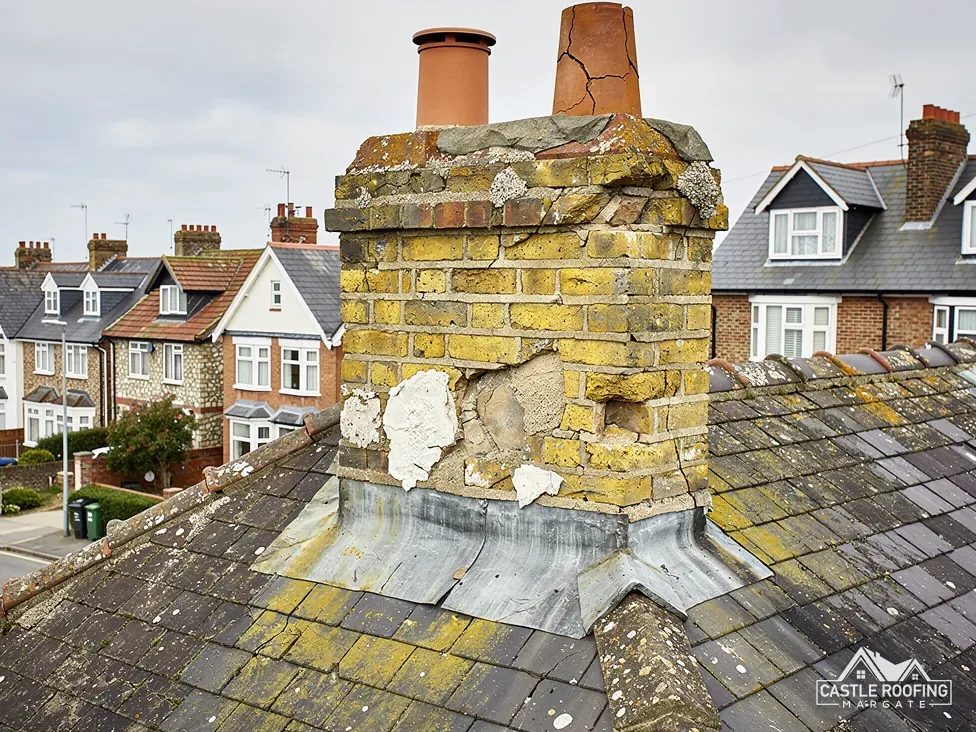
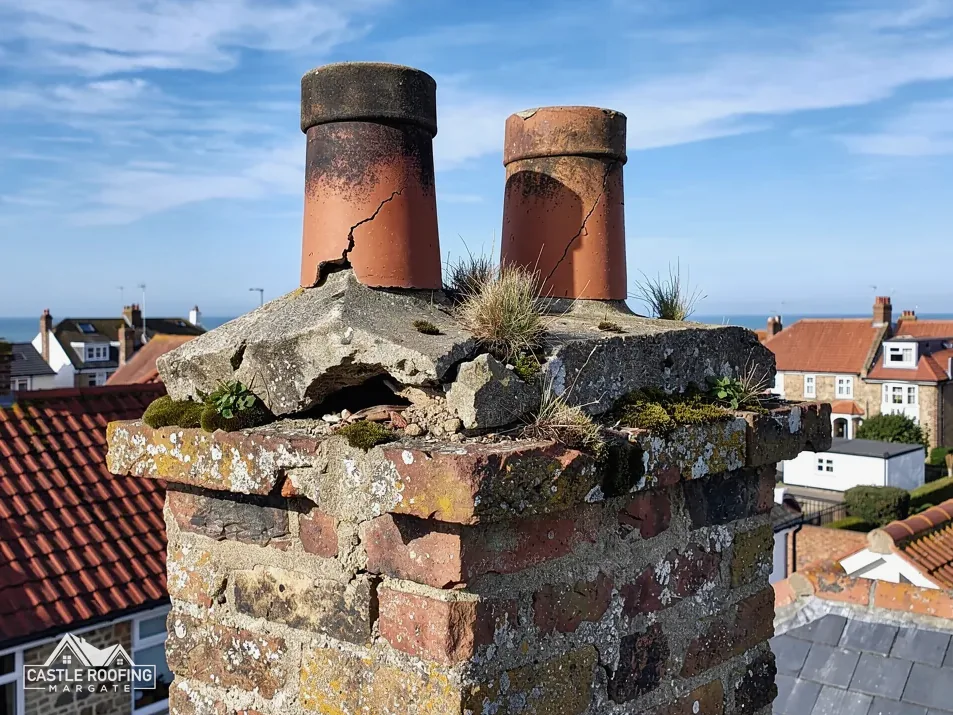
Pots seldom fail overnight. They wear from the top down and from the base up, and each stage can be seen from the ground if you know what to look for. Binoculars on a dry day will show more than a phone camera.
Look for these, and note which side of the stack they are on:
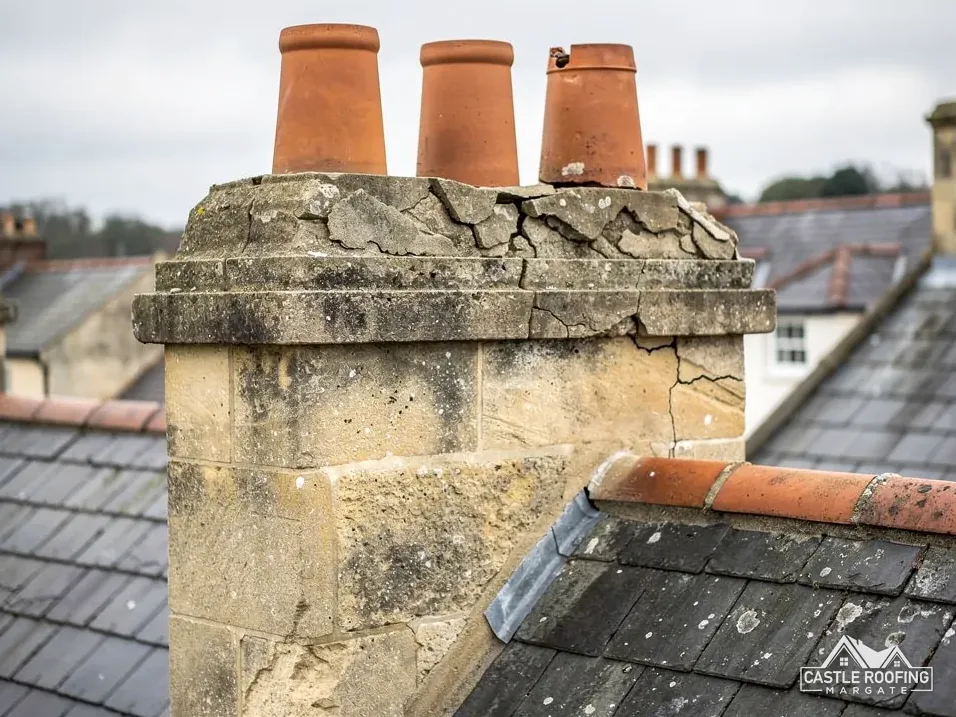
- Cracks running up the pot, especially hairline ones that widen at the rim.
- A pot that leans, even slightly, relative to the stack or to its neighbours.
- Chips or lumps of clay lying in the gutter, on a lower roof or on the ground.
- A pot with a missing section of rim, which lets rain straight in.
- Loose or crumbling mortar at the base, where the pot meets the stack.
A cracked pot is not always a failed pot. A hairline can be monitored. A leaning one is different, because the bed beneath it has failed or the pot has shifted, and a pot that has moved can fall. The Met Office's Manston record shows 21.43 days of air frost a year on average, and frost is hard on a pot holding water in a crack.
If a pot has already come down, keep people clear of the spot, photograph the damage from the ground and do not climb up to look.
Where one pot of several has failed, the neighbouring pots on the same stack are worth checking, since they have taken the same weather for the same length of time.
Cowl and bird guard types compared
The choice of cowl turns on three questions: what the flue serves, whether birds are a problem, and how exposed the stack is. There is no single best answer, and the wrong cowl on a working flue can cause more trouble than none at all.
| Fitting | What it does | Watch for |
|---|---|---|
| Open pot | Plain outlet | Rain and nesting |
| Rain cowl | Hood over the flue | Suits the appliance |
| Bird guard | Wire cage on the pot | Mesh can clog |
| Rotating cowl | Turns with the wind | Moving parts wear |
A guard that is too fine, or one used on a flue that produces a lot of soot, can clog. A clogged guard on a flue that serves a fire or a stove is a danger, because it can stop the fumes leaving. Have the flue swept regularly, and have any guard checked when it is.
On an open site the fixings count for as much as the pattern. The brackets on any cowl are worked out for how exposed the stack is, never guessed, and one that rocks in its bracket needs attention before the next gale. A cowl that comes off in a gust lands on someone's path or car.
Material matters too. Clay pots and cowls last well but crack under frost; metal cowls do not crack, though they can corrode or rattle loose. Neither is a promise of any particular life.
If birds are the problem, a guard is the quiet fix, but fit it only when no nest in the flue is in use or being built. Our short answer on whether a bird guard cowl works goes into that question.
Flaunching: the bed the pot sits in
Under every pot is a mound of mortar that does two jobs. It holds the pot in place on the stack, and it slopes away from the flue so that rain runs off instead of pooling. This is flaunching, and people who only look at the pot often overlook it.
A new pot set in poor flaunching will not last. A new pot set in sound flaunching can outlast the stack's pointing. The usual order for a replacement is:
- Remove the old pot, if it is still standing, and clear the broken flaunching from the stack top.
- Check the brickwork at the top course and repoint or rebuild any loose bricks.
- Wet the stack top and the base of the new pot, so the old brick does not draw water from the new mortar.
- Bed the pot on fresh mortar, checking it is plumb from two directions.
- Form the flaunching up and around the base, sloped out to a clean drip edge.
- Fit the cowl or bird guard once the mortar has taken hold.
Where several pots share one stack top, they may share one continuous bed. The flaunching has to be formed carefully between them so water is shed, not trapped.
A cracked bed beneath a pot is repaired in the same way, with the pot lifted out and reset. Our guide to repairing cracked chimney flaunching covers why it fails and what the repair involves.
The mortar mix, the sand and the lime or cement balance are decisions made on site to suit the brick. A hard mortar on a soft old brick can do harm.
Getting to the stack top safely
Reaching a chimney pot is the hardest part of the job and the reason it should not be a weekend project. The pot sits at the very top of the building. The roof below it may be steep, slippery or fragile, and a stack that has lost its pot may have lost more of its top courses than you can see.
Regulation 6(3) of the Work at Height Regulations 2005 makes the employer responsible for preventing falls that could injure, wherever that can reasonably be done. For a pot we use a scaffold, a tower or an access platform fixed to the stack, and never a ladder leant on the chimney.
Access has its own steps:
- A scaffold standing on the pavement needs a licence from Kent County Council, which the scaffolding company requests.
- The fee is £52 per week for 2026 to 2027, with 5 working days' notice.
- A skip permit from the same council costs £45 per week for 2026 to 2027.
- Pots and cowls come down in pieces, so the area below is cordoned off.
Domestic clients are covered by the Construction (Design and Management) Regulations 2015 in a particular way. Under regulation 7(1), when a single firm does the work, the duties that would fall on the homeowner pass to that firm.
Nests and roosts matter before a pot is touched. The Wildlife and Countryside Act 1981 makes it an offence to intentionally damage an active nest. Bat roosts are fully protected by law, and harming a roost can be an offence with no intent at all.
Keeping the flue working after the work
A new pot and cowl are no use if the flue behind them does not work. Before anything is fitted, the roofer should know what the flue is used for, because that sets what can go on top.
For a flue that serves an appliance, the cowl and the pot must suit it, and the installer's instructions govern. For an open fire, the opening needs to stay clear. For a flue that is not used at all, the best treatment is a cap with a vent, as set out in the capping guide above, so that air can still move through. Fitting a solid cover to every flue because it looks tidy is how damp starts inside a breast.
When the job is done, a short checklist helps:
- The new pot stands upright when viewed from the street and from the side.
- The flaunching slopes away from the pot on all sides, with no hollows.
- The cowl or guard is fixed and does not move when pushed.
- The lead flashings at the base of the stack are untouched, or renewed if they were disturbed.
- You have photographs of the stack top, taken before and after.
Pots and cowls do not need much looking after, and a glance with binoculars once a season is enough. Do it after a storm and after the first hard frost.
What sets the price of a pot or cowl job is the height, the access, the number of pots and the state of the stack top. The written price follows the survey, so a photograph from the street is a good place to start.