For owners of a house with a fireplace nobody uses. It explains the kinds of cap, what a vent is doing, how damp shows itself indoors, and what to weigh up against removal.
When the fire below is gone, the stack still stands on the roof, and the weather still reaches the top of it. Rain drops straight down an open pot. A sealed stack with no air moving through it holds moisture instead of drying out. Both end the same way, with a damp patch on the chimney breast inside the room, which is the brick mass that rises through the house above the fireplace.
Capping is the usual answer. A cap closes the top of the flue against rain and birds, and a good one still lets air pass. This guide is for owners of Victorian and Edwardian houses in Margate, Cliftonville, Ramsgate and Broadstairs, where a bedroom or front room may have a disused fireplace, and for anyone who has had a fire blocked up and wants to know what happens next.
We cover the kinds of cap, the vent at the bottom, what goes wrong, and the other route, which is to take the breast out altogether. The stack itself is part of our chimney repairs work, and the pages linked below go further on the topics that overlap.
What capping a chimney actually means
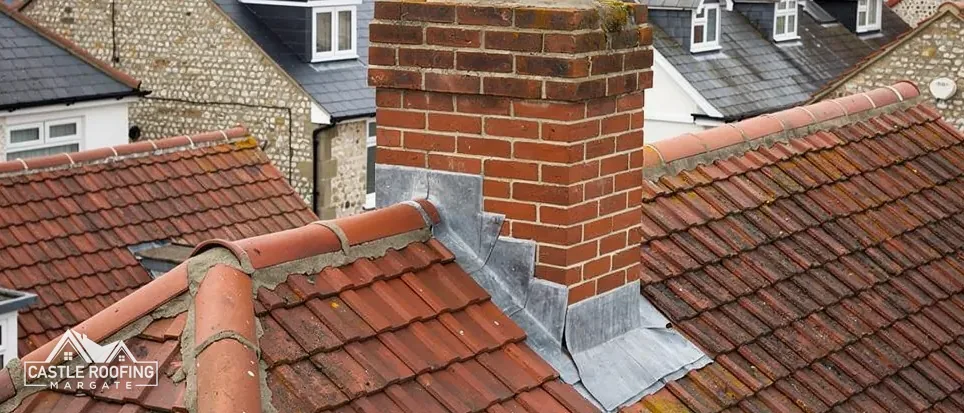
The chimney has three parts you can point to. The breast is the brickwork inside the house. The stack is the part that carries on above the ridge and into the open. The pot sits on top of the stack and is the clay or metal outlet the smoke once left by. Capping deals with the top end: the pot or the stack head is closed, or covered, so that rain and birds cannot enter.
A flue is the passage inside, which in an old house is often lined with clay or simply parged with lime mortar. If the fire below has been taken out and the opening plastered over, the flue is a dead column of still air. It has a wet end at the top and a dry end at the bottom, and it needs to be treated as part of the building's weather skin.
Caps come in a few general forms:
- a clay or metal pot with a cowl fitted, which is a hood that keeps rain out while air gets in
- a stone, concrete or slate cap bedded across the stack head and held clear of the flue with spacers or vents
- a lead or metal tray that sheds water off the top of the brickwork
- a pot fitted with a bird guard, a wire cage that stops nesting but leaves the flue open to air
Which one suits a stack depends on the brickwork, the number of flues the stack carries, and whether any of them still serve a stove or boiler. That is for the survey to decide.
Why a sealed flue still needs air moving
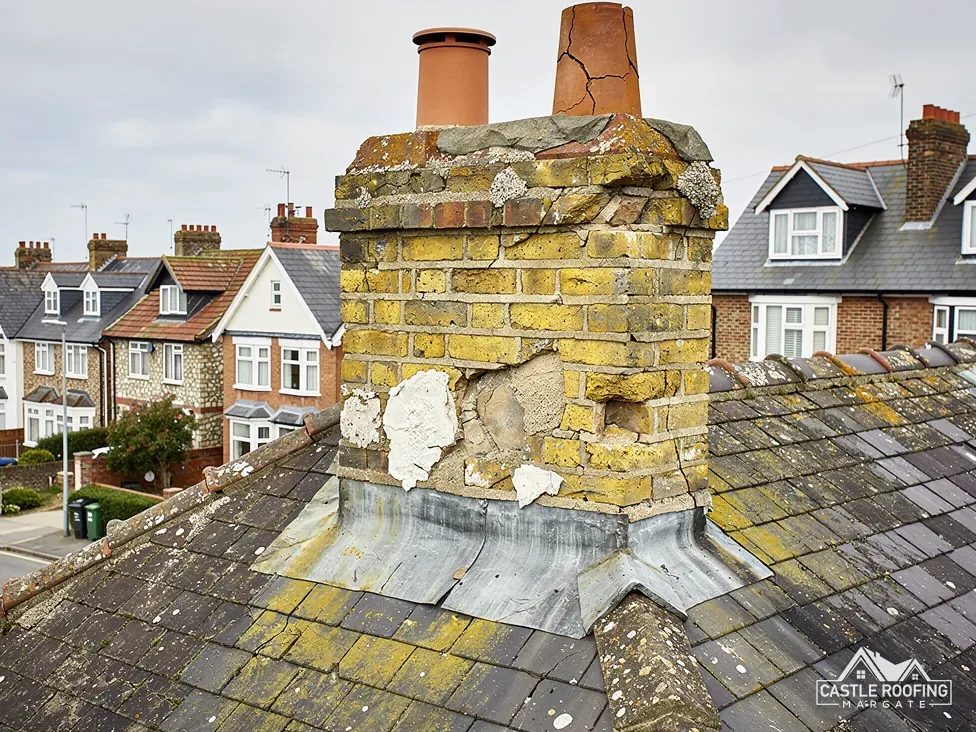
A flue closed at both ends is the worst case. Water can still enter, through cracked pointing, a damaged pot or flaunching that has split, and there is nowhere for it to leave. The brickwork stays wet. The damp then works down into the breast and shows up in the room as a stain that grows and fades with the weather.
Air movement works against that. A vent at the top lets the flue breathe out, and a vent at the bottom, in the room, lets air in. The flue then dries as the air passes through it. This is why a blocked-up fireplace is usually fitted with an air brick or a small vent in the plaster, and why a roofer will ask whether it is still there.
You can spot the symptoms from inside:
- a brown or yellow stain that appears on the breast wall after rain
- wallpaper lifting or paint blistering on one side of the room only
- a musty smell in a bedroom that has had its fireplace blocked off
- salts or white crystals on the plaster surface, which are the residue of damp drying out
None of these proves the flue is the cause, because a failed lead flashing or a leaking gutter nearby can do the same. That is why the look starts at the roof and works down. Our short answer on ventilating a capped chimney goes through the vent in more detail.
Choosing between a cowl, a vent and a cap
The right cap for a disused flue keeps the rain out and lets air through, and there is a trade-off between the two. A heavy cover that seals everything is the wrong answer for a chimney that needs to dry, and a wide-open pot is the wrong answer for a chimney with a damp problem already.
| Option | Air | Rain |
|---|---|---|
| Pot with cowl | Passes through the side | Kept out by the hood |
| Pot with bird guard | Open | Not stopped |
| Vented slab cap | Through the vents | Shed by the slab |
| Solid sealed cap | None | Kept out |
A bird guard on its own helps with nesting but not with rain. A solid sealed cap stops the rain, but a flue with no air in it is the situation described above, so it needs a vent lower down if the stack is to dry out.
Where one stack carries several flues, each pot may take a different treatment. A flue still serving a boiler or a stove must stay clear and suit that appliance, and the person who fitted the appliance knows what it needs. Do not cap a working flue.
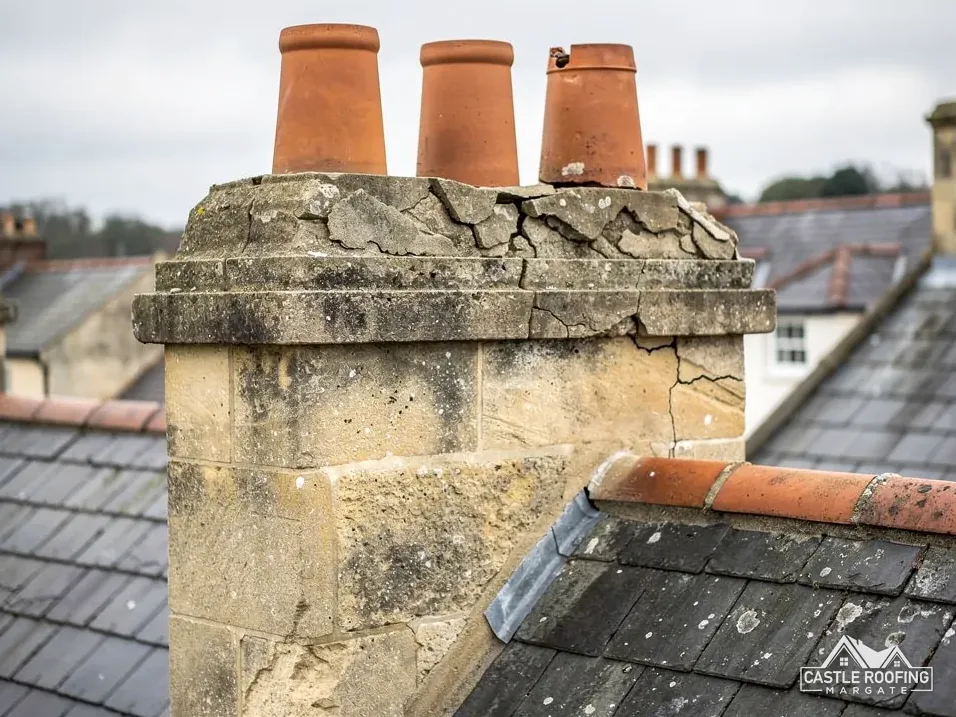
A cap is bedded onto the stack with mortar, and where a pot remains, flaunching goes round its base. Flaunching is the cement or mortar collar, sloped outwards, that seats the pot and carries rain off the flue opening. Our guide to repairing cracked chimney flaunching explains how it fails.
The weather a chimney top has to take
The top of a chimney takes more weather than any other brickwork on the house. It stands clear of the roof, the rain reaches it from every side, and nothing shelters it. The Met Office's Manston station, which sits in Thanet, gives about 613 mm of rain a year over the 1991 to 2020 period, and a mean wind speed of 9.86 knots, with January at 11.21. Those are Manston averages, not a prediction for any one street, yet they give a fair picture of a normal year on a stack head.
The same record counts 21.43 air-frost days a year. Frost matters because a wet brick or a damp mortar joint that freezes expands a little, and thaw after thaw breaks down the surface. That is why pointing at the stack head and the flaunching round a pot go before the rest of the brickwork does.
For a disused flue, the weather does its work in a few predictable ways:
- driven rain enters an open pot and wets the flue lining
- failed pointing lets water into the stack from the side
- a cracked cap or flaunching channels water into the brickwork
- lead flashings that lift at the base let water into the roof void as well
Exposure shapes the choice of cap and fixings. Pots, cowls and vents on a coastal stack should be bedded firmly, and fixings calculated for the site's exposure rather than assumed. A cap that can lift in a gust is a hazard to the people below as well as to the roof.
Check the lead at the base of the stack as part of the same visit. Code 3 lead is for soakers only, and the code for the stack flashings is set in the specification.
Working safely at the top of a stack
Capping is simple work to describe and awkward work to do. The stack head is often several metres above the nearest standing place, the brickwork can be loose, and the mortar that holds the pot may be the only thing between it and the pavement. This is not a job for a ladder against the stack.
The Work at Height Regulations 2005 apply to anyone employed to do the work. Regulation 6(3) puts the duty on the employer to prevent falls that could injure, as far as is reasonably practicable. We meet that duty at a stack head with a scaffold or a tower that has edge protection, never by stretching from a ladder.
On a terrace where the front wall sits on the pavement, the scaffold stands on the highway, and a licence is needed. Kent County Council issues it, and the scaffolding company applies. Kent County Council charges £52 per week for 2026 to 2027, and wants the application in 5 working days ahead. Your roofer should explain who is booking what and when.
Before any work starts:
- check the chimney for an active nest; section 1 of the Wildlife and Countryside Act 1981 makes it an offence to damage an active nest intentionally
- look for signs of bats using the stack; their roosts are fully protected
- photograph the stack head before and after, so you can see what was done
If you find a nest or a roost, stop and take advice before anything is disturbed. Work on that stack waits until the nest is neither in use nor being built, and a roost waits for advice from a bat specialist.
Capping or removing the chimney breast
Capping is the cheaper and quieter route, and it keeps the chimney as a feature of the house. It is the right call where the stack is sound, the breast is wanted for its character or for a future fire, or the stack serves other flues. On a period terrace in Thanet, the row of stacks is part of the roofline, which is a reason of its own to keep one.
Removal is the alternative when the breast is in the way. A room that has lost floor space to a breast it no longer needs is the usual reason. The work is bigger, and it comes with rules that capping does not have:
- The Planning Portal treats a breast as part of the structure, so Building Regulations approval always comes into it.
- A breast on a party wall brings the Party Wall etc. Act 1996 into play, with two months' notice to the neighbour.
- What remains above must be supported, and a structural engineer designs how; building control then checks it.
MyJobQuote, in August 2026, put chimney breast removal at between £1,200 and £3,500, a typical UK range from a national guide. What sets the price of a capping job is access, the number of flues and the state of the brickwork, and your price is confirmed in writing after the roof has been looked at.
If you are weighing the two, our guide to removing a chimney breast sets out approval, party walls and cost. Send us a photo of the stack from the street and we will tell you what it needs.