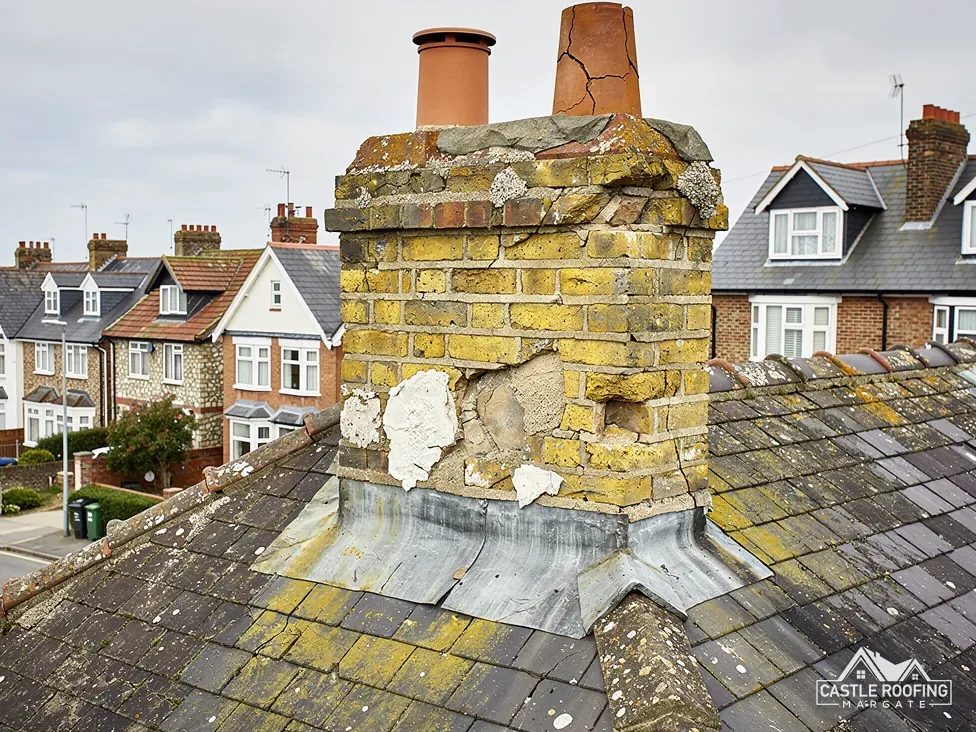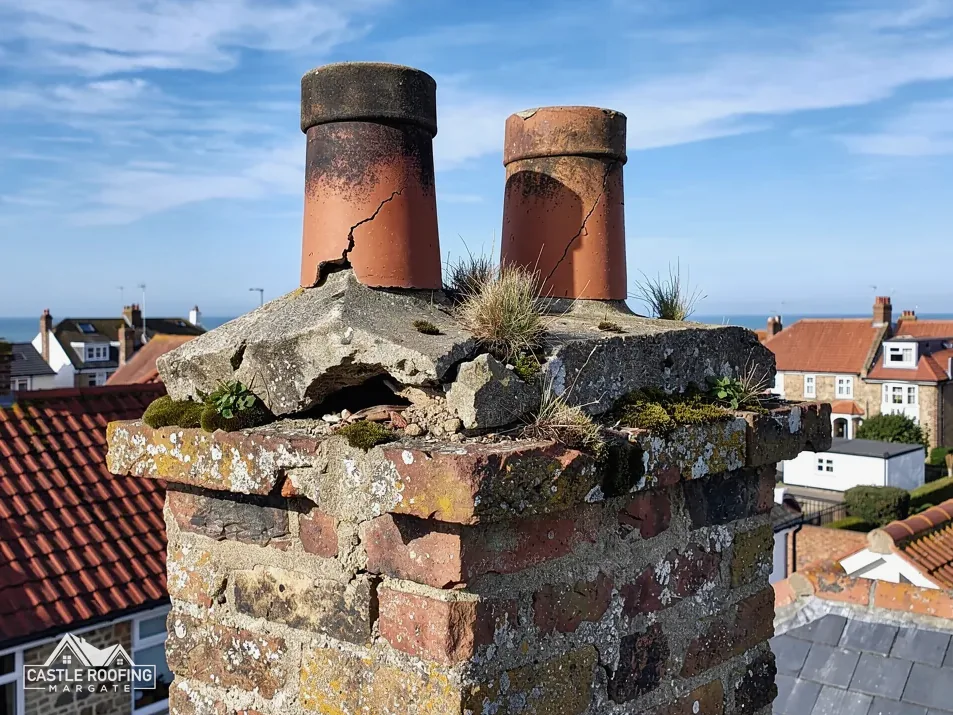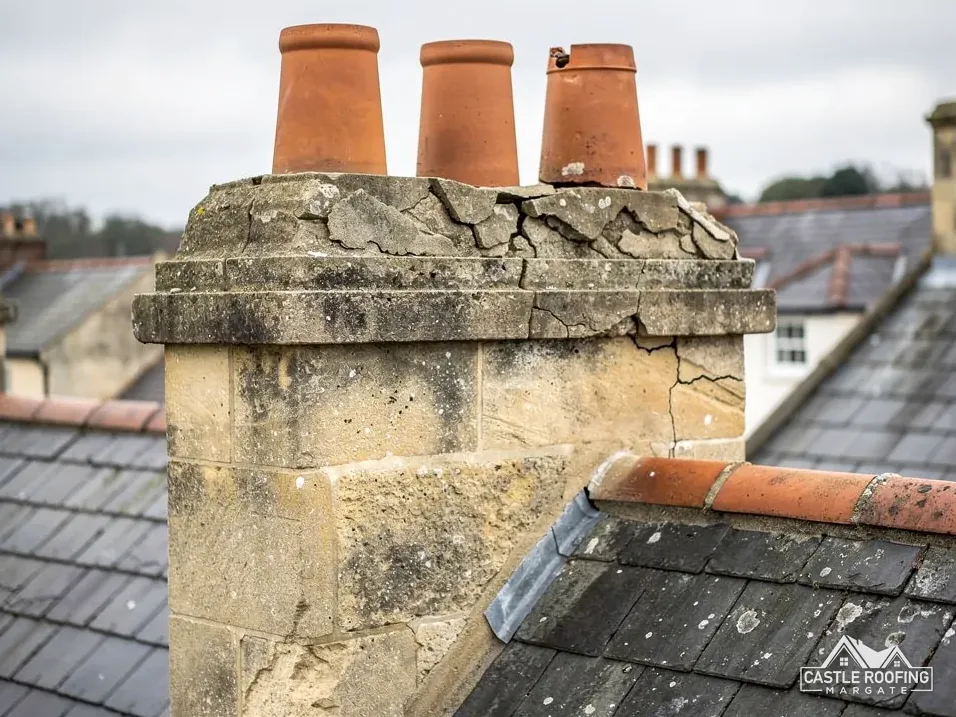
A shared stack is one structure with two owners' interests in it. This guide shows how to recognise one, who answers the legal questions, what the neighbour is owed, and why access is settled before the price.
Where houses are joined, as in terraces and semis, one chimney stack can stand on the wall between the two houses and carry the flues from both. From the road it looks like a single block of brickwork with two sets of pots, and a repair to it is a repair to something that belongs to the street's shared fabric as much as to one house.
That changes the order of the job. Before any quote is meaningful, someone has to talk to the neighbour, someone has to decide whether the Party Wall etc. Act 1996 reaches the work, and someone has to settle where the scaffold stands and whose roof it crosses. Doing those in the wrong order is how a repair turns into a dispute with the scaffold up and the weather coming in.
This guide covers them in the order that avoids that. It belongs with our chimney repairs work, and it is written for the owner who has found a fault on a stack that serves next door as well, and wants to know what to ask, who to ask and what to put on paper. Our own part begins with the survey, the photos of the stack, and a plain description of the work.
Recognising a stack that serves two houses
The sign from the street is a stack that sits astride the ridge line between two houses, or on the party wall at the gable, with pots over each side. Indoors, a chimney breast on the same wall in each house, one behind the other, tells the same story.
The loft is the place to confirm it. A surveyor can see whether the brickwork continues across the dividing wall, and whether the flues run side by side inside it. A stack with flues from both houses is a shared stack in practice, whatever the title deeds say about who owns what.
These are the points that make a stack shared in the sense that matters for a repair:
- The stack stands on or astride the wall between two properties.
- Flues from both houses run up inside the same brickwork.
- The flaunching holds pots from both sides in one continuous cap.
- The lead tray or flashings run across the line between the two roof slopes.
It helps to know what the other house is doing with its side. A neighbour who has capped their flues, removed a breast or fitted a stove changes what the stack carries and how it is ventilated, and the surveyor needs to know.
You see photos of your own side of the stack from the roof, and where the brickwork carries on over the boundary the survey notes it, so that the neighbour can be shown the same evidence if they ask to see it.
What the Party Wall Act may reach
The Party Wall etc. Act 1996 sets out the rights of a building owner who wants to do certain kinds of work to a party wall or to a structure on it. Section 2(2)(g) is the part that mentions chimneys: it gives a building owner the right to cut away a footing, or a chimney breast, jamb or flue that projects. Whether a given repair to a stack falls inside the Act turns on what is done and to which wall, and that judgement belongs to a party wall surveyor.
That is the first rule on this page: party wall questions go to a party wall surveyor. They do not go to building control, and they do not go to the council's planning team. A roofer can describe the work in plain terms and show photos, but cannot say what the Act requires for a given job.
A practical way to put the question to a surveyor:
- Describe the work in one sentence: repoint the shared stack, renew the flaunching, rebuild the top courses, take the stack down.
- Say whether any flue is to be cut away, lined or capped.
- Attach the survey photos of the stack from the roof.
- Give both addresses, and say whether the neighbour already knows about the fault.
The surveyor's answer then decides whether notice is needed, which brings us to the next section. Many shared-stack repairs are small, and the answer may be that the Act is not engaged, but that answer should come from the surveyor and be recorded, not assumed from the roof.
Notice, and the written consent exception
When the Act does apply to the job, the building owner serves a notice on the adjoining owner, and section 3(2) requires it to be served two months or more before the planned start. The notice is a formal document that sets out the work, and the neighbour answers it.
GOV.UK states the position on the neighbour's reply plainly. Where the two owners cannot agree, GOV.UK says a surveyor has to be brought in, and a neighbour who says nothing has not agreed to anything. A missing reply is a dispute waiting to happen, not a go-ahead.
There is an exception. Section 3(3)(a) says nothing in section 3 stops a building owner doing work that the adjoining owners and the adjoining occupiers have consented to in writing. In a rented house those are two different people, and both are asked to sign.
| Route | What is needed |
|---|---|
| Notice | Formal notice, at least two months before work starts |
| Written consent | Signed agreement from owners and occupiers next door |
| No agreement | A surveyor is appointed to settle it |
Dover District Council tells its own residents that at least two months' notice is needed before the work starts, and that the neighbour may agree to let it begin earlier. The Act is the same across East Kent, and the party wall surveyor is the person who advises. Keep a copy of the notice and of every reply with the quote, because the dates on them decide when the scaffold can be booked for.
Agreeing access and the scaffold first
A stack repair needs a way up to the roof, and on a shared stack that way often crosses the neighbour's land or touches their roof. Settle it before the price is agreed, because it can change the cost and the date.
- The spot where the scaffold stands, and whether any of it rests on the neighbour's garden, drive or side passage.
- Whether work will reach over the neighbour's roof, and how their slates or tiles will be protected.
- When the scaffold goes up and comes down, so that both households know.
- Who lets the roofers in, and whether the neighbour is away during the work.
If the scaffold stands on the pavement, it needs a licence from Kent County Council under section 169 of the Highways Act 1980. Kent County Council's licence is applied for by the scaffolding company, with 5 working days' notice, at £52 per week for 2026 to 2027, and the applicant holds public liability insurance of £5 million.
A scaffold in the neighbour's garden is a matter between you and them. Ask in writing, say how long it will stand and how it will be taken down, and get a written reply before the scaffold firm is booked. Our guide to scaffolding for chimney repairs sets out how access is planned, and our page on terraced house chimney repairs covers the terrace case, where a run of houses shares the roofline.
Work on one side, effect on the other
A repair done from one house can change things on the other. Raking out and repointing the shared brickwork, taking the cap off, or rebuilding the top courses all happen to a structure that has two sets of flues in it. The aim is that the neighbour's side is left no worse than it was found.
These are the points a careful repair keeps in view:
- The condition of both sides is recorded before work starts, with photos of the pots, the flaunching and the visible brickwork.
- The flaunching is renewed as one continuous cap, so that no gap is left between the two sets of pots.
- Any lead at the junction between the two slopes is checked and dressed so that water cannot pass from one side to the other.
- Flues on the neighbour's side are not blocked, capped or changed without their agreement.
- The photos of the finished stack are made available to both owners.
If the neighbour's pots or cowls need attention, say so and let them decide, with a separate quote if they want one. It is their roof and their price.
If the survey finds that the stack is leaning or has opened up through several courses, the decision about taking it down, in part or whole, belongs to both owners, because both sets of flues are affected. Our page on removing a chimney stack above the roof sets out the approvals that follow.
Keeping the paperwork and the price clear
On a shared stack, the paperwork is longer than on a single house and the price is a conversation between two households. Keeping both tidy comes down to what is put on paper, and when.
- The party wall surveyor's answer, in writing, saying whether the Act applies.
- The notice, or the signed consent from the owners and occupiers next door.
- The Kent County Council licence reference, if the scaffold is on the pavement.
- Any written permission to use the neighbour's land for access.
- The before photos of both sides, and the after photos taken when the work is done.
- The written price, with the description of the work it covers.
On cost, nothing in this guide tells you who pays what. That is for you and your neighbour to agree, in writing, before work starts, and the party wall surveyor can help with it when the Act is in play. Agreeing it early avoids the awkward conversation that follows a bill.
Our part is simple. We survey the stack, send photos, describe the work, and give one written price for the work you have asked us to carry out, after the survey, with the access described in the same document. If the neighbour wants their own side done, they get a separate quote, and a single scaffold can serve both if you agree it. The stack is repaired once, with one set of access, and both households know what was done.