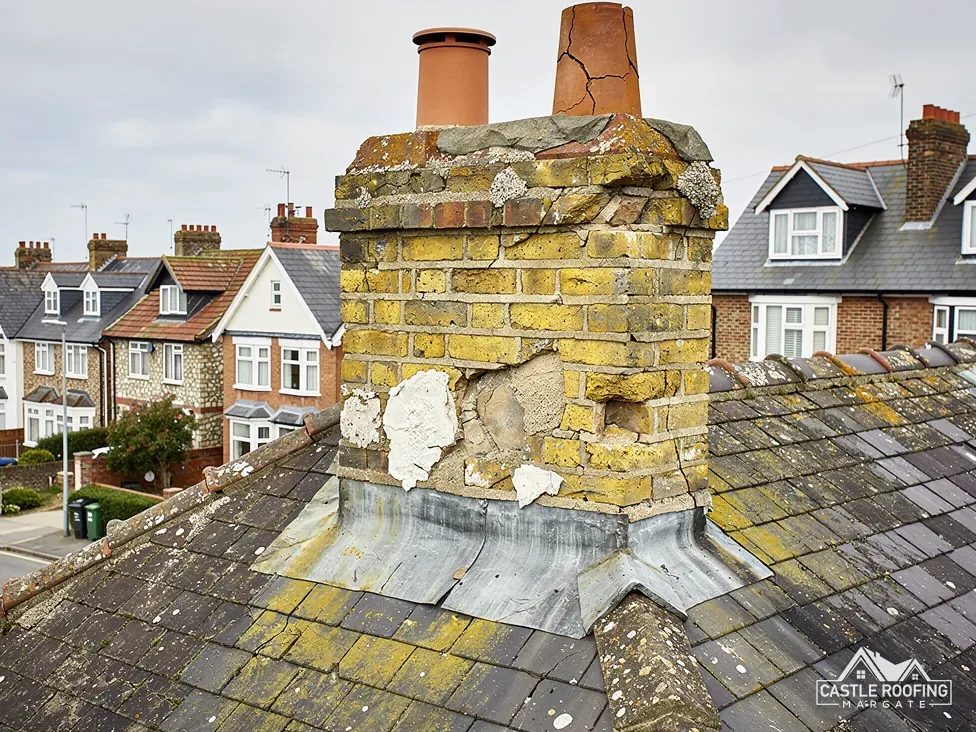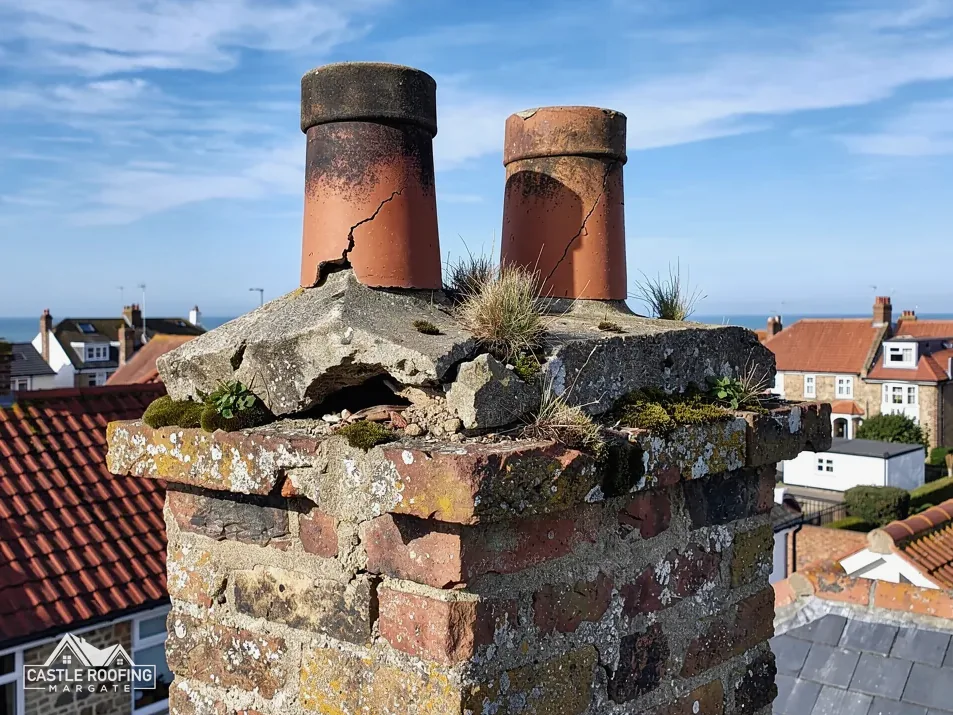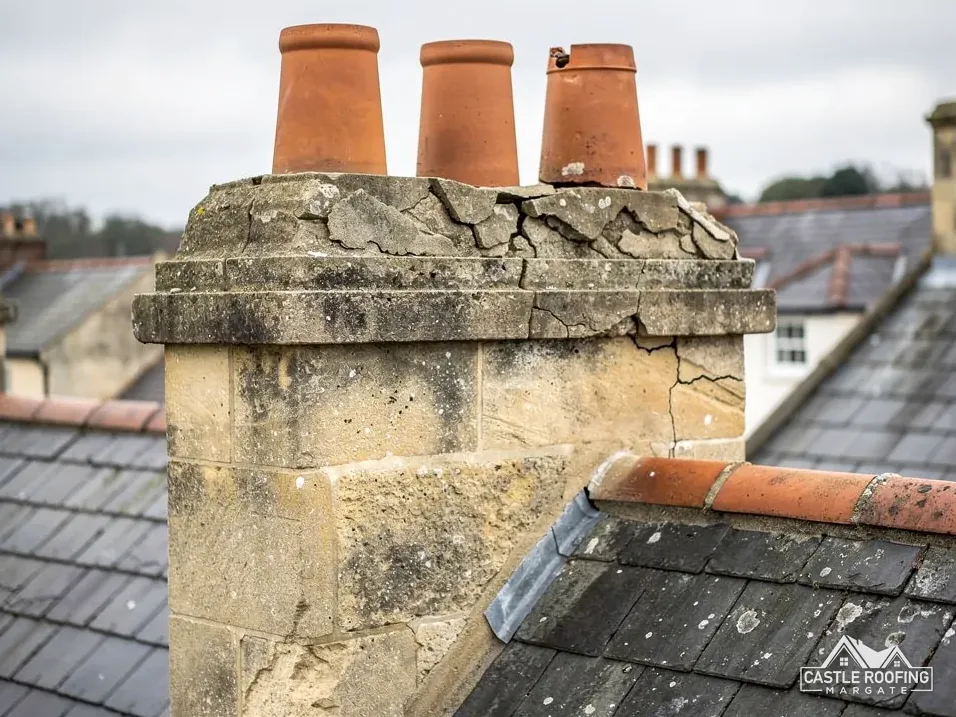
Insurance, removal, party walls and repairs on a listed or conservation-area house: what each rule says, which ones are easy to miss, and who to ask when a question falls outside what a roofer can answer.
A chimney question can start with a leak or a leaning pot, and then turn into a question about rules. Will the insurer pay? Can the stack come down? Does the neighbour have to be told? The answers sit in four different places, which is why advice from one person can sound like it contradicts advice from another. A roofer can tell you what the stack needs. A council tells you what consent it needs. An insurer decides what its policy covers, and a party wall surveyor sorts out what you owe next door.
This guide keeps those four apart. For each, it says what the rule is in plain words, quotes the source where a rule has a precise wording, and says where to take the question. It does not give a ruling on your own house, because a listed building or a conservation area changes the answer, and so does the fact that six different councils cover our patch: Dover, Thanet, Swale, Canterbury, Folkestone & Hythe and Ashford. For the practical side of repairs, see our chimney repairs page.
Insurance: storm or wear and tear
Whether a damaged chimney is covered turns on what caused the damage. Storm damage is normally an insured event; gradual deterioration is normally not. The Financial Ombudsman Service says a storm usually means violent wind, commonly bringing rain, hail or snow, though a fall of rain, hail or snow by itself can count too. Among the usual exclusions it names gradual damage and everyday wear.
So a stack that loses a pot in a night of gales is one thing, and a stack with mortar that has crumbled over twenty winters is another. Policies word storm differently, so read the storm definition in your own policy rather than relying on a figure someone quotes to you. Some insurers set a wind level for a storm and others do not, which is why two neighbours can get different answers. The Ombudsman's helpline is 0800 023 4567 if you disagree with an insurer's decision.
If a chimney is damaged:
- Tell the insurer first, before any permanent repair is agreed.
- Make the property safe, for example by clearing the area below a loose pot.
- Take photos of the damage and hold on to every receipt.
- Keep any fallen pieces until they have been recorded.
Which? reported that in 2024 only 32% of storm-related claims ended in a payout, which is why a clear record of what happened and when is worth the effort. The claim is between you and your insurer, and no result is certain in advance. Our page on whether insurance covers chimney repairs goes further.
Taking a chimney stack down
Removing a stack above the roof is a planning question as well as a building one. The permitted development rights that cover most alterations to a house roof, known as Class C, carve out chimneys: they do not extend to installing, altering or replacing any chimney or flue, or a soil-and-vent stack. In practice that means a chimney alteration needs a check with your local planning authority before work begins, and in a conservation area or on a listed house the check matters more still.
That is a short summary, and the exact wording is set out in our guide to planning permission to remove a chimney. Ask your council whether the work counts as development, and whether an Article 4 direction applies where you live. Thanet, Canterbury, Dover and Swale each publish conservation area lists on their own sites.
Listed status adds listed building consent, which section 7 of the Listed Buildings Act 1990 requires for works touching the character of the house. Canterbury's page says the same in its own words, and a chimney is part of the skyline that conservation officers care about. Thanet's page on its conservation areas adds that like-for-like work makes planning permission less likely, but that is general wording and not a ruling on any one stack.
Keeping the stack and taking the lower parts away is a different job again, covered in the next section. A stack that is only being repaired is a different question from one being removed, so ask the council which of the two your job counts as, and describe it in the same words to your insurer and to the council so the paperwork agrees.
Removing the chimney breast
The breast is the section of the chimney that juts into the room. Taking it out is structural work, and the Planning Portal is direct about it: approval under the Building Regulations will "always apply" when chimney breasts are removed, because they form part of the structure of the house.
That means a building control application, through the council's team or a registered building control approver. Ask whichever you use what drawings and details they want to see with it. Private building control already existed before the registration scheme began on 6 April 2024; the scheme set a register for private firms. Who handles your application depends on where you live:
- Thanet runs its own team on 01843 577522.
- Folkestone & Hythe has its own team too, on 01303 853538.
- Dover District Council runs its own service; use its building control page to reach it.
Canterbury and Swale both use STG Building Control, on 01634 331133. In Ashford's four towns, Ashford Borough Council's own Building Control team takes the application.
MyJobQuote's typical UK range for removing a chimney breast, updated in August 2026, is £1,200 to £3,500. The written price for your house follows a survey, because the number of floors the breast runs through changes the work.
The roof above needs attention as well. If the stack stays and the breast below goes, the stack must still be supported, and whoever designs the work sets out how. Our note on building regulations for chimney breast removal explains the approval.
The neighbour and the party wall
If your chimney breast sits on a wall you share with next door, a second law applies. The Party Wall etc. Act 1996, section 2(2)(g), lets the owner of the building take out a breast, jamb or flue sticking out of a party wall. The same Act, at section 3(2), asks for notice of two months or more before the work is due to start.
The key points are these:
- The notice goes to the adjoining owner, and it is given in writing.
- Under section 3(3)(a), nothing stands in the way of the work when the neighbouring owners and occupiers agree in writing.
- GOV.UK warns that silence from the neighbour is not agreement.
- Where you and the neighbour fail to agree, a surveyor has to be appointed.
- A reply can arrive as consent, as a dissent or not at all, and each leads to a different next step.
Questions about a party wall go to a party wall surveyor. Building control does not deal with them, and it is easy to confuse the two because both come up on the same job. Dover District Council's own page repeats the two months' notice, and adds that the adjoining owner may agree to start earlier.
A stack shared between two houses, where the pots on top serve both, raises the same issue. Our guide to shared chimney stack repairs covers who pays and who must be told.
Repairs on listed and conservation-area houses
Ordinary maintenance, such as renewing a flashing or rebuilding flaunching, usually does not change the way a stack looks. A repair that changes nothing material about the outside appearance of a building does not count as development under the 1990 planning Act, section 55(2)(a). That is a general principle, not a licence, and a council has the last word on what counts for your house.
Where a house is listed, even repair work can need consent if it affects the character. Where it is in a conservation area, the question is whether an Article 4 direction removes permitted development rights for parts of the roof facing the street. In Dover, and in Faversham within Swale, some directions do reach roof work on the sides of a house that face the street. Elsewhere, put the question of any direction on your road to the council, and describe the job the same way each time you ask: rebuilt, repointed, capped or removed, and whether the pots and the height stay as they are. Photos of the stack and the address let an officer answer far more quickly than a general question does.
A Church of England building in worship use is covered by the faculty system instead. Roman Catholic, Methodist, URC and Baptist buildings use their own systems. Where the building belongs to the Churches Conservation Trust, or is Unitarian or Quaker, listed building consent applies. Thanet's conservation areas include Margate, Cliftonville, Broadstairs and Ramsgate, and Ramsgate is one of the areas where the council has Article 4 directions. For classes and addresses, check with Thanet District Council.
The page on chimney repairs in a conservation area goes through how a roofer and a council officer usually split the work.
Who answers which question
The quickest way to avoid a wrong turn is to match the question to the right person. The table pairs them.
| Question | Ask |
|---|---|
| What does the stack need? | A roofer or bricklayer |
| Is my policy covering this? | Your insurer |
| Do I need consent? | The council planning team |
| Does it need approval? | Building control |
| What do I owe next door? | A party wall surveyor |
Before you alter a flue or a hearth, ask the building control team at your council whether that change needs approval. If a chimney is going to be capped, a flue vented at both ends stays drier than a sealed one.
After the work, keep the paperwork: the building control completion certificate, the party wall award if there was one, and the invoice. Photographs from before, during and after the work belong in the same folder, along with the insurer's reference number if a claim was made. Thanet's register copies cost £54 including VAT per copy, so keep the original safe. Our guide on whether roofers repair chimneys sets out which trade does which part.
Questions that cut across these lists, such as a shared stack on a listed house, are best settled in the order consent first, notice second and scaffold last, so nothing is booked that a refusal could undo.
Photos of the stack taken at ground level and inside the loft help whoever visits first to see what is involved.