Why an aerial puts a lever on the brickwork
A chimney stack is a tall, narrow column of brick standing clear of the roof, and an aerial bolted to it adds a long arm at the top. Wind pushes on the aerial, the mast carries that push to the bracket, and the bracket passes it into the brickwork as a twisting and pulling load. The taller the mast, the longer the lever.
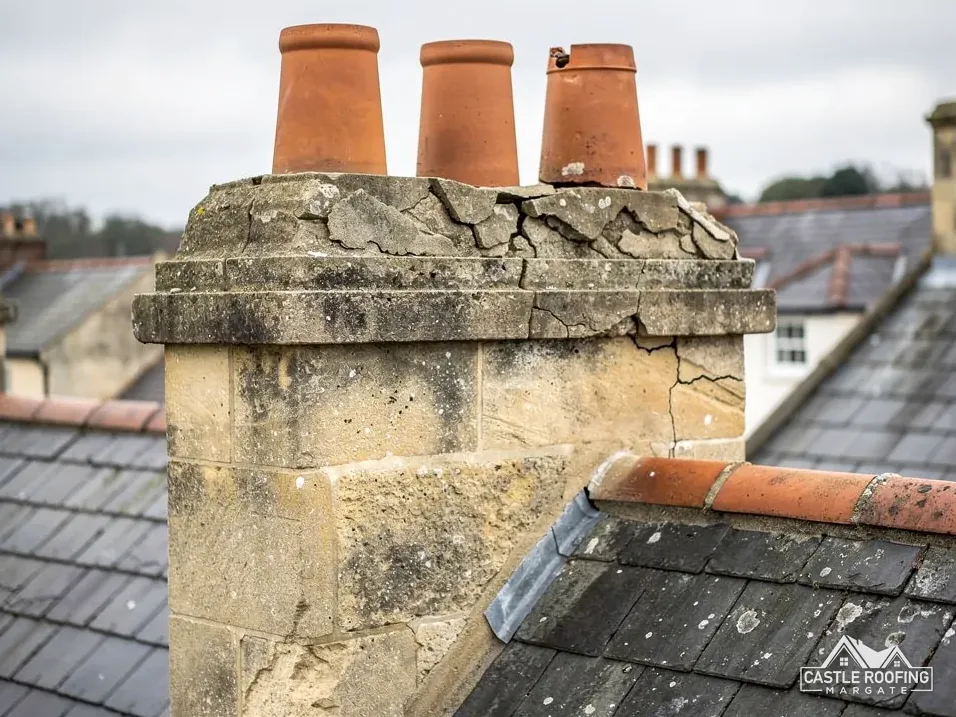
A stack in good order takes this without complaint. Trouble starts where the stack is already tired: mortar joints that have crumbled back from the face, bricks that have begun to flake, flaunching (the sloping mortar collar round the pot bases) that has cracked, or a stack that already leans. Each of those gives the load somewhere to start working.
The bracket can also do harm in a quieter way. Lugs need holes drilled into the brick, and straps are pulled tight round it. A hole in a brick face lets rain in. A strap that has rusted swells and pushes the mortar apart behind it. Water follows the fixing, and frost and thaw widen the gap over several winters.
None of this means every aerial must come down. It means the stack should be sound before it carries one.
Signs the bracket is already doing harm
Most of the warning signs show from the garden or the pavement, and a pair of binoculars helps. Look for these:
- Hairline cracks in the mortar that run out from the bracket or its straps.
- Rust streaks on the brick below a fixing, which show water running along the metal.
- A mast that no longer stands true, or an aerial that has slowly turned on its own.
- Brick faces flaking in a patch around the bracket.
- A visible lean, or a gap opening between the stack and the roof slope.
Inside the house, check the chimney breast (the part of the stack that rises through the rooms) and the loft near the stack for new damp patches. A stain that appears after wind-driven rain, on the side the aerial faces, hints that water is getting in at a fixing or a joint beside it.
Please do not climb up to test it. A stack that leans under an aerial is not something to tug at. Use the ground, or a camera with a zoom lens, and send us the photos so the survey starts from what you have already seen.
What a roofer checks at the bracket
At the stack, the roofer works through a short list. The aim is to learn whether the stack can carry the aerial at all, and whether the bracket caused the damage or merely sits near it.
- Press and sound the mortar joints near each fixing, and note any that are loose, hollow or missing.
- Look at every brick the bracket touches, and at any hole drilled into one.
- Check straps or lugs for rust and bolts for slack.
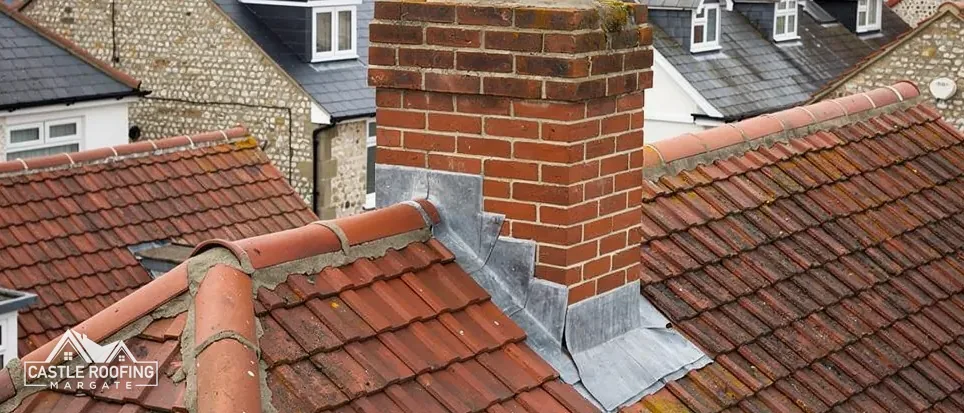
- Check the flaunching and the flashings (lead strips dressed between stack and slope) for cracks and gaps.
- Sight the stack against the ridge and the slopes to see whether it has moved.
What follows depends on the findings. Sometimes only the bracket needs refitting. Sometimes the mortar needs raking out and repointing, which means cutting out loose mortar and filling the joints fresh. In a worse case the top courses are taken down and rebuilt. Which of these applies is only known on the roof, and the price is written after that look.
Moving the aerial instead of mending the stack
If the stack is weak, the simplest cure is often to take the load off it. An aerial can usually be moved to a gable wall, into the loft on a bracket against the joists, or onto a pole fixed to a sound wall that does not depend on the stack. The aerial installer does that part, and the roofer then repairs the chimney once nothing leans on it.
Order matters. If the stack is leaning or shedding brick, move the aerial first, because mending a stack with the lever still working on it only restarts the same damage. Where the brickwork is firm and just the fixing has gone poor, a refitted bracket may do.
Once the aerial has gone for good, the old bracket is also better removed, with the holes filled or the damaged brick cut out and replaced, so the face sheds water again.
For the wider picture, read about a leaning chimney stack, chimney stack repointing and flaunching repair, all part of our chimney repairs work.